
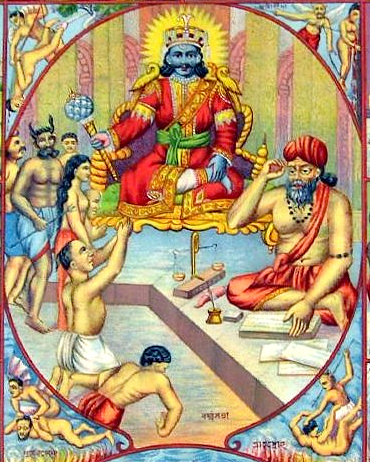
Once there was a king who decided to distribute a bowl of kitchari to every citizen in his country. he announced the day, and soon everyone gathered and the king served the food from a huge pot. after a while, a bird that had just caught a poisonous snake and was carrying it in its beak flew over the palace. unfortunately, a drop of poison fell from the snake’s teeth into the bowl the king was filling. he didn’t see the poison and gave the kitchari to the next citizen. This person ate it and died immediately.
uhhgg! This was a death – perhaps murder? – and in the king’s palace! Yamaräja, the god of justice, came to the spot with his secretary Citragupta. Citragupta asked, “Who will get the negative karma for this violent act? The king, because he distributed the kitchari?”
“No,” Yamaräja said, “He will not get the negative karma – he wasn’t aware that he distributed poison.”
“I need to know for the records,” said Citragupta, “then who will get the karma? Maybe the bird?”
“No, he also didn’t know that he was flying over the food distribution area and that there was poison left in the snake.”
“I need to know where the karma goes,” said Citragupta, “maybe to the snake?”
“No, the snake was already dead!”
At this moment they noticed a bitter old lady who pointed her finger and lashed out at the king: “You rascal! You demon! You killed a human being!” yamaräja looked at Citragupta and said, “Now we know where the karma goes.”
It is a fact, karma or all bad effects that come from human interactions, always go to those who are judgmental and critical. This subject is discussed at length in the Mahabharata – the critic gets the karma, because his or her intention is to hurt.
From a Gaura Meditation evening, on September 1, 2022