
This talk centers on the spiritual significance of prasadam (food offered to God) within the Gaudiya Vaishnava tradition, drawing from a passage in Chaitanya Charitamrita (Madhya-lila 14). The speaker begins by recounting how King Prataparudra, after receiving the mercy of Sri Chaitanya Mahaprabhu, humbly serves Him and later arranges an abundant offering of food for Lord Jagannath. The text vividly describes an extraordinary variety of offerings—fruits, sweets, milk preparations, grains, and delicacies—emphasizing both their quantity and quality. The speaker highlights that even this extensive list is only a “trailer,” suggesting the incomprehensible opulence of divine offerings.
The key philosophical point is that devotees find satisfaction not in eating for themselves, but in seeing food lovingly offered to Krishna. Sri Chaitanya Mahaprabhu Himself is described as fully satisfied simply by witnessing the offering. This establishes a core principle: prasadam is not ordinary food; it is spiritually transformed, having been touched by Krishna, and is therefore non-different from Him.
The speaker explains that a true Vaishnava does not crave variety for personal enjoyment but delights in offering variety to the deity. The spiritual master is pleased when disciples prepare and distribute prasadam, and even more so when devotees joyfully partake in it. An anecdote about A.C. Bhaktivedanta Swami Prabhupada cooking and serving meals personally illustrates how spiritual joy is found in feeding others and witnessing their satisfaction.
A major theme is that prasadam is often underestimated. While chanting, worship, and philosophy are recognized as sacred, eating is sometimes seen as a mundane break. The speaker challenges this, asserting that honoring prasadam is itself a profound spiritual act—an intimate way of associating with Krishna. Stories like Madhavendra Puri tasting even the clay pot that held sweet rice demonstrate the depth of realization: everything connected to Krishna is spiritually potent.
The talk also explores the balance between relishing and regulating prasadam. While it is joyful and abundant, devotees are cautioned not to be driven by the tongue. True appreciation comes from purified senses and spiritual vision, not indulgence.
Finally, the speaker emphasizes the social and cultural power of prasadam. Sharing meals breaks impersonalism, fosters community, and becomes a medium for expressing love among devotees. Cooking, serving, and honoring prasadam together are essential practices that cultivate relationships and spiritual unity.
Key takeaway: Prasadam is not merely food but a sacred medium of divine connection, spiritual transformation, and loving exchange within a devotional community.
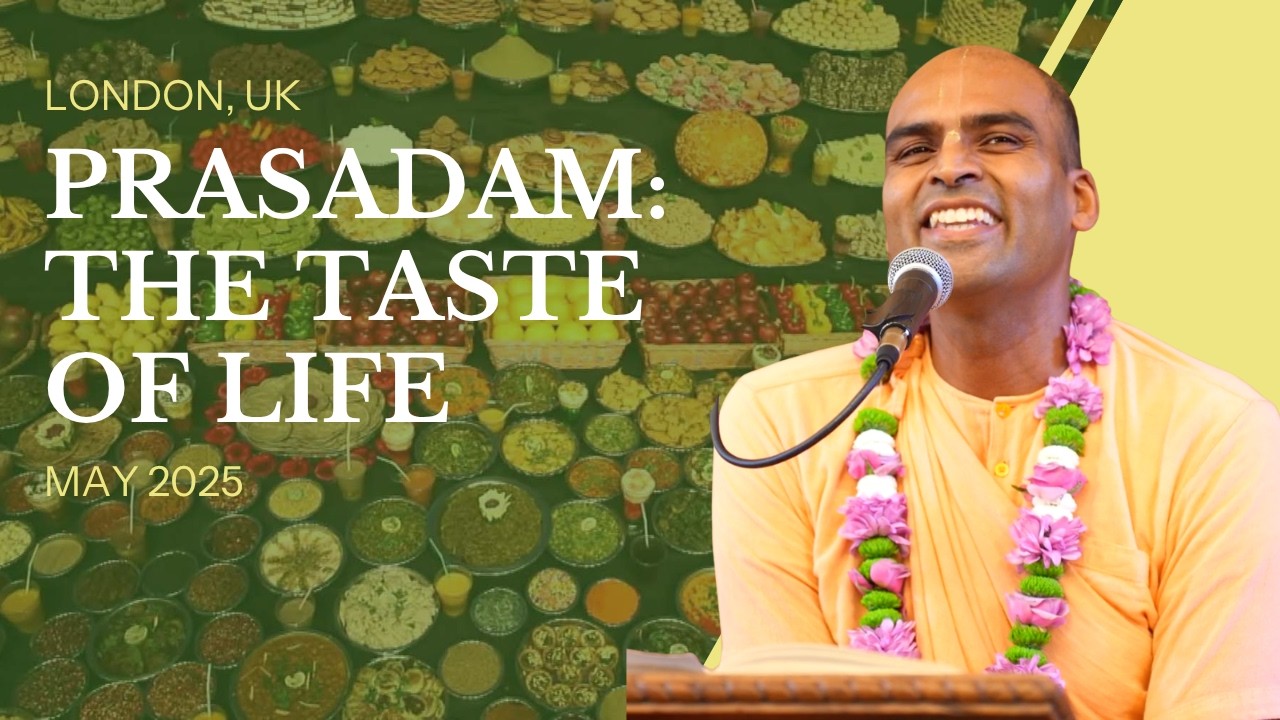
Prasadam: The Taste of Life | CC Madhya 14.36 | London, UK | Svayam Bhagavan Keshava Maharaja