
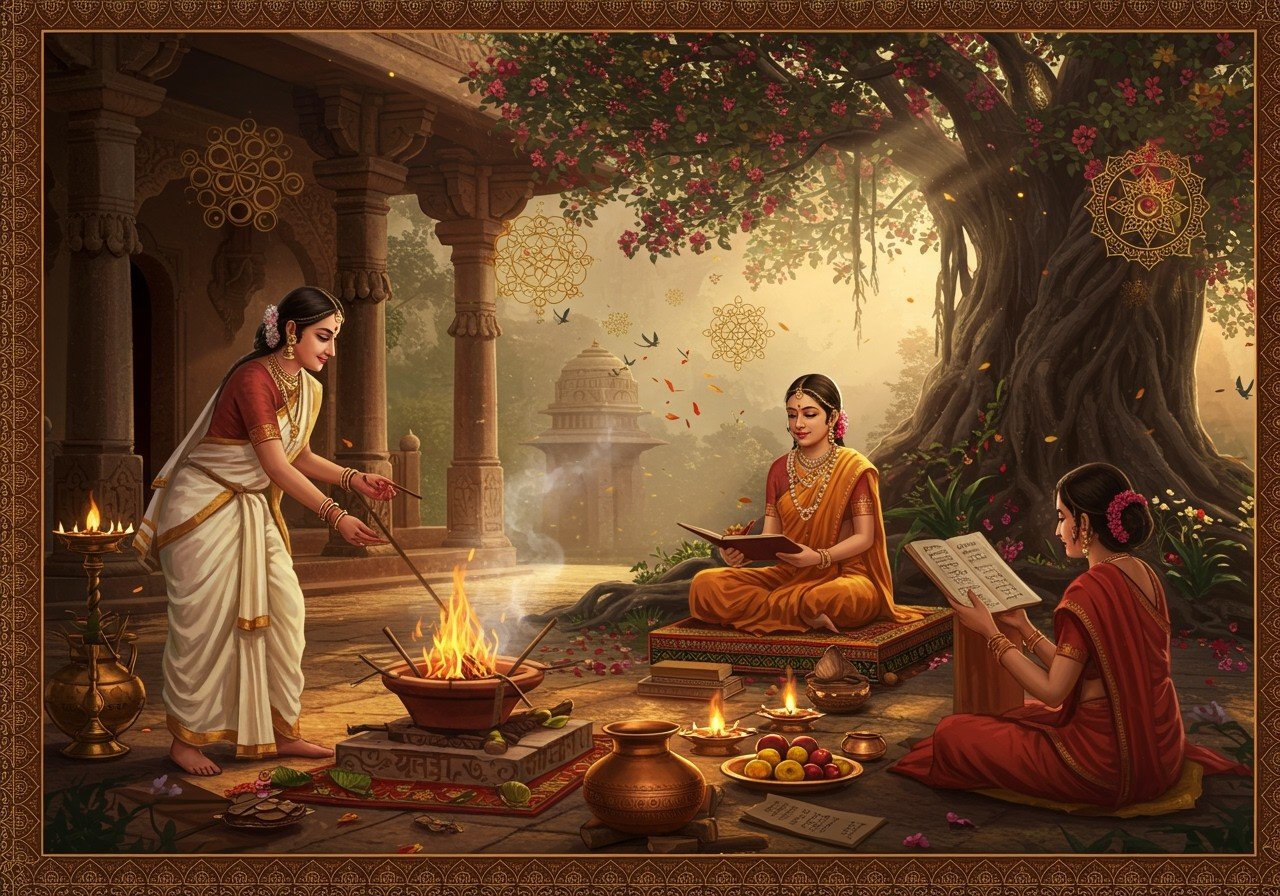
by Sri Nandanandana dasa (Stephen Knapp)
PART ONE
There are many civilizations in the world where respect for women and their role and status in society are prominent, and others where regard for them should be improved. Yet the level of civility along with moral and spiritual standards in a society can often be perceived by the respect and consideration it gives for its women. In the Vedic culture, they are meant to be given much respect and are regarded in a way that allows them to live in honor for their importance in society with reverence and protection, and given the opportunity to reach their highest potential in life.
This article is not meant to be merely a flattery of women. These are truths as outlined in the Vedic texts as a law of nature, or as some would say just plain common sense, which is applicable to a family, society, nation, or entire humanity. We are bringing these points to light since some of them seem to have been forgotten over the years. So, what follows is a focus on the Vedic references and views on the high regard for women as outlined in the Vedic literature, followed by examples of such noteworthy women in society, both past and more recent.
THE RESPECT FOR WOMEN IN THE VEDIC TRADITION
Throughout the many years of ancient Vedic culture, women have always been given the highest level of respect and freedom, but also protection and safety. There is a Vedic saying, “Where women are worshiped, there the gods dwell.” Or where the women are happy, there will be prosperity. In fact, the direct quotes from the Manu-samhita explains as follows:
“Women must be honored and adorned by their fathers, brothers, husbands, and brothers‑in‑law, who desire their own welfare. Where women are honored, there the gods are pleased; but where they are not honored, no sacred rite yields rewards. Where the female relations live in grief, the family soon wholly perishes; but that family where they are not unhappy ever prospers. The houses on which female relations, not being duly honored, pronounce a curse, perish completely, as if destroyed by magic. Hence men who seek (their own) welfare, should always honor women on holidays and festivals with (gifts of) ornaments, clothes and (dainty) food.” (Manu-samhita 3.55-59)
In a similar way that would foretell the future if women are no longer honored, Grandfather Bhishma explained: “O ruler of the earth (Yudhisthira), the lineage in which daughters and the daughters-in-law are saddened by ill treatment, that lineage is destroyed. When out of their grief these women curse these households, such households lose their charm, prosperity and happiness.” (Mahabharata, Anushashanparva, 12.14)
Mahatma Gandhi once wrote that the way we treat our women is an indicator of our barbarism. Whereas men may have greater physical energy than women, the latter clearly have more internal and emotional energy. It is not without reason then that women are identified with shakti in Vedic civilization. If women are kept suppressed, this shakti will be denied to the family and the society, thus weakening all of them.
Vivekananda was also one who observed the cultural rootedness and social status of women in the Vedic period which signified their contribution as equals in shaping the social structure and order of modern Hindu society. He openly called women to actively practice Vedanta and participate in propagating its ideas across the world. He encouraged the idea that Hindu or devotee women go to England to preach Vedic culture. Vivekananda explained his vision in this way:
“If bold and talented women like yourself versed in Vedanta, go to England to preach, I am sure that every year hundreds of men and women will become blessed by adopting the religion of the land of Bharata. The only woman who went over from our country was Ramabai; her knowledge of English, Western science and art was limited; still she surprised all. If anyone like you goes, England will be stirred, what to speak of America! If an Indian woman in Indian dress preach there, the religion which fell from the lips of the Rishis of India — I see a prophetic vision — there will rise a great wave which will inundate the whole Western world. Will there be no women in the land of Maitreyi, Khana Lilavati, Savitri, and Ubhayabharati, who will venture to do this? The Lord knows. England we shall conquer, England we shall possess, through the power of spirituality.” (Swami Vivekananda, Complete Works of Swami Vivekananda, vol. 4, p. 399.)
Interestingly, this did not really happen until the disciples of Srila A. C, Bhaktivedanta Swami Prabhupada, both men and women working together as a team, became successful in preaching in England. They became effective even to the point of meeting George Harrison of the Beatles, recording a hit record of the Hare Krishna mantra, doing television shows, meeting and influencing many other noted personalities, and establishing what became famous temples that have been attended by thousands of people, even England’s politicians.
This was because Srila Prabhupada’s views were that spiritually, both the men and women were equal, and that the practice of Krishna consciousness was open to everyone. Because of that, in the early days, many of the temples also had an ashrama for single women, which was viewed at the time as rather revolutionary for the tradition. There was no mixing of the boys and girls, but the girls could and were expected to attend all of the temple programs, and were also trained in the same way as the boys in such things as how to take care of the Deities, cook offerings for the Deities, distribute books, as well as help take care of the temple, and even preach the philosophy and give lectures to others, and use their talents such as painting, arts, music, etc., in their service to Lord Krishna. He also gave them initiation into the gayatri mantra as well. This was because Srila Prabhupada felt one’s spiritual identity supersedes one’s material gender identity, which was a view he expected his male disciples to attain to avoid the temptation of mundane sexual attraction.
I remember when I first started coming to these Krishna temples, there were women devotees who spent their time preaching to me when I would attend on Sundays. Of course, men did so as well. But I sometimes wonder how they viewed me at the time. I was probably considered a simple but enthusiastic guest. And I wonder if any one of them would have considered that one day I would be the global preacher that I became, giving lectures all across India and other places, writing over 50 books on Vedic culture and Indian history, and even winning awards, up to receiving the Padma Shri award from the government of India for the work I had done in literature and education. I often mentally thank all of those people who helped me along the way, and those women devotees were no less important to my spiritual journey.
Srila Prabhupada was very pleased with his women disciples, who he viewed as his spiritual daughters, and one time Srila Prabhupada mentioned to his male disciples that by associating with these women Krishna devotees, people could become Krishna conscious and reach the spiritual world. That is a very lofty view. One time Srila Prabhupada was accused of saying that women were less intelligent than men, but he replied that statement was for everyone who did not take up spiritual life as being less intelligent. But for his women disciples, they were the most intelligent.
He did accept the Vedic principle, as outlined in the Manu-samhita (2.67 and 9.3) that women should be protected, namely by their father in youth, their husband in marriage, and by their sons in old age. This did not mean women should be limited or restricted from reaching their highest potential, especially spiritually, but that they should live in honor and be able to be safe and free of problems from corrupt men or difficulties in society.
There is much more that could be said about Srila Prabhupada’s view of women, but others have already written extensively elsewhere, so we will not repeat it here.
In real Vedic culture it is taught that every man should view and respect every woman, except his own wife, as his mother, and every girl with the same concern and care as his own daughter. It is only because of the lack of such training and the social distancing from the high morals as this that this teaching is being forgotten, and the respect that society should have for women has been reduced.
In this way, the change in the attitude toward women in India (and across the globe) was due to a loss of culture and of the true Vedic standards and a lack of understanding true Vedic spiritual knowledge. Thus, it should be easy to see the need for organizations that will keep and teach the proper views, which were once a basic part of the genuine Vedic traditions.
As mentioned, when the position of women declines, then that society loses its equilibrium and harmony. In the spiritual domain, men and women have an equal position. Men and women are equal as sons and daughters of the same Supreme Father. However, you cannot bring the spiritual domain to this Earth or enter the spiritual strata if your consciousness is focused on the differences of the sexes, and thus treat women poorly. One is not superior to the other, spiritually speaking, but each has particular ways or talents to contribute to society and to the service of God. So, men should not try to control women by force, but neither should women forcefully try to seize the role of men or try to adopt the masculine nature of men. Otherwise, imbalance results in society, just as a car will not move properly when the tires on one side are too low or out of balance. Of course, there are exceptions in which some men are naturally good at feminine roles and some women are talented in masculine occupations. But the point is that women and men must work cooperatively like the twin wings of a bird, together which will raise the whole society. If there is a lack of respect and cooperation, how can society be progressive? After all, how can there be a spirit of cooperation and appreciation between men and women when instead there is a mood of competition, or of disrespect for one towards the other? It is this mood in materialistic society that is increasing in both family and corporate life which contributes to social imbalance and not to a smooth and peaceful society.
In the matter of Dharma, in the days of Vedic culture, women stood as a decisive force in spirituality and the foundation of moral development. There were also women rishis who revealed the Vedic knowledge to others. For example, the 126th hymn of the first book of the Rig-Veda was revealed by a Vedic woman whose name was Romasha; the 179th hymn of the same book was by Lopamudra, another inspired Vedic woman. There are a dozen names of women revealers of the Vedic wisdom, such as Visvavara, Shashvati, Gargi, Maitreyi, Apala, Ghosha, and Aditi who instructed Indra, one of the Devas, in the higher knowledge of Brahman. Every one of them lived the ideal life of spirituality, being untouched by the things of the world. They are called in Sanskrit Brahmavadinis, the speakers and revealers of Brahman.
In fact, in early Vedic civilization women were always allowed to pursue spiritual advancement without hindrance: “O bride! May the knowledge of the Vedas be in front of you and behind you, in your center and in your ends. May you conduct your life after attaining the knowledge of the Vedas. May you be benevolent, the harbinger of good fortune and health, and live in great dignity and indeed be illumined in your husband’s home.” (Atharva Veda, 14.1.64)
The Mahanirvana Tantra (8.47) teaches that a daughter should be cherished, raised and educated in a similar manner as one’s sons, and then given away to a wise and qualified husband. In this way, in Vedic civilization there is no discrimination between sons and daughters. And the daughters could also study the Vedic philosophy, as expressed in the Rig Veda (10.191.03): “O women! These mantras are given to you equally (as to men). May your thoughts, too, be harmonious. May your assemblies be open to all without discrimination. Your mind and consciousness should be harmonious. I (the rishi) give you these mantras equally as to men and give you all and equal powers to absorb (the full powers) of these mantras.”
In fact, women would sometimes continue their studies in the Vedic spiritual knowledge to the point in which they would qualify as a spiritual authority by their title. Patanjali, commenting on Astadhyayi (3.3.21) of Panini, lists the feminine forms of words such as acharyaa (a woman who is an acharya on her own right) as opposed to acharyani (the wife of an acharya), as well as upadhyayaa (a lady teacher in her own right) as opposed to upadhyayi (the wife of a teacher), along with gurvi and guru-patni, and so on.
Panini also writes that women attended Vedic schools called charanas (4.1.63) and that they sometimes also resided in hostels or chhatri-sala (6.2.86) to pursue their studies. According to grammarian Katyayana (4.1.14, 6.1.92), who lived after Panini, one of such schools was very famous for teaching the grammatical system of Apisali, a distinguished grammarian who lived before Panini. Patanjali in his Mahabhasya (2.206) mentions a school where female students learned the Mimamsa philosophy, and makes a distinction between beginners and advanced female students as defined by the terms adhyetri and manavika (4.193, 2.249) respectively. Of course, this was not common in many of the Vedic schools of thought, but we can see here that it was not something objectionable. In any case, throughout the history of India and the traditions of Vedic society, women were also examples for maintaining the basic principles in Sanatana-dharma.
Plus, we all know the Bhagavad-gita verse (9.32) that explains that women can also approach the supreme destination in their spiritual development. There should be no hindrance in this regard.
Unfortunately, these standards of respect toward women have declined primarily due to the outside influences that have crept in because of foreign invaders, either militarily or culturally. These foreign invaders who dominated India mostly looked at women as objects of sexual enjoyment and exploitation, or as the spoils of war to be taken like a prize. The oppression of women increased in India because of Moghul rule. As such, foreigners gained influence and converts, decay of the spiritual standards also crept into Indian and Vedic culture. The educational criteria of Vedic culture also changed and the teaching of the divinity of motherhood was almost lost. The teaching changed from emphasis on the development of individual self-reliance to dependence on and service to others. Thus, competition replaced the pursuit for truth, and selfishness and possessiveness replaced the spirit of renunciation and detachment. And gradually women were viewed as less divine and more as objects of gratification or property to be possessed and controlled, or even exploited.
This is the result of a rakshasic or demoniac cultural influence, which still continues to grow as materialism expands in society. Money and sensual gratification have become major goals in life, though they alone cannot give us peace or contentment. Instead, they cause us to develop more desires in the hopes of finding fulfillment while leaving us feeling hollow and ever-more restless without knowing why. And this has spilled over into the attitude toward women, which needs to be corrected if we hope to establish a higher level of peace in the world. As previously explained, the civility of the culture is often reflected in their attitude toward their women.
The importance and reverence of the female in the Hindu or Vedic cosmos, and the results of not observing that, is also shown in the episode when eight Vasus had to take birth on earth as penance to being mute spectators as Shantanu and Ganga kept gazing at each other even as the wind blew away Ganga Devi’s veil. While the Vasus chose to look away from Ganga’s exposed body, they were still punished for their indifference towards the Devi and sent to earth as Ganga’s sons to endure an earthly existence. Another example is the entire Kaurava clan was wiped out following their egoistic and adharmic actions directed against Draupadi when they tried to disrobe her, as described in the Mahabharata. And, of course, Ravana and his kingdom, as shown in the Ramayana, suffered dire consequences for forcefully capturing and abducting Sita.
THE STRICT PUNISHMENT FOR HARMING WOMEN
Speaking of abducting women, which is generally considered leading to rape or torture of some kind, the Manu-samhita goes on to describe: “Those who abduct noble men and especially women, or their precious gems, should be given the death sentence.” (8.323) Also, “Those who abduct the wives of others, or incite them into adultery, should be given the harshest punishment that creates fear among others to even think of such a crime.” (8.352)
In this way, the punishment for harming women should never be treated lightly. It is a serious matter that must be dealt with most strongly: “The king shall put to death those who forge royal edicts, those who corrupt his ministers, those who slay women, infants, or Brahmanas, and those who serve his enemies.” (9.232) If a government implements such punishments on these kinds of crimes, the record would show a great reduction in them immediately.
Not even leaving one’s wife or family without making arrangements for their security is to be tolerated, as stated herein: “Those who abandon their mother, father, wife or children without any reasonable cause should face severe punishments.” (8.389
It is also explained that “A father who does not marry his daughter to a deserving groom deserves condemnation. A husband who does not fulfill just demands of his wife deserves condemnation. And a son who does not take care of his widowed mother deserves condemnation.” Manu-samhita (9.4)
In this way, in whatever a situation there may be, a woman should always be protected and made safe, and the person who does not provide that is condemned both morally and spiritually. “Even a weak husband should attempt to protect his wife.” (9.6) Therefore, a society that does not protect its women from attacks of perverts or nefarious and exploitative men, or leaves them defenseless and without shelter, writes its own destiny of doom.
There are also verses in the Vedic texts that explain how a woman who has lost her husband, or is destitute, or is old without assistance, must be cared for by the king or government. She must not be left alone to struggle on her own without care if needed. This is part of the proper respect for women in Vedic culture. This is explained in the Manu-samhita (8.28-29): “If a woman is alone because she has no children, or no men to provide for her security in her family, or is widow, or whose husband has gone abroad, or who is unwell, then it is duty of the government to ensure her safety and security. If her wealth is robbed by her relatives or friends, then the government should provide strict punishment to the culprits and have her wealth returned back.”
Additional quotes can be found in other portions of the Vedic literature in regard to the treatment of women, for this is the proper Vedic standard. If this standard is not being followed, then it represents a diversion of the genuine Vedic tradition. Due to this tradition, India’s history includes many women who have risen to great heights in spirituality, government, writing, education, science, or even as warriors on the battlefield, about which we will read later.
WOMEN’S INFLUENCE IN MOTHERHOOD AND FAMILY
The nature of motherhood of women was always stressed in Vedic India. After all, we often find them to be the foundation of family life and of raising the children properly. Women usually provide the love and understanding and nurturing for the development of our children in a way that is unlikely from most men.
Our own life is a gift from our mother’s life. We were nourished by her, we spent nine months in her womb, and her love sustained us. Even now we are loved by our mother. This includes Mother Nature and Mother Earth, which is called Bhumi in the Vedic tradition. The Earth planet is also like a mother because everything we need to live, all our resources, come from her. As we would protect our own mother, we must also protect Mother Earth.
Women in motherhood, after giving birth to a child that they have carried for nine months, is the first guru and guide of the child and, thus, of humanity. Through this means, before any child learns hatred or aggression, they first know the love of a mother who can instill the ways of forgiveness and kindness in the child. In this way, we can recognize that there is often a strong woman, either as a mother or as a wife, behind most successful men.
In exhibiting the qualities of motherhood, women must be warm and tender, strong and protective, yet also lay the foundation of discipline and the discrimination of right from wrong. Furthermore, in the home it is usually the woman who lends to providing beauty in decorating the house and facility for an inspirational atmosphere. Also, she must usually provide the nutritious and tasty dishes that give pleasure and strength for the fitness and health of the body.
By their innate sense of motherhood and compassion, women also make natural healers, care givers, and nurturers. Those women who have this intrinsic disposition for caring will also be natural upholders of moral standards and spiritual principles. By their own emotional tendencies and expressions, they are also natural devotees of God.
In ancient India the Sanskrit words used by the husband for the wife were Pathni (the one who leads the husband through life), Dharmapathni (the one who guides the husband in dharma) and Sahadharmacharini (one who moves with the husband on the path of dharma–righteousness and duty). This is how ancient Vedic culture viewed the partnership of husband and wife.
When a husband and wife are willing to be flexible to each other’s needs and move forward in love and mutual understanding, the relationship can go beyond equality to one of spiritual union. This means that each one appreciates the talents of the other, and views the other as complimenting what each one already has. This also makes up for the weaknesses or deficiencies of the other. In this way, each can provide support, encouragement and inspiration to the other. This ideal can only be achieved when they properly understand the principles of spirituality. It is also said that where the husband and wife get along well, Lakshmi Devi (the goddess of fortune) Herself dwells in that house.
The Atharva-veda (14.1.20) also mentioned in this regard: “Dear wife! Become the queen and manager of everyone in the family of your husband.”
As the Atharva-veda (12.2.31) describes: “Ensure that these women never weep out of sorrow. Keep them free from all diseases and give them ornaments and jewels to wear, and let them occupy a foremost position in the house.”
Furthermore, women in marriage have the right to conduct religious ceremonies of the Vedic tradition, often sharing such activities with the husband and family. This also includes the right to study the Vedic texts. As the Manu-samhita (9.11) explains: “Women should be provided autonomy and leadership in managing the finances, maintaining hygiene, spiritual and religious activities, in the preparation of food, and overall management of home.”
Engaged in this kind of service to a husband, it is also considered that a wife who serves a spiritually strong and qualified husband automatically shares in whatever spiritual merit he achieves because she assists him by her service. In this way, the whole family benefits.
However, there is one principle that the Manu-samhita (9.101) stresses for both husband and wife, and that is: “Husband and wife should remain together till death. They should not approach any other partner, nor commit adultery. This, in summary, is the Dharma or religion of husband and wife.” But this is based on the idea that both husband and wife are qualified and sincere in their standards and intentions. If it is an abusive marriage, or adultery is being committed, then that changes everything, and the wife may certainly leave the husband. Plus, those societies which justify polygamy or sex-slavery or tactics like what is called temporary marriage, are bound to suffer miseries because they neglect to follow the tenets of Dharma and leave the wife or women in a pitiful position. This has a negative effect on all of society.
In Vedic times years ago, the only ones who could legitimately engage in polygamy were the Kshatriya kings and warriors. They were considered the few to have the wealth, the energy and strength to maintain and protect multiple wives, with a kingdom that could support them. Otherwise, men of other ranks were considered qualified to have only one wife.
RAISING DAUGHTER’S IN THE FAMILY
This section is offered only to present clarity on an issue that still persists in some areas, such as Indian villages and the like.
When considering any differences between the daughters and brothers, the Manu-samhita (9.130-131) explains that in regard to property rights, “A daughter is equivalent to a son. In her presence, how can anyone take away her right over the property (family estate). An unmarried daughter alone has the right over the personal property of her mother.”
This means that while a daughter has equal share as her brothers over property of her father, she has exclusive rights over property of her mother. The reason for this special treatment of women is to ensure that women are never at the mercy or dependence of anyone. Happy dignified women form the foundation of a happy society.
Prohibition of Dowry
Dowry remains a custom that has little foundation. Dowry or presents of various kinds used to be given to the married couple or groom’s family for the benefit and security of the bride. Only later it became a system of demands made by the groom’s family for things they wanted, thus making it into a cheating system or a business relationship, that unless they were given gifts by the bride’s family, the marriage may not continue. And I have seen even today where even after the marriage has taken place, the groom’s family still demanded things from the bride’s family, like refrigerators, furniture, automobiles, which then caused much trouble or friction between the families.
However, herein we find that the Manu-samhita (3.52) has some strong words against such a tactic. It explains that: “Those (male) relatives who rob away or thrive on the wealth, property, vehicles or dresses of a woman or her family are vilest of people and will sink into hell.”
Therefore, any kind of dowry but that which is for the blessings of the bride is forbidden. No one should dare to take away or make arrangements to usurp the belongings of the woman.
The next shloka (3.53-56) takes this concept further and states that even the slightest exchange of tangible items amounts to a sale or purchase of the bride and hence against principles of noble marriage. “Some call the cow or bull (given) at an Arsha (noble) wedding a ‘gratuity;’ (but) that is wrong, since (the acceptance of) a fee, be it small or great, (makes the marriage) a sale (of the daughter). When the relatives do not appropriate (for their use) the gratuity (given), it is not a sale; (in that case) the (gift) is only a token of respect and of kindness towards the maidens. [The point is that] Women must be honored and adorned by their fathers, brothers, husbands, and brothers-in-law who desire (their own) welfare. Where women are honored, there the gods are pleased; but where they are not honored, no sacred rite yields rewards.”
In this way, the Vedic tradition repeats the need to respect the women, and that marriage based on the exchange of dowry turns it into an Asuri Vivaha, or a demonic wedding arrangement. Actually, this reached a level of abuse that became undeniable, giving way to the Dowry Prohibition Act, 1961, enacted on May 1, 1961, and enforced from July 1, 1961, which prohibits the request, payment, or acceptance of dowry in India. It defines dowry as any property or valuable security given in connection with marriage. Penalties include imprisonment (min. 6 months, up to 2 years) and fines.
Marriage of Women
When a girl is to be married, she must be married to a qualified person, which means someone of a similar rank, age, standard of consciousness, etc. That is the responsibility of herself and her family. She must not be pushed into an arrangement that is not suitable or that will only cause trouble or embarrassment for her. The Manu-samhita (9.89) explains: “It is better to keep the daughter unmarried than force her to marry an undeserving person (devoid of good qualities).” However, “A woman can choose her own husband after attaining maturity. If her parents are unable to choose a deserving groom, she can herself choose her husband.” (Manu-samhita 9.90-91)
Thus, although the parents can recommend a candidate for marriage or even display a preference, but the concept of parents being the ultimate deciding factor in choosing the groom for their daughter is against Vedic Dharma. There must be mutual attraction and respect between the bride and groom for a marriage to work. A mature daughter has full rights to choose her husband. Parents act as facilitators for the marriage and not final decision makers, as wrongly practiced in many societies.
MOTHER AS THE FIRST TEACHER AND GURU
Bhishma Pitamaha also said: “The teacher who teaches true knowledge is more important than ten instructors. The father is more important than ten such teachers of true knowledge and the mother is more important than ten such fathers. There is no greater guru than mother.” (Mahabharata, Shantiparva, 30.9)
Women in Vedic culture were also valued for their own personal virtues and role, for their proficiency in the study and practice of Vedic knowledge and Dharmic ethics in various fields.
Manu-samhita (2.145) describes that the teacher or acharya is ten times more venerable than a sub-teacher (Upadhyaya), the father is a hundred times more than the teacher, but a qualified mother is 1,000 times more venerable than the father
Several other texts (Gautama Dharmasutra 2.57, Yajnavalkya Smriti 1.33, Mahabharata 1.196.16) also state that the mother must be considered the greatest Guru for her children.
Furthermore, in the Vedas, when a woman is invited into the family through marriage, she enters “as a river enters the sea” and “to rule there along with her husband, as a queen, over the other members of the family.” (Atharva-Veda 14.1.43-44) This kind of equality is rarely found in any other religious scripture. Plus, a woman who is devoted to God is more highly regarded than a man who has no such devotion, as found in the Rig-Veda: “Yea, many a woman is more firm and better than the man who turns away from Gods, and offers not.” (Rig-Veda, 5.61.6)
In the Taittiriya Upanisad (1.11.2) teachers recommend the students of Vedic knowledge to first offer homage to mothers as embodiments of God, or the Divine Feminine.
THE FEMININE DIVINITIES AND THEIR CHARACTERISTICS
Among the many societies that can be found in the world, we have seen that some of the most venerating regard for women has been found in Vedic culture. The Vedic tradition has held a high esteem for the qualities of women, and has retained the greatest respect within its tradition as seen in the honor it gives for the Goddess, who is portrayed as the feminine embodiment of important qualities and powers. The feminine Vedic Divinities are often connected to traits or characteristics that are respected in women. For example:
Saraswati symbolizes knowledge and wisdom. Women are often educators, researchers, and leaders who guide the next generation and help shape the future through learning and knowledge.
Lakshmi, queen of Lord Vishnu, represents prosperity, harmony, and well-being. Prosperity is not only financial; it is also about creating warmth, stability, and care within families and communities.
Subhadra, Krishna’s sister and auspiciousness personified, who paves the way for spiritual progress.
Sita represents dignity, patience, and resilience. Many women demonstrate these qualities every day as they navigate life’s challenges while maintaining grace and integrity.
Parvati symbolizes devotion, strength, and balance, reminding us of the powerful role women play in maintaining harmony within families and society.
Kali represents courage and protection, standing against injustice and reminding us that strength often means speaking up for what is right.
Draupadi, remembered for her trust in and devotion to Lord Krishna, and her courage in raising her voice against injustice, inspires us to stand for fairness, equality, and respect.
Gayatri is also explained in the Atharva-Veda (19.71.1) and several other texts as “the Mother of all Vedas” (namaste surya sankaro surya gayatrike amle, brahmavidye mahavidye vedamata namostu te).
These, along with others, are some of the Vedic goddesses that exemplify inner strength and divine attributes. Even divine power in the form of shakti is considered feminine.
In the Vedic tradition it is also common to see the pairing of the Vedic male gods or Devas with a female counterpart, thus combining both sets of powers and qualities that each would have. We can easily see this in Radha-Krishna, Sita-Rama, Lakshmi-Vishnu, Durga-Shiva, Sarasvati-Brahma, Indrani-Indra, etc. Thus, we have the combination of male and female Divinities that make the complete balance in the divine spiritual powers.
Through the medium of pure affection, the feminine Divinities have been able to break down the most powerful citadels known to creation, especially those of evil. The divine mystery of life is that the most powerful forces of the universe are subjugated by love, and that love is most completely channeled through the feminine energy and personality.
For example, “Durga” means the one who is difficult to know. Yet, being considered the mother of the universe, or the personification of the material energy, we as her children can approach her through love. And she will respond with love.
Also, out of love the goddess took the form of Mahishasuramardini, or the one who destroyed the dark demon known as Mahishasura. She was generated out of the anger and potency of Vishnu, Shiva, Brahma, and others, and was the combination of their powers. They could not defeat the demon, but the goddess could. Symbolically, Durga can destroy the demonic darkness of the mode of ignorance and the quality of laziness within each of us.
Another example is when Durga expressed her love and care to the Devas and humanity by manifesting herself from her side as Kaushika Durga, also called Ambika. By her beauty she attracted the demons Shumba and Nishumba to her. Thus, they would not disturb the rest of creation. Then from her forehead she manifested herself as the dark goddess Kali who killed all the disturbing demons in that episode. In this way, through love the Divine feminine potency takes on forms to alleviate powerful disturbances in the universe and within us.
Out of love also the Divine feminine potency manifests as Srimati Radharani, the consort and highest devotee of Lord Sri Krishna. One of Her many names is Janagati, which means the Goddess of all goddesses. She is the origin of the divine feminine love and beauty, and the epitome of devotion to the Supreme Being. Thus, from the ideal spiritual world, we can see Her divine reflection mirrored here in this relative world in all that is feminine, beautiful and pure. By being conscious and aware of such qualities, we can perceive the spiritual dimension pervading and flowing throughout this temporary material universe. Thus, we recognize the very qualities of the Divine Persons from whom they originate in the spiritual world. We humans are but limited reflected forms of the Divine Couples who reside in the higher existence. This is why the Vedic tradition placed much value in honoring and worshiping the Divine feminine nature along with the masculine–one without the other is incomplete. This is one of the unique traits that distinguishes Vedic culture from others.
HOW THE VEDIC EXAMPLES CAN UPLIFT THE FUTURE
Examples in Vedic history have shown that all women should be respected and honored for the potential and talent they can provide to keep the family together, as well as bare and raise children, but also for the many women who have taken up the cause to preserve, protect and carry on the spiritual standards found in Vedic culture. Examples of this will follow next.
This shows that we should not diminish the potential that women have to be strong advocates of the Vedic principles. We should not discriminate and think that women have less to offer. It is not one’s sex that will determine one’s strength and character to help champion the Vedic cause.
In this world we need people to help in all areas and all levels of life to protect the Vedic knowledge and traditions, and women have a very important part to play. As we said, they are usually the first inspiration and first teachers of our children. So many of the great men who had become powerful proponents of Sanatana-dharma also had strong and inspiring mothers or wives.
So, you never know who among the women in society, or among our daughters we are raising that may become the next Savitri, Draupadi or Anasuya. Also, you never know who among the boys that the women may raise that may become a great Vedic saint or scholar or stalwart protector of our culture. We must look on everyone as if they have that possibility, because somewhere and sometime it will happen. Another great person may appear, be it man or woman, who will emerge from among us. We need to arrange for that opportunity to happen by giving all women and children the necessary facility and training.
Every girl should have the facility to learn spirituality along with modern education to help her reach her full potential. Of course, this can also be said of boys. No one is born hating another, but this is learned in materialistic societies from wrong association. Only later in life does a person learn the ways of liking their own kind and disliking anyone who seems different. Genuine spiritual knowledge is the alternative to bring a change in such a society and stop the hating and quarrel that go on because of perceiving bodily and external differences between us.
It is the primitive customs as well as the sexist inventions in modern but materialistic society that force social trends to limit, subjugate or even exploit women in today’s world. Such a society does not allow the strength or ingenuity of women to arise or be recognized, at least not without a struggle both inside the mind of women and outside in the field of activity and occupation. Women need to muster the strength to overcome such limitations. It is not that the world does not need nurturing and healing right now, which is a common and normal trait in women. There is also a connection between the way men destroy the environment (Mother Nature) mostly for temporary profits and their exploitative attitude toward women. This must be corrected.
A faulty beginning or childhood, as well as exposure to thoughts and ideas and indoctrinations of one’s limitations rather than of one’s superior potential is one of the reasons why women lose their ability, means or motivation for higher accomplishments in life. This often causes their spirit of achievement and contribution to be squelched. This only adds to the struggle of women which is often passed along from one generation to the next. Thus, all of society loses the capabilities that women could otherwise attain and provide. In this way, women sometimes have a built-in fear of stepping forward to help meet the needs that the world is crying for.
Harmony needs to be restored between the masculine and feminine natures, which are especially exhibited in the relations between men and women. This can be done most effectively through genuine spiritual development, when both masculine and feminine natures become balanced and complimentary rather than competitive. This can harmonize not only the external relations between people, but also the feminine and masculine tendencies within each individual, both men and women. By genuine spiritual progress we can rise above our bodily material identities and work with and compliment the talents and abilities of others, regardless of whether they are men or women. We must know that within each body is a spirit soul that is no different than our own. By that I mean that we must recognize that on the platform of spiritual reality there is no difference between one soul and the next, no matter whether the external body is male or female. But while we are in this world and in different types of bodies, we can work cooperatively for our survival and for harmony among us, and use our naturally varied talents together. Women can do what they do best and men can do what they do best. This certainly makes it easier for all to live peacefully than in a mood of competition and aggression, or envy and prejudice. In such a mood of cooperation we can see that we all have something to offer or contribute, and we all have something for which we can be appreciated. We only need the right opportunity to bring that out of each and every one of us. The proper leaders of society or of organizations who promote such situations are those who can arrange for such a harmonious environment to exist.
One difference that we often see between men and women is that there is often nothing harder to penetrate than the typical male ego, which often causes men to hesitate to show any weakness and to make a show of a tough exterior, while women often respond easily to love with love. However, love and compassion are not meant to be exhibited only by women or mothers. It is a state of being, a level of consciousness. It is an exhibition of one’s spiritual development to have care and concern, compassion and love for each and every being. It should be a common interest that everyone should be able to live a life of opportunity, development and progress for their own material and spiritual well-being. And this concern is natural for both men and women who have reached this level of spiritual awareness, recognizing in many ways the similarities between us all, regardless of our sex, age, race, etc. This is what is needed to help bring more peace and cooperation in the world, and another reason for protecting and emphasizing the traditional standards of spiritual understanding as found in the teachings of Santana-dharma.
PART TWO
Examples of Great Women in Vedic Culture
AND
PART THREE
Great Vedic Women in More Recent Times
of this article can be read at: https://www.stephen-knapp.com/women_in_vedic_culture.htm