
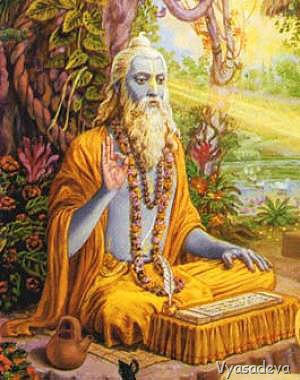
By Akiñcana Balarāma Dāsa
Devotees with inquisitive minds and curiosity for details might have sometimes wondered who is Śrīla Vyāsadeva, the compiler and editor of the four Vedas, the Upaniṣads, the Purāṇas and the author of the Vedānta-sūtra and Mahābhārata. Is he an empowered jīva or does he belong to the viṣṇu-tattva category? In this article we will try to present the conclusive statements that are in accordance with guru, sādhu and śāstra.
Śrīla Vyāsadeva as the compiler of the Vedic literatures is a post, just as Lord Brahmā, Indra, Sūrya etc. are also posts that are held by different personalities at different times. The Viṣṇu Purāṇa (3.3.11–19) gives a list of twenty-eight persons who act as Vyāsa for the twenty-eight Dvāpara-yugas which have passed in the current Vaivasvata-manvantara. The last in the list is Kṛṣṇa Dvaipāyana Vyāsa who is described in the Śrīmad-Bhāgavatam:
“Thereafter, in the seventeenth incarnation of Godhead, Śrī Vyāsadeva appeared in the womb of Satyavatī through Parāśara Muni, and he divided the one Veda into several branches and subbranches, seeing that the people in general were less intelligent.” (ŚB 1.3.21)
As he occupies the post of the compiler of the Vedic literatures, Śrī Vyāsadeva is generally categorized as a śaktyāveśa-avatāra, an exalted jīva empowered by the Lord with portions of His powers such as knowledge. In the yugas previous to the last Dvāpara-yuga some of the personalities who acted in the post of Vyāsa were: Brahmā, Manu, Bṛhaspati, Indra, Yama, Bharadvāja, Gautama, Dhanañjaya, Parāśara and others. In the next Dvāpara-yuga Drauṇi, the son of Droṇa (Aśvatthāmā) will become Vyāsa. All these personalities are especially empowered jīvas.
But in the last Dvāpara-yuga we see an exemption from the general rule: instead of empowering a jīva, the Lord Himself takes up the position of Vyāsadeva, which means that the last Vyāsadeva, Kṛṣṇa Dvaipāyana Vyāsa, is viṣṇu-tattva. This is confirmed by Śrīla Rūpa Gosvāmī in his Laghu-bhāgavatāmṛta (1.3.81–84) and by Śrīla Baladeva Vidyābhūṣaṇa in his commentary on the Laghu-bhāgavatāmṛta (English translation by H.H. Bhānu Swami):
Text 81
dvaipāyano ’smi vyāsānām iti śaurir yad ūcivān
ato viṣṇu-purāṇādau viśeṣeṇaiva varṇitaḥ
“Kṛṣṇa Himself says, ‘I am Dvaipāyana among the Vyāsas.’ In the Viṣṇu Purāṇa and other scriptures, he is described as directly the Lord.”
Commentary by Śrīla Baladeva Vidyābhūṣaṇa:
“Kṛṣṇa (śauriḥ) describes himself as Vyāsa in the Eleventh Canto (11.16.28) as well.”
Text 82
yathā –
kṛṣṇa-dvaipāyanaṁ vyāsaṁ viddhi nārāyaṇaṁ svayam
ko hy anyaḥ puṇḍarīkākṣān mahābhārata-kṛd bhavet iti
“Thus it is said: ‘Know that Kṛṣṇa Dvaipāyana Vyāsa is Nārāyaṇa Himself. Who else except the Lord could produce the Mahābhārata?’ (Viṣṇu Purāṇa 3.4.5, Mahābhārata 12.346.11)”
Text 83
śrūyate ’pāntaratamā dvaipāyanyam agād iti
kiṁ sāyujyaṁ gataḥ so ’tra viṣṇv-aṁśaḥ so ’pi vā bhavet
tasmād āveśa evāyam iti kecid vadanti ca
“It is said in the Mahābhārata that a sage named Apāntaratamā, who had extinguished internal ignorance, became Dvaipāyana Vyāsa. This means that the sage merged into the īśvara form of Dvaipāyana, or that he was an aṁśa of Viṣṇu.”
Commentary by Śrīla Baladeva Vidyābhūṣaṇa:
“This is related in the Nārāyaṇīya of the Mahābhārata. Apāntaratamā was an austere brāhmaṇa who had extinguished ignorance. He (saḥ) merged into Lord Dvaipāyana (atra) or can be regarded as an aṁśa of Viṣṇu (in the manner that Droṇa and Dharā were amśas of Nanda and Yaśodā and merged into them when they appeared on earth with Kṛṣṇa). Because of this, some say that Vyāsa is an āveśāvatāra, like the Kumāras.”
HG Gopīparāṇadhana Prabhu translates the same text 83 as follows:
“We hear from scripture that the sage Apāntaratamā became Dvaipāyana Vyāsa. Apāntaratamā may have merged with Dvaipāyana, or else he was also a partial expansion of Lord Viṣṇu. Therefore some authorities say that Dvaipāyana is an āveśa incarnation.”
HG Kuśakratha Prabhu’s translation of the same verse differs somewhat:
“In the scriptures it is said that Apāntaratamā Muni became Dvaipāyana Vyāsa. Is Vyāsa a jīva who attained sāyujya-mukti, or is he an aṁśa-avatāra of Lord Viṣṇu? Some say he is an āveśa-avatāra.”
Since Śrīmān Kuśakratha Prabhu didn’t have and use Śrīla Baladeva Vidyābhūṣaṇa’s commentary in his translation, he naturally thought that sāyujya here refers to sāyujya-mukti, but with the help of Baladeva Vidyābhūṣaṇa’s commentary we understand that it refers to the merging of sage Apāntaratamā with Lord Dvaipāyana, who is an aṁśa of Viṣṇu, in the same manner as the demigod portions of eternal residents of Vṛndāvana merged with Goloka Vrajavāsīs during Lord Kṛṣṇa’s pastimes on earth. This merging is the reason why some say that Dvaipāyana Vyāsa is a śaktyāveśa-avatāra, but actually he is Lord Nārāyaṇa Himself. In the same way one may refer to Nanda Mahārāja and Mother Yaśodā as demigods (since Droṇa and Dharā merged with them) although in reality they are Kṛṣṇa’s eternal parents from Goloka.
Śrīla Jīva Gosvāmī leaves no doubt that Kṛṣṇa Dvaipāyana Vyāsa is viṣṇu-tattva in his Śrī Tattva-sandarbha 16.1 (English translation by HG Gopīparāṇadhana Prabhu):
“The Skanda Purāṇa says, ‘These others make use of small collections of ideas they have carved out from the infinite sky of Vyāsadeva’s mind. They take advantage of these borrowed ideas like people who pick up things discarded from someone else’s house.’ In the same vein is the statement of Parāśara Muni in Śrī Viṣṇu Purāṇa (3.4.2–5.): ‘Then during the period of the twenty-eight Manu, the great master, my son Vyāsa, divided the one Veda with four divisions into four separate books. In the same way as he, the brilliant editor of the Vedas, arranged their entire text into various books, so have other Vyāsas in the past, including myself. O best of brāhmaṇas, you can understand that in each of the rotations of the cycles of four yugas a different Vyāsa organizes the branches of the Vedas. But know that Kṛṣṇa Dvaipāyana Vyāsa is the Supreme Lord Nārāyaṇa Himself. Who else on this earth, Maitreya, could be the author of the Mahābhārata?’”
Śrīla Jīva Gosvāmī continues (16.2):
“In the Skanda Purāṇa we read, ‘Knowledge in this world was originally generated from Lord Nārāyaṇa. In Kṛta-yuga it remained intact. In Tretā-yuga it became somewhat corrupted, and in Dvāpara-yuga altogether so. When knowledge had thus gradually transformed into ignorance because of Gautama Ṛṣi’s curse, the confused demigods headed by Brahmā and Rudra went to ask protection from Nārāyaṇa, the faultless provider of shelter. Informed of what they needed Him to do, He, the Personality of Godhead and greatest of mystics, descended to earth as the son of Parāśara in the womb of Satyavatī. In that form Lord Hari Himself restored the neglected Vedas.’”
Gopīparāṇadhana Prabhu comments: “Just as infinite space is all-accommodating, so the mind of Veda-vyāsa encompasses everything there is to know. Vedic ṛṣis are greater than ordinary mystics of other cultures who comprehend something of the Absolute Truth and its energies for their own self- realization, but cannot express their experiences coherently for the benefit of others. The Vedic sages are not only mystics but expert communicators as well; they systematically teach practical means by which persons entangled in material life can also become self-realized. Of these sages, Dvaipāyana Vyāsa is incontestably the greatest. His own father, Parāśara Ṛṣi, student of Maitreya Ṛṣi and narrator of the Viṣṇu Purāṇa, attests to this. Previously, in the twenty-sixth Dvāpara-yuga of this Vaivasvata-manvantara, Parāśara himself was Vyāsa, editor of the Vedas. As an incarnation of Nārāyaṇa, however, Kṛṣṇa Dvaipāyana excels all other Vyāsas. He best knows the whole purpose of the Vedas.”
Thus, the śāstras (Viṣṇu Purāṇa and Skanda Purāṇa) and the ācāryas (Śrīla Rūpa Gosvāmī, Śrīla Jīva Gosvāmī and Śrīla Baladeva Vidyābhūṣaṇa) are consistent in the opinion that Kṛṣṇa Dvaipāyana Vyāsa is Lord Nārāyaṇa Himself or viṣṇu-tattva.
Some devotees have argued in the past (see http://www.dandavats.com/?p=3279) that opinions of the ācāryas on this matter differ and that our Śrīla Prabhupāda held the position that Kṛṣṇa Dvaipāyana Vyāsa is a śaktyāveśa-avatāra and thus jīva-tattva. To support this they cite quotes such as:
“So Vyāsadeva, he is also living entity, although he is empowered, so apaśyat puruṣaṁ pūrṇam, he saw the Supreme Personality of Godhead. And māyāṁ ca tad-apāśrayam, and the back side is māyā.” (Lecture, Śrīmad-Bhāgavatam 1.7.2–4 Durban, October 14, 1975)
But, the reality is that Śrīla Prabhupāda was not specific in this or any other similar statements, he never mentions Kṛṣṇa Dvaipāyana Vyāsa as a śaktyāveśa-avatāra or jīva-tattva but is always using a generic term Vyāsadeva that is used for the post of Vyāsadeva in general. To infer that Śrīla Prabhupāda specifically refers to Kṛṣṇa Dvaipāyana Vyāsa, without him ever saying it, would be inappropriate, since it would make his words contradict śāstra and the previous ācāryas. How could Śrīla Prabhupāda ever contradict Śrīla Baladeva Vidyābhūṣaṇa, a great scholar and ācārya to whom he dedicated his Bhagavad-gītā As It Is? Thus we can safely conclude that whenever Śrīla Prabhupāda referred to Vyāsadeva as a śaktyāveśa-avatāra or jīva-tattva, he meant the post of Vyāsadeva in general, and not specifically Kṛṣṇa Dvaipāyana Vyāsa.