
By Puskaraksa das
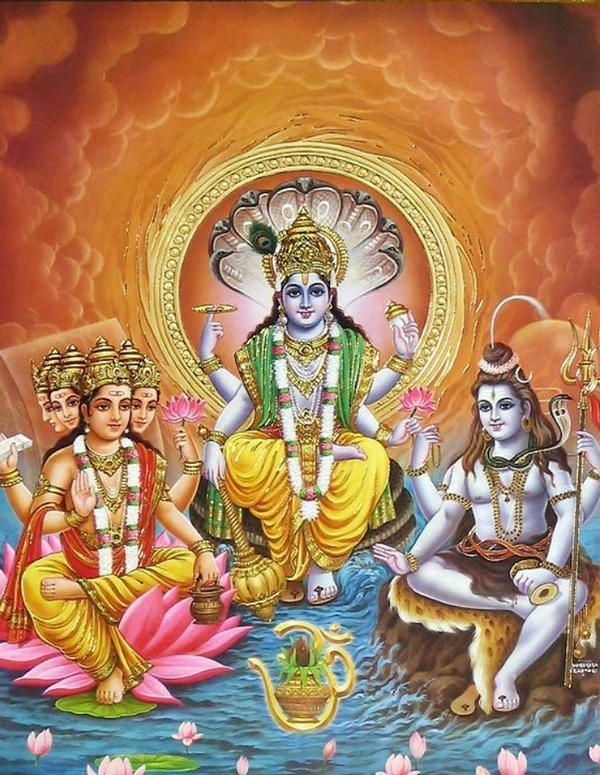
In order to cast some light on the often understood to be polytheistic practices in so-called Hinduism, I often take the example of a Presidential Regime.
We have:
– the President – Krishna (at home), or Visnu (in office)
– the Prime Minister – Shiva – Mahadeva
– the Ministers – the Devas, headed by Brahma, the architect of the universe
So, we worship the Supreme, He from whom everything emanates, and from whom everyone draws his power.
In this sense, Hinduism and particularly Vaishnavism is to be understood to be monotheistic.
But, if people want to address a specific issue, they often also directly approach the concerned minister, in charge of that particular aspect.
For example, if they have an issue related to:
– Health, they approach the Minister of Health: Uma
– Trade, they approach the Minister of Commerce: Ganesh
– Education, they approach the Minister of Education: Sarasvati
etc.
Similarly, in Christianity, the devotees often approach the Saint ruling a particular aspect of life and pray to him or her, so as to receive a particular boon or blessing.
In this way, what may be understood to be mere mythology, because of its external polytheistic appearance, does rest upon a monotheistic, i.e. a pyramidal structure, where Krishna, or His expansion Vishnu, is Supreme.
In the same way, Zeus or Jupiter – Zeus-Pater (father Zeus/God) being the Greek counterpart of the Roman God, Jupiter (Jove, Jove-Pater, Ju-Piter) – were also supreme as they were ruling over all the Devas, also often called gods (plural).
In this regard, let us be careful not to confuse the demi-gods with the Devas, as a demigod is generally known to be a mortal who is the offspring of a god (a Deva) and a human. As it is, the English term is a calque of the Latin semideus, “half god”
The five Pandava brothers, fit this Western definition of demigods (half-gods), but are generally not referred to as such. Queen Kunti, the wife of King Pandu, was given a mantra that, when recited, meant that one of the Gods would give her his child. When her husband was cursed to die if he ever engaged in sexual relations, Kunti used this mantra to provide her husband with children, Yudishtira (father Yama), Bhima (father Vayu) and Arjuna (father Indra). She taught this mantra to Madri, King Pandu’s other wife, and she conceived twin boys, Nakula and Sahadeva (fathers the Asvins). Queen Kunti had previously conceived another son, Karna, when she had tested the mantra out—despite her protests, Surya the sun god was compelled by the mantra to impregnate her.
Similarly, Genesis, 6.2. refers to such demigods: “Some of the heavenly beingsor sons of the gods saw that these young women (on earth) were beautiful, so they took the ones they liked.”
The Vaishnavas, however, often translate deva as “demigod” and cite various verses that speak of the devas’ subordinate status. For example, the Rig Veda (1.22.20) states, Oṃ tad viṣṇoḥ paramam padam sadā paśyanti sūrayaḥ: “All the suras (i.e., the devas) look always toward the feet of Lord Vishnu.” Similarly, in the Vishnu Sahasra-Nama the concluding verses state: “The Rishis (great sages), the ancestors, the devas, the great elements, in fact all things moving and unmoving constituting this universe, have originated from Narayana”. Thus the devas are stated to be subordinate to Vishnu, or God.
In the same way, Srila Prabhupada often translated the Sanskrit word “deva” as “demigod” when the term referred to a god, other than the Supreme Lord.
Moreover, the first verse of the Old Testament literally says that “in the beginning elohim (the gods) created the heavens and the earth.”
By the time the same verse reached the much later King James Version of the Jewish Old Testament, it read, “in the beginning God created the heavens and the earth.” However, the original Hebrew does not say “God” but rather, “gods”!
Similarly, there are other parts in the Old Testament, where the Devas are referred to in the form of a plural:
As it is, David makes the selfsame open avowal of the plural gods of Israel: “Israel, whom gods [elohim] went [plural: balk-u] to redeem … from the nations and their gods [elohim]” (2 Sam. 7, 23).
Moses uses the plural adjective with the plural noun elohim: “hath heard the voice of the living gods [elohim hayyim]” (Deut. v, 26; Heb. Text, 5, 23).
And twice David threatens Goliath for defying “the armies of the living gods” (elohim hayyim; I Sam. 17, 26, 36).
So, we can understand that this pyramidal structure:
– the President – Krishna (at home, i.e. Vrindavana), or Visnu (originating the creation)
– the Prime Minister – Shiva – Mahadeva
– the Ministers – the Devas, headed by Brahma, the architect of the universe
– and us, the human beings right below, on the intermediary planet earth,
is a very feasible, comprehensive and broadly admitted hierarchy in God’s creation, since He, Krishna, delegated the creation, the maintenance and the destruction of the universe through His various agencies.