
By Ravinjay Kuckreja
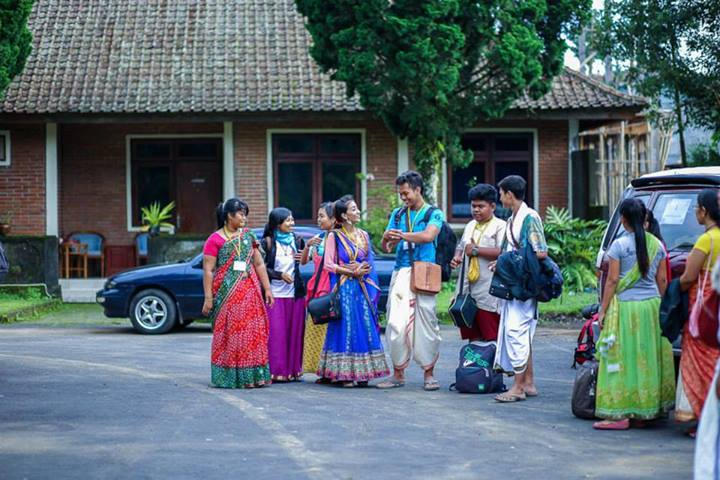
On the 21st and 22nd of December 2013, 45 youth from all over Bali, Indonesia gathered for the Nava Yauvana Sanga 2013. The 20 committee members, also consisting of unmarried youth from the ages of 15-30, wanted to have this camp to encourage friendship amongst the 7 asramas/temple-communities all over the island.
These young, intelligent and broad-minded youth grew up following devotional practices. Some of them are born into the movement, while some found their way to Krishna consciousness at an early age. However, it is shocking to observe that most of them have not completely read the Bhagavad-gita As It Is, the most crucial source of knowledge on which the entire movement bases itself upon. So the committee decided to make this first Nava-yauvana-sanga (‘ever youthful association’) a Bhagavad-gita study program…
And what is more surprising is, none of the participants had to even open their Bhagavad-gitas. The entire knowledge, practical applications and philosophy of the Gita was taught through games, dramas, presentations, kirtan and moments of contemplations.
The event began after the guru-puja at noon for the disappearance day of Srila Prabhupada’s spiritual master, Bhaktisiddhanta Sarasvati Thakur. We chose to open the event at the Sri Sri Radha Gopinatha Temple (one of the five main temples in Bali) for it is the temple with the largest kirtan hall and a central location.
The event opened in a peculiar way. Traditional Balinese music was heard and the voice of Sanjaya, the Gita’s ‘narrator’ was heard describing the scene at the battlefield. Krishna and Arjuna, played by the committee members, appeared in front of everyone and demonstrated the disturbed mind of Arjuna as he reveals his thoughts to Krishna, his charioteer. The participants were then divided into five, each for the tattvas or main philosophical topics of the Gita, which are Isvara (God), Jiva (Soul), Prakrti (Material Nature), Kala (Time) and Karma (Activity). These five groups were given selected verses from the Gita which describes the intricate philosophies of each of these five tattvas. At the end of the camp, which was on Sunday, they had to make a presentation to teach the other participants about the tattvas they studied on.
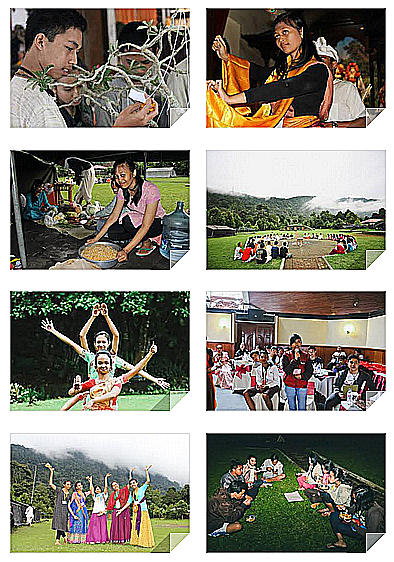
Each of the 18 chapters were discussed in sequence. The first with the drama of Krishna and Arjuna, the second with a tree, representing the Vedas, with flowers, for the flowery words of ritualistic ceremonies, and fruits, for the bad and good karmic reactions. A game was also played with one participant from each group blindfolded and told to throw flowers at the other participants to catch. However, these flowers were mixed with scraps of paper and the participants had to only catch the real flowers, which are able to be dovetailed in Krishna’s service. A drama was also performed to illustrate the influence of lust in the daily conversations of a teenager. For Chapter 3, a short seminar was given on how to preach (by engaging the general public in Karma-yoga). For Chapter 4, we sang Bhaktivinode Thakura’s “Gurudeva”. For Chapter 5, the participants became sages of an equal vision and hunted the field for pictures of the Supersoul. For Chapter 6, we sat in silence meditating on a candle to see if our mind is our best friend or our worst enemy. We also took this opportunity to reflect on our own devotional practices and how we are actually fallen yogis from previous lifetimes.
The next day, we had games for each of the yoga levels. A karma-yogi had to balance a bead on a spoon. A jnani had to complete a Bhagavad-gita quiz. A dhyana-yogi had to hold his breath and bhakti-yogi had to make a marigold garland. For Chapter 7, participants had to role play one of the impious or the pious persons. Various presentations were also held on the three energies of Krishna, the worship of the demigods and the worship of the impersonal Brahman. In Chapter 8, we had kirtan as the best means to always remember Krishna and also we watched a video from Disney Pixar’s “UP” which shows us that death and suffering is natural in this material world. In Chapter 9, the participants opened their hearts to hear the glories of Bhakti and in Chapter 10, they chanted the catuh sloki. In Chapter 11, a traditional dance was performed on the Universal Form. In Chapter 12 and 13, presentations were held on the different levels of Bhakti, the worship of a personal God and the field of activities. In Chapter 14, a tug of war between the three modes of material nature (Sattva won!). In Chapter 16, blindfolded participants had to give divine or demoniac tags to the groups and the groups with the most divine characteristics won. In Chapter 17, participants had to categories different food items according to the three modes. Afterwards, each of the groups had to give presentations on their tattvas. It was inspiring to see that these teenagers could give amazing presentations on such complex philosophies in under 15 minutes!
Finally in Chapter 18, a drama of Krishna and Arjuna to summarise the main points and end the event. It was a wonderful and pivotal experience for all the youth in Bali, for it encouraged them to read and treasure Srila Prabhupada’s books.
After the event, most of the participants and committee members opened their Gitas at their own respective homes and tears of joy and adoration moistened its pages… Friendships were created and a sense of unity sprang with the children of Srila Prabhupada’s movement.
At your service,
Ravinjay Kuckreja
Head of Nava Yauvana Sanga 2013 Committee
International Communications of ISKCON in Indonesia