
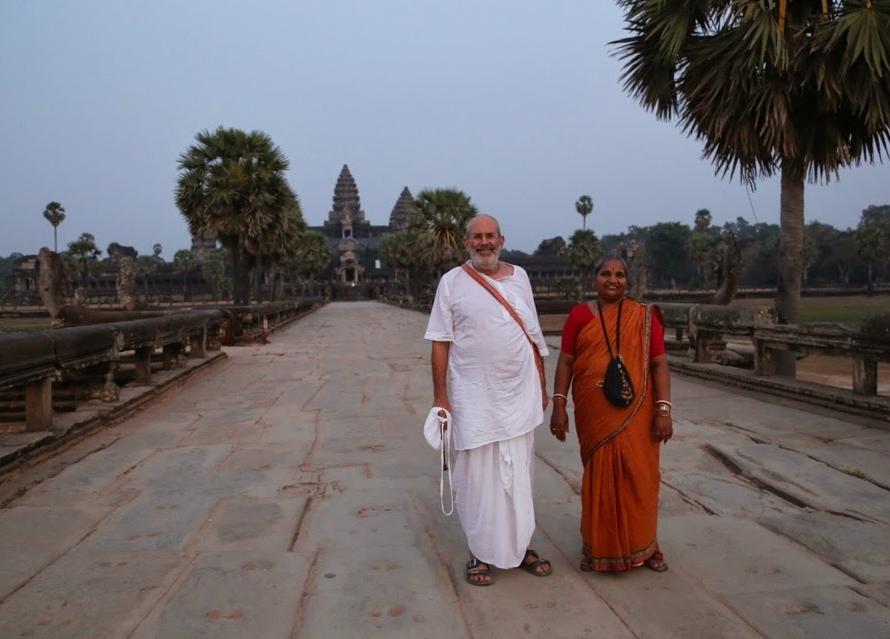
By Basu Ghosh Das
Pictures of our visit can be seen in the seven albums posted at the following URLs/links:
http://tinyurl.com/p36qu9p, http://tinyurl.com/p8w9wms, http://tinyurl.com/nkutkao, http://tinyurl.com/pfyzrv7, http://tinyurl.com/qfhqzj3, http://tinyurl.com/ojt9jcc, http://tinyurl.com/qedepu2
Jitendriya Das, is a godbrother of mine whom I’ve known well since 1989, and with whom I’ve remained in regular touch ever since. A few months ago he informed me of his plan to visit India after a gap of fourteen years.
Jitendriya Prabhu has been residing continuously at ISKCON Chicago since he joined ISKCON there 39 years ago. That’s something of a record for ISKCON devotees in the United States!
During our discussion he suggested we jointly undertake a visit to the famous temple ruins at Angkor Wat, in Northwestern Cambodia, now a popular tourist attraction, and a “UNESCO World Heritage Site”.
A thousand years ago, the Hindu Raja (King) Jayavarman II, built numerous large elaborately decorated stone temples of Lord Vishnu, in the area that today is known internationally as Angkor Wat.
Angkor is a dissimilation of the Samskrita word “nagar”, that is “city” in English. From nagar came “nakor” and then “Angkor” in modern Khmer, the language of Cambodia. Raja Jayavarman II constructed his capitol in this place a thousand years ago, and now the ruins of nearly 250 Hindu temples remain, in various stages of deterioration, after a millennium.
The suggestion to visit Angkor Wat was intriguing to say the least. Of course I had heard of the old Vishnu temple ruins, and it’s reputation of being the largest Hindu temple complex in the world.
Coincidently, I was aware that another godbrother, Kala Das [pronounced “kaaluh”], who spent six weeks with us at ISKCON Baroda during July/August 2009, has been spending almost half the year at Siem Reap for the past few years.
Siem Reap is a town that is quickly becoming a modern city, is located just a few kilometers from the Angkor Wat ruins.
Despite his advanced age of sixty seven, and after recently undergoing coronary by-pass open heart surgery in his native Canada, Kala Prabhu has been graciously supporting the ISKCON center at Siem Reap for the past couple of years.
The ISKCON center at Siem Reap has for it’s inspiration and establishment
His Holiness Bhakti Raghava Swami, an ardent advocate of the reestablishment of varnashram dharma, and ISKCON India Minister for Varnashram. The same age as Kala Das, he is extremely active, and is extremely fit for his age.
Maharaj travels worldwide, but recently spent almost two years residing on a farm project he initiated at Hebri, near Udupi, in Southwestern Karnataka, in South India.
Bhakti Raghava Swami arranged for several of his disciples from Indonesia, all of them originally Balinese Hindus, to develop the ISKCON center at Siem Reap. Some of these devotees have been residing at Seim Reap for the past four years.
Upon our arrival at the Siem Reap International airport, we were greeted and received by Kumudaksha Das, a very friendly, soft spoken, humble and enthusiastic devotee, as well as Bhakta Jerry, from New York City. Bhakta Jerry has been connected to ISKCON since the 1970s.
Kumudaksha Das is one of the Balinese devotees, and has been residing at Siem Reap now for the past three years. He’s learned basic conversational “Khmer”, and is able to converse with the natives of Cambodia.
Bhakta Jerry, an affable and gregarious person, explained his vision of sending groups of local Buddhist monks to visit Sridham Mayapur, with the hope that they would become inspired by the mission of Lord Chaitanya Mahaprabhu.
We were taken to the local ISKCON center, that is located on a main road, just next to a cross roads, but on the outskirts of Siem Reap. There the devotees rent an independent apartment, located in a row of similar, recently constructed and thus modern buildings. The temple apartment has three floors, and an attic for storage.
The ground floor contains a kitchen, bathroom, and dining area. There was a plan to begin a small Govinda’s Restaurant in the dining area, but initial experiments did not succeed, and the plan has been deferred.
On the first floor of the apartment there is a temple of Sri Sri Gaur Nitai, where the local devotees hold kirtan twice a day, and a mid-day lecture and lunch program on Sundays. These devotees also do street “sankirtan” daily, at various places in Siem Reap as well as in front of some of the Angkor temple ruins.
We arrived in time to attend the Sunday program, where I spoke to a small group of twenty guests.
The attending group of visitors was international! There were some Indian guests, with whom I spoke with in Hindi. It seems that there are several Indian businessmen who reside at Siem Reap, and who hail from Uttar Pradesh (North India). They who speak fluent Khmer, and of course, Hindi, but cannot speak English.
At this Sunday gathering we met Smt. Charu Smita Gupta from New Delhi, a life long Museum manager, who has been deputed by the Government of India to help with the opening of a textile Museum at Siem Reap. The Museum is scheduled to open sometime this month, April 2014, and so she was quite busy preparing for the opening.
Also present were some local Khmer visitors, and three congregational devotees from Russia in attendance as well, who later on turned out to be of great assistance to us while visiting the various places of touristic interest in the area.
The other Indonesian devotees are Gunavatar Das, Havi Vishnu Das, and Saumaka Das. Kishor Krishna Das, also from Indonesia, whom I later met at Mayapur, resided at Siem Reap for several years, but has now returned to Indonesia, where he has taken up managerial responsibilities in ISKCON there.
The very next day, on Monday we visited the main Angkor Wat temple, and the other large temple, Angkor Thom. Historically, Angkor Wat was known as Vara Vishnuloka in Samskritam, and the Khmer name is Preah Pisnulok1
The modern name, Angkor Wat, means “Temple City” or “City of Temples” in Khmer; Angkor, meaning “city” or “capital city”, is a vernacular form of the word nokor, which comes from the Sanskrit word nagara. Wat is the Khmer word for “temple grounds”, derived from the Pali word “vatta”.2
What we saw in these two main temples, and then later on the next day when we visited some of the other, smaller temples, were ornate carved images decorating the stone walls, as well as carved statues, intricate temple architecture, and also trees and forests surrounding the temples.
We were accompanied on our visit to the main temples by congregational devotees Bhakta Alexandar (“Sasha”), and Bhaktin Olga, both from Russia. They know both the history of Cambodia, as well as the specific history of the temples. They also are familiar with the stories that explain the meanings and history of the various carved images that we saw.
The majority of the carved images are scenes from the Mahabharata, Ramayana, and the Puranas, the ancient histories of India. There are scenes depicting various battles as described in these histories. There are scenes from the “svargalokam”, the heavenly planets within this material world, as described in these ancient Indian literatures. There are also scenes of the contemporary life as it was at Cambodia a thousand years ago.
The temples, their architecture, the stone construction, and carved images certainly make for fascinating viewing!
We noted that hundreds of visitors from all over the world – Europe, the USA, South America, and many from Russia and China, are touring the temples. Many were photographing the ruins, and we struck up conversations with several of our fellow visitors!
One thing of particular interest in the temples are where huge trees had intertwined with some of the temples, or even canopied over the temples and temple gates!
We talked with visitors from Canada, Argentina, the USA, and a particularly meticulous photographer – an elderly gentleman who was quite gracious, talkative, but soft spoken, from Belgium. He was using a very professional Hasselblad camera with a fixed 60mm, lens, keeping it firmly on a tripod, and using a light meter before taking each photo! He was making very slow but determined progress in visiting just one of the temples. His movements were in sharp contrast to most of the visiting tourists who attempt to see as much as possible in as little time as they can manage!
Besides hearing detailed stories of the various carved images within the various temple complexes from our guides, we also learned from them that many of the international tourists spend a very short time at Angkor Wat.
This may be due to the fact that the Cambodian government charges visitors to enter the temples. A one day pass costs twenty dollars, a three day pass for forty dollars and there is a one week pass for sixty dollars.
We took the three day passes, but really spent only two full days, as well as just a few hours on a third day, visiting the Siem Reap area temples. Some of the temples we visited were Prasat Bayon (Angkor Thom), Prasat Preah Khan, Prasat Preah Neak Pean, Prasat Ta Som, Eastern Mebon, Prasat Pre Roup and Prasat Ta Prum.
Later on, during the morning of the day we were to depart Siem Reap, we visited the hill area of Phnom Kulen. This area is located some 70 kilometers (43.3 miles) North of Siem Reap. There, there are images of Lord Vishnu, Goddess Lakshmi, and myriad Shivalingas carved on stone, but inside of two hill streams, under water! Additionally there are also two waterfalls, that make for serene viewing.
Bhakta Inal organized our visit to this beautiful area and accompanied us there. He showed us the hill streams, and took us to the local Buddhist temples. He took us to the waterfalls, but we missed seeing the large one, due to a steep climb down to reach it. We did see the smaller one.
One interesting thing we saw here were bundles of Cambodian currency notes that are kept by small merchants so that locals can leave tiny donations at the various Buddhist shrines. Cambodian currency has lost much of it’s value, and most purchases and financial transactions – even at the Government Post Office, is done using US dollars!
We left Angkor Wat with a certain sense of astonishment at how grand the civilization of the past must have been in this area! Surely visiting these temples had an extra special charm, especially for those of us who are followers of vedic culture and religion, although beyond a shadow of a doubt this area has become one of “the” places to visit for many who are curious about the glory of ancient civilization!
Devotees of ISKCON who may wish to visit Angkor Wat and would like help and guidance there, may contact Kala Das Prabhu via e-mail, kala.dasa@gmail.com>, Bhakti Raghava Swami,