
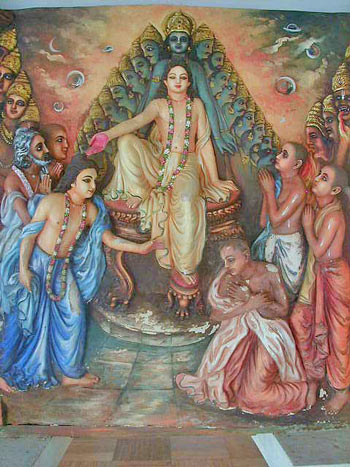
 Agents of Lord Caitanya’s Compassion and Love: An Overview of Gaudiya Vaishnava Missiology
Submitted by the Bhaktivedanta Mission Center
We offer our humble obeisance to all the Vaishnavas. It is only by the grace of the Lord carried in the compassionate hearts of such devotees, especially His Divine Grace A.C. Bhaktivedanta Swami Prabhupada, that we are given the privilege to assist the Lord’s dear servants.
In many articles and discussion threads, contributors to this web site discuss ISKCON’s mission, or the mission of Srila Prabhupada. As devotees gather in Boston, Massachusetts this weekend to celebrate the Bhaktivedanta Mission Festival on the 41st anniversary of Srila Prabhupada’s arrival in America, we think it appropriate to invite the members, supporters and friends of ISKCON into a thoughtful discussion about Gaudiya mission.
With the kind permission of the editors of Dandavats.com and its readers, over the course of the next several months we will post a series of eight articles on this topic. We apologize that these articles will be longer than most articles you find here. We don’t like to stand on soapboxes or hear ourselves speak, but these concepts require explanation according to the teachings of scripture and the acaryas.
We shall begin with an introduction to missiology and a discussion of the first doctrinal principle of Gaudiya mission. Each successive essay will address one of the following principles:
Four Doctrinal Principles of Gauòéya Missiology
Avatara: The Lord’s Descent as the Model for Mission
Yutha: The Sampradaya as the Lord’s Service Group and Missional Instrument
Saragraha: The Essence According to Time, Place and Candidate
Yukta-vairagya: Utilizing Everything Favorable in Krishna’s Service
Four Practical Principles of Gauòéya Missiology
Vairagya-vidya: The Foundation of Mission in Preaching, Practice and Worship
Adhikara: Mission’s Appeal to Various Audiences
Ei desa: The Native Expression of Worldwide Mission
Sva-cesöitam: The Wholeness of each Vaishnava Community
An Introduction to Missiology: Why Bother?
We use the word mission often, but do we understand the aim of the mission, and how it has appeared over time in different social contexts to benefit new audiences?
In theological circles, there is a specialized field of study called missiology. It is the purpose of ISKCON-Boston’s Bhaktivedanta Mission Center to use historical and scriptural analysis to increase our understanding of the mission of Sri Caitanya Mahaprabhu that Srila Prabhupada so ingeniously transplanted in scores of countries in the short period of twelve years. It is our hope that our efforts – though faulty and incomplete – will inspire Srila Prabhupada’s followers to actively participate in and thus realize the full depth and breadth of this mission.
ISKCON members are sincere servants and practitioners of bhakti yoga. Most of us are not trained theologians. Undoubtedly, many of us came to Krishna consciousness in part because we did not find satisfaction in other religious denominations. Consequently, many of us may be a little skeptical about adopting theological terminology and concepts from other traditions. Some may see the use of missiology as an inappropriate attempt to apply Christian concepts and methods to Gaudiya Vaishnavism.
While the term missiology is strongly associated with Christianity, it is not the sole possession of Christians. The word is derived from the Latin word “missio”, and the Greek word “logos”. Missiology is the study of a religious tradition’s mission, especially the character and purpose of missionary work.
Mission is where theology and human society intersect. Mission is the endeavor to make human beings godly, to reconcile lost souls with God. It is how the word of God is sown into the hearts and minds of the people of the world. Missiology concerns itself with appropriate approaches and methods to bring the mercy of the Lord to different audiences in different cultures at different times.
The effectiveness of mission is not rooted in the application of public relations, marketing, business, or politics. The methods used by adherents and practitioners of these sciences are aimed at manipulating people’s minds (and/or wallets). A spiritual mission is aimed at healing the hearts of souls estranged from God. That healing is accomplished by bringing the soul in contact with the Lord.
As we shall see in this and other articles, this is a dynamic endeavor fueled with many possibilities. “Sri Caitanya Mahaprabhu appeared in order to deliver all the fallen souls. Therefore He devised many methods to liberate them from the clutches of maya.” (Caitanya-caritamrta, Adi-lila, 7.38)
Srila Prabhupada states in his purport that the means of mission will vary, “It is the concern of the acarya to show mercy to the fallen souls. In this connection, desa-kala-patra (the place, the time and the object) should be taken into consideration.”
Note: Elsewhere the word patra is defined as circumstance or person. In this article, we will use it to refer to persons or audience.
While missiology may seem arcane or irrelevant to many believers, it in fact helps us to understand and apply the dynamic principles of faith that expand the glories of the Lord in society and give solace to the forlorn spirits of those seeking solace from a life dedicated solely to materialistic goals.
The First Principle: Avatara – The Lord’s Descent as a Model for Mission
Our understanding of the Lord’s mission begins – appropriately enough – with the Lord. After all, as stated in Srimad Bhagavatam (6.3.19), “Real religious principles are enacted by the Supreme Personality of Godhead. Although fully situated in the mode of goodness, even the great rishis who occupy the topmost planets cannot ascertain the real religious principles, nor can the demigods or the leaders of Siddhaloka, to say nothing of the asuras, ordinary human beings, Vidyadharas and Caranas.”
The scriptures explain that Lord Krishna appears during each universal age (or yuga). As stated in Bhagavad-gita (4.8), He appears to deliver the pious, check the forces of irreligion and reestablish religious principles. In each yuga, the Lord takes a different form and reveals specific teachings and practices appropriate to the people of that Age.
Srila Prabhupada explains (Bg 4.7 purport), “Each and every [avatara] of the Lord has a particular mission and they are all described in the revealed scriptures… In each and every [avatara], He speaks as much about religion as can be understood by the particular people under their particular circumstances. But the mission is the same – to lead people to God consciousness and obedience to the principles of religion… The whole purpose of the mission of [avataras] is to arouse Krishna consciousness everywhere.”
In other words, according to time, place and audience, the Lord contextualizes religious teachings, forms and practices to suit the needs and day-to-day realities of the conditioned souls. Contextualization is a key concept in the discussion of mission. The Lord does not limit His appearances to a particular nation, religion or even species, nor does He designate those of a particular sect, nationality, or species as exclusive recipients of His compassion and guidance. As the Lord states in Bhagavad-gita (9.29), “I envy no one, nor am I partial to anyone. I am equal to all.”
However, not all beings are equally inclined to understand and act on spiritual principles. Nonetheless, the Lord creates auspicious circumstances for the conditioned souls to advance toward love of Godhead according to their ability. When the Lord descends, He engages pure devotees and highly advanced souls in His personal service. For those inclined to religious life, the Lord gives instructions. And for those who are unable to follow religious principles (i.e. sub-human species), the Lord creates auspiciousness by appearing among them. Srila Prabhupada explains that the Lord demonstrates His universal love by descending Himself or sending His emissaries into all communities of living entities (SB 1.2.34 purport):
There are innumerable material universes, and in each and every universe there are innumerable planets inhabited by different grades of living entities in different modes of nature. The Lord [descends] Himself in each and every one of them and in each and every type of living society.
He manifests His transcendental pastimes amongst them just to create the desire to go back to Godhead. The Lord does not change His original transcendental position, but He appears to be differently manifested according to the particular time, circumstances and society. Sometimes He [descends] Himself or empowers a suitable living being to act for Him, but in either case the purpose is the same: the Lord wants the suffering living being to go back home, back to Godhead.
In each Age, the Lord descends as a yuga-avatara to inspire and teach devotional service. He specifies a particular spiritual practice (yuga-dharma), which is most conducive for the souls of that time. According to Srimad-Bhagavatam (11.5.35), souls should worship the yuga-avatara by practicing the yuga-dharma, “The Supreme Lord Hari is the giver of all desirable benefits of life. Intelligent human beings worship the particular forms and names that the Lord manifests in different ages.”
On the basis of scripture and the conclusion of our acaryas, the members of ISKCON, as do all Gaudiya Vaishnavas, accept Sri Caitanya Mahaprabhu as the yuga-avatara, and the chanting of the Holy Names of the Lord as the yuga-dharma. Therefore, our understanding of ISKCON’s mission begins with Lord Caitanya and winds through His disciplic succession to the present day.
The Master’s Mood and the Servant’s Mood
Among all the avataras of the Lord, Sri Caitanya is considered unique. Normally when the Lord appears, He descends with His divine feminine aspect (or pleasure potency). Though the Lord and His pleasure potency are non-different, for the purpose of pastimes, they descend as individuals. In Sri Caitanya, however, Lord Krishna and Srimati Radharani (His supreme pleasure potency) appear in the same form. Sri Caitanya is Lord Krishna imbued with the mood of Sri Radha. Thus, Sri Rupa Gosvami praises the Lord:
namo maha-vadanyaya
krishna-prema-pradaya te
krishnaya krishna-caitanya-
namne gaura-tvise namah
“O most munificent incarnation! You are Krishna Himself appearing as Sri Krishna Caitanya Mahaprabhu. You have assumed the golden color of Srimati Radharani, and You are widely distributing pure love of Krishna. We offer our respectful obeisance unto You.”
Caitanya Mahaprabhu is the emblem of audarya-rasa. He is glorified above all for His unprecedented compassion. He is considered even more compassionate than Lord Krishna. Srila Prabhupada explains (Cc, Adi 8.15 purport) that Krishna in Bhagavad-gita demands surrender as a precondition to divine love. Mahaprabhu, however, made no preconditions: “Lord Krishna simply gave the Bhagavad-gita, by which one can understand Lord Krishna as He is, but Sri Caitanya Mahaprabhu, who is also Krishna Himself, gave people love of Krishna without discrimination.”
The servant imbibes and reflects the mood of his or her master. As Sri Caitanya is known primarily for His compassion, His followers should understand that compassion and cultivate it as their primary means of relating to others. As it was divine compassion that fueled Lord Caitanya’s teaching 500 years ago, such compassion expressed through the hearts and deeds of His followers is the power that will continue to expand His mission around the world well into the future.
Mahaprabhu as the Gardener and the Tree of Divine Love
Sri Caitanya-caritamrta is a tremendous source of inspiration and guidance for the followers of Sri Caitanya. Srila Prabhupada found solace in its pages as he weathered two heart attacks aboard the cargo ship Jaladuta during his 1965 journey to establish Krishna consciousness in the West. It is also an indispensable source for missiological research and discussion. The heart of our mission beats within these pages.
The author, Sri Krsnadasa Kaviraja Gosvami, creates a beautiful allegory – now well known to devotees of Lord Caitanya – to illustrate that the Lord and His mission are identical (Adi-lila, Chapter 9), “I take shelter of the Supreme Personality of Godhead Sri Caitanya Mahaprabhu, who Himself is the tree of transcendental love of Krishna, its gardener and also the bestower and enjoyer of its fruits. Lord Caitanya thought, ‘My name is Visvambhara, one who maintains the entire universe. Its meaning will be actualized if I can fill the whole universe with love of Godhead.’ Thinking in this way, He accepted the duty of a planter and began to grow a garden in Navadvipa. Thus the Lord brought the desire tree of devotional service to this earth and became its gardener. He sowed the seed and sprinkled upon it the water of His will… By His inconceivable powers, the Lord became the gardener, the trunk and the branches simultaneously.”
This metaphor is elaborated in succeeding verses culminating in Sri Caitanya’s missionary order to His followers: “As a big fig tree bears fruits all over its body, each part of the tree of devotional service bore fruit… The fruits ripened and became sweet and nectarean. The gardener, Sri Caitanya Mahaprabhu, distributed them without asking any price… Not considering who asked for it and who did not, nor who was fit and who unfit to receive it, Caitanya Mahaprabhu distributed the fruit of devotional service. The transcendental gardener, Sri Caitanya Mahaprabhu, distributed handful after handful of fruit in all directions, and when the poor, hungry people ate the fruit, the gardener smiled with great pleasure… Lord Caitanya thus addressed the multifarious branches and sub-branches of the tree of devotional service: ‘…I am the only gardener. How many places can I go? How many fruits can I pick and distribute? It would certainly be a very laborious task to pick the fruits and distribute them alone, and still I suspect that some would receive them and others would not. Therefore I order every man within this universe to accept this [fruit of love of Godhead] and distribute it everywhere. I am the only gardener. If I do not distribute these fruits, what shall I do with them? How many fruits can I alone eat? By the transcendental desire of the Supreme Personality of Godhead, water has been sprinkled all over the tree, and thus there are innumerable fruits of love of Godhead. Distribute this [fruit] all over the world. Let people eat these fruits and ultimately become free from old age and death.’
“The descendants of the tree [the devotees of Sri Caitanya Mahaprabhu] were very glad to receive this order directly from the Lord. The fruit of love of God is so delicious that wherever a devotee distributes it, those who relish the fruit, anywhere in the world, immediately become intoxicated. The fruit of love of Godhead distributed by Caitanya Mahaprabhu is such a great intoxicant that anyone who eats it, filling his belly, immediately becomes maddened by it, and automatically he chants, dances, laughs and enjoys. When Sri Caitanya Mahaprabhu, the great gardener, sees that people are chanting, dancing and laughing and that some of them are rolling on the floor and some are making loud humming sounds, He smiles with great pleasure.”
The prophetic description of Lord Caitanya’s mission encompasses changing times, different audiences and far flung lands. Sri Kaviraja Gosvami explains that the seed of this tree sprouted in the heart and teachings of Sri Madhavendra Puri two generations before the appearance of Sri Caitanya, and that it will reach maturity only when its leaves and branches provide fruit and shade to all corners of the globe. The history of the Gaudiya lineage is in fact the growth of this metaphorical tree of devotional service. It is a growth of assimilation – the enfranchisement of practitioners from all walks of life in numerous nations to chant the Holy Name of the Lord – through the last 500 years. It is also a work in progress, a continuous history-in-the-making.
Srila Prabhupada writes that ISKCON is one of the branches of this tree. So a mission that began in 15th century West Bengal, India is meant to inspire and animate the followers of Sri Caitanya around the world today. We are the beneficiaries of unprecedented compassion, and by the order of Sri Caitanya, it is our simultaneous privilege and responsibility to be agents of that compassion. If we wish to bring a smile to the moon-like face of Caitanya Mahaprabhu, we must imbibe love of Krishna and share it.
In essence, the goal of Gaudiya mission is to extend the compassion and love of Lord Caitanya to the people of the world. The purpose of Gaudiya missiology is to help us understand how our acaryas have applied the teachings of Lord Caitanya in enfranchising different audiences to chant the Holy Name in different times and cultures. Guided by the essential principles of Gaudiya mission, we can act as agents of our acaryas in discussing and implementing methods to effectively expand the Krishna consciousness movement as a vehicle of Lord Caitanya’s compassion and love.
The Contextualization of Religious Practice by Sri Caitanya
Teaching is at the heart of religious mission. Sambandha, abhidheya and prayojana are the three essential elements of Vaishnava theology. In defeating the speculative Vedic teachings of Sarvabhauma Bhattacarya, Sri Caitanya explained (Cc, Madhya 6.178-179), “The Supreme Personality of Godhead is the central point of all relationships (sambandha), acting in devotional service to Him is one’s real occupation (abhidheya), and the attainment of love of Godhead is the ultimate goal of life (prayojana). These three subject matters are described in the Vedic literature. If one tries to explain the self-evident Vedic literature in a different way, he is indulging in imagination.”
By its very nature, teaching is contextual. A knowledgeable teacher instructs according to the ability of his or her audience to understand the subject at hand. A mathematics teacher does not assign differential equations to ordinary first grade students. She teaches addition and subtraction.
In Kali-yuga, the Lord appears as a teacher or brahmana. In the 4,500 years between the departure of Lord Krishna and the descent of Lord Caitanya, the world and its population changed – for the worse, according to the scripture. Society had grown inimical to the varnasrama institutions that were conducive to the development of piety and spirituality. When Lord Krishna appeared approximately 5,000 years ago, members of the ruling class generally followed religious teachings, supported the brahmanas (religious teachers), and encouraged the citizens to be religious. No one particular religion or theology was imposed because the Vedic tradition is inherently multi-faith.
At the time of Krishna’s descent, however, key elements of this system were under attack from materialistic leaders. For example, in north central India, Maharaja Kamsa waged a campaign of persecution against the brahmanas, especially those who worshipped Lord Vishnu. While many of the other kings were not theists, they did adhere to many other aspects of traditional Vedic culture. Over time, Krishna and His followers (e.g. the Pandavas) defeated Kamsa and his allies, fully restoring the traditional social system that privileged religious teaching and practice.
With the onset of Kali-yuga, however, state support for Vedic culture and religion declined as the subcontinent came under the control of colonial powers. From the beginning of the 13th century (CE), northern India came under the rule of a series of Muslim dynasties.
Therefore, those expressions of Vaishnavism present during the time of Lord Krishna did not apply in the 15th century. Sri Caitanya Mahaprabhu demonstrated how Krishna bhakti could be practiced under a government inimical to its expression. Lord Caitanya accepted those roles in which dharma could still be expressed fully: devoted son and brilliant student (brahmacari); formidable scholar and exemplary husband (grihastha); renounced traveling mendicant and empowered preacher (sannyasi); and unalloyed devotee in pure love of Krishna (Vaishnava).
The Bhagavatam (12.2.6) explains that not even these religious principles are well understood or sincerely followed in Kali-yuga, “The principles of religion will be observed for the sake of reputation.” As a result, Lord Caitanya did not impose the same yuga-dharma as the previous avataras. Other Ages demanded prolonged meditation, great sacrificial ceremonies or elaborate temple worship, requiring time, wealth and discipline that people today lack.
Understanding our inadequacies, Sri Caitanya adjusted religious practices. Although simplified, this does not mean that they were weakened. (Cc, Madhya 20.343-344), “In the other three yugas—Satya, Treta and Dvapara —people perform different types of spiritual activities. Whatever results they achieve in that way, they can achieve in Kali-yuga simply by chanting Krishna’s names. Although Kali-yuga is full of faults, there is still one good quality about this age. It is that simply by chanting the name of Krishna, one can become free from material bondage and be promoted to the transcendental kingdom.”
Thus we see by the Lord’s own example that the mission to deliver the conditioned souls undergoes change as it encounters new audiences in new places. It is eternal in its principles and contemporary in its application. As we ponder the means to present Lord Caitanya’s love and compassion to common people, intellectuals, politicians, and religious leaders around the world in the 21st century, we must understand the utter necessity of proper contextualization of the Lord’s teachings to inspire people to chant the Holy Names, worship the Lord and follow His instructions. Without appropriate contextualization, teaching cannot take place; without appropriate contextualization, mission stumbles and wanes. Through this examination of essential missiological principles, we hope to inspire reflection and discussion on how our acaryas have adjusted the forms of devotion without compromising their essence.
Next Time: Part 2 – The Sampradaya as the Lord’s Service Group and Instrument of Mission