
From the Education Conference, Radhadesh, Bhaktivedanta College May 3rd – 5th, 2014
Report prepared by Anasuya Dasi
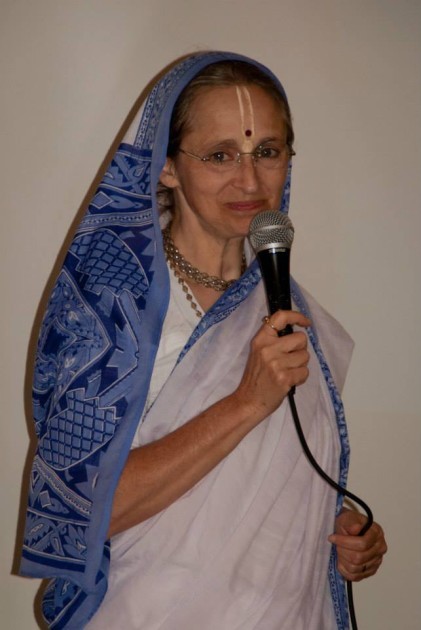
Key Note Speech – Jewels in our Backyard
by Urmila devi dasi
Her Grace Urmila devi dasi, a disciple of Srila Prabhupada, with decades of experience in education in ISKCON, and a PhD in education, gave the Key Note speech to this year’s Education Conference in Radhadesh. She was also one of the main organizers of the event.
Urmila devi dasi urged all participants to think about what their goals are, especially their goals related to education. Since all participants are somehow engaged in education, what would education in one’s own city or yatra look like in its perfected form? Urmila devi dasi warned us regarding the dangers of focussing on the negative. When we feel that our needs are too big or too many, our project seems impossible. However, a lot of what we need actually already exists. It is more a matter of connecting with what is already there. Drawing our attention to some of the issues that make it feel impossible, Urmila devi dasi mentioned that, in ISKCON, we often simply don’t connect with others. Relating to her own experiences of connecting, she explained that these connections can be very enlivening and practically helpful. In Mumbai, for example, many devotees sat in one room to talk about school administration, sharing resources, sharing human resources, sharing experience, etc. Sometimes, resources can be obtained from people who are not at all engaged in education. Maybe someone else has done it in a different way or language, but that does not mean it cannot be used for our own project. Have we looked outside of ISKCON for resources, such as Gaudiya Math, Christian Church, or the secular world? There was a time when ISKCON looked down on academics or non-devotees. However, Urmila devi dasi explained that she has received resources of good quality for free by professionals outside of ISKCON, especially from educators.
The kind of people we need to connect with are people with “people networks”, some people simply know a lot of people. All one has to do is find that person and one is connected with that whole network. Then there are people who are resource persons. Urmila devi dasi called these “the cosmic librarians”. One has to build a collection of resource people, because they tend to collect within their own field. At the same time, we also need to go beyond that and be able to look at the Ministry. It would be wonderful if it could function as a resource and information centre.
Maybe the Ministry can also provide validation and support. This can sound scary, but there seems to be a need for such validation, since many devotees ask about the quality of different education projects. Without a procedure for validation, how can we provide an answer based on more than just our own feeling or experience? For now, this question usually gets answered through gossip. Yet, we are all a little nervous about being evaluated like this by a neutral party. However, it would be healthy to learn about our areas of strength, and our challenges from a professional and neutral perspective. In this way, the Ministry can aid the different projects.
In conclusion, Urmila devi dasi asked all participants to make a list of their needs for their projects, so that everyone is prepared for the sharing exercise later on.
How the Jesuits Expanded Their Mission through Education and Higher Values
by Yadunandana Swami
His Holiness Yadunandana Swami first expressed his gratitude to the organizers of the Conference. Even though not many educators could make it, due to the late notice, Maharaja was very happy to see it happen. He stressed that quality is at least as important as quantity.
Maharaja asked the audience how many temples ISKCON has worldwide. And compared to that, how many colleges, primary schools, or secondary schools do we have? To find an answer to how we could change this, Maharaja looked to the Jesuits. Maharaja gave an account of how St. Ignatius of Loyola founded the “Company of Jesus” (Jesuits). Ignatius first studied at university in order to prepare himself for his mission. He started a College twelve years after founding the Jesuits with some of his friends. Today, there are 231 Jesuit universities, 462 secondary schools, 187 primary schools, 70 technical institutes worldwide, and nearly 3.000.000 students. The main purpose of the Jesuits is the salvation of souls, for which they primarily use education. In establishing themselves worldwide, they did not try to impose their own cultural values, as the Europeans did. They transferred their values in a way locals could relate. One of the pioneers in China dressed as the Chinese scholars and learned the language and taught in a relevant way to locals. Sometimes, the Jesuits were persecuted because of the ingenuity they used to adapt to embrace a changing world.
Yadunandana Swami connected the example of the Jesuits and the way they connect education with missionary work and community development, with what ISKCON could do. The Jesuits network with the communities and thus reach out through education. How much is ISKCON doing this? We see the example of His Holiness Sivarama Swami, who has made steps to integrate the mission into the community through education. Now, also the Goloka foundation is taking initiative in this direction, but it needs to be developed more. Maharaja concluded by saying that systematic education is essential to preserve Srila Prabhupada’s legacy. As long as ISKCON does not develop a sound, concrete, and practical educational strategy, ISKCON’s missionary work and Community development will remain incomplete.
Teaching Sastra so as to be Relevant to Individual Students’ Lives
by Krishna Kshetra dasa
His Grace Krishna Kshetra dasa started off by having the group brainstorm about what kind of associations we make with “relevance”, and he suggested two overarching principles in finding relevant ways to teach sastra, Religious Reading and Life Writing. Paul Griffith contrasts “religious reading” (repeatedly going back to one’s reading and finding new lights as one does this) with “consumer reading” (looking for what one can get from the reading and never reading the same material again). Many educators want to instil this notion of reading in students. However, it will not make sense unless we find how the reading is relevant. Sometimes, in consumer reading, we end up losing the point. There used to be a culture of reading and remembering philosophy, lila, and so on.
One starts with reading the story, sravanam. Then, with sravanam comes some kind of remembering, retention of the content, mananam. As guide, you can draw out some hypothetical questions. This means, creating some discussion where the students think about what would I do or think if I were there. Discussion can inspire interesting topics and bring out incomplete knowledge about the situation. It depends on the age of the students how much of this can be articulated. Further mananam is to identify which part of the lila one likes or dislikes, identifies with, would like to relate to others, etc. The last part of this process is called nidhidyasanam, internalizing the story.
At this point, Krishna Kshetra dasa explained the second of the two principles, namely Life Writing. This is any kind of writing about life, like a journal or a blog. The two principles combined, religious reading and life writing, could bring a very rich and powerful experience that brings one to realisation. For example, one could write a few lines of dialogue in case you were the demon, or any other member of the story. Writing dialogue can be great fun and then of course be performed as well. For younger students, it might be more interesting to perform. After this, one can relate this again to one’s present life, or particular situation. To recount in the third person can be easier than in the first person. Otherwise, it might be too confessional. That detachment may help to think about oneself as an observer. And then relate that again to the original story.
Creating New Learning Environments by Using Innovative Methods of Teaching
by Raghupati Dasa
His Grace Raghupati dasa commenced his presentation by expressing his appreciation that, after fifteen years of silence, the yearly education conferences are taking place again since 2012. After a brief introduction to the topic he wanted to discus, Raghupati dasa asked the participants to reflect upon the kind of teacher they think they are. The possible answers he provided for this exercise were: law enforcer to the potentially criminal, carer to the vulnerable, salesperson to potential buyer, preacher to the sinful, sheepdog to sheep, website to surfers, gardener to plants, and tour guide to tour bus. Several issues came up while reflecting upon this. This role depends on the audience one has. We sometimes take more than one role, different roles for different individuals in the audience. Raghupati dasa continued on to say that also one’s dress and environment help determine the kind of role one takes. There are many external identifications one accepts according to one’s roles.
Next, Raghupati dasa asked the participants to answer the following questions in relation to what teaching and learning mean for themselves, in pairs: What do you believe? What do you feel strongly about? What are your priorities? What is your instinctive feeling? Raghupati dasa then explained the Kolb cycle, going from having an experience to planning the next steps. He also urged the educators among the participants to become learner centred in case they were teacher centred. Instead of being teacher centred, we should be learner centred. To encourage this, Raghupati dasa gave some examples for making the teaching/learning experience more interactive, and asked participants to share what they will do to create a new learning environment in their classroom.
Making E-Learning Work: Case Study Based on Bhaktivedanta College
by Dina Dayal dasa
His Grace Dina Dayal dasa introduced us to the online learning program of Bhaktivedanta College Radhadesh. Since many of the participants were already familiar with online education, he presented some of its history, in general and at Bhaktivedanta College.
The first time any course was offered anywhere online was in 1989, with eight graduates. In 2011, 355 000 students graduated online. At Bhaktivedanta College, we had 26 online students in 2011, and 186 online students in 2014. The main differences with offering courses onsite are in Place, Time, and Interaction. Speaking from personal experience, Dina Dayal dasa, warned against overloading one’s students. Students get frightened by work-overload and tend to leave the program. Furthermore, one should not overlook the importance of real-time contact between tutors and students. At the same time, his experience is to guard against too much personal e-mail interaction with one’s students, he feels it is better to push forum discussions. Nevertheless, daily reminders or small motivating messages are good to keep students on track. Challenges in teaching online are mainly in regards to the difference in time zones between and with students, and the lack of personal contact with students. The tutor tends to spend a lot of time with students individually, addressing their often synchronous questions through personal e-mails. Additionally, it also seems harder to engage silent students, or know how they are doing. Through the medium of webinar classes, where there is direct contact between all attendees, part of this issue can be resolved. Students have expressed challenges regarding self-discipline due to a lack of support and association with peers, which is naturally there when students reside on campus.
Regarding the amount of students, Dina Dayal dasa explained that if one has masses to appeal to, one easily gets clients. However, what Bhaktivedanta College offers is not for the masses. However, we experience that when there is some endeavour in marketing, the results come. Students who get attracted to Bhaktivedanta College Online Courses (BCOC) are mainly female, married, in their late thirties, with children, often from the USA, living in big cities, middle class, and initiated.
How Centro Studi Bhaktivedanta Educational Programs Specifically Assist Prabhupada’s Mission of Forming a Society
by Matsya Avatara dasa and Ananta Deva dasa
His Grace Matsya Avatara dasa and Ananta Deva dasa introduced us to the Centro Studi Bhaktivedanta (CSB), which has a huge impact, especially in Italy. It was founded by Matsyavatar dasa (ACBSP) in 1995. It is a non-profit cultural institution, recognized by the Italian Government. Its Academic Department of Traditional Indian Sciences collaborates with several Universities, Institutes, Colleges and researchers worldwide. However, its degrees of MA and PhD are not yet accredited. The degrees they offer stand on their own. Their program is meant to build a cultural and spiritual bridge, a bridge of language and civilization between two worlds, the Western one with its major representatives and the one of the Great Vaisnava Acaryas, by trying to fulfill one of Srila Prabhupada’s main requests, the spreading of Krishna Consciousness in lay society through culture, organizing public events and Courses in universities, hospitals, cultural centers, economical, scientific and artistic institutions. It is therefore aimed at the general public, not only specifically at those who have already made a religious commitment. CSB Courses have already lead hundreds of people to the study of Krishna Bhakti and of Srila Prabhupada’s books and dozens of them to undertake initiation life in our Guru-Parampara. CSB is introducing Srila Prabhupada’s teachings in important cultural institutes and university faculties through hundreds of lectures and conferences all over Italy, explaining Gaudiya Vaisnava Philosophy, Psychology and Spirituality in a scientific language that also scholars can appreciate and feel comfortable with.
CSB organizes seminars (generally two-day seminars) all over Italy. These seminars are attended by 50-90 people each time and are dedicated to an intensive study of Vaisnava tradition and Srila Prabhupada’s teachings in all their sociological, psychological and philosophical aspects. However, it is especially through the residential seminars, generally attended by two hundreds people each time and offering a full and intense week of study and sadhu-sanga, the participants get the chance to taste practically the main aspects of sadhana bhakti: mangala arati, japa, Srila Prabhupada’s books, prasadam and so on. During these retreats many people have started their spiritual practices and have became devotees.
The Meaning of Oral Tradition in the Context of Personalism
by Maha-vidya devi dasi
Her Grace Maha-vidya devi dasi introduced us to the importance of the oral aspect of teaching. She asked the attendees to meditate on the importance of how one addresses someone in terms of enhancing personalism. For example, buying some stamps at the post-office. In the West, we have procedures for everything, we do not encounter the persons behind the procedures, we encounter the procedures. In India, there is no such thing as procedures. You are just constantly dealing with the particular person and their mood. In this context, Maha-vidya devi dasi looked at our education and teaching, because it is easy to get stuck in procedures as well for Westerners. But we have to remind ourselves that we are dealing with a person. We have to come back to the personal level.
Maha-vidya devi dasi then gave the example of Plato, how all he left was dialogue, an oral act. According to Plato, wisdom can only happen through dialogue. Looking at the Vaishnava tradition, we can recognize the same in the Srimad Bhagavatam. The invention of letters is, for Maha-vidya devi dasi, one of the greatest inventions. Letters are a support for memory. The first written testimony of European civilization is receipts, for sheep and wine. These are not really very important to remember. What was important to remember was kept in the heart. Plato was mostly concerned with “sophia”, wisdom. However, wisdom is only possible when the subject is properly understood. Even when there was extensive literature, they read it aloud in the circle of students, and then discussed. Derveni Papyrus, X 1-8, said:
“For it is impossible for one who does not utter to say; and (Orpheus) deemed say and utter the same thing. Say and teach have the same sense; for it is impossible to teach without saying the things that are taught by means of words; and teaching is deemed to be a kind of saying. So teach was not distinguished from say and say from utter, but utter, say and teach have the same sense.”
From the Caitanya Caritamrta (Antya 7.53), we learn that one has to serve a pure Vaishnava in order to understand transcendental topics. It is difficult to grasp the meaning and context of the narrative without someone’s guidance. Maha-vidya devi dasi questioned whether we actually know what the popular term “realised knowledge” means. Kala-desa-patra (time, place, and circumstance) is the main consideration for applying book-knowledge. Nobody could find his way on his own according to time, place, and circumstance. In our own practice and lives we can see that personal adjustment is constantly needed.
In conclusion, Maha-vidya devi dasi encouraged the attendees to reflect on the elements that could enhance our attitudes and understanding while trying to convey messages.
Teaching Dharma in Religious Studies; Looking into Ancient Histories through Contemporary Arts and Media
by Bhakti Rasa dasa
His Grace Bhakti Rasa dasa expressed his gratitude and happiness for being able to attend the conference. He addressed the group on the subject that he discusses in his PhD application, namely dharma in the vehicle of the Indian epics. Bhakti Rasa dasa explained that an important part of his research work is determining who Dharma is as a person, and which dharma is discussed when. Dharma is multi-layered and can be described differently by various translations of the word. One of the questions Bhakti Rasa dasa wants to address is whether this pre-secular idea of dharma can contribute to the post-secular idea. In order for dharma to be relevant in the post-secular era, one also needs to consider what is accepted as religious education in different countries. Do we look at Ramayan, or Mahabharat, or the Puranas? What combination is best suited for western colleges and university audiences? Since this is the audience Bhakti Rasa dasa has in mind, it is important for him to focus on them in determining how to present his subject. He also wants to find contemporary ways to present these epics, so that the principles presented are relevant and can be applied in students’ actual lives.
After thus introducing his topic, Bhakti Rasa dasa then took the audience on a journey, a short listening experiment. He presented a five-minute segment of radio, which was broadcast earlier this year on BBC4. It was a section of Ramayan, set in modern India. The approach of the writers and readers was neutral regarding the divine identity of the characters. After listening, the attendees were requested to write about which features of dharma could be illustrated through such hearing experiences, and whether or not they found this presentation of Ramayan at all acceptable.
Short, Medium, and Long Term Goals of MoE, and Moving Ahead with Serving Educational Initiatives in Europe
by Ramgiridhari dasa
Speaking in name of the Ministry of Education, His Grace Ramgiridhari dasa brought an enlivening and encouraging mood to the conference. There are more than two hundred and fifty thousand children in our movement, but not even 5% of our children attend our own educational institutions. During a meeting of the ministry in October, the members of the ministry decided to again take on the name Srila Prabhupada had given the ministry, namely Ministry of Education. The first concern of the Minister of Education, Sesa dasa, is to set up a team to do strategic planning. During the many brainstorming sessions that already took place, the ministry set up a framework for how the ministry can globally function more efficiently, and determined three goals for the near future. Firstly, we need to consolidate the identity of the Ministry through one-on-one meetings with, and conferences such as this for educators in ISKCON. Secondly, we want to connect educators and educational initiatives worldwide. Ramgiridhari dasa invited all attendees to contribute towards this. And thirdly, to provide some supervising support for the development and execution of educational plans and projects. It is not the intent of the members of the Ministry of Education to interfere, but to facilitate. The most important way to facilitate now is to dig up the jewels in our own backyard, to bring educators and their resources together.
After this short but powerful presentation, Ramgiridhari dasa asked for input from the attendees regarding whom could be asked to become the European regional representative for the Ministry of Education. At first the discussion focussed on which countries are included in “Europe”. The discussion then moved towards the qualifications needed for being the regional representative. Funding, and support from the GBC were also hot topics, and specific suggestions of candidates for the role of regional representative were made. This discussion continued the next, and last day of the conference. Plus, the different attendees shared their own needs and offers in regards to their education projects or plans. This was found to be an inspirational and practically very useful session. The process of sharing resources among educators and educational institutes that the Ministry of Education has as one of its goals had successfully started.
Available EU Funding and Grants
by Dasaratha Suta dasa and Mukunda dasa
Even though the presenters were not physically present, and there had been some technical issues, this session was well received. Through Skype and by showing some introductory videos, Dasaratha Suta dasa and Mukunda dasa gave an overview of the possibilities of EU funding for the ISKCON Ministry of Education, and the different education projects run in Europe. It was an eye-opener for many attendees and lots of discussion followed, both with the presenters, and among attendees afterwards.
Presentation of and Brainstorming for Specific Projects
His Grace Ananta Deva dasa elaborated upon Centro Studi Bhaktivedanta (CSB). He explained in more detail what their BA, MA, and PhD programs entail and what courses they have developed for these spiritual degrees. He also expressed the desire to see these degrees accredited by established universities, so that they may also receive recognition by society at large. While most students attend these courses with the aim of self-improvement, and not to obtain a degree, it would still be advantageous if these degrees received some accreditation. Several attendees of the conference expressed their amazement at the vastness and depth of CSB, and their appreciation for having carved out a career path within ISKCON. Independent of accreditation, CSB is offering something important to ISKCON, and society at large. Attendees wondered if this model could be replicated in other countries.
His Holiness Yadunandana Swami presented the education institute he is setting up in Spain, mainly in Nueva Vraja Mandala. The farm is becoming a wonderful place for sanga and education, whereas it was up for sale until recently. Sastric courses and weekend retreats have been the main focus of the institute. Moreover, now the organizers are thinking of organizing festivals as well, since the Spanish love festivals. So far, there are not many students for the residential courses, but even those few students give life to a place that would otherwise be empty. For half of the planned courses there are enough applicants, the other half we have to cancel. Many of the courses on offer this year are designed based on the needs expressed by the local leaders. The concept is working out well and we have started to offer similar courses in other Spanish city temples, such as Madrid, Malaga, and Barcelona. The courses are tailored to the local needs of those temples. The desire is to ultimately reach out to all of the fifty ISKCON centres in Spain.
Metaphors and Stories
by Urmila devi dasi
Building on Maha-vidya devi dasi’s discourse on the invention of letters and the need for personal communication, Urmila devi dasi gave a presentation on metaphors and the power of stories. She started off by giving the example that some powerful and very qualified devotees were quarrelling and thus not being very effective in their service. Urmila devi dasi addressed the problem by narrating a metaphor, when people do not row a boat in harmony; they go in circles and get nowhere. Instead of addressing what each person was doing wrong, this metaphor effectively addressed the issue without hurting or offending anyone. Urmila devi dasi explained different scenarios in which people come to us for guidance, or help, or we feel the need to help someone without being solicited by them. These different approaches to helping someone are efficient in different ways for different scenarios. Metaphors can be a useful tool in most of these approaches. We can also see that they are present in Krishna’s pastimes. Aside from Krishna being a real person and the pastimes having actually happened, there is also a metaphorical understanding for, for example, the demons. Metaphors bypass the false ego, and engage people. One goes into a light trance. The deeper the trance, the more the mind sleeps and the intelligence becomes more active. Stories can turn over culture. As one is exposed to stories, sometimes in the shape of movies, stories change people’s opinion. Opinions do not change because of logic or facts. Abortion, homosexuality, the ecological movement, all these paradigms change through stories, very quickly! Another interesting phenomena is that when you are listening to a story, your body is also active, you are practicing the values and behaviours portrayed by the characters in the stories. That is why the media is full of stories.
The idea that fiction is not true and non-fiction is true, is false in Urmila devi dasi’s opinion. Some fictional stories that did not happen in time and space teach truth, and the other way around. Scripture is also full of stories. The frame of the Bhagavad Gita and Srimad Bhagavatam are stories. Srimad Bhagavatam is a good example of how to use metaphors or a story within a story, within a story. Layering stories is one of the most powerful ways of using a metaphor, because it even further removes the story from the person you are talking to. Thus, it is even less threatening. One can either look for a true historical story, or create one’s own metaphor. Acaryas regularly use stories and metaphors. The reason we all enjoy stories is because Krishna enjoys them too. Rasa is made of stories.
Concluding Words
by Sesa dasa
His Grace Sesa dasa, the ISKCON Minister of Education, thanked all organizers and participants to the Education Conference 2014. He said he had given up hope that it would happen this year, but then Urmila devi dasi, Maha-vidya devi dasi and Ramgiridhari dasa bravely stepped forward. He felt that a difficult page has been turned for the Ministry of Education, the conference was not put off anymore when the organization became difficult. Uniting educators and education projects is important for the entire society. Sesa dasa is now on the executive committee of the GBC, and sees that there is a great need for an educated body of devotees. For several issues it has become clear to Sesa dasa that, in order to understand these issues, in order to analyse them and solve them, we need an educated populace. We will not be able to do it if the devotees are not educated. You think education is expensive, try ignorance. Things will be perpetuated that will hold us back. Therefore, he wants to encourage educators and managers. We need to be able to send our people for training and education. Not that we just educate outsiders. Sesa dasa truly hopes that these conferences can inspire and encourage those in the field.
Thank you, Maha-vidya devi dasi, for inviting and informing attendees. This gave us hope to take it up. Thank you to all participants for coming and sharing. Thank you, Urmila devi dasi, for putting together a program and organizing the speakers. Thank you, Sridama dasa, for organising the arrivals and funds. Thank you, Sesa dasa, for donating 1000 dollars for this conference.
For the other reports: http://bhaktivedantacollege.com/report-for-education-conference-radhadesh-bhaktivedanta-college-may-3rd-5th-2014/