
By Dusyanta dasa
If there is one food that represents the fullness of the mode of goodness, the Earth, the Moon and our mother cow it has to be Ghee or mother Ghee. Many of us who experience ghee just do so by opening a tin of ghee purchased at the market store. But how many of us really think about this product and how it came to be in this tin in this form. For devotees who are aspiring to live the “simple” lifestyle influenced as much as possible by the mode of goodness then our food becomes of prime importance to healthy living. And the way it is grown and manufactured or processed even more important.
Of course oils and fats are essential for a balanced diet, and cold pressed olive oils and clarified butter (ghee) have been around for millennia. But today’s highly processed refined oils are a far cry from those original fats. Because we live in a capitalistic influenced world then commercialised, not healthy foods are produced for the supermarket shelves. The key word in supermarketism is “shelf” life not health life. Starting off with genetically modified, violently fertilised, chemically grown oil seeds, the refinement that oil seeds undergo is a transformation into a devitalised stripped non-food. The 6/7 stages of oil seed refinement strips out all the original goodness to leave a smooth, odourless, fluid that is translucent and lives on a shelf indefinitely. Cooking with this product is the antithesis of Vedic health care and can actually be positively harmful, especially if it is used repeatedly for deep-frying.
If like some devotees of today you follow a vegan diet then you are subject to using these highly toxic oils. The only way around this for a vegan is to use cold pressed/virgin olive oil, unless you make all your own cooking oils! By following the authorised Vedic and Ayurvedic dietary plans the dairy product from cows such as ghee is far superior to the modern refined and processed oils of today. In fact all you need is the mode of goodness to convert grass to milk via the protected cow, then by churning the milk to convert to butter, and then a simple wood burning cooker to produce ghee.
The production of processed, commercialised refined oils is highly complex, using different petro-chemicals and industrialised techniques that are not available to the general public. And in this case a solvent called hexane is used to “bath” the seeds in to help extract the oils. Using refined oils therefore does not come under the umbrella of mode of goodness simple living. Actually the usage of refined oils for butter substitutes such as margarine and soya spreads are so industrialised it is not possible to produce them in the mode of goodness. The commercial production of today’s oil seeds is one of genetically modified, chemically sprayed and mechanically harvested and then carbon transported before it is brutally processed and refined into a nutrient stripped, human consumable. Such an unsustainable product.
Devotees who have never imbibed the “simple living” philosophy and the mode of goodness influence in food and diet have never really got to grips with the whole yogic way of eating healthy food. Wholesome food is produced from wholesome soil using organic manures from cows and in this way the fresh, daily produce for a balanced diet provides all the necessary nutrients for vital growth and health. For example here in Wales there are numerous water powered stone grinding grain mills where the germ of the grain remains intact as a healthier whole food rather than the pressurised and high temperature steel roller process that strips out all the goodness from “milled” grains in the commercial market. It’s not just important to grow wholesome food but to process it where necessary in a wholesome sustainable way. But on the subtle level fresh vegetables, fruit, milk and grains also feed the life airs with Praana, which merges with the bodies’ life airs for rejuvenation and energetic needs as well as medical needs. That’s why food has to be fresh. This helps support, and nurtures the natural immune system for longevity, anti-ageing and anti oxidisation.
For the devotee to encapsulate the healthy mode of life means to operate a mode of goodness lifestyle. In other words a diet of fresh food, grown wholesomely, picked, prepared and cooked and offered within hours on the same day before consumption; self-sufficiency. This should be the standard for kitchens cooking for devotees; it’s the application of the mode of goodness. Grow it, pick it, cook it, offer it and eat it. That’s our motto. And this harmonious dynamic maintains our connection to our homegrown food. Once you have tasted and connected to homegrown food you will never want to buy old market sold bhoga again, not knowing its origins, how old it is and how it was grown.
One of the benefits that mother ghee offers is that she is not only a cooking medium, the very best, but also a medicine in many ways. The proper ingestion of ghee will prolong our life and keep us young and energetic. But there is a caveat to understanding the mode of goodness ghee. When we talk about the mode of goodness ghee it means how to obtain mode of goodness milk from grass eating cows where there is no trace of chemicals, fungicides, pesticides and herbicides, where the proper process of culturing whole milk by yoghurt enzymes is employed and where the real process of churning is also used to make the butter from whence ghee is made using mode of goodness heat.
So there are a lot of processes involved and a lot of mode of goodness qualities needed. But all are accessible and practicable, unlike the commercialised and industrialised modern cooking oils of today. So to start at the beginning of the process;
Milk for proper ghee is obtained from cows that eat only fresh green growing grass. Once you introduce herbicides, pesticides and chemicals and artificial synthetic fertilisers, the contamination in silage, hay, grains and vegetables and fruit is passed on to the milk. Fields located close to busy roads also pick up a lot of pollution so rural places are better. Commercialised organic fertilisers are contaminated in the same way but also with the violence of dead animals that makes up a good percentage of organic fertiliser. Any contamination in milk is magnified in the ghee because ghee is concentrated milk and the contamination in milk becomes concentrated. Another important aspect of collecting milk for ghee making is that cows eating exclusively with grass is affected by the waxing and waning of the moon which directly affects growing herbaceous plants.
B.Gita, As It Is 15.13. … “I become the moon and thereby supply the juice of life to all vegetables.”
Purport by Srila Prabhupada… “Similarly, it is due to the Supreme Personality of Godhead that the moon nourishes all vegetables. Due to the moon’s influence the vegetables become delicious. Without the moonshine, the vegetables can neither grow nor taste succulent…. Everything becomes palatable by the agency of the Supreme Lord through the influence of the moon.”
Once the cows are put on to a diet that excludes fresh grass ie, hay, silage, haylage, vegetables, grains etc. then the milk produced is better used for other products but not ghee. So this would dictate the making of ghee to the spring, summer and autumnal months in colder climates. Ghee tastes succulent because of the moonshine in the fresh green grass. And as long as the grass has been managed through grassland management in the correct way the grass will always appear lush, green and leafy, not with stems or seed heads. .
The process of “pasteurisation” and “homogenisation” is a modern industrialised language that only sounds good but actually when the milk is heated to 161degrees or up to 200 degrees F a lot of the original nutrients are also lost. After being treated at 200 degrees F the milk can be stored at room temperature and requires no refrigeration, as it will store for weeks not days. It won’t go off because there is nothing left in the sterile milk to go off. Its just white water now. In the making of skimmed milk powder the liquid milk is forced through a tiny hole (extrusion) that oxidises the cholesterol in it. Natural cholesterol is a good friend but not oxidised. And guess what, they add milk powder back to skimmed milk to replace the fats they removed by skimming. And this milk powder contains oxidised cholesterol, which is particularly bad for heart problems, so what you think is good for you by drinking low fat skimmed or semi-skimmed milk is actually the worst. So much for modern commercialisation and undoing nature’s bounty of good wholesome fresh un-pasteurised milk.
In today’s highly commercialised mentality the milk /cream is not churned any more. No in today’s society, the butter is made by the extrusion method. Many foods are made in this way because it is commercially viable, not because it is healthier. So by this extrusion method the resultant butter has lost all its qualities of goodness. The molecules of fat in the milk are bombarded by high temperatures and extremely high pressure which makes the original product lose all its subtle qualities needed for healthy living and the resultant butter is a dead food. So if you have to buy butter make sure its churned butter by reading the information on the packet. If it doesn’t say its traditionally churned butter then you can assume it is extruded butter. Also you must avoid butter that has salt added otherwise the ghee loses its natural succulent taste.
If then we use this extruded butter to make ghee then we just lose even more good qualities that should be in the ghee and the resultant toxins left in the butter become magnified in the ghee. The extrusion method of making foods today is the same across the board. It’s used in juices, grains, oils, breakfast cereals and sugars. And a whole host of other products. So for devotees wanting to live the mode of goodness lifestyle they need to obtain genuine milk from grass eating protected cows at the right time of the moon. Then by using the holistic method of mixing yoghurt and whole milk, by churning to make butter and buttermilk. By finishing off the process by using your hands then the butter is able to obtain those energies from your hands as nature intended rather than a vast metal machine working at high temperatures and huge pressures in a ridiculously noisy industrialised and sterile environment that makes the modern so-called cooking oils and spreads and foods. You know the factories where they all walk around in funny nets on their heads with blue outfits and white wellies and its all stainless steel machines, really impersonal food factories. Commercialised food factories.
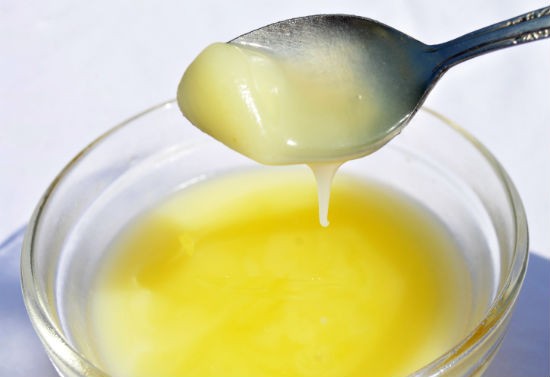
We make milk into butter into ghee by hand with just a churn and then a wood-burning cooker; it’s a peaceful wholesome activity with just a few crackles coming from those well-seasoned logs. It’s a harmonious ambience. If there are two of you making ghee you can talk about Krishna and His cows. This is how we employ the mode of goodness lifestyles into our lives. Because the mode of goodness is just one step away from pure goodness we are living a very sensitive subtle life that is feeding our body, minds and spirit. And we feel that wholesomeness throughout our existence. Once we have made our proper butter that will be fairly yellow in appearance, from the Vitamin K in grass-eating cows, the next step is to make ghee. On to the mode of goodness again where we use wood heat. If you have ever made Burfi on a wood burning cooker with raw wholesome milk you will remember it as the best Burfi you have ever made and tasted. And once you have made ghee from wood burning cookers you will never buy that stuff that is called ghee from tins again. The quality is incomparable and this ghee is what they refer to in scripture when they talk about ghee.
S.Bhagavatam, 8.8.11. Purport by Srila Prabhupada, Founder Acharya of Iskcon.
“ Panca-gavya, the five products received from the cow, namely milk, yoghurt, Ghee, cow dung and cow urine, are required in all ritualistic ceremonies performed according to the Vedic directions. Cow urine and cow dung are uncontaminated, and since even the urine and the dung of a cow are important, we can just imagine how important this animal is for human civilisation. Therefore the Supreme Personality of Godhead, Krishna, directly advocates go-raksya, the protection of cows……..”
The execution of Vedic ceremonies such as Initiation, Second Initiation, Weddings that require the Panca-gavya products from protected cows means we have an axiomatic universal instruction for all devotees to engage comprehensively and participate fully in cow protection. How does a vegan who wants Initiation or Marriage participate in a Vedic ceremony without protecting cows to obtain these five products? Are they going to pour contaminated cooking-oils over the fire that represents Vishnu? Or are they going to support the dairy industries violence by using those dairy products for the Agni-hotra? Here is a great example at the very core of the Hare Krishna movement where the cow is a quintessential participant. Without cow protection how is it possible to perform the Agni-hotra ceremony for Initiation? Another keen example of why being a vegan is at odds with cow protection. Unless all devotees support cow protection, including vegans, then when we perform the Agni-hotra with those five cow products we support cow slaughter. Cow protection is intrinsically inherent in Vaisnava life, period.
There is a massive list of qualities that ghee has inherent in its composition and for mode of goodness devotees that are trying to imbibe that lifestyle it is well worth looking into. And once you have learnt this beautiful, caring art of living, then healthy, energetic and youthful life is accessible. It becomes a second nature and it’s not as complicated as it may seem to start with. For devotees the simple life is theirs for the taking and for devotees this simple lifestyle is necessary to help us come closer together as a community and as dependants. If we don’t nurture our legacy that we have inherited to live that simple lifestyle then we just plug into the capitalistic way of life or some grey mish mash in-between.
The simple way of life is intriguing and mysterious, the mechanistic influence of capitalism that hammers you right in the face with its grossness that takes you away from subtle material life and then from eternal spiritual life answers to no one. We should be taking this communal simple living where we get the benefit of wholesome, nurturing subtle mode of goodness lifestyle that is harmonious with nature. Our cows should be healthy, grass eating, milk producing participants in our community so we relate to them by natural symbiotic dependency on a personal level. They just need a simple Goshalla, real animal husbandry and loving relationship within the community dynamics right at the heart of the village. The Deities and the cows are the centre of our communal lifestyle because we worship them both. And this culminates in the quintessential production of mode of goodness ghee. Ghee that is used in cooking, used in medicine, and ghee that is used in Vedic ceremonies, and ghee that is suitable for all devotees.