
Sankirtana Das: A recent article in the Op-Ed of the Dec 8 New York Times entitled “Know Thy Self – Really” by Quassim Cassam, philosophy professor at the University of Warwick, UK., asks “How do you know you believe you are wearing socks?” and explores the conundrum of many philosophy professors that their work is of no relevance to the human condition. He continues by stating that “Knowledge of such beliefs is seen as a form of self-knowledge.”
The noble professor tries to elevate the discussion in saying, “What is missing from this picture is any real sense of the human importance of self-knowledge. Self-knowledge matters to us as human beings, and the self-knowledge which matters to us as human beings is substantial rather than trivial self-knowledge. We assume that on the whole our lives go better with substantial self-knowledge than without it, and what is puzzling is how hard it can be to know ourselves in this sense.”
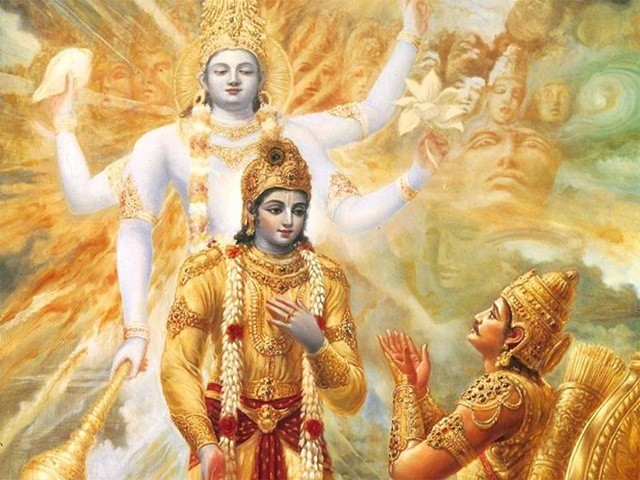
Professor Cassam, however, sees the question about the socks as trivial self knowledge rather than substantial self knowledge. But real self knowledge can never be trivial. It’s always substantial, because once we understand ‘self’ we can understand our relationship to every thing around us. It’s all about posing the right questions. The Bhagavad Gita explains that we can’t come to self knowledge if we mistakenly think that our mind or our body is the self. In the Gita, Arjuna asks, “What happens to a philosopher who becomes confused or gives up the path of self knowledge. It seems that such a philosopher will achieve neither spiritual nor material success.” Krishna responds, “A philosopher who asks beneficial questions and is engaged in beneficial activities will not meet with failure, for one who does good is never overcome by evil.”
At this point Krishna helps us to distinguish between matter and spirit. He explains that we need full knowledge, both physical and metaphysical to draw proper conclusions. And that which is comprised of earth, water, air, ether, mind, intelligence and false ego make up the lower, material energies. And the living being, comprised of life force, is part of the superior, spiritual energies. This distinction is a vital step toward self knowledge. We first have to know who the self is and know what the self is not, otherwise all discussions on the topic will be flawed. If I could I would like to assure the professor that self knowledge is not as hard to obtain as one might suspect.
“One who understands this philosophy concerning material nature, the living entity and the interaction of the moods of nature is sure to attain liberation. He will not take birth here again, regardless of his present position.” Bhagavad Gita 13:24
For info on my award-winning book visit www.Mahabharata-Project.com