
 Date: March 1, 2008
Verse: Srimad-Bhagavatam 3.13.8
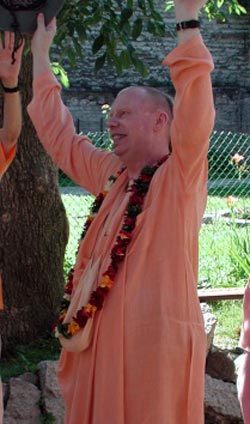
Speaker: HH Bhakti Caitanya Swami
By Ananda Tirtha (das) PVS (Mayapur – IN)
You can download the audio file from here
or start the player below to listen
____________________________________
tad vidhehi namas tubhyam karmasv idyatma-saktisu
yat krtveha yaso visvag amutra ca bhaved gatih
TRANSLATION: O worshipful one, please give us your direction for the execution of duty within our working capacity so that we can follow it for fame in this life and progress in the next.
PURPORT: Brahma is the direct recipient of Vedic knowledge from the Personality of Godhead, and anyone discharging his entrusted duties in disciplic succession from Brahma is sure to gain fame in this life and salvation in the next. The disciplic succession from Brahma is called the Brahma-sampradaya, and it descends as follows: Brahma, Narada, Vyasa, Madhva Muni (Purnaprajna), Padmanabha, Nrhari, Madhava, Aksobhya, Jayatirtha, Jnanasindhu, Dayanidhi, Vidyanidhi, Rajendra, Jayadharma, Purusottama, Brahmanyatirtha, Vyasatirtha, Laksmipati, Madhavendra Puri, Isvara Puri, Sri Caitanya Mahaprabhu, Svarupa Damodara and Sri Rupa Gosvami and others, Sri Raghunatha dasa Gosvami, Krsnadasa Gosvami, Narottama dasa Thakura, Visvanatha Cakravarti, Jagannatha dasa Babaji, Bhaktivinoda Thakura, Gaurakisora dasa Babaji, Srimad Bhaktisiddhanta Sarasvati, A.C. Bhaktivedanta Swami.
This line of disciplic succession from Brahma is spiritual, whereas the genealogical succession from Manu is material, but both are on the progressive march towards the same goal of Krsna consciousness.
________________________________________________________________________________
(Invocatory prayers)
Bhakti Caitanya Swami: So Svayambhuva Manu and Satarupa, his wife, are requesting direction from Lord Brahma, perhaps more particularly in terms of their service as progenitors. Svayambhuva Manu is the father of mankind. All of humanity is coming from him and Satarupa. Indeed it is said that this term man, or human, even has it roots in the term “manu”.
This is the basic idea that, “We have to produce population as a service to you so you please, guide us, inspire us, help us how we can do this nicely.” We know, and Prabhupada is focusing on this in the purport, that Lord Brahma is not only there for that material purpose of procreation and material development in this material world, but he is the head of our sampradaya, Brahma Madhva Gaudiya sampradaya.
Srila Prabhupada points out, not of course all the members, but generally all the main members, generation by generation through from Brahma himself who was directly instructed by Lord Krsna all the way through to Srila Prabhupada himself. It’s interesting to note that Prabhupada includes himself in the disciplic succession.
So Lord Brahma as an instructor, as a teacher, is an authority when it comes to developing the material world and filling the material world with living entities in the right way, certain things done properly and all the species come in the right way and live in the right places and the planets are there, everything is arranged nicely for all the different species in all the different situations. Lord Brahma is the authority on that, from Krsna he is empowered by Lord Krsna for that.
Even in his prayers to Lord Krsna in the 14th chapter of the Tenth Canto, following the brahma-vimohana lila, Lord Brahma makes the point that even if someone were able to count the number of grains of sand on the beaches, in the deserts and so on in the universe, and one was able to know that big number; or if someone was able to count the number of stars in the sky, that’s also a very big number; or even if someone were able to count the number of atoms in the universe, now that’s a very big job, that is bigger than the others; but even if someone were able to do all those things and arrive at some concrete figures, huge figures, still those numbers whatever they might be, billions and trillions and zillions and who knows, that number, Lord Brahma said, is not as great as the number of qualities that you have, my Lord. Not as great.
How many atoms in the universe, how many atoms in this temple room, how many atoms in any one of our bodies, this is all completely fantastic. The number of atoms in the universe, well what can we say?
But Srila Visvanath Cakravarti Thakur makes the point in commenting on this point that Lord Brahma knows how many atoms are in the universe. For us it is something totally beyond us altogether. But Brahma knows; he knows the number of atoms. And the number of qualities that Krsna has is much greater than that, inconceivable, actually it is infinite. Each quality is most extremely remarkable and most extremely extraordinary.
Even Srila Sananata Goswami makes the point in one of his purports in the Tenth Canto, in one verse Lord Krsna is referred to as gunatama, meaning that he is the embodiment of all qualities. Sanatana Goswami makes the point not only does Lord Krsna have so many qualities, an infinite number, but Krsna has for each and every single living being in existence, Krsna has one quality reserved which he only exposes, only reveals to you. And then another one only to you, and then another one. . . . so for each person. This is inconceivable times inconceivable. For every living entity there is a particular quality, most amazing, that is only revealed to that personality. So what can we say?
In terms of the material creation, Lord Brahma is the authority, and he is quite qualified and capable of instructing Manu and his wife, Satarupa, in those regards, but really the main thing is, as we can see Srila Prabhupada is focusing here, that Brahma is not only the material authority, but he is spiritual.
Here Svayambhuva Manu is making the point that, “Please guide us so that we can by your direction do our duty according to our capacity as completely as possible, so that we can achieve in this life fame, and progress in the next or in other words, so we can go back to Godhead and perfect our lives and become pure lovers of the Lord.” This is the main point ultimately, at least.
So Srila Prabhupada lists out the whole disciplic succession, at least the main members, generation by generation. An interesting little point, Srila Prabhupada says Lord Caitanya, Svarupa Damodara, and then Sri Rupa Goswami and others. Normally the one main member of the sampradaya in the particular generation is referred to, but in that generation there were lots, many very significant members of the sampradaya, parampara, who were all quite qualified to deliver that knowledge, deliver people, deliver the worlds. (Sri Nrsimhadeva Bhagavan ki jai!)
This is Krsna consciousness. This is Krsna consciousness, it comes in disciplic succession, it doesn’t come from any do-it-yourself process. In England they have these shops called DIY, “Do it Yourself,” There are many things if you get tuned in a bit, get the right gear, and go for it, then you can do it yourself, whereas normally you would have to call in somebody, the plumber or carpenter or electrician, someone who can lay the floor tiles, whatever it is, but no, you can do it yourself if you get it together. They have chains of shops dedicated to that.
But Krsna consciousness is never a DIY, or do-it-yourself process. That doesn’t mean that someone else does it all for you, but you have to take shelter of the disciplic succession, not just take shelter of anybody like some material authority or intellectual authority, but take shelter of someone or ones who are genuine members of the disciplic succession. Then they can give guidance, they can give inspiration, they can give correction. They can give correction so that then the best is drawn out of you. Your potential capacity spiritually is drawn out of you so you can also become a devotee, you can also become a lover of the Lord and a perfect person. Then you can do the same thing, you can help others in exactly the same way to bring out their most innate capacities spiritually.
This is Krsna consciousness; this is how it works. Evam parampara praptam, probably most of us are familiar with this verse, Chapter Four, Verse Two. Lord Krsna is saying previously I personally gave this knowledge to Manu, Vaivasvata Manu in that case, or previously I gave that knowledge to the sun god, and then he passed it down, also through Vaivasvata Manu. In that way the knowledge was transmitted. But Krsna says:
sa kaleneha mahata yogo-nastah parantapa
In course of time that succession was broken and the science as it is appears to be lost.
Therefore Krsna says to Arjuna there in Bhagavad-gita therefore I have appeared now and therefore I am giving you that knowledge of Bhagavad-gita again. Somehow or other, just prior to the appearance of Lord Krsna the parampara was interrupted (Sri Sri Radha Madhava ki jai!) the parampara was interrupted and Lord Krsna had to step in and Srila Vyasadave had to step in and in different ways the situation was corrected.
In Tattva-sandarbha, Jiva Goswami discusses this whole point, how Krsna appeared and how Vyasadeva appeared and the significance of “our” Vyasadeva and he refers to this verse, Chapter Four, Verse Two, how the succession was broken. Jiva Goswami says what happened was the succession was broken due to the curse of Gautama some time before Krsna appeared.
Baladeva Vidyabhusana, in his commentary on Tattva Sandarbha, refers to Varaha Purana Chapter 171 or so, and he says that how the succession was broken was that there was a big drought in the universe and everybody was suffering. Gautama performed austerities, some type of pious activities, and he got the mercy of Lord Brahma and Lord Brahma gave him the blessing that even though there was this great drought in the universe, whatever happens, in any circumstances, you will always have food.
So in Gautama’s ashram there was plenty of food even though there was a huge drought going on. So many brahmanas and rsis and sages took shelter in Gautama’s ashram and they were fed sumptuously despite the fact that there was this great drought and scarcity everywhere else. After some time the drought broke and there was rain and everything returned to normal. But Gautama had become attached to them; he didn’t want them to leave. They wanted to go home, but he wouldn’t let them leave. The Vedic standard is that when the guest wants to leave, he or she has to ask permission and receive permission. If they don’t get permission, they can’t leave. So he wouldn’t give permission. And they didn’t just say, “Well, look, sorry, we’re going anyway.” They stayed, but they wanted to leave.
So they thought, “We have to do something to create inauspiciousness around Gautama apparently. And because we are very pure brahmanas and sages and rsis, to maintain our purity, we will have to go.” They created an illusory cow and one morning they placed the illusory cow on the path to the river where Gautama would go to take bath early in the morning. And as he walked down the dark path, he hit the illusory cow. Those brahmanas came and showed him, “Look, you killed a cow! We can’t stay here, we have to go.” So they left.
Gautama was bewildered, “Me? Kill a cow? How could I do that when I was just walking down the path?” So he found the illusory cow. Then he cursed all the brahmanas and sages in the universe: “May your knowledge turn to ignorance!”
According to Varaha Purana, this is what happened and Jiva Goswami points this out in Tattva Sandarbha. This is how the disciplic succession became broken, just prior to the appearance of Lord Krsna. Then Krsna appeared and reestablished the succession.
Of course the succession that we read here takes a slightly different course. Srila Vyasadeva, living in the Himalayas, when Madhvacarya went to the Himalayas, (this is a long time after Lord Krsna was present here 5000 years ago) at that time, when Madhvacarya was living, he met Vyasadeva and Vyasadeva instructed him. Therefore in our specific sampradaya it goes in that way, from Vyasadeva to Madhva.
The basic point in principle is that Krsna consciousness is transmitted through sampradaya, not through some independent process. Sometimes you meet people, at least if you mix in the Hindu society at all, even nowadays even though everything has fallen to pieces at least ninety percent, but still you meet some people who have some great bhava, you could say in a certain sense of the term, some type of feeling for somebody, some big Hanuman-bhakta, or Rama-bhakta, Krsna-bhakta or Siva bhakta.
Srila Bhaktisiddhanta one time was on a preaching tour in South India and he came to one town and the devotees said, “Just nearby here there is a great Hanuman-bhakta, he is somehow in communion with Hanuman and he is just very amazing.” So on their insistence Srila Bhaktisiddhanta went there and met this man who was just, “Hanuman, Hanuman, Hanuman! Rama, Rama, Rama!” all the way. And all the other devotees were very impressed.
Srila Bhaktisiddhanta asked him, “Is your connection to Hanuman through anyone, or is it just between you and him?” And the Hanuman-bhakta said, “It is direct, just me and Hanuman.” Then they left and the devotees asked Srila Bhaktisiddhanta, “So what do you think?” And Srila Bhakitsiddhanta said, “I think he is bogus.”
Because it comes through disciplic succession. Even, for that matter, those from Hindu backgrounds or familiar with life in Hindu society, even the worship of demigods, actual proper worship of demigods is also only done through sampradaya. There are Siva-sampradayas, Durga-sampradayas. They have fallen apart more than our Vaisnava sampradaya. So generally when you find some Siva temple, Durga temple and so on, there is no presence of sampradaya at all and no connection at all, but traditionally all these things are done through some sort of sampradaya, some sort of disciplic succession and this is how it works. Even some simple educational process of ABC, literally, there is always some sampradaya. This is the way knowledge is transmitted, it is never a do-it-yourself process.
So in Krsna consciousness it is always essential, 100%, 101 or 108% essential, the connection through disciplic succession. Through that, through the transmission of knowledge, everything becomes, first of all everything remains as it is and doesn’t become deteriorated, but even in many cases it becomes enriched.
Srila Prabhupada talks, in regard to Sukadeva Goswami, of the Suka principle, that the parrot bites the mango or some fruit. Normally you would think that if a bird bites some fruit, then it becomes unusable, becomes contaminated. But when the parrot bites it, it becomes even richer and sweeter. This is the Suka principle.
That point is also made in Tattva-sandarbha by Srila Jiva Goswami that when the knowledge was passed from Krsna to Brahma to Narada and then Vyasa, and then Vyasa to Sukadeva. . . that’s a long story but basically that happened and eventually a little later on Sukadeva arrived on the banks of the Ganges where Maharaja Pariksit was already there and all the sages were already there. Maharaja Pariksit was preparing to fast to death and he wanted to hear about Krsna till that time. Everyone was gathered, so many were gathered. And Narada was there, and Vyasadeva was there. But then Sukadeva appeared on the scene. The question was who is actually going to speak here, who is going to speak about Krsna to Maharaja Pariksit? When Sukadeva appeared on the scene, then everybody, including his spiritual master, Vyasadeva, and Vyasadeva’s spiritual master, Narada Muni, they all said “Let him speak, Sukadeva, he is the most qualified, he will be able to present it the best.”
And when Vyasadeva heard the Bhagavatam as presented by Sukadeva, which he had given Sukadeva, and Narada when he heard that Bhagavatam which he had given Vyasa (who had then given it to Sukadeva), both of them were astonished, the richness, the depth, they couldn’t believe it: “Is this what I transmitted? It seems even better.” This is the Suka principle.
That’s a very elevated thing, but at least the principle of parampara, disciplic succession means that what Arjuna received on the Battlefield of Kuruksetra from Krsna, can be received even today. And the same benefit that Arjuna received, that same benefit can also be received even today through the system of disciplic succession. As Arjuna’s life was revolutionized, so anybody’s life can be revolutionized no less even today through the principle of disciplic succession. This is very important, very vital cornerstone, fundamental principle in Krsna consciousness and Srila Prabhupada is stressing it here.
Sometimes I remember when Srila Prabhupada was present, someone would become a little frustrated and lose faith even in Srila Prabhupada. And say “Oh, if only Srila Bhaktisiddhanta was here!” Even a handful would say, “Oh, if only Lord Caitanya was here then we would be OK.”
But we see when Lord Caitanya was here, in the case of Srila Raghunath Das Goswami, if you read Caitanya-caritamrta then you would see in certain places, Srila Raghunath Das Goswami, first of all his struggles to get the shelter and the association of Lord Caitanya, what he went through for that. Finally he made it to Jagannath Puri and he got the shelter. Lord Caitanya was living there. He was with Lord Caitanya, in his personal association, but then Lord Caitanya handed him over to Svarupa Damodara Goswami.
There were three Raghunaths in Jagannath Puri. Raghunath Das was the third Raghunath, so when Lord Caitanya handed him over to Svarupa Damodara Goswami he said, “We will call this Raghunath “Svaruper-Raghu”, the Raghunath of Svarupa Damodara, not just Raghunath One and Raghunath Two, to distinguish him from the other Raghunaths, a much more cultured way.
Then Raghunath Das Goswami lived with and under the guidance of Svarupa Damodar Goswami. And more or less, at least to a great extent, he did not then approach Lord Caitanya, but he would sometimes present something to Lord Caitanya but he would do that through Svarupa Damodar Goswami. The Lord told Svarupa Damodara that “You accept this Raghunath, putra, bhrtya, accept him as your son, accept him as your servant.” So Svarupa Damodar Goswami accepted him like that and guided him on a daily basis.
From time to time Raghunath Das would present a question and ask “Could you ask Lord Caitanya about this?” And Svarupa Damodar Goswami would do that, but the connection was through Svarupa Damodar. Raghunath Das, in one sense we would expect, he could have just walked up to Lord Caitanya because they were extremely close, but he didn’t, he went through Svarupa Damodar Goswami. In Caitanya-caritamrta there is a very beautiful description how Raghunath Das asked Svarupa Damodara, “You please ask Lord Caitanya what are my duties, what should I do in life?”
It’s described there in Caitanya-caritamrta that Lord Caitanya tells Svarupa Damodara that “You tell him that he must not wear nice cloth, he must not associate with materialistic people, he must not eat fine foodstuffs, and he should worship Radha and Krsna within his mind, he should chant the holy names incessantly.”
And then at least the first time it is recorded that he spoke this very, very famous verse, Lord Caitanya told Svarupa Damodar Goswami, “You tell Raghunath that he should chant in this way:
trnad api sunicena taror iva sahisnuna
amanina manadena kirtaniya sada hari
You tell him he must chant in that way.”
Then Svarupa Damodar Goswami repeated those instructions to Raghunath Das Goswami and we know that Raghunath Das dedicated his life absolutely to those instructions, but he took them in disciplic succession through Svarupa Damodara.
Later Lord Caitanya left this world, and Svarupa Damodar Goswami left this world. And Srila Raghunath Das Goswami was thinking, Lord Caitanya had given him a Govardhan sila, and Svarupa Damodar Goswami had given him a gunja mala. I don’t know, I suppose it has been changed by now, but in Caitanya-caritamrta it was translated as a garland of conchshells, but it is something a little different. Maybe it has been updated in our Caitanya-caritamrta.
So Raghunath Das was thinking “What to do? Yes, Lord Caitanya gave me a Govardhan sila so that means I should take shelter of Govardhan Hill. And Svarupa Damodara gave me gunja-mala so I should worship in that Vrindavan spirit.”
Actually he thought when they left this world, “Let me go to Govardhan Hill. I will climb it even though it’s not really done by us, but I’m going to climb it and I’m just going to throw myself off the top and get smashed to pieces on the rocks of Govardhan Hill and leave this world. That’s what I’m going to do.”
He went to Vrindavan with that intention, but when he arrived he met Srila Rupa Goswami, and when he met Srila Rupa Goswami, something clicked, so to speak, in that relationship even more so than in his relation with Svarupa Damodar Goswami. So finally he took shelter under the lotus feet of Srila Rupa Goswami and then everything became complete for Raghunath Das Goswami. Then he became the great Raghunath Das Goswami, member of the six Goswamis, under the shelter of Srila Rupa Goswami. Even more complete through Rupa Goswami than directly with Svarupa Damodar Goswami.
So it’s very interesting how this system of disciplic succession is there in so many situations and so many ways, in so many relationships that system is applied and respected and its glorious transcendental nature is shown.
Srila Raghunath Das Goswami lived out the rest of his life at Radha Kunda under the shelter of Rupa Goswami and renovated Radha Kunda and so on under the shelter of Rupa Goswami.
There is a very nice description how Raghunath Das was living there at Radha Kunda. He was following various instructions which had come from Lord Caitanya leading an extremely austere life, offering his obeisances to Deities, offering his obeisances to devotees every day hundreds, thousands of times.
In his old age, when he was would offer his dandavats sometimes he couldn’t stand up, they would have to pick him up. There is a very nice description, one time he was offering his dandavats in front of one Deity and he couldn’t stand up. Some devotees came around and found Raghunath Das Goswami just lying there on the ground. They picked him up and they told him, “You know, you don’t have to do this any more.” Because he was very old at that time. “You’re such a great devotee you could just stand there and offer your pranams in front of the Deity; Krsna will understand and it won’t be so inconvenient and uncomfortable for you.”
Raghunath Das Goswami said, “Yes, very good, thank you, thank you. They left. Next day they came around Radha Kunda again and they stopped at the same temple at the same time. There was Raghunath Das Goswami flat on the ground offering obeisances. He couldn’t stand up again.
He accepted those instructions, but they came in parampara. That same system, that same system that Krsna applied, which is being applied here in this particular incident in Bhagavatam, in the pastimes of Lord Caitanya, that same principle is here today, that is the eternal principle of disciplic succession.
Hare Krsna. Srila Prabhupada ki jai!
[Applause]