
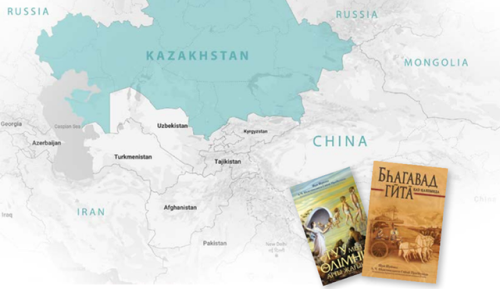
The Kazakh Switch, From Cyrillic to Latin.
North European Bhaktivedanta Book Trust: The change in scripts has been in discussion since 2006. The decision was announced in October 2017, with the goal for a complete transition to the new writing system by 2025. Most of the country’s reasons are probably obvious – nationalism, a move to distance the Kazakh people from their past as a Russian colony, and shifting political and economic allegiances. But there’s also an idea that Cyrillic has never suited the Kazakh tongue because Kazakh has a number of sounds that don’t have natural Cyrillic equivalents. Also, its subsequent forty two letter Cyrillic alphabet doesn’t translate well to computer keyboards. By contrast, the new Latin based alphabet has only thirty two characters and uses a script that appears on almost every keyboard worldwide. The writing system needs to be modernized, the Kazakh president has announced. It’s expensive to change a country’s writing system, and it takes at least a generation for the change to be effective. One news report said that Kazakhstan would have to “reenroll the entire population in kindergarten.” Other countries have tried similar language adjustments. Germany, with its orthographic reform in 1998, and Uzbekistan, with its switch from Cyrillic to Latin in 1993, are two examples. The BBT has several books in Kazakh, including Bhagavad-gita As It Is, which, if the switch in alphabets takes place – or the law demands – we will convert and republish. The devotees in Kazakhstan ultimately hope to make all of Srila Prabhupada’s books available in their language in whichever script prevails. Sorry, Cyril!