
 By Padmapani das
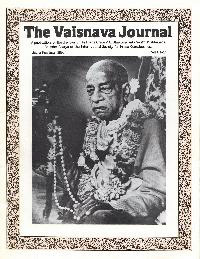
The first issue of “The Vaisnava Journal” was published to commemorate the 500th anniversary of Lord Caitanya’s Appearance Day in 1986. Although only five issues were printed and distributed over the next two-and-a-half years’ the magazine was popular and well received by many leaders, members and friends of ISKCON. The journal was originally created to help devotees work through their differences in a respectful and co-operative manner. To this end, the Vaisnava Forum (letters section) was launched to help facilitate a healthy dialogue among all participants. The mood was friendly and hopeful, to which the devotees responded in kind. In a similar fashion, I now anticipate (and hope) that your online publication, “Dandavats,” has taken the opportunity to further the lines of communication among Vaisnavas everywhere in the same tradition of Prabhupada’s open and loving exchanges.
Srila Prabhupada encouraged us to study the scriptures from “different lights of direction.” In his personal absence there are bound to be various points of view; some of them right, and others not. So to protect one another from deviation, we need the opportunity to exchange our opinions in an open forum. This will force us to examine the credibility of our own thoughts and actions, as well as those of our godbrothers and godsisters. This is the meaning of Vaisnava association, and the motive behind publications like “The Vaisnava Journal” and others.
Another function of open communication is to help bridge the gap between those devotees who have remained dedicated servants in the temples, and those devotees who have, for one reason or another, chosen to live outside the movement, but who still maintain their loyalty to Prabhupada and ISKCON. Over the years, so many devotees have left the movement and are now scattered here and there across the globe. Some are maintaining their strict disciplinary vows, and others are unable to do so. But with the proper encouragement and association, it’s possible that we can help to revive the dormant devotional creepers in the hearts of our godbrothers and godsisters who have left. Many talented and experienced devotees are waiting for the right time to revive their active participation in the movement. If we can demonstrate our maturity and genuine Krishna consciousness, then we can act as a catalyst for their return, thus pleasing Srila Prabhupada, who constantly reminded us that every devotee is so valuable. We all know one devotee or another who is living outside, disconnected in some way. Why not make the small effort to invite him or her back to the fold, take prasadam and once again make them feel welcome and appreciated? After all, Srila Prabhupada undoutedly wants all his followers to return to his family. It’s up to us to make the conditions favorable. In light of the above, I’d like to reprint our first editorial, hoping that it might serve as an inspiration to your ongoing work:
“Welcome to the first issue of ‘The Vaisnava Journal.’ The main purpose of this publication is to help unify the senior members of ISKCON.
“We have all felt the need for better Vaisnava relationships in our society. For one reason or another, we have to admit there has been a gradual erosion of love and trust among the disciples of Srila Prabhupada. Now more than ever, we need to revive the spirit of unity so prominent during the time of Prabhupada’s physical presence.
“As the founder-acarya of ISKCON, Srila Prabhupada has always been the center of our movement. In the absence of personal association with the guru, it is essential that one should serve his instructions. ‘There is no difference between the spiritual master’s instructions and the spiritual master himself.’ Therefore the central pivot of our worldwide activities is the vani of Srila Prabhupada. His instructions form the guiding principle of our movement, nay the world, for the next 10,000 years. As disciples of Srila Prabhupada, we share the heavy responsibility of insuring that his message is preserved and transmitted without adulteration.
“One of Srila Prabhupada’s most important instructions to his disciples is that we co-operate with one another in spreading Krishna consciousness. He recognized there would be differences of opinion among godbrothers, but he also reminded us that we share a common objective which supersedes all petty disagreements:
“Perhaps you may know that there are many political parties in a country but when the country’s total responsibility has to be executed, they become combined. To have some little disagreements among yourselves is not very unnatural because we are all individual beings. But as we are working on behalf of Krishna, we should always forget our personal interests and see to the prime cause.” (Srila Prabhupada letter, January 21, 1969)
“It is certainly unpalatable to think that we could fall short of fulfilling this order, but history has taught us a lesson that we should be careful not to repeat. If our movement is to be truly successful, then it is necessary that we co-operate with each other. And in order to co-operate, we have to communicate.
“In the 10th Chapter of the Bhagavad-gita, Krishna describes how the devotees relate to one another. He uses the words bodhayantah parasparam, translated as “preaching among themselves.” Thus, Krishna Himself, has clealry emphasized the importance of exchanging spiritual realizations among devotees.
“‘The Vaisnava Journal’ has been created to help establish a healthy dialogue among the Prabhupada disciples. By communicating with each other on a regular basis, we can better achieve an overall consensus on vital issues. Hopefully this will help to improve the quality of our relationships. Of course, some lively discussions may ensue, but that is not unwanted. Krishna consciousness is not dry or static; neither are the devotees. Please note that all articles should have their foundation in Prabhupada’s instructions, with respect for the basic codes of Vaisnava etiquette. We’re looking forward to hearing from you. All glories to Srila Prabhupada.
“Our motto was humbly fashioned after Srila Prabhupada’s original motto, published in his first volume of BTG, entitled: “First Appearance on the Vyas Puja Day 1944”
“We have to defeat tyranny in the realm of thought, and create a will for world peace.
“Jayadvaita Swami had written from India, advising that Prabhupada may have been ‘paraphrasing someone else — perhaps Nehru, Gandhi, or some other prominent person.’ At the time, I didn’t have the opportunity to investigate the actual source of this quote, but had been satisfied using it, knowing that Srila Prabhupada originally employed it in the service of BTG. It immediately struck me as an appropriate maxim, succinctly defining the challenge facing humanity in general, and the followers of Srila Prabhupada in particular. Therefore I was surprised when I received the following letter from a devotee in Europe:
“Your motto of ‘defeating tyranny in thought’ obviously implies there has been some gross discrepancies on somebody’s part. Who are the perpetrators of this great crime? Where are the tyrants? (String ’em up!) Unless all our godbrothers and leaders alike can feel a welcome access, and unless there is not a ‘counter-tyranny of thought’ being made publicized, this effort will have, at best, only a crippled effect. However, if this unifying spirit can be achieved and everyone can be drawn in, then this circular will be of great significance in the history of our movement.”
“Of course, the word ‘tyranny’ has its connotations, indicating the presence of an oppressive power. But that imposing force is not external in this case; rather, it dwells ‘in the realm of thought.’ Naturally I recognized that it may also apply to our interpersonal relationships, but the ‘tyranny’ was clearly perceived as that force or handicap which seems to prevent us from co-operating with each other in ISKCON, and thus establishing a collective ‘will for world peace.’ That inability cannot be blamed on any single individual. The responsibility lies on all of us, and therefore ‘We have to defeat tyranny in the realm of thought.’ In this context, Prabhupada is challenging us all. The question is, will we seize the day? Only time will tell.
“So now I wish to express my gratitude and enthusiasm that you please carry the torch even further — to places where devotees of all persuasions, opinions and schools find common ground and love in the teachings of His Divine Grace, our universal teacher, leader and unadultered guiding force. He has always been our only chance, no matter what, plain and simple. May he always remain the very center of your publication and efforts. Then our future is a very rosey one indeed. Thank you very much.”
All glories to His Divine Grace, Srila Prabhupada! All glories to the assembled devotees.
Your servant,
Padmapani das