
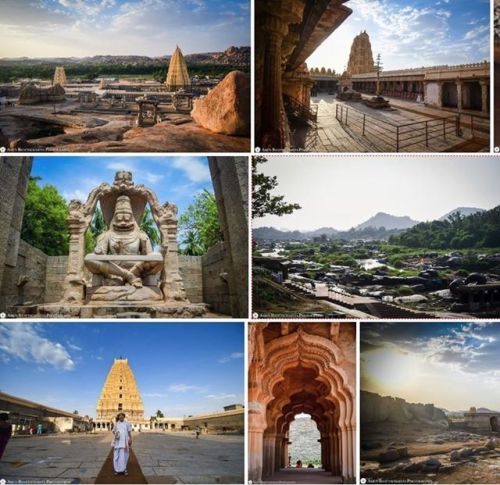
Visiting Hampi (Album of photos)
Hampi is a UNESCO World Heritage Site located in east-central Karnataka, India. It is the site of the once-magnificent imperial capital of the Vijayanagar Empire in the 14th century. Chronicles left by Persian and European travelers, particularly the Portuguese, state Hampi was a prosperous, wealthy and grand city near the Tungabhadra River, with numerous temples, farms and trading markets. By 1500 CE, Hampi-Vijayanagara was the world’s second-largest medieval-era city after Beijing, and probably India’s richest at that time, attracting traders from Persia and Portugal. The Vijayanagara Empire was defeated by a coalition of Muslim sultanates; its capital was conquered, pillaged and destroyed by sultanate armies in 1565, after which Hampi remained in ruins. This place has a connection with Ramayana’s Kishkindha chapter and both Sriman Mahaprabhu and Nityananda prabhu visited this place.
We started our trip with Virupaksha temple, which is the oldest shrine, the principal destination for pilgrims and tourists. Parts of the Shiva, Pampa and Durga temples existed in the 9th-century; it was extended during the Vijayanagara era. Then we explored the temples in Hemankuta hill and saw the Ganesh temples and soon enough we got darshan of the most famous Lakshmi Nrisimha Deity. Then our guide took us to a magnificent Krishna temple followed by underground Shiva temple. Next day we explored Vijayanagar’s queen’s palace, Elephant stable, Hazararama temple and many other places. Please come along with us and walk into the history of India’s once glorious city and be mesmerized by the sculpture and artwork of whatever that remains.
Find them here: http://bit.ly/2YLgPBB