
By Jiovaan Chetty
The University students from the UK and South Africa went on a spiritual adventure to Mayapur in Kolkata, blending seminars on Vedic knowledge and interpersonal communication with voluntary service.
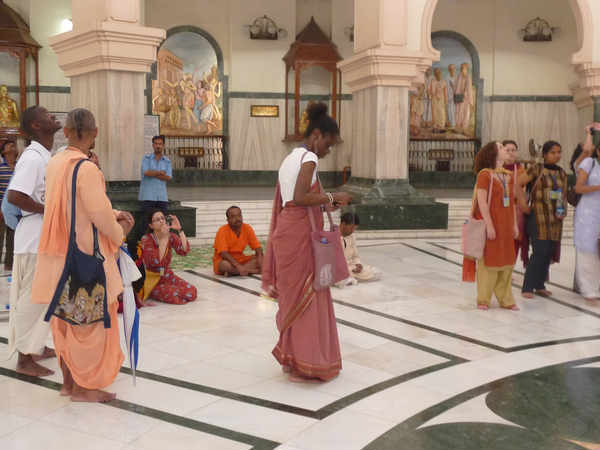
A visit to Srila Prabhupada’s Pushpa Samadhi taught us about the life and times of the founder Acarya of the International Society for Krishna Consciousness and his early efforts in birthing the movement. The marble interior and tiled mosaics of the Samadhi inspired our hearts a feeling that it difficult to give name to. Everybody expressed a keen interest in the function of a Samadhi, which was to be repeated in the form of questions at other points in the tour.
The three dimensional exhibits in the gallery depicting key moments in Prabhupada’s life were used to effect by the facilitators to further the discussion and answer our questions. Incidents from Prabhupada’s life became a catalyst for a dynamic flow of questions and answers regarding Krishna Consciousness and the Vedas, as we traversed the levels of the Samadhi.
At the end of the visit, all of us had a better understanding of Srila Prabhupada, his life, and his mission than we had before.
We were able to participate in the authentic ritual of a temple visit when we made offerings of incense and partook of caran amrit at the temples we visited. After paying our obeisance to the presiding deity, we were treated to a discourse on that deity’s pastimes. Often, this would lead to a discussion about deeper issues within the stories that one or more of us would mark as a point of interest.
Discussions at the temples would be lead by facilitators with particular themes in mind. For example, at one temple, a facilitator called for volunteers among us to stage a brief impromptu play. After the play, we were asked to guess the lesson. After much suggestion and intelligent guesswork, we worked out the lesson to have been reincarnation. This then became the catalyst for a wider discussion on reincarnation and the temporary nature of all things, not least of all our human bodies.
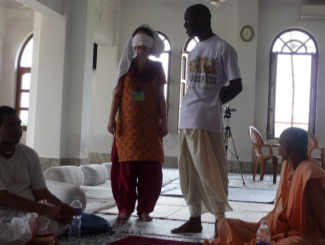 The seminars on Vedic knowledge and interpersonal communication were a highlight of the tour. Pictured is an exercise where, blindfolded, a student must successfully navigate the room to find her partner, going only on the instructions that her partner calls out. Since she finds her way across the room and its obstacles based only on what she can hear, the lesson becomes a warning against the blind following of authority.
All seminars were highly interactive, but there were those that derived their topics for discussion from questions submitted anonymously by students in the beginning minutes of the class. In this way, we could ask questions about issues relating to life and relationships that we might not have felt comfortable about raising in person. This particular kind of seminar allowed students not native to Hinduism or Krsna Consciousness to broach questions without fear of embarrassment. We covered topics ranging from reincarnation and karma to deity worship and the Vedas.
We were periodically asked for feedback as a group, which was taken into account by the facilitators at each juncture and used to improve upon and change the tour according to our needs as we went along. We found this good, because where one of us expressed an issue, it would immediately be addressed and the rest of the group would benefit from the change in focus.
The tour provided us with the opportunity to render service in the dham, and to the dham. And it is said that the potency of service rendered in the dham is greater than that rendered anywhere else.
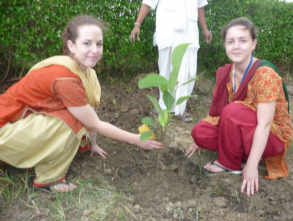 This service took the form of tree planting, where each of us were helped to plant a tree, getting down and dirty in the soil of the dham and revelling in the contact with Mother Earth. These trees will not only reduce the carbon footprint of our stay, but symbolically, the tree teaches the lesson of being flexible and bending with the winds of the time.
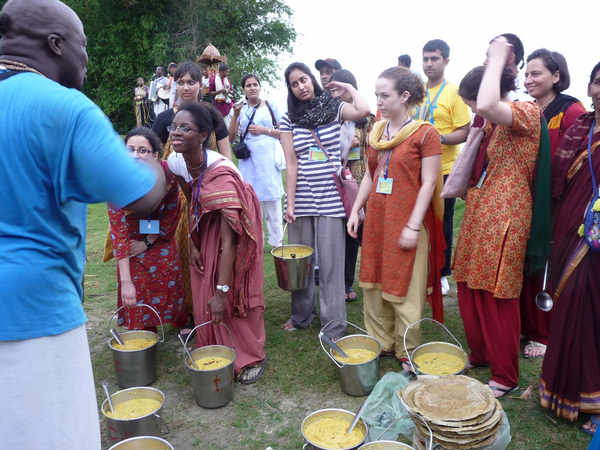
Later, straight after the tree planting in fact, we joined in a hari nam and journeyed down the Ganges by boat to take food to a local village. This experience ranks as my personal highlight of the tour, and after speaking to the other students I now have the pleasure of calling my friends, I know it ranks the same for many of them. Indeed, the only disappointment expressed about the tour was that we could not have repeated the experience. It is an afternoon that has earned pride of place in our hearts.
We were delighted to visit the Goshala, where we learned about the importance and sacred duty of cow protection. Reaching a hand to pat the head of one of these beautiful creatures, it is difficult to imagine that their slaughter can be condoned on any ground. The expressions in their eyes truly are as soulful as any human’s.
Available at the Goshala are a number of Ayurvedic products that the cows were not harmed in the production of, and they were a subject of fun and speculation for our group, since many of us have a medical/scientific background.
Our tour culminated in an awards ceremony where we were presented with certificates of achievement recognizing our participation in, and completion of, workshops in interpersonal communication and conflict management. This was a surprise to us, as we did not expect to receive anything of the sort. But it was a welcome feeling, to have had the insights we received on the tour validated in this way. We have been provided with a skill set that will serve both devotee and non-devotee alike equally as well in dealing with the pressures of the world we all find ourselves in.
The tour lasted seven days, and each day I was surprised by the quantity and quality of new experiences and places to visit. I did not believe I could be this productive on an average day back home. But such is the magic of Sri Mayapur Dham. And I invite you to experience it firsthand. I was put at ease by facilitators who acted as surrogate mothers to the group, always asking after my health and general well being. We all felt just as pampered and well cared for as we would have back home.
On day one I made the acquaintance of individuals I learnt a tremendous amount from, not only about living one’s faith, but how to genuinely relate to others. We were a group of different nationalities, ethnicities and interests and not once in seven days was there ever any kind of conflict to point to this fact. In a dynamic exchange of culture, we learnt just as much about and from each other as we did about the sacred sites of the nine islands. We have all pledged to stay in contact and we hope to return here in the future on a reunion tour of the nine islands.
All glories to Sridham Mayapur!
For future University Tour advice and bookings contact Sukanti Radha on mayapurworldwide@pamho.net or visit www.mayapurworldwide.org