
IS SANTA REAL?
Carl Herzig (Kalachandji das ) HH Tamal Krishna Goswami’s younger brother, & Stella (Shradhanjali dd) his wife, shared this article. Carl is a professor of English literature and Stella is a librarian and they are parents to 3 adult children. They are initiated by HH Giriraja Swami and live in Davenport, Iowa, USA. They do not live anywhere near an ISKCON temple. Carl has helped edit many ISKCON books including Aindra Prabhu’s book and Miracle on 26 Second Avenue by HH Mukunda Goswami.
The Herzigs are part of a Christian congregation and this article is about appreciating the great saints in all faiths and religions. Christmas is celebrated by Christians the world over and Santa plays a large part in the traditions of this festival. He is described as a jolly and kind person who visits children during Christmas eve. He enters down the chimney (or in our case through a window) and leaves gifts under the decorated Xmas tree. He eats a cookie, leaving crumbs, and drinks the milk left for him. The carrots left outside for his reindeer have bites taken out of them when the children inspect them in the morning.
Attached is a response to a question by a child called Virginia written to the New York Sun in 1897. Virginia asked is there a Santa Claus?’
Stella Herzig is celebrating Christmas with Carl Herzig.
December 14 at 4:25 AM ·
Carl Herzig writes and I agree: “I’d like to speak up in defense of Santa Claus. Many people (including Krishna devotees) seem to take it as a given that not only is Santa not a divine santa, a devoted servant of the Lord, but that he is not even “real.” That to state or even suggest by omission to one’s kids that Santa is real would be a lie. And so the concern about whether telling our children this lie could harm them or affect their trust or faith when they grow up and discover the “truth.”
I can understand that Santa is not present in everyone’s lives, and that he is present in most people’s in only the most crass, mundane way—and that some of our experiences and backgrounds haven’t fostered loving relationships with him or appreciation for the values of Christmas or even Christianity. By no means do I mean to deny or minimize any of them. There are many things about the public display of Christmas and Santa in particular that can alienate people both in and out of the faith.
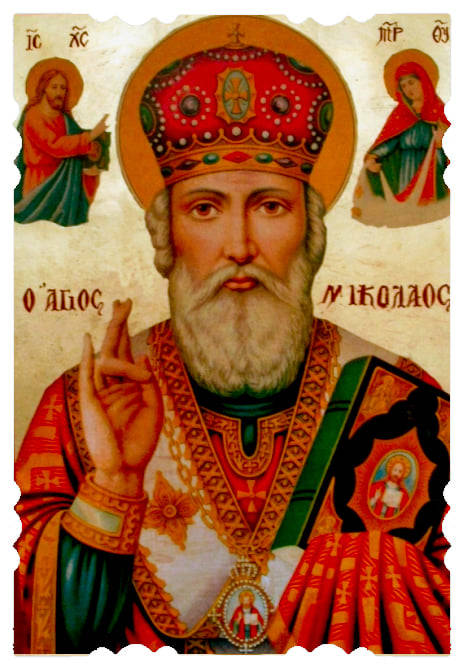
But despite what most of what American commercial culture tells us, Christmas is a holy day, and, yes, Virginia, Santa is real! The historical Saint Nicholas was born in third-century Greece, in an area now claimed by Turkey. Nicholas was raised to be a devout Christian in a wealthy but pious family, and at a young age he dedicated his life to serving the Lord. When his parents died in an epidemic, leaving him their riches, Nicholas followed Jesus’s instructions and used his entire inheritance to help the needy, the sick, and the suffering. While still young, he was made a bishop, receiving a form of advanced initiation that required both preaching and celibacy. Like a sannyasi, he gave up material attachments and traveled widely to preach and bring the word of God to the masses. (“A pure devotee of the Lord, therefore, follows in the footsteps of the great devotees like Narada and Prahlada and engages his whole time in glorifying the Lord … Such a preaching process is transcendental to all material qualities.” SB 1:6:21) He made a pilgrimage to the Holy Land (no mean feat in those days) and became known far and wide for his generosity; his love for children; his protection of ships, sailors, and voyagers of all kinds; and his help for all those in need (“regardless of caste, creed, color, or social position”). In time, of course, Bishop Nicholas was exiled and imprisoned for his faith in God.
After St. Nicholas left his body (on Dec. 6, 343, Dec. 19 on the Julian calendar), manna, a divine liquid substance known for its healing powers, formed on his grave. Through the centuries, various accounts of St. Nicholas’s pastimes fostered worship of this beloved saint, and the anniversary of his death became a day of celebration—St. Nicholas Day.
There are many examples of St. Nicholas’s generosity and protection. One tells of a poor father of three daughters, who could not afford their dowries. In their culture, the three girls, without the protection of husbands, would be sold into slavery. Mysteriously, on each of three different occasions, a bag of gold appeared in their home, providing the needed dowries. Tossed through an open window, the gold was said to have landed in stockings or shoes left by the fire to dry—and to be gifts from St. Nicholas. This led to the custom of children hanging stockings or putting out shoes by the hearth.
In another story, the people of Myra, St. Nicholas’s home, were celebrating the eve of his feast day when the town was attacked by a band of Arab pirates. The invaders stole treasures from the Church of Saint Nicholas and abducted a young boy as a slave. For almost a year, the boy served in bondage as the emir’s personal cup bearer. As the next St. Nicholas’s feast day approached, the boy’s mother would not join in the celebration; it had become a day of tragedy. Somehow, however, she was persuaded to have a simple observance at home—with quiet prayers for her missing son. And while she was engaged in this simple worship, St. Nicholas appeared to her son in the emir’s palace, whisked him up, blessed him, and set him down at his home right before his mother, still holding the emir’s golden cup.
Another story tells of three students of religion traveling to study in Athens. A wicked innkeeper robbed and murdered them on their way and hid their remains in a large pickling tub (eww!). Nicholas, a bishop then, was traveling along the same route and stopped at the inn. In the night he dreamed of the students’ murder, got up, and went to help them. He prayed to God, and the three were restored to life and wholeness. In France there is a similar story, of three small children who wandered in their play and became lost. They were lured, captured, and murdered by an evil butcher (is there any other kind?). St. Nicholas again appeared and appealed to God to return the children to life and to their families.
Many stories honor St. Nicholas as the patron of young children. Others show him protecting sailors and voyagers, saving people from famine, and sparing the lives of those innocently accused—as the friend and protector of all in trouble or need. Miracles are attributed to his intercession. Almost invariably, he accomplishes his kind and generous acts in secret, expecting nothing in return. To this day he remains a model for the compassionate life.
Sailors especially carried the glories to St. Nicholas throughout and beyond the continent, and during the Middle Ages he became the patron saint of Sicily, Greece, and Lorraine (France), and many cities in Germany, Austria, Switzerland, Italy, Russia, Belgium, and the Netherlands. Vladimir I brought St. Nicholas worship to Russia, where Nicholas became the people’s most beloved saint. More than two thousand churches throughout Europe have been named for him, and St. Nicholas’s shrine was one of medieval Europe’s devotional centers and is still a popular place of pilgrimage.
St. Nicholas’s feast day is still widely celebrated in Europe. The Netherlands’ celebration includes sharing candies (thrown in the door), chocolate initial letters, gifts, and riddles. Dutch children traditionally leave carrots, nuts, apples, and hay in their shoes for the saint’s horse, hoping St. Nicholas will exchange them for gifts.
Worship of St. Nicholas held strong until the sixteenth-century Protestant Reformation, which tried to stamp out customs related to him and other saints. Even then, however, St. Nicholas was so loved by the people that with the exception of England, the observances survived throughout Europe.
Puritans and Protestant Reformers dominated early New England settlements, and St. Nicholas worship did not fully take hold in early America. He was, in a sense, the first to arrive—the Vikings dedicated their Greenland cathedral to him, Columbus named a Haitian port for him on his first voyage, and the Spanish named Jacksonville, Florida, St. Nicholas Ferry—but even in Dutch New Amsterdam, there is only limited evidence of his worship. It isn’t until the nineteenth century that St. Nicholas was restored, promoted as patron saint of New York (by the writer Washington Irving, among others). He had changed, though—from a pious old sadhu into a chubby, red-cheeked elfin Dutch burgher smoking a clay pipe. The transformation of Santa’s image in American culture became complete when the jolly gift-giving elf was first drawn by Alexander Anderson and then Thomas Nast and most famously entered into American lore by Clement Clark Moore’s classic “The Night before Christmas.” All this was less than a hundred years ago, and almost two thousand after St. Nicholas left his body. And though the image of the saint had become changed, even distorted, he remained the beloved St. Nick.
Like many pre-Christian and early Christian holy days, St. Nicholas’s feast day has also been shifted and adapted to coincide with other Church-approved celebrations, and then changed further by American materialist culture. Mix all this up with his disappearance day, the winter solstice, the birth of Jesus Christ, Dutch-American culture, and a couple political satirists, and voila: Christmas.
Whether this, as is likely, is a corruption of sacred text or just the evolution of worship across time and circumstance, what we see today in mall windows across America is still an offshoot of a sacred, religious tradition. Significantly, St. Nicholas’s day appears near the onset of the holy period of Advent, in some ways like a Christian Kartik.
From the St. Nicholas Center website: “Advent is the time when Christians prepare to greet Christ—who came as a babe in a manger, who comes into our lives each day, and who will come again at the end of time. Advent is the time when people of faith are most at odds with the [American] culture. The church calls people to focus on getting ready to receive Christ—preparing hearts and lives to make room for Jesus, to live as he would have us live. It is a time of longing, not fulfillment. Quiet reflection, not celebration. The culture, however, is already in a time of festivity, unable or unwilling, to wait and contemplate and prepare for the real festival. It is not easy to observe Advent without being pulled prematurely into Christmas… . Nicholas is a good Advent saint for more important reasons than the date of his special day. Whatever he did, and it is said that he did many kinds of amazing things, may not be as important as the way he did it. Nicholas became so popular because he was a faithful follower of Jesus Christ. His life clearly reflected the way each one of us is called to show God’s love to others, especially those in need.
“Celebrating St. Nicholas on his day in Advent brings a bit of fun and festivity into homes, churches, and schools. His small treats and surprises help keep the spirit of good St. Nicholas, especially when stories of his goodness and kind deeds are told and ways to express his care for those in need are sought. Saint Nicholas helps us remember Christmas is a feast of love, hope, kindness and generosity.”
Many of us feel stronger attraction to St. Nicholas than to what American culture has created of him. But there is a real Santa. And though belonging to a line different from Vaishnava heritage, St. Nicholas, Santa, is revealed by so many accounts to be a pure devotee of the Lord. And as such, Santa, even as he has become, can be both real and attractive to devotees of any faith, including to Gaudiya Vaisnavas, and to our children.
I’m somewhat surprised that devotees would have such a hard time believing in Santa’s reality, find stories about him ridiculous, or do not distinguish between Santa’s spiritual body, murtis, and dramatists. How many dozens—hundreds—of stories do devotees embrace as literal “pastimes” that 99 percent of the Western world around us—and even much of “Hindu” India—would find charming tales at best? Yes, we have guru, sadhu, and shastra to confirm the reality of our stories. But so too do people of other faiths have parallel authorities to confirm theirs. I don’t have to go through a list of pastimes to make the point of how far we are willing to follow our faith. Can we really say that next to them, Santa giving gifts to kids throughout the world, or riding through the ether on a reindeer-drawn sleigh and coming down a chimney is impossible, a lie that we shouldn’t tell our children?
In fact, Santa does come down the chimney of children of all ages all over the world—even when they don’t have chimneys. And he needs a snack when he stops off—some light prasada—and maybe a carrot or two for the reindeer. Santa/St. Nicholas is a minister of the loving, gift-giving, child-protecting Lord, rewarding children for pious behavior, for being not naughty but nice. Of course most Americans use this to further their greedy materialistic ways. But that’s how the rest of the world also approaches Sri Ganesh, for example, and don’t we still offer him respect? Yes, Santa has been used as the spokesperson for the material side of Christmas. But let’s not forget that he is also a saint in the line of Lord Jesus Christ.
We worship the Lord by many names. And though devotees of Srila Prabhupada’s movement define many differences between Jesus Christ and other, Vedic divine personalities, and Prabhupada directs us in no uncertain terms to worship the Original Supreme Personality of Godhead, he also instructs us in Christian reverence and tells us of the place of Jesus in our devotional lives:
“There are many examples in history of devotees of the Lord who risked their lives for the spreading of God consciousness. The favorite example is Lord Jesus Christ. He was crucified by the nondevotees, but he sacrificed his life for spreading God consciousness. Because one surrenders to the Supreme Personality of Godhead Sri Krsna and Srimate Radharani does not mean that one must reject other traditions of worship.” (Bg 11.55 purport)
“A Vaiñëava should follow the examples of such Vaiñëavas as Haridäsa Öhäkura, Nityänanda Prabhu and also Lord Jesus Christ.” (SB 4.6.47 purport)
“Actually, one who is guided by Jesus Christ will certainly get liberation.” (PQPA 9)
“But certainly he is the representative of God. Therefore we adore Lord Jesus Christ and offer our obeisances to him.” (SSR 4b)
If we can accept the divinity, at least the holy quality, of Jesus Christ (even if one doesn’t worship him), can’t we also accept the pastimes—the reality—of his pure followers? Santa, after all, has many of the qualities of a Vaishnava (in the non-sectarian sense of the word, which Srila Prabhupada often uses).
“The symptoms of a sadhu [also of a saintly person] are that he is tolerant, merciful and friendly to all living entities. He has no enemies, he is peaceful, he abides by the scriptures, and all his characteristics are sublime.” (SB 3.25.21 [and elsewhere])
“A devotee of the Lord does not demand respect from anyone, but wherever he goes he is honored by everyone throughout the whole world with all respect.” (SB 4.9.47)
“A Vaisnava is one who has developed all good transcendental qualities. All the good qualities of Krishna gradually develop in Krishna’s devotees.” (Cc. Madhya 22.75)
“A Vaisnava is distinguished from a non-Vaisnava by his indifference to anything other than Lord Krishna and His service. The more a devotee develops this quality, the more advanced he is.” (PP 5.6) Even if St. Nicholas might not have known about Sri Krsna by this name, he unarguably was “cent percent sold out” to the Lord his God.
If we might treat Santa as a Vaishnava, “The transcendentally situated Vaiñëava is most advanced in spiritual knowledge, and therefore he is most deserving of respect, reception, service, and worship, regardless of his varëa, äçrama, age, or other external condition. Serving the Vaiñëavas is an important aìga of devotional service and is the active ingredient of sädhu-saìga, or association with devotees.” (PP 5.6)
“There are four basic ways to serve a Vaisnava: giving him a seat (reception), washing his feet (respect), hearing from him (association), and assisting him in any way (practical service).” (PP 5.6) Leaving him cookies is practically included!
And how may we honor Santa and Christmas in other spiritual traditions? “Offering gifts in charity, accepting charitable gifts, revealing one’s mind in confidence, inquiring confidentially, accepting prasada and offering prasada are the six symptoms of love shared by one devotee and another.” (SB 11.28) Already, these are some of our best and most cherished Christmas-season activities.
However one may feel about it—and certainly there are plenty problems—we live in a land of Christian traditions. Without compromising Krishna consciousness, or the beliefs and practices of any faith, we can honor Christian and Jewish and other saints who serve the Supreme Lord according to their time and circumstance. And we can teach our children to embrace devotional aspects of many Judeo-Christian traditions within the context of Vedic culture and Vaishnava shastra. One need not be lying to them to say that a saint comes unseen into every home. Narada Muni does it all the time, traveling everywhere, respected and worshipped by demons and the demigods alike. He is welcomed everywhere; for him the door of every house is open. “A perfect Vaisnava’s position should be just like Nārada Muni’s, completely independent and unbiased.” (SB 4.31.3 purport) Is Nārada Muni’s visiting a lie because we can’t see him? We know he is there—maybe we should be leaving cookies for him as well!
So, I would encourage you to sing Santa’s praise. With Christmas, we have a choice of whether to celebrate the holy day based on what is best about it, or reject it based on what is worst. But it seems to me that Christmas’s (and Santa’s) best qualities are intrinsic, whereas its worst are those corruptions stamped on it from without (by our culture). Instead of rejecting those sullied (and what hasn’t been in Kali-yuga and in today’s America?) qualities and throwing the Baby out with the dirty bathwater, why not embrace and try to rescue those whose core value nourishes our own beliefs and practices—our own Krsna consciousness?
Our family dovetails Christmas and Santa and our Christian worship with our Vaishnava spirituality. We have a big beautiful, fragrant Christmas tree, but it’s not “ours”—it’s Krishna’s, and we offer it to Him every year, hoping He’ll be pleased. The tree is decorated with festive ornaments, including figures of Krishna, Brahma, and Vishnu. Lord Jagannatha smiles out front and center, and His image, along with those of Subhadra and Baladeva, surround a hanging globe. On the mantelpiece, tiny carolers sing holy verses to a framed picture of Sri-Sri Radha-Syamasundara; a manger is arranged under a painting of Sri Madan-mohan; a Santa figure rests under the fiercely protective eyes of Lord Nrsimhadeva; little snowmen play their instruments under images of my brother, Tamal Krishna Goswami, and our guru, Giriraj Swami, who observe the whole scene with love and guidance. At church, my wife accepts Holy Communion with “Hare Krishna,” and we give talks about Vaishnavism and the holy dhämas to groups of church elders and assemblies of Christian high-school students.
Present-giving and receiving doesn’t have to conform to American super-consumerism; it too can be part of devotional festivities. Presents can be offered first to Gopal Krishna, and then to children as prasada. And they can be Krishna conscious—a great time to pick up a Hanuman comic or Vrindavan coloring book. While sitting under the tree on Christmas Eve, gifts are blessed by St. Nicholas, and the kindness of his pure heart is reflected in the eyes of the parents and children in the morning.
It’s a time for acting in the spirit of St. Nicholas: giving and sharing and helping those in need. There’s the annual Food for Life marathon, and there’s always a new calf or injured mother at Care for Cows. One can, as we have, visit retirement homes or hospitals and talk with and preach to older folks there who don’t have families nearby, or who can no longer remember them. I’m mentioning these just as a few examples; there are so many ways to engage in the Christmas spirit. And one great way when your children do grow into teenagers and beyond (yes, it will happen!) to keep them coming “home for the holidays” is to keep those Krishnaized Christmas traditions alive. I won’t even get into devotees’ obsession with “forbidden” chocolate, the classic Christmas treat.
Is the celebration of Santa bona fide? Let me please share with you a private—and my favorite—cherished family Christmas Eve moment. In 1999 we were in Vrindavan for Christmas—myself, Stella (my wife), and our three children, aged 8, 10, and 12. As you might have gathered, we do Christmas big in our house—tree, decorations, music, fire, games, gifts, cookies for weeks. So being in India at that time was a significant austerity for our kids (and for us!). We hung an Advent calendar in our flat and brought in a potted plant and decorated it. On Christmas Eve we had a special dinner and read and then discussed Krishna, Jesus, and Santa pastimes. Did Santa come to Vrindavan, they asked? Of course he did, we assured them; he came to children all over the world. He’d know where to find them. And we had a small, special Christmas Eve gift for each to take to bed and wake up to in the morning. It was a wonderful evening.
But the most special, magical time of the night came with a knock on the door as we were preparing for bed. Who could it be?! The children all looked up expectantly. It was Christmas Eve, but in Vrindavan? Could it be?! We hardly knew anyone, and no one had ever come to visit. I opened the door, and who should appear, with a sack slung over his back and a bellowing a hearty “Ho, Ho, Ho!” but Santa himself: Tamal Krishna Goswami! “Ho, Ho, Ho!” he proclaimed. “And who do we have here?” He took off his many layers of winter sweaters and, resplendent in his saffron-colored sannyasi cloth, one by one took each of the children on his lap and asked, “Have you been a good Krishna-conscious child this year? Have you been naughty or nice?” And one by one he pulled from his sack a special present for each—a book, bracelets, devotional pictures—and (without taking us on his lap!) one for my wife and one for me: an embroidered-cloth-covered Bhagavad-gita and a silk painting of Madan-mohan. (We read the Gita especially at Christmastime, and Madan-mohan has a choice spot for viewing the Christmas tree.)
One of the sweetest moments of the night came when Santa had distributed all the presents and, in a brief, awkward silence, the other five of us realized that we had no present for him. Stella was just beginning to apologize and explain, when Irene, our youngest, at eight, spoke up: “Oh yes we do!” she exclaimed. And she reached behind her and pulled out her own Christmas Eve gift (a Slinky). Stella’s eyes and mine filled with tears of proud love. “Thank you!” Santa/TKG said with a knowing smile, and gave her a big hug. “You hold onto it for me, and we’ll play with it together tomorrow.” (And they did, on the stairs and roof of his house.) It was a priceless Christmas Eve. Santa had come to our home and into our hearts, had visited us in person. And when they went to bed (with “Hare Krishna” on their lips but also dreams of sugar plums in their heads), our children’s eyes were still shining with happiness and love.
We churn the nectar of that night every year, and often in-between. But there are so many wonderful Christmas stories. And so many ways for all of us to celebrate love, generosity, care for the needy, and goodwill for all.
In short, I’d like to suggest not worrying so much about the undermining of children’s faith when they grow up and find out the “truth” about Santa. For one thing, children mature one minute at a time. Their understanding of the world evolves bit by bit, and they incorporate each new discovery into a vast, complex matrix of understanding that includes so much more than we know—some of it “real,” some of it “fantastic,” some of it supported by scripture, some of it just fun, and all of it with the Lord’s amazing grace. If we think we’re lying to them, then we are, and they’ll hear that. But if we ourselves can embrace the spirit of St. Nicholas, we can speak the real truth to them, and that will be the truth they’ll hear and know. Santa and Christmas—even without, especially without, its commercial trappings—can be a wonderful part of that experience. The “truth” as I still know it, many decades after I was supposed to grow up and see it, is that Santa is as real as I, and our children, ever imagined—and more. And he loves cookies!
If you’re still with me, let me please conclude (finally!) with the corny Christmas classic, the most reprinted newspaper editorial in the history of the English language—from the Sept. 21, 1897 New York Sun:
“Dear Editor: I am 8 years old. Some of my little friends say there is no Santa Claus. Papa says, ‘If you see it in The Sun it’s so.’ Please tell me the truth; is there a Santa Claus? –Virginia O’Hanlon, 115 W. 95th St.
Response:
Virginia, your little friends are wrong. They have been affected by the skepticism of a skeptical age. They do not believe except [what] they see. They think that nothing can be which is not comprehensible by their little minds. All minds, Virginia, whether they be men’s or children’s, are little. In this great universe of ours man is a mere insect, an ant, in his intellect, as compared with the boundless world about him, as measured by the intelligence capable of grasping the whole of truth and knowledge.
Yes, Virginia, there is a Santa Claus. He exists as certainly as love and generosity and devotion exist, and you know that they abound and give to your life its highest beauty and joy. Alas! how dreary would be the world if there were no Santa Claus. It would be as dreary as if there were no Virginias. There would be no childlike faith then, no poetry, no romance to make tolerable this existence. We should have no enjoyment, except in sense and sight. The eternal light with which childhood fills the world would be extinguished.
Not believe in Santa Claus! You might as well not believe in fairies! You might get your papa to hire men to watch in all the chimneys on Christmas Eve to catch Santa Claus, but even if they did not see Santa Claus coming down, what would that prove? Nobody sees Santa Claus, but that is no sign that there is no Santa Claus. The most real things in the world are those that neither children nor men can see. Did you ever see fairies dancing on the lawn? Of course not, but that’s no proof that they are not there. Nobody can conceive or imagine all the wonders there are unseen and unseeable in the world.
You may tear apart the baby’s rattle and see what makes the noise inside, but there is a veil covering the unseen world which not the strongest man, nor even the united strength of all the strongest men that ever lived, could tear apart. Only faith, fancy, poetry, love, romance, can push aside that curtain and view and picture the supernal beauty and glory beyond. Is it all real? Ah, Virginia, in all this world there is nothing else real and abiding.
No Santa Claus! Thank God he lives, and he lives forever. A thousand years from now, Virginia, nay, ten times ten thousand years from now, he will continue to make glad the heart of childhood.”
~Carl Herzig~
Hare Krishna! Santa ki jaya!