
 By Lakshman (das) Vrindavan (IN)
For Photos please see the link…….
http://www.flickr.com/photos/48332942@N05/
SEVENTH DAY:
Govardhana Parikrama:
In the Adi Varaha Purana it is said, “Anyone who performs Govardhana parikrama will never have to take birth in this world again.”
There are many important spots that is visited while going around Govardhana Hill. The Six Gosvamis of Vrindavana would all do parikrama of Govardhana Hill. Sanatana Gosvami and Raghunatha das Gosvami, when they stayed near Govardhana, would do parikrama daily. Other important devotees who have done parikrama of Govardhana are Sri Nityananda Prabhu, Advaita Acarya Prabhu, Madhavendra Puripada, Vallabhacarya, Visvanatha Cakravartipada, Srinivasa Acarya, and Narottama Dasa Thakur.
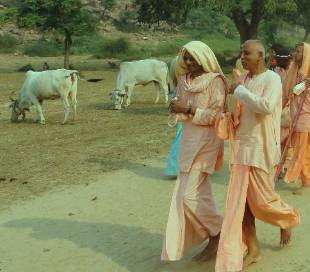
Govardhan Parikrama started from Radha Kunda at 5:00am, It was little difficult to manage all 900 devotees to keep them together. Some devotees walking fast and some are far behind walking very slow. Anyway in the Govinda Kunda all the devotees gathered at 8:00am.
HH Subhaga Swami Maharaja, HH Loknatha Maharaja, HH Sacinandan Maharaja and HH Radha Raman Maharaja delivered Sweet Kirtan and Krishna Katha. All participates were in great happiness having Krishna Katha and association of all those great devotees.
In the middle of Jatipura and Govardhan a place called Kadam van, where so many Kadamba trees are there. HH Subhaga Swami Maharaja spoke about the glories to Sadhusanga and Parikrama. Around 2:30pm, Parikrama back to Radha Kund after nine and half hours long Parikrama tour.
A brief description of Pastimes places :
Of all devotees, Govardhan is the best. This hill supplied Krishna and Balaram as well as Their calves, cows and cowherd friends with all necessities such as sweet water for drinking, tender grass, caves for protection, fruits, flowers and vegetables. Thus the hill offered services to the Lord. Touched by the tender lotus feet of Krishna and Balaram, Govardhan Hill appears very jubilant.
KUSUM SAROVAR: This is a large and beautiful kund on the Parikrama Marg of Giriraj approximately 2 km east of Radhakund. Here, the Gopis came to pick flowers for Krishna.
ASHOK LATA: Ashok Lata is a kunj situated near Kusum Sarovar. In this kunj, Lord Krishna braided Srimati Radharani’s hair.
UDDHAVA MANDIR: There is a small temple on the south-west bank of Kusum Sarovar dedicated to Uddhava. Uddhava remains here in the form of grass.
NARAD KUND: This is a beautiful kund on the left side of the Parikarama Marg. Narada Muni wrote the Narada-bhakti-sutra here.
MANASI GANGA: At the middle of the Govardhan village, the Manasi Ganga is situated. After Lord Krishna killed Vatsasura, His friends told Him to bathe in the waters of Ganga for purification. Unwilling to travel a long distance, Krishna brought Manasi Ganga here and took bath in it.
HARIDEV MANDIR: Haridev Mandir is located on the southern bank of Mansi Ganga. The temple is made of red rock. Haridev is one of the four presiding Deities in Vraj. It is a famous temple in Govardhan village. Later, the Deity was moved elsewhere fearing the conquest of the Yavanas. People take darshan of Haridev during the Govardhan parikrama. The Deity is said to have been installed by Vajranabha.
BRAHMA-KUND: After Brahma stole the calves and Gopas (cowherd boys), Lord Krishna expanded Himself to assume the calves and boys exactly identical to them. Lord Brahma permanently resides here. Bilvamangala Thakura performed austerities and penance here. Lord Chaitanya Mahaprabhu and Lord Nityananda Prabhu visited and rested on the banks of Brahma-kund.
CHAKRA TIRTH: The Chakra Tirth is on the bank of Manasi Ganga. The Chakra Tirth was created when Indra tried to devastate the whole of Vraj with pouring torrential rains. For the entire seven days, Krishna held the hill up and His Sudarshan Chakra generated immense heat of many suns rose up together in sky and dried up the flood water.
DANAGHATI: Danaghati is located at the middle of the Govardhan Village. Here, Lord Krishna begged for milk and yogurt from the Gopis.
ANIYOR: This village is located 3 km south of Danghati on the Govardhan Parikrama Marg by the eastern side of Giriraj. Here, the Vrajavasis at first offered bhoga (food offerings) to Giriraj.
SANKARSHANA-KUND: Outside the Anyor village is this Kund. Near to it at Sringar Sthali, Madhavendra Puri found the Deity of Gopal.
NARAYANA SAROVAR: There was a Kadamba tree here before and it was here, Krishna entered in a cave and lifted up the Govardhan Hill.
GOVINDA-KUND: This kund is located near the Aniyor village on its south. Here, Indra worshipped Lord Krishna and performed His abhiseka (bathing ceremony) after lifting the Govardhan Hill. This kund was filled with the water from that abhiseka of the Lord. While Madhavendra Puri was living at Govinda-kund, a beautiful dark boy came near and gave him a pot of milk. Later in a dream, the same boy came and told him where the Deity of Gopal was shielded in a nearby kunj.
CELA DAUJI GOVINDA: On the south of Govind Kund and atop the Giriraj is this temple. Devotees cannot go to this temple.
PUNCHADI: This village is in Rajasthan. Punchadi is the southern tip of Govardhan Hill. Here, Lord Krishna performed the rasa dance with the Gopis.
LAUTHA BABA MANDIR: On the Govardhan parikrama near the Punchadi village is this temple of Lautha Baba. When Akrura took Sri Krishna away to Mathura, Lautha, one of Krishna’s friends, asked Him when He would return. Krishna told him He would come soon. Lautha did not eat or drink until He returned. Then he arrived at this place and sat down. Lautha Baba is still awaiting Krishna here. This is a beautiful temple and in it, the deity of Lautha Baba is established.
NAVALA-KUND AND APSARA-KUND: The Apsara Kund is located 100 m away on the north-east of Lautha Baba Mandir. Near to Apsara Kund is Naval Kund. Here, Lord Krishna performed rasa dance with the Apsaras.
SHYAM DHAK: This is approximately 2 km away from the Parikrama Marg. This is a small forest where Krishna played with the cowherd boys. Near to this is the Gopi Sagara Kund, where Krishna enjoyed with the Gopis. Parikrama will not touch here.
RAGHAVA PANDIT GUPHA: On the north of Apsara Kund is the cave of Raghava Pandit (a close associate of Sri Caitanya Mahaprabhu), who performed bhajan in this cave. He knew most of Krishna’s primordial pastimes in Vraj.
SURABHI KUND & IRAVAT KUND: These two kunds are at close proximity and located approximately 1.5 km from Lautha Baba Mandir. Indra, together with Surabhi and Iravat, arrived here to plead for forgiveness from Lord Krishna.
YATIPURA: This is a village on the Parikrama Marg path approximately 3 km south of Govardhan village. Yatipura is named after Madhavendra Puri, who lived here during his visit to Vraj. Yati means a sannyasi and pura means village. Here is the prime lotus mouth of Giriraj where bhoga is offered.
GOVARDHAN: The new Govardhan village is 3 km from Yatipura on the north on the Parikrama Marg.
UDDHAVA KUND: This is a small and beautiful kund located 3 km from Govardhan on the Parikrama Marg. Uddhava lives here forever as a clump of grass.
RADHA KUNJ BIHARI MANDIR: This temple was founded by Srila Bhaktisiddhanta Sarasvati in 1935. The puspa-samadhi of Gaura Kisora Das Babaji is located here.
Eighth day :
Radhakund Appearance day:
The eighth day of the waning moon of Kartik month, or Kartika Krishna ashtami, is also known popularly as Bahulashtami. Its significance is that it marks the appearance of Shri Radha Kund, which is said to be the holiest of holy spots and the special scene of Radha and Krishna’s divine pastimes. Thousands of people come to Radha Kund to bathe in the two holy kunds (Radha Kund and Shyamkund) and to light lamps which are placed all around them both. The sacred bath traditionally takes place at midnight, and it is a moment of great joy and one of the unique and special festivals in the Braj area. Please go to the link below for nice ambrosia article by Madhavendu das “THE GENUINE APPROACH FOR TAKING BATH IN RADHA KUNDA” http://www.dandavats.com/?p=7815 and find yourself in the line of true representative of Srila Prabhupada and Guru parampara.
A brief description of Pastimes places :
Radhakund Parikrama
Among the dear Gopis, Krishna is dearest to Radharani. This kund is a delight to Krishna like Radharani. Taking bath once in this Kund, bhakti will arouse soon.
RAGHUNATH DAS GOSWAMI’S SAMADHI: On the northern bank of Radha Kund is this samdhi. Raghunath Das Goswami lived in this place. For many years, akhanda-kirtan (non-stop kirtan) goes on here.
RADHA GOPINATH MANDIR: This temple is close to Srila Raghunath Das Goswami’s Samadhi. This is where Srimati Jahnavi saw Gopinath. Originally, Vajranabha installed these deities in Vrindavan and later Madhu Pandit Goswami worshipped them.
JAHNAVA GHAT: Located on the northern bank of Radha Kund, this is Mother Jahnava Devi’s bathing place.
SHYAM KUND: This kund is dug by Lord Krishna’s lotus feet.
MANASA PAVANA GHAT: This ghat is on the north-west bank of Shyam Kund. Radharani takes bath in Shyam Kund from this ghat.
PANCA PANDAVA: This is located on the northern bank of Shyam Kund near the Manasa Pavana Ghat. The Panca Pandavas dwell here as trees. When Raghunath Das Goswami was excavating Shyam-kund, Maharaj Yudhisthira appeared in a dream and told him not to cut down the trees beside Shyam-kund since they exist there as trees and perform bhajan. One among them alone is visible now and appears dried up.
RAGHUNATH DAS GOSWAMI’S BHAJAN KUTI: In this bhajan kuti, Raghunath Das Goswami sung the glorious pastimes of Lord Caitanya Mahaprabhu every day and he lived at Radha-kund for 41 years.
KRISHNA DAS KAVIRAJ’S BHAJAN KUTI: This is between the north of Shyam Kund and east of Radha Kund. Here, Krishna Das Kaviraj wrote the Caitanya Caritamrita.
THREE GOSWAMI’S SAMADHIS: The three Goswamis- Raghunath Bhatt Goswami , Raghunath Das Goswami, and Krishna Das Kaviraj- left this world on the same day, but in different years. Their samadhi’s are here.
GOPAL BHATT GOSWAMI’S BHAJAN KUTI: Sri Gopal Bhatt Goswami was born in a village near Sri Rangam. He performed bhajan in Vraj for 45 years, mainly at Radhakund. He compiled some books as well while living here. His bhajan kuti is near Radha-kund.
RADHA GOVINDA DEV MANDIR: This temple is on the right side of the Parikrama Marg. The original Deity of Govindadev was installed nearly 5000 years ago by Vajranabha. Lost for years, Govindadev appeared to Rupa Goswami in a dream and revealed the whereabouts of the hidden Deity. Govindadev was later brought to Jaipur in Rajasthan. During the transit preparations, the Deity was kept safely at Radha-kund. The Deity here now is the replica of its original at Jaipur.
GOVARDHAN JIHVA MANDIR: Raghunath Das Goswami decided to dig a well and when the diggers partly dug down, they struck a rock and blood flowed from it. That night, in a dream, it was revealed to Raghunath Das Goswami that the stone was the tongue of Govardhan and it should be worshiped. The same stone is established in this temple.
BHAKTIVINOD THAKUR’S & BHAKTISIDDHANTA SARASWATI’S BHAJAN KUTI: Bhaktivinoda Thakur’s house was used as a bhajan kuti. Their puspa-samadhis are also here. This is located a bit away from the Parikrama Marg on the left towards the north.
JAGANNATH MANDIR: This is an ancient temple of Lord Jagannath on the Parikarama Marg.
LALITA-KUND: Moving a little ahead of Jagannath Mandir, we reach Lalita Kund. This is the kuti of Lalita, one among the eight kutis of the Astasakshis. This is on the left of Parikrama Marg. The temple of Lalita sakhi is on the bank of this kund.
JIVA GOSWAMI’S BHAJAN KUTI: Sri Jiva Goswami stayed here when he visited Radhakund. This is located near Lalita Kund on the northern bank of Shyamkund on the right of Parikrama Marg.
MADHAVENDRA PURI’S BAITHAK: This is Madhavendra Puri’s sitting place on the eastern bank of Shyamkund. This is located on the eastern bank of Shyamkund and on the right of the Parikrama Marg.
GOPI KUPA: This is an ancient well from where the tongue of Govardhan was found while digging. This is on the east of Shyamkund on the Parikrama Marg. In a small temple here, the footprints of Caitanya Mahaprabhu can be seen.
ASTASAKHI MANDIR: On the eastern bank of Shyam-kund, the Astasakhi Mandir is located.
TAMAL TALA: This is on the south-eastern bank of Shyamkund. There was a tamal tree here and under its shade, Sri Caitanya Mahaprabhu sat down and chanted.
SANGAM: This is at the meeting point between Radhakund and Shyamkund.
NITYANANDA BHAITAK: This is the sitting place of Lord Nityananda Prabhu. The Nityananda Baitak located on the south of Radhakund.
9th Day of Parikrama:
Today 31st Of Oct 2010 Radhakund To Deeg. pls see the photo link:
A brief description of Pastimes places:
KUSUM SAROVAR: About 2 km from Radhakund is Kusum Sarovar. This lake is known as Kusum-sarovar because many flowers blossom in it. Once bathing in this Kusum-sarovar, Narad Muni received the form of a gopi.
CAKLESHWAR MAHADEV MANDIR: This temple is on the northern bank of Manasi Ganga. This is one among the famous Shiv-lingas installed by Vjranabh in Vraj. When Sanatana Goswami came to Govardhan village, he stayed in this temple. When Sanatana Goswami thought of moving away from here frustrated by mosquito bite, Lord Siva (Cakleshwar) appeared and told him that the mosquitoes would no more disturb him. Even now this place is free from mosquitoes.
SANATANA GOSWAMI’S BHAJAN KUTI: The Bhajan-kuti of Sanatana Goswami is in the premises of the Cakleshwar temple.
GANTHOLI: This village is on the Govardhan-Deeg Marg 3 km west of Govardhan. For some period, the Deity of Gopal was kept in this village. During the holi-lilas, the Gopis tied together the clothes of Srimati Radharani and Krishna.
GULAB KUND: In Gantholi village, Gulab Kund is located.
BAHAJ: This village is 7 km west of Govardhan on the Govardhan-Deeg Marg. From here begins the Rajasthan State.
DEEG: Deeg is 16 km away from Govardhan. Deeg is comparatively a large town located in Rajasthan. There are many ancient forts and palaces here.
10th Day of Parikrama:
1st Nov 2010, Deeg to Badrinath. Please see the photo link:
A brief descriptions of Pastimes places:
DIDAVALI: This village is located 5 km north-west of Deeg on the Parikrama Marg. There is a temple for Narasimhadev and a kund in this village.
TANKOLI: This village is 3 km north-west of Didavali on the Parikrama Marg. It is on the right of the surfaced road.
KHOH: This village is especially famous for milk products. A small temple for Radha-Raman exists in this village.
KADAMBA-KANANA: This village is on the east of Alipur village. A grove of Kadamba trees exists in the midst of the hilly terrains and Lord Krishna performed absorbing rasa-lila here.
ALIPUR: This village is located 1 km north of Badrinath temple. We cross this village while going and returning from Badrinath.
BADRINATH: The Badrinath temple is 1 km south-west of Alipur village. Once, Nanda Maharaja and the cowherds wished to go on a pilgrimage to the holy places in the Himalayas. Krishna informed them that Badrinath and Kedarnath were manifested in Vraj and the same benefits would be derived by visiting these places. This is the Badrikashram in Vraj.
TAPASYA KUND: This kund is in front of the Badrikashram temple courtyard. This is a very beautiful and placid Kund. The pond water is always cool, for it is surrounded by large trees.
BADRI NARAYAN MANDIR: In this temple, the Deities of Lord Nara and Narayana are installed. Nara and Narayan Rishis are in deep penance here since time immemorial for the welfare of all living entities.