
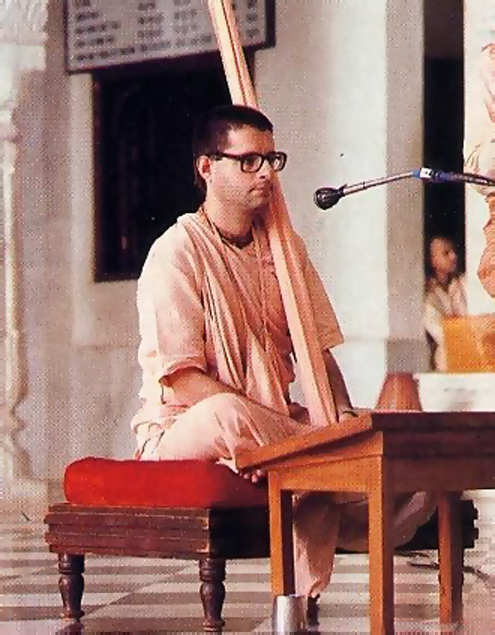
Giriraja Swami
Starting To See The Center Of Things
A simple explanation convines a young man to dedicate himself to a life centred around chanting the names of and serving God.

“Ever since the Stone Age, people have come up with so many nonsensical ideas to explain the forces of nature.”
That’s what my father, a Chicago lawyer, would tell me when I was growing up. “The idea of a God may give peace and inspire morality, but scientifically minded people are beyond all that.”
My seventh grade teacher showed me a different angle. He reasoned, “There are so many things we can’t see. We can’t see atoms or air or our own minds. Does that mean they don’t exist? Just because we can’t see God, does that mean He doesn’t exist?”
That made sense to me, and I had a change of heart. I didn’t exactly know who God was, but somehow I knew He was at the center of things.
Then, four years later (in my junior year of high school) , a close friend laughed at my ideas. “The wonders of nature are just coincidences. You’re just imagining that a God is doing these things.” His strong personality and arguments persuaded me to set aside my belief for the time being.
Still, I wanted some kind of perfection in my life, and I thought I could find it by studying psychology. I read books like Eric Fromm’s The Art of Loving, and finally I enrolled in Brandeis University’s psychology department so that I could learn how to help people get along better. But soon it became clear that most psychiatrists were themselves disturbed, and that their rate of suicide was surprisingly high. Besides, all the “experts” had different theories and rarely agreed on anything.
SEEKING THE EAST
Dismayed at not being able to find any peace of mind, I turned to the East for spiritual wisdom and looked for a spiritual teacher. For a start, I read about Zen Buddhism and also attended a weekend meditation led by a well known American Zen master. What an experience that was. All of us had to sit straight and stiff and play all kinds of mental games to empty our minds. We had to meditate on riddles like, “What is the sound of one hand clapping!” At times} when I fell asleep, a monitor would swat me on the shoulder with a stick. Needless to say, I felt uncomfortable. After the meditation, someone asked the master about Vedanta philosophy. He replied, “I have enough trouble keeping up with Zen. How can I think about Vedanta?” It seemed to me that a real spiritual teacher should know everything about spiritual life. So right then I knew that this man wasn’t the teacher I was looking for.
Later, I studied the writings of a famous Indian whom many people had called an incarnation of God. I asked one of my friends how I could study under him, but my friend told me that he didn’t accept any students. I thought, “What kind of master is this? Without accepting students, how can he benefit anyone? So that he can be detached he’s denying others the opportunity to be enlightened?” This didn’t make much sense to me, so I gave upon him.
Next, I became interested in a group that offered a popular version of meditation. Their leading American representative had rented a big hall in Cambridge to demonstrate the technique. But when I went there I found out that I’d have to pay an initiation fee of thirty five dollars and give up some kind of sense pleasure for one week. I wondered, “Thirty five dollars this is spiritual life? And if sense pleasure is bad, then why give it up for only one week?” It all sounded a little strange.
So it went. Whenever I found that a “swami” or “yogi” or “perfect master” or “realized soul” was anywhere within a thousand miles, I would rush to meet him. ‘”This ananda,” “That ananda” -so many anandas I met, but I always came away disgusted.
MEETING MY MASTER
Then, on April 18, 1969, His Divine Grace A.C. Bhaktivedanta Swami Prabhupada came to the Brandeis campus to speak on the Bhagavad gita. My girl friend tried to persuade me not to go. “Why can’t we be like other couples?” she asked tearfully. “Why do you always have to run to these swamis and yogis? Why can’t we be like everyone else?” I didn’t want to disappoint her, and I actually tried to forget about the lecture, but from within I felt I had to go. Not wanting to hurt my girl friend’s feelings, I reassured her, “Let me go to this one lecture, and this will be the last swami I visit.”
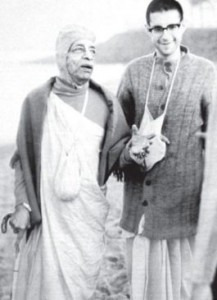
When one of my classmates and I entered the hall, the lecture had just ended. We saw Srila Prabhupada sitting on a magnificent chair in the middle of the stage.He was surrounded by chanting and dancing devotees. Satsvarupa Dasa, (now Satsvarupa Goswami) the president of Boston’s Krishna temple, led the enthusiastic chanting. As the sound system boomed the transcendental vibrations off the bare brick walls, I felt like jumping up and joining in. When the chanting ended, the devotees bowed to offer their respects to Srila Prabhupada. Then he left the stage, and a few disciples followed him.
Some of the devotees needed a ride to Harvard Square, so I gave them a lift in my station wagon. As we rode along, I mentioned that I’d been looking into Zen. “According to the Buddhists,” I said, “this world is just an image; it’s like a movie. And behind it all is nothing.”
A devotee commented, “Sure, this world is like a movie. But when you’re watching a movie, you know that there’s someone behind the whole show: a projectionist. So there’s also someone behind this world Krishna.” The more I listened to the devotees, the more I wanted to hear their guru. When Idropped them off in Harvard Square I asked a devotee named Patita pavana where the temple was. He told me how to find it and said that Srila Prabhupada would be speaking there the next evening. I decided to go.
I spent the next day anticipating my visit to the Krishna temple. Finally, about 6 p.m., I set out. The temple was in an out of the way but pleasant part of Boston called Allston. At the given address, 95 Glenville Avenue, I found a small storefront. With anxiety and eagerness I rang the doorbell, and a pleasant young man opened the door and welcomed me in. The room was thick with the smoke and fragrance of incense. It was a smallish room, crowded and warm. I saw Srila Prabhupada seated on the same chair as at the auditorium on campus. He was speaking, but I could hardly hear him. Yet I did catch one thing he said. He quoted a verse from the Bhagavad gita: “Out of many thousands among men, one may endeavor for perfection, and of those who have achieved perfection, hardly one knows Me in truth” (Bg. 7.3).
That struck me. I thought, “Spiritual life isn’t cheap. That’s one thing I’ve learned already.”
After he finished speaking, Srila Prabhupada asked for questions. A nicely dressed young man in the back of the room raised his hand. “Swamiji ,” he said, “How has Krishna created maya [illusion, or forgetfulness of Krishna] ?”
Srila Prabhupada gave a beautiful answer. He began, “Maya is just like a cloud. Isn’t the cloud produced by the sun?”
“Yes.”
“And doesn’t the cloud also cover the sun?”
“Yes.”
“In this way Krishna is also creating maya, and due to maya, Krishna becomes covered. Actually Krishna is not covered, but our vision is covered, so we are not able to see Krishna.”
Then I asked my question: “There are so many different processes of self realization, like Zen Buddhism, kriya-yoga, and others, and so many different teachers, with each one advocating his process as the best. How can we actually know what is the proper way?”
Srila Prabhupada then questioned me. “First of all , what is your goal? Do you want to serve God, or do you want to become God?”
I didn’t know what to say.
“If you want to become God, that means that you are not God now. But how can somebody who is not God become God? God is God. He never has to become God by any mystic yoga process. He already is God. Krishna is God when He is on the lap of His mother, Yasoda; He is God when he is tending the cows with His friends; He is God when He is speaking the Bhagavad gita on the Battlefield of Kurukeetra. God is always God. Not that by some mystic yoga process He becomes God. You are not God, nor can you become God. God is in your heart, and if you surrender to Him you can become godly. He is ready to help you, but if you try to become God you are only cheating yourself. If you want to become God then why should God help the competition? But if you want to serve God then God will give you all facility. So what do you think do you want to become God or do you want to serve God?”
ILLUSION SHATTERED
As Srila Prabhupada was speaking, I realized that actually I had wanted to become God. In fact, in my apartment I had painted a sign in bright, fancy letters; it said, “You Are God.” Another thing I realized as he was speaking was that Srila Prabhupada was the spiritual teacher I’d been looking for, and that he could see right into my heart. I became ashamed, because I knew that Srila Prabhupada was seeing all of my foolishness. Then he repeated, “What do you think do you want to serve God, or do you want to become God?”
I hesitated. I had some inclination to serve God, but I admitted, “Actually, I see that I wanted to become God.
” Srila Prabhupada said emphatically, “Yes, that is right! But how can you become God? You cannot. God is in your heart, and if you water the seed of devotion by chanting Hare Krishna, He will give you all the sunshine to make it grow.”
Every vibration in Srila Prabhupada’s voice struck my ear and entered my heart. Meanwhile, Srila Prabhupada asked the devotees to distribute prasada (spiritual food, offered to Krishna) to everyone. Earlier in the evening Srila Prabhupada had initiated several new devotees, and now a feast would complete the occasion. One devotee brought a large platter with many varieties of prasada and offered it to Srila Prabhupada, who quipped, “I am not God; I cannot eat all this. Distribute it.” Then one joyful devotee approached me. “If you like,” she said, “you can help distribute the prasada.” I was thankful for the chance to do some service.
After everyone else had begun eating, I sat down and looked at my plate. There were so many preparations that I’d never seen before; I didn’t know which one to try first. I bit into a pakora (a breaded cauliflower chunk, zestfully spiced and deep fried in pure butter). In all my life I had never tasted food so delicious. I looked at the devotees around me relishing their prasada, and then I tried a puri (a light pastry, puffed in pure butter) and some eggplant and tomato with curd. Again the taste was extraordinary. One by one I tasted all the preparations, and each one was more wonderful than the last. I’d never experienced such pleasure in eating. I reflected that everything in Krishna consciousness was that way. The philosophy, the prasada, the chanting, the temple, the devotees, and their spiritual master all were on a superior level.
The next evening I visited again. On alternate nights, instead of speaking at the temple, Srila Prabhupada would speak at one of the nearby universities, and that night he was going to speak at Boston University. I came early so that I could drive the devotees to the program in my station wagon. Srila Prabhupada spoke clearly and simply and then opened the floor to questions. One person asked, “What can this movement do for the hungry people of the world?”
Srila Prabhupada replied, “If you give a bag of rice to the pigeons, one pigeon will take some grains and go away, another pigeon will take some grains and go away, and in this way all the pigeons will have enough. But if you put a bag of rice in a busy marketplace, the first man who sees it will take the whole bag and hoard it. So the real solution to the food problem is to change the greedy mentality in human society. Actually, there is no scarcity of anything; there is only a scarcity of Krishna consciousness. God has provided for everybody. We simply have to accept what He has given and distribute it equally. That is Krishna consciousness.”
After the questions and answers, with Srila Prabhupada looking on, the devotees danced in a circle and chanted Hare Krishna. When I joined them I began to sense that Lord Krishna actually is present, as He says in Bhagavad gita, “within the hearts of all living beings.” It was a bright moment in my spiritual life.
The next night, after Srila Prabhupada’s lecture at the temple, I asked a question (each time Prabhupada spoke I would limit myself to just one carefully thought out question): “What is the relationship between service to man and service to God?”
Srila Prabhupada replied, “If a hungry man comes to you and you feed him, in a few hours his hunger will return and he will have the same problem all over again. But if you give him Krishna consciousness, all his problems will be solved permanently. If you give a man a million dollars, all of his ten dollar problems will be solved. Similarly, if you give a man Krishna consciousness, all of his little problems will be solved, including eating. And his problems will be solved permanently. He’ll become completely satisfied .”
WITH SRILA PRABHUPADA IN EARLY DAYS
A few nights later, after a lecture at Harvard, the students asked Srila Prabhupada many challenging questions, but he easily answered all of them. One student said, “You’re chanting Hare Krishna, but couldn’t you just as well count from one to ten over and over again, and wouldn’t that have the same results?” Srila Prabhupada replied, “Yes, you can try counting, and when you finish counting, you can try chanting.” Everyone laughed.
Another boy rambled on about how we need revolution. “This chanting has been going on for many years,” he said. “But now we have to take action, just like the Russian Revolution.”
Srila Prabhupada inquired, “Now you’ve had your Russian Revolution, but are the people in Russia happy?”
The boy replied, “Well, no.”
Then Srila Prabhupada said, “Then what is the value of this revolution? And even if the situation has improved, again it will get worse. Better to chant Hare Krishna and get the permanent solution.”
After the question and answer period, the devotees chanted Hare Krishna. Later, I lingered among the audience, noting how they’d appreciated Srila Prabhupada and the chanting of the Hare Krishna mantra. A disciple told me what I’d already gathered: Krishna’s pure devotee can never be defeated.
I kept coming to hear Srila Prabhupada speak, either at the temple or at a university. One night he said something that I found especially illuminating: “Our whole life is simply wasted in these two activities hankering and lamenting. Either we are hankering after what we don’t have, or we are lamenting over what we’ve lost.” That pretty much summed up my life. Prabhupada added, “The peace we are hankering for, life after life, moment after moment we’ll get it when our desires are purified and dovetailed with the Lord’s desires.”
The next day Srila Prabhupada gave a moving lecture at the Harvard University International Students Association. He said, “Our radius of love is always expanding. If you give a baby some food, he’ll simply put it in his mouth; he thinks only of himself. But when he gets a little older, he may think of sharing the food with his mother, then with his father, and then with his brothers and sisters. If you give him food when he is still older, he might share it with his friends. When he is a youngman, he may think of his community’s welfare, and when still more mature he may think in terms of serving the society or the country, until finally he might come to the point of serving all humanity. But still his love is not all encompassing. What about the cows? Are they not also sensitive living beings? Then why should we kill them? And what about the plants? We are cutting down so many trees and killing so many cows and other animals. Why should we not love all living entities?”
Srila Prabhupada then gave a nice example. What he said cleared things up for me. “This is our defect: our love is not perfect. I have my area of interest, and you have your area of interest, but mine overlaps and conflicts with yours. If I throw a handful of stones into the water, the circles they make will overlap and clash. But if I could throw the stones all at one center point, the circles would never clash. In the same way, if I have my center of interest and you have your center of interest, our interests will clash. But if we find the perfect center, we’ll have perfect harmony. And what is that perfect center? That perfect center is God Krishna.”
Although I was still living at my apartment, I liked the idea of working with Prabhupada’s disciples. But I was in doubt about whether I should move into the temple or stay where I was. One night, I got th e opportunity to drive Srila Prabhupada back to the temple after his lecture. Here was the chance to ask him something that had been on my mind for some time. “Srila Prabhupada, what should I do with the rest of my life?” I was anxious, because I expected that he would ask me to move into the temple right away. But he replied, “Just study our books very thoroughly and chant Hare Krishna.” I was relieved that Srila Prabhupada was so understanding. He’d already helped me to see that Krishna is the center of things, and I could see that the rest would come naturally.
At the end of 1970, Giriraja Swami went along on Srila Prabhupada’s well received return tour of India. Later, while he was the president of ISKCON’s Mumbai branch, among his other responsibilities, Giriraja Swami helped coordinate the Indian affairs of the Bhaktivedanta Book Trust and ISKCON’s life membership program. After that he extensively preached all over the world and now lives in the USA.