
By Lakshman das
https://picasaweb.google.com/106652055478422838217/BarsanaFestivalVMP2011
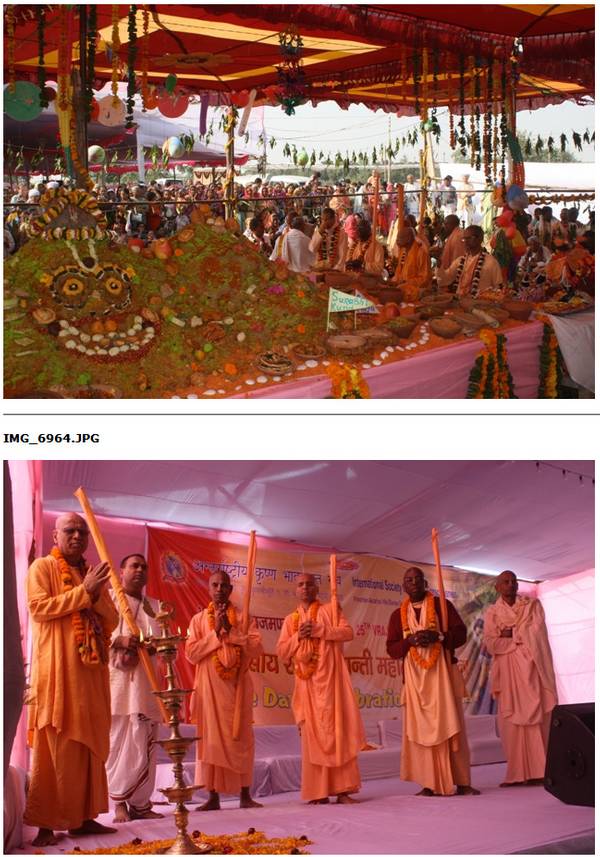
Today is the first day of silver jubilee festivals; more than three thousands devotees from 25 different countries took part this year. Free transportations arranged for the devotees of Vrindavan to attend the festivals.
On 26th oct, morning devotees performed Varshana Prarikrama followed by Prasadam at 9am, Silver jubilee festivals began at 10:30am with flag hoisting (symbolized with Hanuman), lighting lamp, breaking coconuts etc..
HH Bhakti Rasamrta Swami delivered the opening speech glorifying 25th Vrajamandal Parikrama. Along with HH Bhakti Narsimha Swami, others like HH Radharaman Swami, HH Ramgovinda Swami and HH Loknatha Swami had glorified Vrajamandal Parikrama and enthused the devotees.
After lunch Prasadam at 3pm, second session of the festivals begins with Bhajan Kirtan by Bangladesh devotees headed by Krishna Kirtan Prabhu. Then devotees recollect the memories of 25 years Vrajamandal Parikrama through slide show presentation from the 1st Vrajamandal Parikrama, after the Odyssey Dance performance all the devotees offered lamp to Damodar Bhagavan.
2nd day of Silver jubilee festivals. :
All the Parikrama devotees attended Mangal Aratik, Japa class, Gurupuja enthusiastically at 4:30am. At 8:00am Srimad Bhagavatam class which was given by HH Radhagovinda Goswami about Govardhan Puja. Gopuja began by 10:30am, HG Pankajanghri Prabhu performed Gopuja and HH Radharaman Majaraja delivered a short speech about the glories of Gopuja after the class, all the devotees enthusiastically feed the cows followed by Maharaja. HH Kavicandra Swami, HH Sacinandan Swami, HH Bhakti purusottam Swami and HG Sesa prabhu was also present on that day.
From 11am to 1pm, Maharaja delivered short speech and simultaneously Giriraj Abhiseka took place. A huge Giriraj was made by 350 delicious items, specially of Haluwa headed by HG Varahrupa Mataji. Arati for Giriraj and Parikrama also took place at the same time.
2 to 3pm a special program was held to honor donors who generously donated for Vrajamandal Parikrama, by special gift items and garlanding and also praising them.
In the evening Bhajan Kirtan was carried on by HG Krishna Kirtan prabhu and his team, HH Loknatha Swami delivered a speech, Noida devotees performed Rasadance followed by Damodar Arati.
Third day of Festivals:
All the Parikarama devotees visited Khadirvan in the morning, HH Radha Raman Swami spoke few words in Khadirvan, after coming back to Varshana HH Loknatha Swami gave a energetic class after break fast Prasadam. In the evening Bangladesh devotees did Bhajan Kirtan and ISKCON Vrindavan devotees perfomed Sakshigopal drama headed by Ramakanta Prabhu.
Brief descriptions of Varshana Parikrama :
At 5am all the devotees, still in a joyous mood, gather to go on Varsana parikrama. Varsana Parikrama is a transcendental activity; therefore it was better from one moment to the next. It is pratipadam purnamrita svadanam. The four-mile parikrama path will take us through the most enchanting pastime places of the Lord and His eternal consort.
Varsana, at present a small town of five thousand inhabitants, was once the capital of King Vrsabanu. When Nanda Maharaj and the vrajabasis moved from Gokula to Nandagram, Vrsabanu Maharaj also travelled from Raval, where Srimati Radharani was born to Varsana, where She grew up. Varsana literally means rain, and this area is sprinkled with Radha and Krsna’s unlimited pastimes. The most significant festival in this lively town is Radhastami. On the eighth day of the bright half of Bhadra when Srimati Radharani’s appearance day is celebrated, the town attracts at least one lakh of devotees. Dancing, chanting and singing of Radharani’s glories continue throughout the night. Rangoli and Holi is also another grand festival in Varsana.
The Padma Purana describes how Lords Siva, Brahma and Visnu all desired residence in Vraja bhumi to render some service to Lord Krsna. Lord Siva first prayed to become a hill and was granted the position of Nandisvara Hill in Nandagram. Brahma and Visnu also desired a similar benediction and they were thus allowed to appear here. Lord Brahma became the Varsana hill and its four white peaks are understood to be manifestations of his four heads. Lord Visnu appeared as the darker coloured hill on the east of Varsana, known as Vilas Garh.
Next we follow the parikrama trail between the Brahma and Visnu hills. The golden and deep purple rocks of the respective hills merge to form a steep, narrow passageway – Sankari Khor. Under the pretext of delivering dairy goods to the brahmanas in the surrounding villages, Srimati Radharani and Her friends would use this route. The real reason they passed here, however, was in hope of meeting Krsna who would often come this way. One day the lotus-eyed king of loving affairs stopped them and demanded that they pay a tax to get past. Adamanantly refusing to pay the tax, the gopis pushed forward. The cowherd boys pushed them back. The gopis pulled their sikhas. This tug of war lasted many hours and when Krsna saw that His side was losing He broke the gopis’ yogurt pots and feasted on the contents. The rocks here still bear the history of this pastime; one can see the white streaks left by the yoghurt spilt on them. Devotees carefully cross this precarious rock ledge in great wonder that the gopis and cowherd boys once enjoyed mock fights on this very stone.
The village we next go through is Chiksoligram, the birthplace of Citradevi. It is here that most of Vraja’s dairy products were prepared. When Srimati Radharani moved to Javat, the eight sakhis lived in villages around her new home.
We then enter Gahvarvan, a beautifully forested area. It is said that 5000 years ago this place had many caves in which Srimati Radharani and Krsna would enjoy pastimes. In Gahvarvan we find Krsna Kunda, dug by Krsna’s flute, at the foot of Mor Kutir hill. Tall trees with small delicate leaves overhang the water. Many such trees grow in the surroundings. Madhumangala’s throne stands at the head of the kunda. We sit for some time here and hear about a very delightful pastime that happened in this place.
Krsna and His friends would often steal yoghurt and butter from the gopi’s houses in Chiksoligram. One day a gopi realizing that Krsna was stealing her milk products crept to the door and pulled the latch, locking them inside. Krsna heard the noise and quickly escaped through the window with His friends. Madhumangala limped to the window and, as he was rounder than the others, he got stuck in the window while trying to escape.
When the gopi returned accompanied by Srimati Radharani and the other gopis, everyone had disappeared except Madhumangala. They tied him up and brought him to this kunda. A string was attached to his sikha. They threw one end over the branch of a tree and took turns pulling the string. As the gopis pulled they told him “Now call your friend!” and Madhumangala was calling “Krsna! Help!”. When Krsna arrived on the scene He chastised them, “Don’t you know this is not a cowherd boy! He is the son of a brahmana and you have commited a very great offence…” The gopis asked how they could atone for their offence and Krsna told them to collect as many ladhu’s as were available in Vraja and offer them to Madhumangala. In this way they could become free from the offence and get Madhumangala’s blessings. So Krsna’s brahmana friend sat here at Krsna Kunda to enjoy thousands of laddhus! As he started becoming pacified gave blessings, and the desire of the gopis was to have Krsna as their husbands. This desire was fulfilled at Cir ghat (?)
Although we will not manage to go there today there is mention of a beautiful lake north of Varsana known as Pili pokhar. Mother Yasoda loved Srimati Radharani very much and within her heart of hearts, she wanted Krsna to marry Her. One day when Srimati Radharani visited Nandagram, Mother Yasoda applied turmeric paste on her hand. Customarily, this is done when the parents of the bride and groom finalize the agreement for their marriage. Seeing her yellow hands, Srimati Radharani became very embarrassed and came to this kunda to wash Her delicate lotus hands. As a result the water turned yellow, and has remained so even to this day. Therefore this pond was given the name Pili (yellow) Pokhar.
To our right a flight of steps leads up to Mor Kutir – the temple of peacocks. One day Srimati Radharani’s admiration of the peacocks’ jubilant dancing ignited the fire of jealous competition in Krsna’s heart. Proudly twirling beside the peacock, He asked His amorous onlooker for Her judgement. Srimati Radharani replied that without a doubt, the peacock displayed superior dancing skills. Mystically turning Himself into a stunning peacock, Krsna danced again. Praising His elegance, Srimati Radharani agreed that the Lord had improved but was still no competitor for the peacock. She then turned Herself into a peahen and with Krsna, danced extravagantly. Blessing an elderly, blind vaisnava with the vision of this extraordinary pastime, Srimati Radharani asked him to paint it. This devotional masterpiece is still admired in this temple.
We go back down the stairs and climb another hill to see Maan Kutir, a small temple crowning on the Varsana’s peak. In many places around Varsana, Srimati Radharni exhibited her jealous anger (maan) to Lord Krsna. These feelings increased their amorous dealings and to hear about these confidential pastimes is the inconceivable mercy of the exalted vaisnavas. The pure devotees to whom these pastimes have revealed showered us with causeless mercy by sharing them with us. We should hear these transcendental activities with faith and never try to imitate them. Let them awaken our dormant love of Radha and Krsna and increase our desire to serve Them.
Once, while standing near Maan Kutir in the moonlight, Krsna compared His beloved’s face with the full moon (Chandra). That he should not only remind Her of Her rival, Chandravali but also compare Her complexion to the spotted moon upsetted Radharani very much. Exhibiting symptoms of transcendental anger, she left His company. She returned a few minutes later, dressed up as Krsna Himself. “Who are you?” Krsna enquired upon seeing Her. “Krsna!” she retorted. Krsna called Her an imposter to which She challenged, “if You are Krsna, then where is Radharani?” She laughed as She watched Him search and call for Her. So sweetly did he play His flute that finally Srimati Radharani could no longer maintain Her disguise. Laughing and holding hands they sped towards Unchgaon to see if Lalitadevi could tell who was who!
We walk along a narrow tranquil path through the forested hills to Dan Garh, where we have darsana of Radha Dan Bihari. From this mountain we have a clear view of Vilas Garh. During the month of Sravan married girls often return home to their parents. It was the last ekadasi of one Sravan month while Radharani was in Varsana that she was playing with her sakhis on Vilas Garh. They saw a gopi wearing a fancy sari approaching them. Radharani invited the new gopi to sit next to her on the swing. Overwhelmed by the proximity of Radharani, the gopi fainted into Her lap. When Lalita and Visakha tried to revive her by massaging her chest, they pulled a flute from beneath her blouse! Ever since that day, from that ekadasi in Sravan to Lord Balarama’s appearance day, Jhulan yatra (the swing festival of Radha and Krsna) has been celebrated.
The scenery is picturesque. Large shady tree shelter a rich undergrowth of ferns. In March the trees lose their leaves and resemble silver filigree. Mysterious caves stud the sloping mountainside. Cascades of small brownish rocks fall along the path where gnarled ancient roots intertwine in ecstasy. When knocked together they sound like the tinkling of ankle bells. Like at Govardhana, visiting pilgrims of little homes build with these stones along the way. Here, we also pile up our stones to implore Srimati Radharani eternal residence in Her abode.
A short walk towards the north takes us to a handsome temple built by the king of Jaipur, at the turn of the century. He wanted to move the original Radha Krsna deities of Varsana from the Sriji Mandir to this hill, which was under his rule. The Varsanavasis, however did not want the deities to move because they were afraid that the king might then move the deities to Jaipur, so the king had to install new deities in this temple.
Locally, the impressive temple built by the king is known as Jaipur Raja Mandir, but its official name is the Radha-Kushal Bihari Mandir. Next to Sri Sri Radha Kushal Bihari are deities of Hamsa Gopal, Nimbarkacarya and Radha Nritya Gopal amongst others. Beautiful intricate and detailed paintings of the ten avataras of the Lord are painted on the exterior temple walls which enclose a central garden. An old Vrajavasi lady sits at the exit of the temple, serving the pilgrims fresh drinking water.
The northern most peak is the highest of the four. At the summit of the hill stands the glorious Sriji (or Larliji) Mandir. We enter the temple grounds through Srimati Radharani’s blossoming garden. “Sri Radhika is the lover of Sri Krsna, the moon of Vraja. Some say she is the Supreme Goddess of Fortune, and others say that tantras describe Her as the pastime potency
(lila-sakti) of the Lord. The masters of the Sruti-sastra say she is the pleasure potency (anandini-sakti) of the Lord. All His potencies, all His pastimes, all His qualities, and all His handsomeness, sweetness, expertise and other virtues under Her dominion, Krsna’s lover, Sri Radhika, shines with great splendor.” (Sri-vraja-riti-cintamani 61-2). So attached to Radha’s association is Krsna that when she doesn’t wish to see Him He prays to become a stick in the broom of one of the sweepers of Varsana. The fragrance of Radha’s pastimes is carried in the soft breeze and we peer hopefully around the corner anticipating a glimpse of Her delicate gait. While chanting Srimati Radharani’s glories together we pray to capture the pastimes we hear, in the depth of our being and allow them to elevate us to the spiritual realm.
We enter the temple room, falling flat in the dust of Srimati Radharani’s lotus feet and offer our obeisances to our spiritual master, who is Her mercy incarnate. Colourful murals depicting Radha and Krsna’s conjugal pastimes adorn the walls and cieling. The dieties, installed by Bajranabh are the personification of sweetness. We offer a donation and in return accept Their Lordships maha prasad. What a downpour of mercy! The ivory colored palace is a masterpiece of art. Domes, spires, alcoves, balconies, pillars and arches are all decorated and carved with reliefs of peacocks.
As we leave the well maintained temple we look out over Vrndavana, the land of Krsna. Dusk is setting in. Eight kilometers away is Nandagram. It stretches before us in a panoramic scene. Dust rising beyond the houses and fields catches our sight. The gopis would stand here looking for such signs announcing Krsna’s return to Nandagram from the pastures.
Hundreds of time honoured stone steps lead up to the majestic temple. Descending them we pass many little temples. Their pujaris beckon us to come and take darshan of the deities within. Our procession follows in the footprints of millions of devotees who have walked before us. Many pilgrims are also walking with us. An old lady travels to the top in a palanquin, carried by two strong men. “Jaya Radhe!” she cries, as we meet her. Several pujaris mount the stairway with empty clay pots on their heads. There is no running water at the top of the hill so they will bring the supplies needed for cooking and deity worship. Their devotion to the deities touches us.