
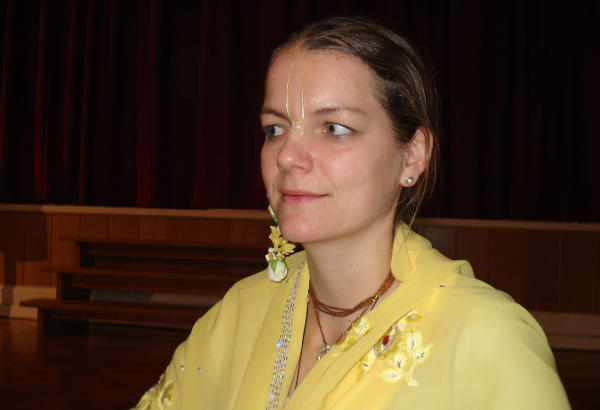
By Vrndadevi Dasi
Reflections on Devaki Mataji’s three-week course “Exploring The Roots Of Spiritual Culture” given in Mayapur during January 2013. For further informations on this most transformational course please see www.therootsofspiritualculture.net
“What is night for all beings is the time of awakening for the self-controlled, and the time of awakening for all beings is night to the introspective sage”(BG.2.69).
The day of the ordinary materialist has to become night to me, if I truly want to progress in my spiritual life. The worldview and culture of the materialist and that of the transcendentalist are as opposite as day and night. In the ultimate sense they are incompatible. Understanding this fact more deeply, I can consciously choose how much uplifting spiritual culture I want to integrate into my daily life.
Krsna has endowed the female form with a very powerful energy. I have the choice to use it as an instrument of maha-maya which bewilders and exploits, or I can use it to become an auspicious source of energy to men and thus uplift others around me (SB 4.21.4.). In this way I can greatly influence the atmosphere of my surroundings and have a tremendous responsibility within society. I can choose to either use everything and everyone for my enjoyment in a gross or sublte way, or to nourish all with my service and care.
“Actually, a woman is supposed to be the energy of the man. Historically, in the background of every great man there is either a mother or a wife.”
(SB.4.26.15.) The spine gives the main support to the entire body and keeps it upright. But the spine is in the back – not visible from the front. Women who know the art of being the auspicious source of energy to men are like the backbone of society: they keep things together and upright. Men could be compared to the face of society. Just imagine what would happen when the spine wants to be in the front….! It seems to be a forgotten dignity and honour to serve in the background.
In spiritual culture women are considered to be mothers. They are the care givers and nurturers within society. They balance the forces and harmonize the relationships. Mother’s mood is ‘I am last – everybody else comes first.’
ISKCON needs more true mothers and grand-mothers…..
In the name of progress, freedom and independence I lost respectability and real shelter – and I wasted so much time and energy by constantly competing with men and women for the highest position of control and influence. But “the hand that rocks the cradle rules the world.” Our children need good mothers who can empower them to become emotionally strong adults one day.
Men need my uplifting energy rather than the bewildering one, and thus they will be inspired to make the sacrifice of protecting and sustaining a family or a community. And in order to take charge of things they need my encouragement, rather than one more competitor. This is an eternal principle which I can observe within family life, but also within society at large.
Hierarchy means “divine order” with Krsna being on the top. But if Krsna is removed, the divine order turns into exploitation. Rather than rejecting the idea of hierarchy and throwing out the ‘baby with the bath water’ I want to put Krsna back on the top. Being protected as a wife and mother will be a blessing for me, not a curse.
I want to deeply understand the eternal and universal underlying principles of spriritual culture. Spiritual culture is Krsna’s culture, which He has made available to me to derive tremendous support on my path back to Godhead. I am not so interested in the details of application of the remnants of Indian or even Vedic culture. I need to understand the eternal underlying principles. Then the application will follow. I need to be convinced of the beauty and joy of serving and preaching in the mood of a mother, rather than an agent of the prison keeper Durgadevi.
I sincerely pray to Srimati Radharani that She may help Devaki Mataji and others to dive deeply into the subject of spiritual culture. I feel it can indeed give the root and foundation to a more caring and happy International Society for Krsna Consciousness. This course clarified many of my misunderstandings I had grown up with in the sometimes confused family of ISKCON.
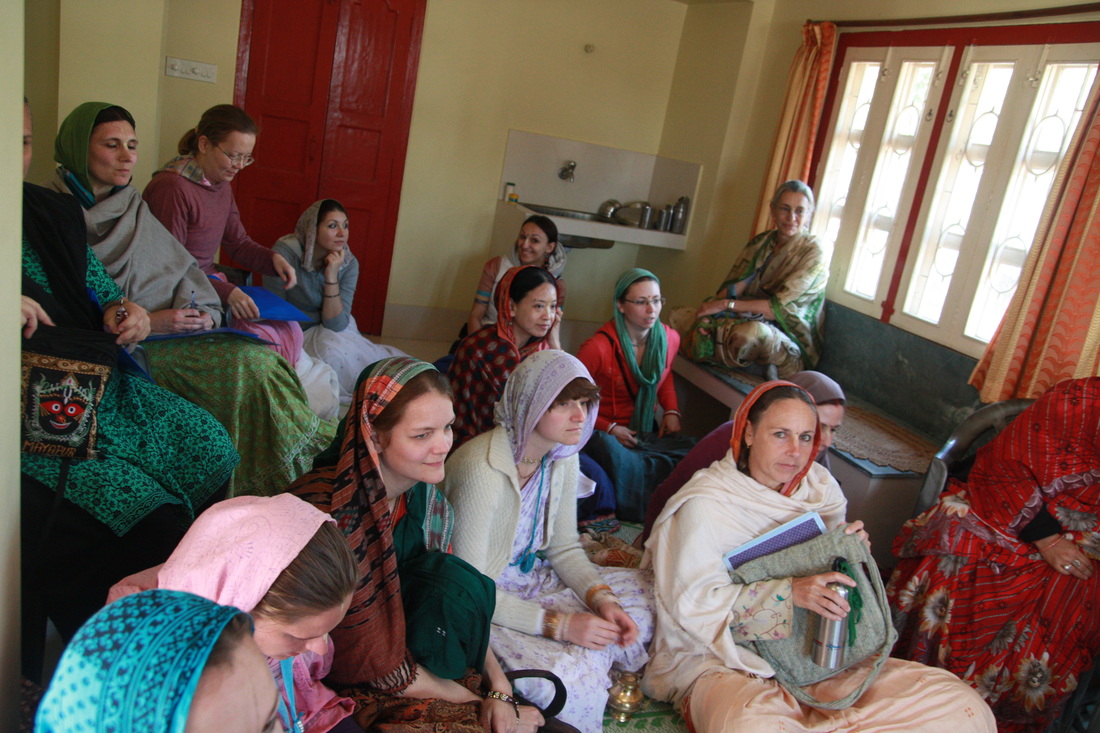
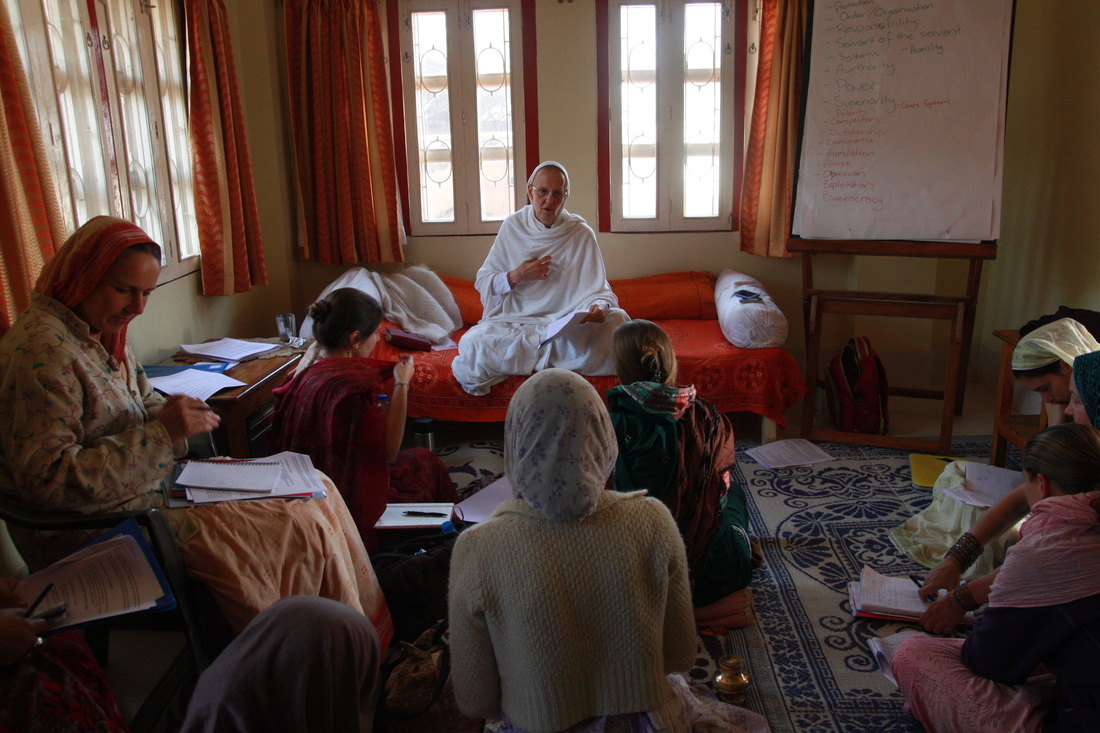
Once, I had the good fortune to happen onto a festival of vaisnavas in a very beautiful walled place.
The Deities Lord Caitanya and Lord Nityananda were there in the courtyard being fanned by a brahmacari, and many vaisnavas were performing kirtana. Other devotees were gathered here and there discussing devotional topics. There was one room for the vaishnavis. It was separate but males could enter if they wished. The scene I saw was very much like the bottom of your two pictures, only all the women wore white, and the floor was washed dirt. They were of varied ages, some young, some old, and all had japa mala in their hands. My eye immediately went to the arms of the speaker on her small asana; they had krsna’s names written on them, reminding me of that famous kirtaniya madhava prabhu.
That vaisnavi spoke on the glories of the association of devotees. When a young woman sitting close to the speaker addressed the speaker as sakhi, not mataji, i paid closer attention. She asked what is rati and where does it reside and to whom should be directed. Tears rolled down the face of the vaisnavi on the asana and then she began to speak. She first addressed the questioner as “sakhi,” and then gave a beautiful answer of which i tried to understand. I remember that she said that a woman’s rati, or affection, rushes to a man naturally, but that the transcendental rati, the rati of the soul, rushes toward krsna only. She supported the younger girl’s decision to give up the happiness of family life and devote all her time to directly cultivating her divine consciousness.
You speak of only two choices for you, a soul in a female body. Either to bewilder and exploit men or to become attached to a man and be his energy and support him and raise his children. The second choice is godly and uplifting, but do not be unaware of a third choice.
A word of caution: Vrindaban is filled with many who are prakrita-sahajiya. It is strange to address one as “sakhi”, ie a confidant of the manjaris and Srimati Radharani. So, a word of caution. Do not accept every thing is this Vrindaban as bonafide.
Next, when we analyze the beautiful example of Krishna’s gopis in Vrindaban during His pastimes, we can understand that the gopis were young cowherd girls, mostly married and some with children. However, their example is one of divine love for Krishna. Even though they were externally engaged as wives, mothers, simple cowherd girls, internally they were always thinking of Krishna.
The point I want to place before you is this: It is best to meditate on the example of the gopis and avoid imitating them. Some one at the temple in San Jose once asked me: “I am thinking of my self like Mother Yashoda. Is that ok?” My reply was that it is better to meditate upon the example of Mother Yashoda, but not to think that I am like Mother Yashoda. One risks falling into the prakrita-sahajiya category of practice.
I think that the psychology of self-centered-ness, where one wants to enjoy subtly, still pervades the decision to “think of one’s self as a gopi and the like.” When I was Srila Prabhupad’s personal secretary, one letter came to him regarding a “Gopi Bhava Club” that was being attended by some of the ISKCON LA people. Srila Prabhupad replied rather forcefully: “What is that, Gopi Bhava CLub? Let them first chant Hare Krishna for 300 years and then talk about the gopis!” So beware of the sahajiya tendency and understand how to discriminate appropriately to protect your bhakti creeper. I hope this may help some. Pusta Krishna das
Obeisances. Jaya Prabhupada! I find it fascinating, sad, and amazing that Prabhupada’s instructions to men (not to women!) to see and address women other than their wife as ‘mother’ have spawned a concocted philosophy about women’s roles in society. Prabhupada explained that this cultural (not spiritual) instruction from Canakya Pandita serves the purpose of men seeing women other than their wife in a non-sexual way. There is never any instruction from sadhu-sastra-guru for women to call other women mother, or to call themselves mother, or to see this cultural address as something spiritual, or to then make up all sorts of explanations about women’s positions based on something cultural and practical–men seeing women other than their wife non-sexually, as they would see their mother. Unless women have wives, how can they see other women “except their wife” as mother?
Of course, in a natural society both men and women marry young and become parents at a young age. So, for the majority of women to become biological mothers in their youth is the way of nature and, for most women, is helpful to make the mind peaceful for spiritual life. So, if we really and truly want to apply sadhu-sastra-guru to women’s cultural role in society, let us help young people to find good spouses and encourage them to raise godly children.
But most important is that we all develop bhakti and see ourselves as the servants of everyone, especially all other devotees. Most important is that we free ourselves from upadhis and come to the platform of “I’m a servant of the servant of the servant of Krsna.”
Your servant, Urmila devi dasi
Thank you very much, Mother Vrindadevi, for this article. In the name of spiritualism and surrender to the mission of Prabhupada we should be careful not to undermine the eternal social structure which could be very nourishing to that same spiritualism and that same mission.
I see devotees take to householder life, and in many many instances i do not see that the act of male-female interaction, raising children, making money–usually working for a non devotee….i don’t see those activities as being as conducive to krsna consciousness as harinam, book distribution and etc. For the woman, having children is usually a full time job, unless they must also go out into the world to make money and then come back and take care of the children. It is natural for a woman to want a husband and love him and love her children, but that is all material, that is the desire of the subtle body not the soul. There is room for some women to want to grow attachment to only krsna not to a husband, just as there is room for some men to want to love krsna only. This is even more true in our present culture which does not demand that a woman marry. Krsna is, ultimately, the only protector, as draupadi demonstrated; and the service of directly spreading His glories in this place is the real satisfaction for all souls.
I knew someone would find fault with my little story, but i’m surprised it was you. Do you not recognize it? What i had the good fortune of doing was to happen onto this festival that took place in the mind of bhaktivinoda thakura. I dare say, he is bonafide.
ys,klh
Regarding Srila Bhaktivinode Thakur, and specifically in his work, Jaiva Dharma, the later chapters delve into the identification of the individual jiva soul by their spiritual rasa. This position was also taken by a recent Gaudiya preacher. We must understand that, although such conversations exist in a certain group of aspiring servants of the Lord, it was not supported by Srila Prabhupad externally….at all. This is a dangerous position, if a conditioned soul “imagines” him self (or her self) as being of one rasa or another. That is “sahajiya”. Actually, the position described by Her Grace Urmila dd is correct. Whether in the body of a male or female, all are spirit soul. Krishna advises that one can look upon the dog, the dogeater, the elephant, the sage…all as spirit souls. Hence, Srila Prabhupad did not appreciate the Gopi Bhava Club mentioned above in #2. Some who were influenced by Srila Narayan Maharaj feel an urgency to “find their rasa” by meditating that they are aspiring gopis or such. This is not recommended. Better to appreciate the quality of love and devotion displayed by the Gopis. When Uddhava, Krishna’s friend, was sent to Vrindaban to witness the extraordinary love of the gopis, Uddhava then aspired to take birth as a blade of grass in Vrindaban, so that he might be blessed by the dust of the lotus feet of the gopis. How many persons (aspiring to “be gopis” in their sahajiya point of view) pray like Uddhava to become blades of grass in Vrindaban to be so blessed by the gopi’s foot dust? Uddhava recognizes the super excellent quality of the gopi’s love yet he realizes without mercy of such souls, it is not possible to increase devotion by willing only. It is a spiritual state of “rasa”, nondifferent from their soul, their sanatan-dharma.
Please do not take advise or even spiritual debate to be “criticism”. It is not. We must be able to understand things from many viewpoints. It is not an issue of ego or who wins. But, I believe that Urmila dd has dissected this argument properly. The advice which Srila Prabhupad gave (to see older women as mother, younger women as sister) is designed to help decrease material lust. However, it is a fact that older women are not my mother, nor younger women sister. It is a mental adjustment to avoid contemplation of sense objects leading to lust. All are Krishna’s…mamaivamso jiva loke.
Please continue contributing to this discussion. Pusta Krishna
Actually, the word “sakhi” means “friend.” It is used throughout the Bhagavatam, not just in connection with the gopis, but in many different contexts. For example, in SB 9-18-6, it is stated: ekada danavendrasya/sarmistha nama kanyaka/sakhi-sahasra-samyukta: “One day Vrsaparva’s daughter Sarmistha, who was innocent but angry by nature, was walking with Devayani, the daughter of Sukracarya, and with thousands of friends (sakhi-sahasra-samyukta), in the palace garden.” Somehow, in the late nineteen eighties, the “Prabhu/Mataji” syndrome developed, probably as the result of many disgruntled ISKCON devotees taking shelter of India after their gurus’ falldowns. Previous to that, most devotees would only visit India at Gaura Purnima time and we would call one another “Prabhu,” regardless of gender consideration, because we were trying to act in our dasa dasanudasa position outside the bodily platform. I am confident that anyone in good faith who joined ISKCON before 1985 can testify that women didn’t call each other “Mataji” but either “Prabhu” or their given spiritual name and that most men did call us “Prabhu” too rather than “Mataji.” In those days, we were not so Sanskrit –oriented and didn’t even know that grammatically the appellation was no correct in connection with the female gender. We simply followed the ISKCON tradition and Srila Prabhupada’s instruction to see everybody else as master and ourselves as servants.
The large influx of devotees visiting India for extended periods of time and their exposure to various Gaudiya institutions seems to have caused this dramatic switch to the gender-based “Prabhu/Mataji” appellation never instituted by Srila Prabhupada. I am not inclined to make an issue of it. But Pusta-Krsna Prabhu mentioned recently on one thread that we need to tell the truth, not for the sake of winning an argument but simply out of duty. And frankly, at this stage of my life, I have no taste for controversy. I am tired. But duty calls and we have to answer the call.
Continued in next post…
His Holiness Giriraj Swami describes an incident in which the Boston devotees were attacked one night by hooligans. Somehow they were caught and brought to justice and their attorney was bent on discrediting the Hare Krishnas. The main witness, His Grace Nanda-Kumara Prabhu, was very young, shy, and inexperienced in worldly dealings, and when he got to the witness stand, the lawyer was ready to tear into him. He began his investigation by asking: “Who was there on the night of the alleged attack?” Nanda Kumara Prabhu replied, “Satsvarupa was there, Murari was there,” and a host of other names of Krsna. And as he was reciting these powerful names of the Lord, his spiritual strength increased and he was able to hold his ground and ultimately the devotees won the case.
So, when devotees, especially women, thoughtlessly call each other “Mataji,” regardless of whether they are older or younger than the person they call in this way—instead of instead of calling them by the glorious names they were given by their spiritual masters, I deplore it.
I heard—and I don’t know if it’s true or not—that His Holiness Sivarama Swami forbade his disciples to call women “Prabhu.” Perhaps there are some varnasrama considerations that need to be applied in developing varnasrama communities, and I accept that. But Srila Prabhupada gave us the choice: the elevator (lift) or the staircase. So we have to be careful to validate and respect those choices since the International Society for Krishna Consciousness is meant to give shelter to everyone—including the minorities.
Thank you for reading this. Hare Krsna!
Your servant,
Visakha Priya dasi
I am a little baffled by your remarks pustakrsna prabhu. My original comment to vrndadevi was that there is always the choice, for any living entity, to focus solely on attachment to krsna–i gave a story from bhaktivinoda’s prema pradipa seventh ray to exemplify, for her, women who choose to leave behind the material mind’s desire for family. Not every woman must aspire to motherhood; it is not her only way to krsna consciousness, most especially in the unpredictable kali yuga. How many women will choose devotion to krsna only?– not many, but the option is there for everyone.
S0 now, why did my story inspire you to such a rant against the sahajiya condition? The story was almost straight from prema pradipa, which you know is not a book that goes into gopis at all. I chose it because the pictures vrndadevi posted were so similar to the gathering of vaisnavis given to us by bhaktivinoda thakura, and yet the gatherings had such very very different messages. Certainly a vaisnavi speaking on the glories of devotee association, and on eternal rati cannot be somethiing that would inspire you to such scolding. It must have only been the use of the address sakhi that offended you, but as visakha priya so nicely said, sakhi means friend, and there is nothing sahajiya about it, at least not to Bhaktivinoda thakura. It seems you missed the main point of my comments, so now i have explained them again.
I was very glad to read urmila and visakha priya’s comments.
Visakha Priya dasi’s discussion is well received. True, sakhi can mean a female friend, and does not (I must admit) necessarily refer to one who is of the stature of a confidante of the gopis. Still, and I say this not to defend myself, it is important to realize that there is much sahajayism in Vrindaban. During the early days of ISKCON, we generally addressed each other as “prabhu”, that is true. We were learning the art of offering respect to others. It was not easy to throw 100 or more people into a dynamic temple setting, away from whatever familiarity we knew, and with many, many diverse backgrounds. Some may have been serious students, some serious dealers of one thing or another, and everything in between. The one unifying principle was learning about Krishna and rendering service to Srila Prabhupad and the temple. Some temple authorities were kind-hearted, and some were exploitative. It was quite a time! And, we were asked by Srila Prabhupad to conquer the world for the sake of Lord Chaitanya. It was amazing. At that time, even in places like London, New York, and Los Angeles, there were very few Indian nationals who visited the temple. When they came, being few and far between, they would often be introduced to Srila Prabhupad when he was there, and they often were treated with affection. Of course, when we returned to India en masse for the Pandals and large programs with Srila Prabhupad, we were presenting his style of Sankirtan to the Indian public, many thousands at a time.
Every situation becomes challenged by a new situation…thesis and antithesis. The result is a synthesis…which in turn becomes a new thesis, and on, and on, and on. The material dialectic of change is a constant challenge to the status quo. That is (as the I Ching states), the only thing that does not change is change itself. It is a testiment of transmigration, constant transformation, and stands apart from the unchanging existence of the soul.
It is of course welcome and refreshing to hear from women in Krishna consciousness about issues related to the role of women in devotional service. Many months ago there was debate about the possibility of women being “gurus”. Certainly, they are siksha gurus, as in this article and its comments. Writing is a good way to organize one’s thought process, and debate is a good way to sharpen the intelligence. Thank you for being such an instrument. Pusta Krishna das
The elevator or the staircase, yes, and all human beings–male and female– have to make that choice for themselves; and before making it should understand as fully as possible what they are getting themselves into.
I’m not convinced that it is best to encourage young devotees to get married and have children right away. It is in accordance with varnasrama, true, but i see this moment in time as very special– i believe there are an unusual number of extraordinary devotees present. Now is the time to get the energy of preaching up, to encourage full time engagement in the lord’s service. It is a fact that preaching service is more enlivening and enduring and uplifting than the entanglement of household life. Varnasrama can be instituted later when there are lots more devotees.
pusta krsna prabhu, I did not take your comment on sahajiya mentality as criticism. I pointed out that you found fault with the story itself. You were afraid that i was relating the interactions of sahajiyas. I am sorry that i gave you that worry. But your mind can now be relieved because the story is from bhaktivinoda thakura’s prema pradipa seventh ray. It is an uplifting chapter showing a glimpse into the life of vaisvavis…there is nothing about gopis.
ys, klh
Yes, i totally agree about the writing. Lots of people seem to read these articles, but so very few comment, and they just don’t know what they’re missing. Interacting with devotees in this thoughtful way is interacting with the compassion of krsna–it lets you see where you are and also how to improve. It may not appear to be such a sublime experience to a reader…but just try it and see!
“We were asked by srila prabhupada to conquer the world for lord caitanya”—yes that’s the ticket, that mood, mixed with ideas to creatively draw people into krsna’s service, mixed with a personalism so people feel you actually care about them….. then no one will be meditating on the glories of being a mother.
Devotee: Śrīla Prabhupāda, should we call all the women “mother”?
Prabhupāda: Yes. And treat it like mother. Not only call, but treat it like mother.
Morning Walk — October 25, 1975, Mauritius:
When I joined Iskcon in 1972 both male and female devotees referred to each other as prabhu. Sometime later in the 70’s (as per the above quote) the men were told that Srila Prabhupada wanted us to address all women as mataji.
So contrary to Visakha Priya dasi’s testimony (posted below) the use of ‘mataji’ was being used in Iskcon during Srila Prabhupada’s time. Indeed, the use of mataji is not generally used in gaudiya math, there the use of di di or sister is more common.
(btw. Pusta Krsna prabhu was with Srila Prabhupada on the above posted morning walk).
“Somehow, in the late nineteen eighties, the “Prabhu/Mataji” syndrome developed, probably as the result of many disgruntled ISKCON devotees taking shelter of India after their gurus’ falldowns. Previous to that, most devotees would only visit India at Gaura Purnima time and we would call one another “Prabhu,” regardless of gender consideration.(Visakha Priya dasi )”
Just a quick comment for clarification: to serve in the mood of a mother does not mean that we have to be married and have our own children. No, it simply means we women serve IN THE MOOD of a mother, agreeing to be the auspicious source of energy to the men, helping them to become good leaders, giving support and service, and serving in the mood of: ‘I am last, everybody else comes first’, rather than competing. This is what Vrindadevi is expressing.
I don’t have any physical children, but I travel the world and preach in the mood of a mother, giving upliftment, care and guidance to many devotees in various parts of the world. I do get a lot of appreciation and affection in return, from Sannyasis, preachers, and devotees in general. If we serve like this, also as a preacher, then everything else falls into place.
Your servant, Devaki dd
“I have already written to Hayagriva that the instructions which I impart are not dogmas. Our instructions are all based on sufficient logic and philosophy.” (SP letter 67-11-05)
I always found this statement fascinating. Many of Srila Prabhupada’s instructions are based on time, place, and circumstances, and I do not find it contradictory or mutually exclusive that he should have at one time instructed all of his disciples to call each other “Prabhu”—to implant upon our conditioned souls the idea that each one of us is the servant of the servant of the other servants, regardless of gender — and that he instructed at another time that the men should call the women “Mataji” and threat them as such, which of course implies that they should behave as such—as Devaki devi has so nicely explained. The women, on the other hand, have no reason to see the other women as mothers, unless those women they call “Mataji” are old enough to be treated as such. “Didi” means older sister, a term which is not suitable to address a woman younger than oneself. But, just as in ISKCON we made do with “Prabhu”, regardless of gender, for quite some time, in the Gaudiya Matha they are making do with “Didi”, regardless of who calls who like that. It is not satisfactory, but what to do? My personal objection to what I call the “Prabhu/Mataji syndrome” is that it is not a balanced pair and also doesn’t properly reflect our ontological nature. We usually speak of men and women, demons and demigods, ladies and gentlemen, brothers and sisters, and fathers and mothers –pitajis and matajis. But this Prabhu/Mataji appellation implies that the conditioned souls in male forms are superior to the conditioned souls in female forms. And guess what? I do AGREE that the conditioned female form is meant to be subordinate to the conditioned male form for the purpose of peaceful enjoyment in the material world. But this is not what the Krsna consciousness movement is about. The first teaching is that we are not these bodies, and unless we train ourselves to speak the proper language that reflects proper thoughts, we are not going get out of the material world.
(Personally, I quite like “sakhi.” It is soft and gentle and personal. But again, what is wrong with calling our godsisters by their glorious spiritual names and perhaps add “Devi” as an extra mark of respect for our god-aunties?)
Hare Krsna.
Your servant,
Visakha Priya dasi
devaki dasi– The core of what you are teaching is, as you put it, “I am last; everyone else comes first.” Looked at materially, i’d say it was closest to the mood of mother, but looked at spiritually i’d say that is precisely what lower than a straw in the street is all about. Devotees respond to you not because you think of yourself as their mother, but because you are developing the proper vaisnava mood as lord caitanya instructed. All vaisnavas, men and women, are striving for this mood. So it’s not “mood of mother,” it’s mood of krsna’s devotee– wanting to “be the auspicious source of energy” to not men (which is a material vision), but to everyone, devotee and non devotee…that is, wanting to help everyone to increase their service to the Lord. I think you are misnaming the mood.
And i don’t understand all this talk of competition. If a living entity in a woman’s body goes out on book distribution and does well, is that some kind of unhealthy competition in your eyes? If a woman devotee leads an ecstatic bhajan or kirtana, is that not great? I don’t understand your point of view.
ys, klh
Sometimes, you reach a beacon and wonder whether it is a major stepping stone or not. In this case, lately I have been meditating upon the dis-connect between having an identity as a “spirit soul” (with spiritual form, no blood, no bones, no muscle, no brain or nervous system, no water) and the covering of the material body (70% water and the rest as you know). Truly, we are not, by identity, human beings but rather spiritual persons. We are encased in a mostly liquid temporary form, no better than any other animal form by substance. So, the question we raise is: Does the use of the terms Mataji, D.D. (sister), or any other expression help the next soul to go forward in their spiritual life…or is it simply a method of suppressing lust, or re-routing desire away from lording over or contemplating exploitation. My opinion may not matter much, I know. The ideal of Srila Sukadeva Goswami walking about truly seeing all souls for what they are, either ignoring the material covering or seeing things as they ‘really’ are, is a state of consciousness that is supremely purified. We cannot imitate. Hence, we have to make adjustments.
Surely, we have heard the expression that the material world is not our enemy. It is Krishna’s energy. The example of the person mistaking a rope in the corner of a room to be a snake is appropriate here. We mistake the rope to be a snake, something harmful. We mistake the shadow to be the real thing. We are illusioned by our conditioned consciousness, and there seems no way out…or is there? Yes, this is why we have accepted a Guru. The Guru (om ajnana timirandhasya…)opens our consciousness, our vision as it were, by smearing the salve of transcendental knowledge. We cannot look through our eyes, these eyes, but we must try to see through the eyeglasses of transcendental knowledge. We must hear with the preliminary understanding of that which is transcendental sound vibration. We cannot whimsically choose a sound to meditate upon and expect to be purified beyond our wildest dreams. Proper adjustment means that one gives up viewing reality except through the wisdom that descends from Krishna. And, Krishna within our hearts, gives us the way by which we can return to Him.
Indeed, we are not human. We are spiritual persons. Not a bag of water and stool. I hope it is a beacon and a stepping stone. Hare Krishna. Pusta Krishna das
Sri Gopal das – Part 1
Hare Krishna. All glories to His Divine Grace Srila A.C. Bhaktivedanta Swami Srila Prabhupada.
Ceto-darpana-marjanam bhava-maha–davagni-nirvapanam
sreyah-kairava-candrika-vitaranam vidya-vadhu-jivanam*
anandambudhi-vardhanam prati-padam purnamrtasvadanam
sarvatma-snapanam param vijayate sri-krsna-sankirtanam
vidya-vadhu-jivanam — vedic culture or transcendental knowledge, bride, girl, mature woman, the life or soul.
“*A lady whose life endowed with vedic culture and whose life and soul is the principles of vedic culture that is prescribed for women. Of course, this is the comparison Sriman Mahaprabhu is giving how one should be in relation to Sri Krishna Who is the Supreme Husband of all the living entities.”
A woman who is brought up in vedic culture as prescribed by shastra and trained by another female who was also brought up in similar environment is considered vidhya vadhu – vedically trained woman; vidhya means vedic knowledge. The result of the training is that the Vadhu – Bride/lady is well behaved, very humble and tolerant, never selfish, never self-centered and she is always blissful and happy because she lives the life of vedically educated woman. The practice of vedic culture prescribed for woman brings out the feminine nature of woman which is full of love and because of this love, the woman, whether she is a mother, daughter, wife or sister, they are always tolerant and bear the pain like no one else can. That is why the Supreme Lord has given them the responsibility of bearing children and their love manifest in the form of milk during pregnancy which nourishes the child and prepares that child throughout his/her life to properly behave. We are aware of the fact that when a child whose life is not nourished by mother’s love and father’s discipline is always in trouble, one way or another.
Sri Gopal das – Part 2
Woman being prakriti (feminine) by nature is full of love and this love is the natural disposition of woman, whereas jnana and vairagya is the activity of Purusha and is the natural disposition of purusha, of course real purusha. Where there is love there is a simultaneous mood of renunciation and spontaneity meaning if a woman who loves her husband very much will do everything that is pleasing to that person including any sacrifice that is warranted. She can do this because she loves that person, of course, in Kaliyuga it is not possible because vedically trained women are rare personalities and kaliyuga men are not purushas who will bring out that feminine nature in women. Lotus blooms only in the Sun, lotus being female and Sun being Purusha. A purusha does not mean, husband, he can be father, brother, son, uncle, etc. Sri Krishna the Supreme Purusha is well loved by everyone from His wives, mothers, aunts, sisters, etc. and looked up to for guidance and help. Purushatva does not depend on age either, Sri Kapila Muni, Sri Prahlad, Sri Dhruva and Sri Sukadeva Goswami and of course our own Srila Prabhupada who all the young ladies and men at that time and still today consider Him to be their hero the Purusha because of the Supreme Purusha Sri Krishna present in Him. Because of this love we have for Srila Prabhupada we are still continuing His mission in ISKCON and try our utmost best to follow His divine teachings and sacrifice our desires wherever it is possible. Of course, there are others who loves Srila Prabhupada more than I do but nevertheless you get my point.
Mother’s greatness or should I say a woman’s greatness can be measured in scientific way. A human body can bear only 45 units of pain on dolorimeter. But at the time of giving birth,a mother feels upto 57 units of pain… This is similar to 20 bones getting fractured, all at the same time. This is just to tell you the extent to which a mother goes through to bring the child in this world and if she didn’t have love why would she do it. Love your mom, sister, daughter till the end of your life. See the motherly aspect in every ladies, the mother with whom you fight almost every day suffered so much pain just to give you a beautiful life. When you possess that much love for your mother, wife, daughters and children the Supreme Lord Sri Krishna will definitely notice you because He is attracted by love not jnana and vairagya.
Sri Gopal das – Part 3
Love is for the pleasure of the Lord and jnana and vairagya is for our own selves. We do ourselves a favor by being vairagi – renunciant, if we possess some anarthas by getting rid of those anarthas we rid ourselves of the burden of what the anarthas are doing to our consciousness. For example, if we are constipated by getting rid of our waste from the body we are doing ourselves a favor and save ourselves from being diseased. So here we did favor to ourselves not others. On the other hand love means doing favor to others and if we display true love and compassion it attracts even worse human being and gives him hope to transform. Even the Supreme Lord Sri Hari is attracted to that person because He is attracted to that love that person possess and not knowledge or renunciation because He possess all these opulences except love.
That is why in our Gaudiya Vaishnava line starting from Mother Yashodha upto Srimati Radharani and the Gopis are given topmost position. This means Sri Krishna favors prema bhakti over gyana and vairagya because through Jnana and Vairagya; knowledge and renunciation is for personal purification while bhakti or prema bhakti is for the Supreme Lord Sri Krishna. Jnana means to know and bhakti means to accept the conclusion of the knowledge and apply it in one’s daily lives. Jnana and Vairagya are automatically included in the bhakti, if a devotee is fortunate enough to get the seed of prema bhakti by another premi bhakta then as a result of that prema bhakti one will simultaneously develop jnana and vairagya. The definition of knowledge in the eyes of vrajavasis are different, here in Vraja mood is to love Sri Krishna and serve Him with all your heart and please Him in any way you can. Because of this love the devotee has no interest in anyone and anything including himself except Sri Krishna the object of His love, so here again because of that love for Sri Krishna, he/she lost interest in their own selves so where is the possibility of maya coming and disturbing them. Maya means choice, either Sri Krishna or your own enjoyment but here it is only Sri Krishna so maya cannot disturb us. Maya means something other than Sri Krishna.
Cakshu dana dilo jeijanme janme prabhu sei
divya gnan hradaya prokasito
prema bhakti jaha hoite avidya vinasa jate
Sri Gopal das – Part 4
Mother Bhakti Devi who is female had two sons Gyana and Vairagya this means Gyana and Vairagya are male where as Bhakti is feminine in nature. We can see that during treta yuga, the rishis of Dandakaranya forest who were personification of gyana and vairagya they saw their purusha ego disappear and feminine nature invoked when they saw Lord Rama the Supreme Purusha and they all choose to become gopis in Krishna Leela. We all know that Prema is the trait of the prakriti (feminine nature) and gyan and vairagya is the nature of purusha (male). Another example of that feminine nature’s potency in spiritual perfection is our own Sriman Gauranga Mahaprabhu. Sri Vrindavan Chandra the Supreme Enjoyer – Bhogaisvara, Who is always surrounded by females however when He assumes the mood of Srimati Radhika He ends up being the Greatest Renunciant Sriman Gauranga Mahaprabhu of Gambhira. Those who want to keep up their sannyasa vows must worship Sriman Mahaprabhu of Gambhira Puri Who is in Sannyasa Vesha otherwise it is very difficult to follow sannyasa dharma in Kaliyuga especially in the current situation. Prema bhakti jaha hoite avidya vinasa jate. When you have love for your beloved (Krishna) then the focus is on Him. It is pure self-annihilation, no, I didn’t mean suicide rather the devotee is so much absorbed in her beloved Krishna that she forgets about herself and when she forgets about herself and her focus is always on Krishna then how it is possible for maya to disturb that devotee. That is why prema bhakti jaha hoite avidya vinasa jate vede gay jahara charito. The Great Transcendental Supreme Enjoyer became a Great Sannyasi Sriman Gouranga Mahaprabhu of Gambhira by just assuming the mood of Srimati Radharani. Because of Srimati Radharani’s Krishna Prema Sri Krishna Himself end up renouncing His desire to enjoy. Those who are Sri Gauranugas they are actually Sri Radhanugas and only those people cannot be touched by Vishnu Maya because Vishnu Maya is also prakrti – feminine.
Cakshu dana dilo jeijanme janme prabhu sei
divya gnan hradaya prokasito
prema bhakti jaha hoite avidya vinasa jate
vede gaya jahara charito
Sri Gopal das – Part 5
Conclusion is Sri Krishna is attracted to Prema only not jnana and vairagya. Bhagavan is always attracted to something He does not possess that is love for Him. So if anyone is interested in making the Supreme Lord notice that person then only Love for Him can attract Him. So those who are naturally disposed or possessed with this love kindly divert it towards Sri Krishna make your life successful. Please remember this Jnana and Vairagya Sri Krishna possesses in abundance however this love for Him, hmm it is not His asset and He confirms this in Srimad Bhagavad Gita.
Sri Krishna says in Srimad Bhagavad Gita:
ananyas cintayanto mam
ye janah paryupasate
tesam nityabhiyuktanam
yoga-ksemam vahamy aham
“But those worship Me with devotion, meditation on My transcendental form – to them I carry what they lack and preserve what they have.” (BG 9.22)
What do we really have, nothing in terms of spiritual asset. Here Sri Krishna says that He will carry what His devotees lack and preserve (protect) what they have. Sri Krishna is not guaranteeing protection of material assets that we have, the family, house, cars, relationships, etc. they are product of this material world, all these belongs to Him. Everything in this universe belongs to Him except devotion to Him, that asset does not belong to Him, so Sri Krishna is guaranteeing the protection of that bhakti asset that we have for Him, if we have any at all. And when Sri Krishna says that He will carry what we lack He means He will provide all the facilities to remove the deficits and make us complete by providing us sadhu sanga, shastras, gurus, temple worship, archa vigrahas and tirthas. We very well know that unless we have this prema bhakti asset Sri Krishna will not look at us nor would be interested in giving us protection.
Sri Gopal das
Sri Gopal Das’ heartfelt advice is very well to contemplate. But, the idea of Purushatva or “manliness”, perhaps manly ego, is of course material. All creation, both para-prakriti (jiva souls and spiritual reality other than Vishnu tattva) and apara-prakriti (material creation) is all dependent and designed by nature for being predominated by Sri Krishna, the Predominator, and Enjoyer, Purusha. True that the state of Krishna prema is one of utter self-forgetfulness, being full with Krishna consciousness (not self-consciousness), charmed by Sri Krishna’s opulences of beauty, etc. He is all-attractive. All such technically exists within the para-prakriti, but is achintya-bedabeda-tattva, inconceivably one and different. Loss of identity does not occur, but is forgotten due to the ananda-budhi-vardanam, drowning in the ocean of loving ecstasy for Krishna. Still, divine eternal pastimes and rasa occur which even further increase the pleasure of Sri Krishna in His divine play.
It is said in the Chaitanya Charitamrita that the ecstasy of seeing Krishna by the jiva soul is 10,000 times greater than the ecstasy of Krishna seeing the jiva souls. Now we can appreciate that Krishna has expanded His own senses to encompass the spiritual senses of His jiva souls…for His own pleasure. In the process, the jiva souls are immersed in divine ecstatic love. Hrikena Hrishikesa sevanam bhaktir ucyate. These are subtle ontologic facts that cannot be touched by mundane thinking.
We should appreciate that Krishna consciousness is not “Hindu culture”. We know that all religiosity is for mundane or self-centric advancement, even to the level of going to the heavenly planets for one’s own pleasure seeking. Dharma-artha-kama-moksha…all have one’s self as the center. However, Krishna consciousness is another category altogether.
We have heard such contemplation of Sri Sikshastakam before, and one must know that Vedic knowledge is not the goal of existence. Even though, BG by all the vedas I am to be known, still we understand from Sri Brahma Samhita that one can search the vedas and not find Him, but He is very easily obtained by bhakti. Also BG bhaktya mam abhijanati yavan yas casmi tattvatah…to know Krishna in truth and fact is only possible by bhakti, not through other spiritual pursuits.
The topic: Food for Thought…interesting and good line of discussion. Even when I have been faulty, I have grown in my alignment. Thank you. Pusta Krishna das
During Srila Prabhupada’s time it might have been easier for devotees to address each other as Prabhu, and Godsisters as Mataji and Prabhu.
Would the same hold true in situations where say, a 60 plus year old Prabhupada disciple writes to an initiated young woman who is in her teens for example, and she is addressed as Mataji? She is clearly young enough to be his grand daughter.
Within our greater Iskcon family, would it be sensible for elderly uncles, granddads and fathers to address all ladies, regardless of age as Mataji and Prabhu? The English language for instance affords apt descriptions for all possible family and extended family members.
Sanskrit can also do this. A young sister or neice could be called Bhagini. A younger brother could be called Kanistha in some instances, which would not be suitable for patronising types.
It is clear that Srila Prabhupada wanted reverential terms of address for fellow devotees because all are Vaisnavas and aspiring Vaisnavas. But it can happen that our use of the terms Prabhu and Mataji can become merely social or convenient, like socialists and ‘commies’ referring to each other as Comrade – male or female.
Someone can be called Prabhu and yet be chastised or ridiculed. This makes the term Prabhu redundant. Could there be a need for us to develop a lexicon of uses to address each other reverently whilst identifying our positions within the Iskcon family?
The nice term Sakhi came up and caused initial misunderstanding. When put into proper context the Sakhi term became acceptable. Would our male species like to call fellow devotee friends “Hey Sakha?” Just so long as it is not misheard as Sucker!
Ys Kesava Krsna Dasa,
While not necessarily the case, having passed 63 years in this human form, I can relate that grosser desires become lessened or sublimated with the years. It may be hormonal, or lack thereof, or it may be Krishna’s mercy (I hope this is the case) to help the conditioned souls become less materially lusty. However, I remember as a young aspiring bhakta in my late teens and early twenties, it was a genuine battlefield within the psyche to work toward controlling, bridling, tolerating the urges of the senses. It is not as difficult to accomplish later in life, but then again, the passion of youth can be dovetailed in one’s spiritual life to help contribute more fervently to the Sankirtan movement. I know that many of you who have passed down that road might identify with that struggle. So what is this all about?
Kesava Krishna das brings up suggestions as to how we might greet each other in ways that avoid lust, recognize service, and may help give form and order to the society of devotees.
It is appropriate, as has been described, to relate to older women as mataji (mother), younger women as sister or daughter (and this may give meaning to didi). Men can relate to other men as prabhu perhaps, or simply by their names with das attached. Srila Prabhupad personally would address us by the names which he gave us as his disciples. He was always respectful.
I think that the key is to be thoughtful in their interactions with others (amanina manadena), don’t hanker for respect or honor for one’s self, but give honor to others. It is ultimately conducive to one’s own spritual development, as recommended by Lord Chaitanya.
Pusta Krishna das