
 An article from Speaking Tree 25th August 2013
By Ranjeni A Singh
I woke up to the chirping of sparrows, barbets and robins, something I’ve never experienced in Delhi. Excited, I went to the balcony of my guesthouse to hear them better. I was greeted by the crisp early morning breeze. Enchanted by bird song, I soon heard another, the melodious chanting of “Hare Rama, Hare Krishna” set to the clapping of manjira and beating of khol. I looked around for the source of the music. I saw a group of people walking through paddy fields; they were on their way to the Mangala Aarti at the Chandrodaya Temple. As they drew closer, I noticed that the group was an eclectic mix of Indians, Europeans and Africans, not unusual for Mayapur, headquarters of the International Society for Krishna Consciousness (ISKCON), 130 km from Kolkata.
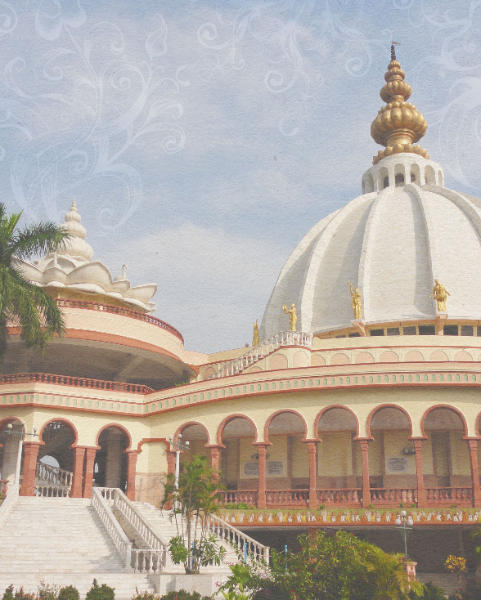
Mayapur is the birth place of Chaitanya Mahaprabhu, who is regarded by followers as an incarnation of Krishna. For Krishna bhaktas, this place is as sacred as Mathura or Vrindavan. Spread over 400 acres on the banks of the Ganga, the sprawling township is home to several temples dedicated to incarnations of Vishnu. Besides, there is the Samadhi Mandir dedicated to ISKCON founder His Divine Grace A.C. Bhaktivedanta Swami Prabhupada. The world’s largest vedic temple, as grand as the Hagia Sophia of Istanbul but bigger, is coming up in Mayapur. Called Vedic Planetarium, the structure is expected to be completed in 2016.
By the time I freshened up and reached the temple, the aarti had begun: The priests were offering lighted diyas at the altar of Radha Madhava and the Ashta Sakhis — Lalita, Champakalata, Chitra, Tungavidya, Vishaka, Indulekha, Rangadevi and Sudevi. Young men and women, standing below the pulpit, performed a beautifully co-ordinated singing and dancing ritual.
As the aarti progressed, the hall was getting packed with devotees. To begin with, people were just chanting the “Hare Krishna” mantra, but slowly and subtly, the atmosphere changed. Soon, the whole place reverberated with bhajan, kirtan and rhythmic dancing. At first, I stood there as mere spectator, unmoved and indifferent, but the power of collective devotion soon took over and I found myself matching my steps with the singing-dancing crowd. It was as if Krishna emerged from the idol, and leaving behind Radha and the Ashta Sakhis, started dancing with each one of us…
Someone tapped my shoulder and offered me the mahaprasadam that is distributed after the aarti. By the time I stepped out, the sun was up and the whole of Mayapur was swarming with activity. Teenage boys were pedalling furiously to reach their Srimad Bhagavatam class on time; kiosk-owners were displaying their wares that included tulsi-bead malas, photographs and figurines of little Krishna, flutes and conch shells. Outside the central kitchen, containers full of cooked rice, vegetables and daal were being loaded onto the station wagon, to be distributed to the hungry under the Iskcon food distribution programme. Book stalls were being set up by a group of Russian devotees. At a pandal next to the Vamsi Guesthouse where I was staying, a dozen residents were rehearsing a play to be staged on Janmashtami.
For the people of Mayapur, Janmashtami is a big event. The Bhagavatam classes during the week that concludes with Janmashtami, focus on the transcendental tattva, janma and karma of Krishna. On the eve of Janmashtami, an adhivasa ceremony is performed in the evening to invoke divine grace and help devotees prepare themselves for the next day’s festival. On Janmashtami, the festive mood sets in. A grand abhisheka is performed at midnight for the Radha Madhava deities.
For residents of Mayapur, every day is Janmashtami. “Janmashtami happens at every moment of our life. Whenever our heart is dark with misery, the Lord appears in our heart, bringing with him lots of love, care and protection. The manifestation of Krishna in our heart is the real Janmashtami,” says Jayapataka Swami, a senior initiating master in ISKCON.
Similar to the legends of Vrindavan and Mathura, Mayapur, too, exudes an ethereal charm. Every resident is soaked in love for Krishna. Whether you are promenading along the coconut tree-lined streets or sipping tea at a kiosk or eating prasad at the dining hall, you will be greeted by men and women, sporting a beatific smile and chanting with beads. If you stop to ask them for directions, they will do so happily; and then take leave of you with folded hands and a little bow. – Ranjeni Singh (An article from Speaking Tree 25th August 2013)