
By Divesh Maharaj
Anger is a natural emotion that every human being experiences. Mild forms of human anger may include displeasure or irritation. When we react to frustration, criticism or a threat, we may become angry. Anger may be a secondary response to feeling sad, lonely or frightened. When anger becomes full-blown rage our judgment and thinking becomes impaired and we are more likely to do and say unreasonable and irrational things. Anger is not just a state of mind. It triggers an increase in heart rate, blood pressure and levels of adrenaline. But anger also has survival benefits, and forms part of our fight or flight brain response to a perceived threat or harm.
When a human or animal decides to take action to stop or confront a threat, anger usually becomes the predominant feeling and takes over our behaviour, cognition and physiology. It is described in the Vedic literature that anger may sometimes be spiritually appropriate if it is provoked by injustices against the Supreme Lord or His devotees. A good example is Hanuman who displayed anger at Ravana for abducting Mother Sita.
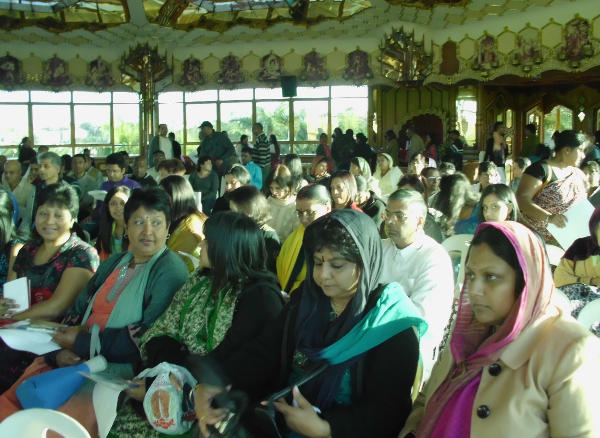
Partha Pratim Das of India presented an anger management workshop at the Sri Sri Radha Radhanath Temple in Durban, South Africa. Approximately five hundred people attended the programme. Partha Pratim quoted relevant verses from scripture relating to anger: “A person who desires liberation from this material world should not fall under the control of anger because when bewildered by anger one becomes a source of dread for all others.” Srimad Bhagavatam, 4.11.32. He explained that in the age of Kali, people are agitated by the slightest misunderstanding and that unmanaged anger can be dangerous. He screened an amusing video clip on road rage to demonstrate this point. Partha Pratim also presented many appropriate quotes from great personalities: “For every minute you remain angry, you give up sixty seconds of peace of mind,” Ralph Waldo Emerson.
He concluded by asking everyone to chant the Hare Krishna Maha Mantra which he said was a very potent way to overcome angry emotions. He stressed that sincere meditation on the sound vibration of the mantra has a calming effect on the mind and will purify one’s consciousness and will have the effect of eliminating unwanted emotions such as anger. He demonstrated this by playing an audio recording of Srila Prabhupada chanting and asked everyone to concentrate on the sound. After 10 minutes many attendees indicated that they felt calm and relaxed. In his concluding remarks, he again highlighted the potency of chanting in order to purify the consciousness and eradicate anger. He also stressed the importance of following a vegetarian diet which he indicated will also help in controlling anger. Vegetarian foods in the mode of goodness that are offered to Lord Krishna and consumed as prasadam remnants have a deep purifying effect on the consciousness. For further detials, e-mail iskcon.initiatives@gmail.com
I remember a saying that “you can tell the size of a man’s character by the size of the things that makes him angry”.
And most of the things that make us angry are trifles, when you consider the amount of misery in the world. It is embarrassing to fly into a rage because of being cut off in traffic while people are being gassed in Syria or cows are being needlessly slaughtered by the millions daily.
Anger (and similar emotions like annoyance, irritation and frustration) come from pridefulness and an inflated sense of false ego. We feel anger that someone does not give us the respect that we think we deserve. It is better to just think it is our (deserved) bad karma that a person or situation has “wronged” us, and feel grateful, knowing that we actually deserve much, much worse.
Even better is to develop the “tolerance of a tree” that Lord Caitanya advised in the third verse of His Siksastakam.
On Speaking Strongly in Srila Prabhupada’s Service
“To the devotees it was inconceivable. Why had Prabhupada, in the middle of his talk, invited a crazy hippie onto stage, given him a microphone and a seat, and then argued with him to the point of yelling and shouting? And all before an audience of twenty thousand!
Bhavananda: One man who had helped organize the pandal protested, “Oh, wamiji has gotten angry. This is not good.” But Srila Prabhupada seemed to have done it purposefully. He had spoken for a long time that evening on how to understand the Bhagavad-gita, and then he had this hippie brought on the stage. It was bewildering to us. We couldn’t figure it out.
Giriraja: Srila Prabhupada was actually using the entire incident to illustrate the process of understanding Bhagavad-gita. After the man left, Prabhupada completed his lecture by stating that one must approach Krsna or Krsna’s representative with a submissive attitude, by serving and inquiring, not simply asking challenging questions. The whole incident had illustrated this point.
Yadubara: Many in the audience misunderstood the incident. It caused a split. But those who understood what Srila Prabhupada had done could see that this hippie was a rascal, and this had been a time for transcendental anger against his nonsensical opinions.
Tejas: After everything was over, Prabhupada told us, “Just as the gopis were lusty for Krsna, Arjuna would also get angry for Krsna. So it is not bad that a devotee becomes angry for Krsna.” But many people in the crowd could not understand this point — how a devotee is not impersonal. (From Srila Prabhupada Lilamrta Vol. 5 Ch. 1)
Srila Prabhupada could have dismissed the hippie with a terse comment. But he didn’t. He called him up on the stage and publicly engaged in a shouting match with him. If any other member of ISKCON had done it, they would have been dismissed as immature or inexpert. Satsvarupa Maharaja has commented on this incident, explaining his understanding of Srila Prabhupada’s action: that Prabhupada wanted to stress on hearing the acarya, not challenging him. Srila Prabhupada is the empowered representative of Krsna, and there is no question of his preaching in a manner any less then perfect. Here we see him fighting on stage with a hippie.”
– From the “My Memories of Srila Prabhupada” by HH Bhakti Vikas Swami
Srila Prabhupada – Lecture — Seattle, September 30, 1968:
Upendra: Prabhupāda, what is the nature of anger? How is anger…
Prabhupāda: “Anger means lust. When you are lusty and your lust is not fulfilled, you become angry. That’s all. It is another feature of the lust. Kāma eṣa krodha eṣa rajo-guṇa-samudbhavaḥ. When you are too much influenced with the modes of passion, you become lusty. And when your lust is not fulfilled, then you are angry, next stage. And next stage is that there is bewilderment. And then next stage is praṇaśyati, then you are lost. Therefore one has to control this lust and anger. This controlling means you have to put yourself in the modes of goodness, not in the modes of passion. There are three modes of material nature: modes of ignorance, modes of passion and modes of goodness. Therefore if anyone wants to know the science of God, then he has to keep himself on the modes of goodness. Otherwise he cannot. Therefore we are teaching our students that “You don’t do this, you don’t do this, you don’t do this, you don’t do this,” because he has to keep himself on the modes of goodness. Otherwise he’ll not be able to understand. Kṛṣṇa consciousness cannot be understood on the platform of ignorance and passion. The whole world is under the influence of ignorance and passion. But this method is so simple that if you simply follow the four principles of restriction and chant Hare Kṛṣṇa, you are immediately surpassing all the modes of material nature. So the anger is on the platform of passion.”
By Giriraj Swami:
“One of Srila Prabhupada’s friends in Bombay, Dr. Patel, had been born in a Vaisnava family and followed Vaisnava principles of purity, but he often talked like an impersonalist, and when Prabhupada would accuse him of being a Mayavadi, he would beg to differ: “No, Sir. I am a Vaisnava.”
One day, on a morning walk on Juhu Beach, Srila Prabhupada happened to criticize a famous Indian religious figure whom Dr. Patel revered, and Dr. Patel became very upset. “You cannot criticize like this!” he said. But Srila Prabhupada replied, “I am not saying. Krsna is saying: na mam duskrtino mudhah prapadyante naradhamah–anyone who does not surrender to Krsna is a fool, rascal, demon, the lowest of mankind. I am not saying; Krsna is saying.”
Still, Dr. Patel kept insisting, “You cannot criticize like that!” The argument escalated to the point where Dr. Patel was shouting at Srila Prabhupada and Srila Prabhupada was actually shouting back. Dr. Patel was a leader among his friends–he was a little intelligent, educated in England, a doctor–but even his friends were catching hold of his arm and saying, “Swamiji has a heart condition. Don’t upset him.” They tried to drag him away. He was shouting, and Prabhupada was shouting, and we all were very disturbed. Finally they pulled Dr. Patel away.
Back in Srila Prabhupada’s room, Tamal Krishna Goswami asked Prabhupada, “Why do you tolerate him? What is his actual position? Is he a Vaisnava? Is he a Mayavadi? What is he?” In response, Srila Prabhupada told a story about a man who could speak fluently in many languages. He came to a place, but nobody could figure out where he was actually from. In whatever language people addressed him, he immediately responded perfectly in that anguage. So it was a big topic among the village people–where he was from. Finally one man said, “I will find out.”
One day that man snuck up behind the speaker of many languages and gave him a very hard whack, and then the linguist began cursing in his original language. Srila Prabhupada said that Dr. Patel was like that. “He can speak like a Vaisnava, he can speak like a Mayavadi, he can speak like a nationalist,” Srila Prabhupada said. “He can speak many different languages expertly. But when I hit him where it really hurt, his real language came out.” So then Tamal Krishna Goswami asked, “Well, then why do you tolerate him?” And Srila Prabhupada replied, “It is our duty to engage everyone.”
That is real compassion.”