
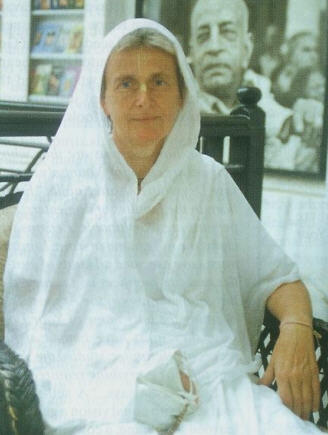
Submitted and endorsed by Visakha Priya dasi
Dharma is defined as a spiritually aimed activity in accordance with one’s material nature.
The Nature of the Divine
The Divine, according to the Vedic knowledge, comprises two principles: Purusha– male, and prakriti –female.
The purusha is God –the source of everything, the supreme independent, from whom everything emanates and upon whom everything rests. He is the one, the supreme enjoyer, who expanded Himself into many for His ever-increasing spiritual bliss (ananda) – bliss derived from spiritual loving relations.
Prakritiis His energy, the expansion of the purusha. As such, she is dependent on the purusha, attached to Him, rests upon Him, and is defined through Him (in the same way that the sunrays are dependent on the sun, and are defined through it). She is pleasing, and He is the enjoyer to be pleased. She is a secondary enjoyer, finding her pleasure in the pleasure of the purusha. Prakriti is the sum total of God’s energy, which includes the infinite number of spirit souls.
By nature, prakriti is attracted to the purusha in the spirit of loving service, and the purusha, by His nature, is attracted to prakriti in a mood of providing protection and shelter. He is the foundation, the Lord, and she is the dependent and the servant.
The purusha is the one, and prakriti denotes the numerous–including us, the souls. Thus, we all are essentially feminine, and our nature is love and service, especially love and service to the Lord. And since He is one and we are many, He reciprocates with each and every one of us, responding to the special mood of love each and every one of us has for Him. (This unique taste of love is our spiritual uniqueness.)
The Material World
Those souls who try to deny their prakriti nature and who want to experience the taste of being the purusha, meaning that they desire to enjoy separately from God and to try themselves to be God – the Lord, the center for whose pleasure everything is meant – those souls are cast into the material world. And here, in a perpetual struggle for supremacy, we put on and take off bodies, and each body offers a different type of opportunity for pleasure.
We are prakriti in relation to God (para-prakriti, or conscious spiritual energy meant for the service of the Lord), yet here, in the material world, we imagine that we are purusha (the master), and use the material energy, which is also prakriti (apara-prakriti, or unconscious energy), as an object for our own exploitation and pleasure.
Intrinsically, we are eternal, sentient, and longing for infinite happiness (sac-cid-ananda), but presently, we identify with unconscious and perishable matter – the material body – and think that it is us. The material body is made of 8 elements which constantly change – earth, water, fire, air and space (ether) form the gross body; and mind, intelligence and false ego form the subtle body. The material body appears to be alive only because of the soul within it.
The souls in the material world are by nature prakriti, or feminine, permeated with the spirit of purusha, or masculinity. That is to say, we are all egocentric here, trying to control and subordinate everyone else to our service, although our true happiness lies in service – in giving and in love.
What is Dharma?
Dharma includes law, duty, religion, order, purpose, natural quality, path – the divine law, or the natural activity according to one’s intrinsic nature.
Each and everything has its own certain nature, activity or use that is inherently correct for it. A watch, for instance, is meant to show the time. If we try to use it to crack nuts, we would most probably ruin it and fail its true purpose. Similarly, each body has natural modes of function. Animals and plants act according to their bodily nature. As humans, due to the fact that we have a higher intelligence that enables us to understand the greater complexities of life, we experience the two contradicting natures that are part of us: the prakriti nature, or our eternal-spiritual, feminine nature – as servants, and the purusha nature, or the masculine-egocentric desire to control and enjoy the material world – as an illusory master. This higher intelligence offers an opportunity for spiritual advancement and self-realization.
Therefore, for a human being, Dharma does not mean behaving only according to one’s bodily nature. We should act in accordance with our nature, but also with the aim of becoming cleansed from egocentrism, in order to return to our true eternal loving and giving nature – the prakriti nature.
In this sense, the term Dharma is not much different from Yoga, which, in its broader meaning, denotes every process that awakens us and connects us to our eternal spiritual nature.
The Vedic culture, in general, arranges the responsibilities and qualifications of people in 8 orders: 4 social and 4 occupational.
The social orders are organized according to the different stages in a person’s life:
-
Until 20-25– these are the years dedicated to studying (Brahmacharya).
-
At the end of these years of studying, a person enters into family life (Grihastha).
-
At around 55, a person’s children are independent and he can retire from social and economic involvement and dedicate himself to spiritual life (Vanaprastha).
-
The fourth stage is the stage of renunciation, suitable for those who are spiritually advanced and can live alone in the world (Sannyasa).
The occupational division is according to one’s propensity of work:
-
Teachers and religious priests (Brahmanas)
-
Administration and military (Kshatriyas)
-
Trade and agriculture (Vaishyas)
-
Artisans and laborers (Shudras)
This structure exists, in one way or other, in every society. Each of these divisions involves different commitments (social and occupational). When these commitments are used for spiritual advancement, that is to say, when one learns to perform them in a spirit of service and without false ego, that is Dharma.
The spirit of service is what turns a society into a community. Only through service and commitment to others can we create relationships and enable the natural flow of respect, compassion, and mutual assistance among all.
A Dharmic society is compared to the human body – in which every organ serves the entire whole. The Brahmanas are the teachers or priests, and are compared to the head. They offer their services without financial obligation, to maintain their integrity, and they live very simply from occasional donations. The rulers – men of power – are compared to the arms, and their role is to protect the entire society. They must listen to the advice of the Brahmanas, and must serve their citizens as their own children. The members of the mercantile class are compared to the stomach area. They are supposed to give donations and pay taxes, and support the entire society. The laborers, who are compared to the feet, carry the entire body. They are financially dependent, and serve the society with their hard labor.
In fact, the professional division applies only to the householders. In the years of studying, of course, there are no social or financial commitments. The young boys used to live in the home of the Guru (the teacher) and subsisted on donations, while the girls usually stayed at home and studied there. The studies were focused mainly on spiritual knowledge and cultural values (the rules of Dharma), and only in the later stages, would one begin to specialize in one’s occupation.
Upon entering family life, the commitments expand – to the spouse, the children, the profession, and the entire social and economic structure.
In the stage of renunciation, the social and economic commitments decrease, but the spiritual commitment to advance and to give spiritual knowledge and guidance to one’s surrounding grows. One’s vision expands from economic and familial interests to seeing the spiritual needs of people in general.
One who advances further in spiritual knowledge expands this vision, and sees the entire world as a home, and all the souls as connected to the Lord, meaning that the heart expands with love for all living beings. Such a person can wander alone in the world, having full faith in God, sharing spiritual knowledge with everyone.
Since spiritual realization is the highest goal of a Dharmic society; since service is the true nature of the spiritual self; and since each and every one in society can reach spiritual realization through his occupation and social roles, competition is no longer considered necessary or meaningful, and the people in such a society are completely satisfied in their natural occupation. The foundation of Dharma– a mood of service – creates harmony and full cooperation in society, while a mood of mastership – purusha mood – creates dissatisfaction and a constant struggle for supremacy.
On Men and Women
In addition to the 8 divisions mentioned above, there is another natural division – between men and women. This is a clear and obvious division, yet at times too exclusive, especially in a boundary-breaking age like ours.
In any case, even though all of us are feminine souls (prakriti) with a masculine mindset (purusha), and although we all try to enjoy in the world as the master and as the center (and therefore repeatedly take birth after birth), in general it can be said that the male body is an imitation of the purusha principle and the woman’s body is an imitation of the prakriti principle. Hence, the nature of their activities in the world is different.
They are naturally attracted to each other, like the purusha and prakriti. The man is attracted to the woman as a protector and a giver of shelter, and the woman is attracted to the man in the mood of love and service.
A man, due to his masculine nature, tends to define himself in terms of “I”, through personal career, security and status. A woman, however, tends to define herself more in terms of “mine”, of belonging – to the husband, the home, and the children. For example, when she cooks, it is part of her domestic activities and an expression of her love. But when he cooks, he is a “chef”…
The most fundamental difference between a man’s body and a woman’s body is found in the structure of their intelligence and emotions. This fundamental difference (manifested in a different brain structure) is meant to enable their various roles in society.
Since it is the woman who is responsible for nurturing relationships and creating a loving home for the children and husband, the woman’s intelligence, emotions and senses are always connected to one another. A woman is emotionally wise and intuitive, and consequently she is very practical, soft, mentally strong, and can connect and reconcile contradictions. However, because of this connection between her emotions and her intelligence, sometimes it is not easy for her to separate them when necessary, especially in contact with the aggressive and rough world. Because of her physically weaker body, she tends to feel unprotected when not surrounded by a loving atmosphere (therefore, when women are forced to go out into this situation, they usually close up and toughen themselves, harming their soft feminine nature).
In contrast, the man’s intelligence, senses and emotions are separate, enabling him to cope with the harsh and competitive world outside without being harmed. His intelligence can analyze, separate, and differentiate more efficiently, because it is less emotionally involved. However, at home –where he is expected to function emotionally – he is very vulnerable and dependent on the woman.
The man’s power is in his self-control (and this is also his Dharma), and once he lets go, gives in to his impulses and becomes needy, he moves into the emotional dimension, where he loses his wisdom. In contrast, the woman’s strength (and Dharma) is in her loyalty, patience, pleasing mood, and in being satisfied with what exists – which are also forms of self-control.
Men and women are different in the way they think and in their intellectual and emotional needs. In fact, they are two worlds apart. For instance, in distress, she needs compassion, someone to listen to her, and someone to share with, while he needs practical solutions (when he offers her his practical solutions while she is distressed, it only annoys her). The sequence of her conversation moves from one emotional point to another, she loves spending time in heart-to-heart conversations, and discussions about others and their emotional world fascinate her. The man, however, is interested in practical-intellectual discussions, and his conversation progresses in a logical sequence. She is sensitive to subtleties and responds to them, while he might not even notice them, etc…
Dharma (or a mood of service, commitment, and sensitivity to others) is designed to bridge and regulate the relationship between these two separate worlds, and make the cooperation between them conducive to spiritual advancement, until they reach full freedom from self-centeredness, or from the bodily identification of “I am a man”, “I am a woman”, returning back to the eternal spiritual nature – the prakriti nature.
Final Thoughts
When human culture deteriorates into a-dharma, when “doing whatever I like” becomes the central value, with competition and utilitarianism as a prime and respected incentive for action; or more philosophically, when the spirit of purusha becomes almost the exclusive ideal, it is only natural that the spirit of prakriti, of giving and love, is diminished and gradually disappears. The masculine ideal is seen as guaranteeing the fulfillment of more pleasure, and therefore men and women – all compete for such masculine supremacy. The result, of course, is imbalance, instability, lack of commitment, and insecurity. Due to the lack of connecting, bridging, and service – the feminine strength – or in a deeper sense, because of moving away from the spiritual ideal, the society, and even the nuclear family, turn from a supportive community into an aggressive and egocentric arena devoid of satisfaction.