
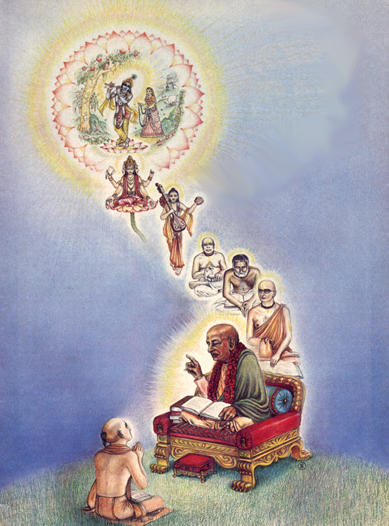
 By Dusyanta Dasa
In this article about the Spiritual Master(s) for the usage of definitions I will be referring to Srila Prabhupada’s works. It appears that Srila Prabhupada would use the word “guru” and “spiritual master” as synonyms, that is the words are interchangeable. But at a closer inspection the definitions of the word “spiritual master” breaks down into two manifestations. So for clarity of this article I will be using the words that Srila Prabhupada does for the word “spiritual master” which are found in the Chaitanya Charitamrta.
“The first manifestation described is the spiritual master, who appears in two plenary parts called the initiating spiritual master and instructing spiritual master. They are identical because both of them are phenomenal manifestations of the Supreme Truth.”
Cc Adi Lila Chapter 1 introduction, page 18.
In the beginning of Chaitanya-caritamrta, Srila Krsnadasa kaviraja Goswami writes;
“I offer my respects to my spiritual masters.” He uses the plural here to indicate the disciplic succession. It is not that he offers obeisances to his spiritual master alone but to the whole parampara, the chain of disciplic succession beginning with Lord Krishna Himself. Thus the spiritual master is addressed in the plural to show the authors high respect for all Vaisnavas.
When we address the spiritual master in terms of plurality we can only be referring to the instructing spiritual masters. The initiating spiritual master is in a singular address mode. But the instructing spiritual masters are limitless in their numbers.
“ A devotee must have only one initiating spiritual master because in the scriptures cceptance of more than one is always forbidden. There is no limit, however, to the number of instructing spiritual masters one may accept. Generally a spiritual master who constantly instructs a disciple in spiritual science becomes his initiating spiritual master later on.” Cc 1:35 purport.
Commenting on this paragraph there seems to be a paradox or anomaly at work. A disciple can accept many instructing spiritual masters AND generally an instructing spiritual master who constantly instructs the disciple becomes his initiating spiritual master. Out of many instructing spiritual masters there may be one who becomes the disciples’ initiating spiritual master, and this is a general rule. It may also be noted from this quote that the Diksa Guru must previously be a Shiksa Guru simultaneously but not vice versa. There is no such concept it would appear as an exclusive Diksa guru. If there is an emphasis then that would seem to be the Shiksa Guru being more emphasised, not the Diksa Guru.
As in the case in early Iskcon Srila Prabhupada set this example. He was the main, if not the only instructing spiritual master for all His disciples and later on became the initiating spiritual master for them all. But now after Srila Prabhupada is no longer with us this is not the case. Interestingly many devotees are trying to copycat this same principle today and apply the same environment, as it was when Srila Prabhupada was physically present..
In the Cc Adi-lila chapter 1 text 34 there is another interesting piece about the spiritual masters.
“ Vande gurun” is again the plural translation which in the word for word in this instance is translated as “I offer my respectful obeisance’s unto the spiritual masters” (plural) and in Srila Prabhupada’s word for word to the text Cc Antya-lila 2.1. The word “sri-gurun” is translated as “unto the spiritual masters in the parampara system, beginning from Madhavendra Puri down to Srila Bhaktisiddhanta Saraswati Thakura Prabhupada.”
But in that same verse from Cc Antya-lila 2.1 the word “Sri-guroh” is translated as “of my initiating spiritual master or instructing spiritual master”. The real relevance of this is that the singular spiritual master that we repose all our faith and love to and we worship as good as God can be either the singular initiating spiritual master or the singular instructing spiritual master. This is opposite to the assumed conception by many devotees that it is exclusively the initiating spiritual master.
Often the initiator is the main instructor but this is not always so. Another guru who is an instructing spiritual master may become more important to the disciple for a number of reasons. An initiator may very well direct the disciple to instruction from a more advanced devotee than himself, and so the disciple may become more attached to the instructor than the initiator.
“Gurun is plural in number because anyone who gives spiritual instructions based on the revealed scripture is accepted as a spiritual master. Although others give help in showing the way to beginners, the guru who first initiates one with the maha-mantra is to be known as the initiator, and the saints who give instructions for progressive advancement in Krishna Consciousness are called instructing spiritual masters. The initiating and instructing spiritual masters are equal and identical manifestations of Krishna , although They have different dealings. Their function is to guide the conditioned souls back home back to Godhead.” Cc Adi-lila 1; 34.
Thus the instructor spiritual masters are known as the saints or sadhus and have a huge inference in the barometer of our spiritual lives whether they are physically present or not.
Later on in Cc Srila Prabhupada describes the different kinds of instructing spiritual masters and numbers them as two. The predecessor Acharyas that Srila Prabhupada has referred to in His word for word translation are described as spiritual masters. But which spiritual master are They?? When using the plurality of the word spiritual masters this can only refer to the instructing spiritual masters.
From Cc Adi-lila 1; 35 Srila Prabhupada writes this concerning the service to the spiritual master;
“The service of the spiritual master is essential. If there is no chance to serve the spiritual master directly, a devotee should serve Him by remembering His instructions. There is no difference between the spiritual master’s instructions and the spiritual master Himself. In His absence, therefore, His words of direction should be the pride of the disciple.” Cc 1:35.
This can be and has been interpreted by many camps of devotees to mean different conclusive things. But in my own way I wanted to couple this text with another text from Srila Prabhupada’s Srimad Bhagavatam. And then I believe we obtain the genuine and original meaning. In the Cc 1:35 text, Srila Prabhupada is discussing the difference between when the spiritual master is physically present and when He is not physically present on the planet. I am saying the word “absent” is not just when the spiritual master is not in the disciples eyeball so to speak, not that kind of absence. This “absence” is when the spiritual master is no longer with us.
“In His absence” in this text means, “after He is no longer physically existing”.
So my meaning to this is that Srila Prabhupada is describing the time after He is no longer physically with us to the time when He was physically present. In the text He says His “words” of direction should be the pride of the disciple. The “words” of the spiritual master in this context are His Vani. When we apply the axiomatic principle of serving the spiritual master’s physical body when He is physically present and then serving His “words” or Vani when the spiritual master is no longer physically existing there is a service differentiation.
In Srimad Bhagavatam 4.28.47 Srila Prabhupada describes this service differentiation.
“The disciple and spiritual master are never separated because the spiritual master always keeps company with the disciple as long as the disciple follows strictly the instructions of the spiritual master. This is called the association of vani (words). Physical presence is called vapuh. As long as the spiritual master is physically present, the disciple should serve the physical body of the spiritual master, and when the spiritual master is no longer physically existing, the disciple should serve the instructions of the spiritual master.” S. Bhagavatam 4.28.47.
Thus according to these instructions we have a differentiation of service, relationship and function.
The disciple only serves the spiritual masters body, His vapuh, only when the spiritual master is physically present. The differentiation comes for the disciple when the “absent” spiritual master is no longer physically present. When there is no chance to serve the spiritual master directly, ie when He is no longer physically present, the disciple can serve the vani (words) of the spiritual master exclusively. Because there is no difference to the words of the spiritual master and the spiritual master Himself the disciple associates with the spiritual master and serves the spiritual master via His Vani.
Can we also describe the service to the spiritual master as “direct” when He is physically present and service to the spiritual master when He is no longer physically existing also as “direct”? In the quote from Cc 1:35,Srila Prabhupada states the following, “If there is no chance to serve the spiritual master directly…”, which infers a differentiation in service again; i.e. direct service and indirect service. Direct service appears to be only when the spiritual master is physically present and the inference appears to be when the spiritual master is no longer physically present the service is indirect service. Can we conclude that Vapuh-seva is temporary and direct whereas Vani-seva is eternal and indirect?
The service to His Vapuh was only ever temporary as Srila Prabhupada explains in His book “Elevation to Krishna Consciousness” pages 57-58.
“There are two conceptions of presence-the physical conception and the vibrational conception. The physical conception is temporary, whereas the vibrational conception is eternal.”
If we add up all these specific instructions together we find a cogent, common theme. That is that the service and therefore the relationship to the spiritual master is made of two types of service that chronologically/simultaneously follow. Firstly, service when the spiritual master is physically present to His physical body called vapuh, which is temporary. Then when the spiritual master is no longer with us (absent) service to His words or Vani, which is eternal.
But also the relationship is differentiated between the disciple and spiritual master when the spiritual master is no longer with us. The instructions are that the Vani of the spiritual master are eternal and that the Vapuh or physical presence of the spiritual master is temporary. Therefore the relationship of Vapuh, based on physical presence is also temporary and not eternal. The eternal relationship of the disciple and spiritual master is based on the Vani relationship and service. The Vani is also present when the spiritual master is physically present and when Srila Prabhupada was physically present He was the instructing spiritual master for all the devotees before they were initiated. Disciples in favour of the temporary Vapuh relationship may have overlooked this eternal relationship. Srila Prabhupada describes the physical conception as temporary so any relationship based on Vapuh is temporary; it’s real, but temporary. Its easy to understand that disciples may have mistakenly understood that their eternal relationship with their spiritual master was based on the vapuh relationship but Srila Prabhupada explains that vapuh is only a temporary conception.
The function of the spiritual master in His Vani is as instructing spiritual master and later the spiritual master becomes the initiating spiritual master for the disciple. This is the chronological principle of the environment when Srila Prabhupada was physically present. All disciples that first came to Iskcon heard/read Srila Prabhupada’s words and then became convinced to be His initiate.
In the form of His words He is instructing spiritual master. And in Cc Adi-lila 1:47 we find evidence that this is the case.
“Srila Krsnadasa Kaviraja Goswami states that the instructing spiritual master is a bona fide representative of Sri Krsna.Sri Krsna Himself teaches as the instructing spiritual master from within and without. From within He teaches as Paramatma, our constant companion, and from without He teaches from Bhagavad-gita as the instructing spiritual master…” Cc 1.47.
Here we find that the spiritual master is a bona fide representative of Sri Krsna as the instructing spiritual master. The example given is that in the form of Sri Krishna’s Vani (Bhagavad-gita) He is the instructing spiritual master and that the instructing spiritual master is the bona fide representative of Krishna.
In the form of His Vani the spiritual master is the instructing spiritual master and after He is no longer with us we can only serve His Vani because the Vapuh is finished and temporary. The eternal service is through His Vani as instructing spiritual master.
Srila Prabhupada goes further to define and describe the two different kinds of instructing spiritual masters.
“There are two kinds of instructing spiritual masters. One who is the liberated person fully absorbed in meditation in devotional service, and the other is he who invokes the disciples’ spiritual consciousness by means of relevant instructions. Thus the instructions in the science of devotion are differentiated in terms of objective and subjective ways of understanding.” Cc 1.47. Purport.
Now we are getting into the real detail of who are the instructing spiritual masters, how they function and who they are. The differentiated ways of understanding the science of devotion are subjective and objective, both are bona fide. And different kinds of instructing spiritual masters will teach according to their capacity and function and both are manifestations of the Supreme Truth. Srila Prabhupada further writes in the same purport;
“There is no difference between the shelter-giving Supreme Lord and the initiating and instructing spiritual masters. If one foolishly discriminates between Them, he commits an offence in the discharge of devotional service.” Cc 1.47.
A perfect example of the instructing spiritual master is Lord Krishna as Sri Govindaji acting exactly as the siksa-guru (instructing spiritual master) by teaching Arjuna the Bhagavad-gita. And of course as we all know that same Bhagavad-gita is available to us now in the form of Krishna’s Vani. The instructing spiritual master is a personal representation of Srila Govindadeva vigraha. And from the Bhagavad-gita 10.10 Lord Krishna instructs us all,
“ To those who are constantly devoted and worship Me with love, I give the understanding by which they can come to Me.” Bhagavad-gita 10. 10.
When we accept the teachings of Bhagavad-gita we are accepting simultaneously Lord Krishna as our instructing spiritual master and Srila Prabhupada as our instructing spiritual master- through the experience of Vani (words) and both being absent. Just as when Srila Prabhupada was asked in Melbourne, Australia, “ What is your idea of Jesus Christ?”, Srila Prabhupada answered,
“I told them, ‘ He is our guru, He is preaching God Consciousness, and so He is our spiritual master.’ ”.
Actually, anyone who is preaching God’s glories must be accepted as a Guru/spiritual master. Although Srila Prabhupada was critical of the practices of Christians themselves He did not nullify their relationship with Jesus Christ. Nor our relationship. He stated that Jesus Christ is our spiritual master- that must make Him our instructing spiritual master.
Can we accept non-physically present instructing spiritual masters? It appears that through Their Vani (words) we can accept Them either objectively or subjectively. And that Sampradaya/Parampara Acharyas can also be described as instructing spiritual masters.
Does the same relationship continue with the initiating guru after He is no longer with us as it did when He was physically present- it appears that the same relationship does not continue – the service and therefore the relationship is differentiated from vapuh to vani. Subjectively for the disciple the initiating spiritual master is differentiated into the instructing spiritual master and objectively the spiritual masters’ function is also differentiated. From both sides of the disciple-spiritual master relationship the relationship changes at the time when He no longer physically exists. Vapuh relationships are temporary whereas vani relationships are eternal.
To be contd.
Also, as Sri Caitanya Mahaprabhu said in the Sri Caitanya Caritamrita (Madhya-lila, 15:117), “One who awakens devotion to Krishna is certainly the spiritual master.” Just like Bilvamangala Thakura considered the courtesan, Cintamani, as one of his spiritual masters, because she awakened his devotion to Krishna. The very first line of the Krishna-Karnamrita reads, “All glories to Cintamani and my initiating spiritual master, Somagiri.”
Thank you to Dusyanta das Prabhu for his sastric research.
Yet, we have to beware the fact that a mere intellectual approach or a tentative to dissect Sastras may not be sufficient, if not inappropriate.
As a matter of fact, Krishna Himself explains that He can be approached through bhakti only… bhaktya Mam abhijanati..
Moreover, there is a gap of diffence in between jnana and vijnana, the former being based on theoritical knowledge, whereas the latter is most often the fruit of some experience or revelation…
Hence, the points stressed here that the relationship with the diksa guru is temporary, as it would be based on a temporary physical body, and that the relationship with the siksa guru would be eternal, since it is based on some vani, seems to be not only far fetched but also, to some extent, offensive, even though we understand there is no harm intended, but only maybe a lack of practical realization or of spiritual understanding…
First of all, we see that in Tattva, both the diksa and the siksa Guru are manifestations of the eternal Absolute Truth, free from duality “advaya jnana-tattva, vraje vrajera-nandana” who is Krishna Himself.
So, how could the relationship with one be temporary…?
Of course, we are referring here to Sat Gurus, who are pure devotees and liberated souls. We are not talking of some conditioned souls unduly assuming the position of guru.
So, on the first hand, we have to beware the first offense which would be to consider the body, vapuh, of the bona fide spiritual master, i.e. of the pure devotee as material: arcye visnu, shiladir gurushu…
On the other hand, a truly enlightened disciple doesn’t consider the service unto his Sat Guru to be temporary… How could that be…?
Neither, does he envision his service to his guru to be limited to the service opportunity which was availed to him in this lifetime by the causeless mercy of Sri Guru, to the forms they both temporarily assumed…
In other words, the service to vapuh, to the person of the spiritual master never stops and continues eternally all the way up to the spiritual world… To give you an example, we are not only serving Srila Rupa Goswami… We are serving Sri Rupa Manjari… This is why we are called Rupanugas… At least, we aspire to become so…!
Thus, we shouldn’t approach this topic from a material (and somewhat offensive) platform in relation with a temporary, yet not material, form assumed by Sri Guru…
Beisides, we have to understand the role played by these two Sat Gurus, i.e. the Diksa Guru and the Siksa Guru who, by the way, can jolly well be the same person…
As it is, the Sat Diksa Guru establishes our eternal relationship with Krishna. He makes us stand in the spiritual world. He is the manifestation of Sri Madana Mohana… He is the sambandha-jnana acarya. His personification is Sri Srimad Sanatana Goswami, who is Labanga Manjari is the spiritual world…
The Sat Siksa Guru, on his side, teaches us how to act within that relationship with Krishna. He teaches us how to walk in the spiritual world. He is the manifestation of Sri Govinda Dev… He is the abhideya-jnana acarya. His personification is Sri Srimad Rupa Goswami, who is Sri Rupa Manjari in the spiritual world…
As it is, both of these Sat Gurus, or that same one Sat Guru acting in both roles, have the capacity and purpose to lead us to the ultimate goal of life, prayojana, pure love of God, i.e. Krishna prema.
So, how could the relationship with any of these two acaryas, as well as the relationship with any of their bona fide successor acaryas be temporary…?
As an example, some time after I got initiated by Sri Srimad Gour Govinda Swami in 1986, he told me in Bhubaneswar: ” This is not a material relationship. It is not limited by time and space. This is an eternal loving relationship…” And then he added: “You should think about this very deeply, Puskaraksa…!”
In the example of Cintamani, as alluded to in Post 1, she acted as a vartma-pradarsaka-guru for Bilva Mangala Thakur:
Yāre dekha, tāre kaha Kṛṣṇa-upadeśa: (CC Madhya 7.128)
“Whomever you meet, you just give him the instruction of Kṛṣṇa.”
That is to say: “Become My devotee, surrender unto Me, absorb your mind in Me and you will come to Me”
This is how Bilva Mangala Thakur, later on, expressed his gratefulness towards Cintamani…