
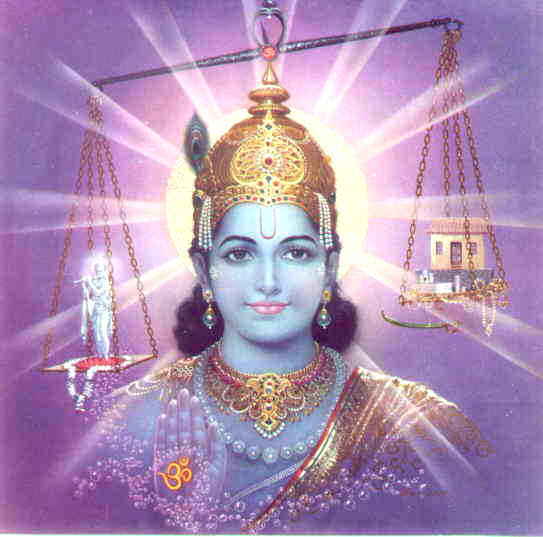
By Chaitanya Charan das
Question: Why does Krishna brag so much in the Bhagavad-gita, proclaiming that he alone is the Supreme, that his glories have no end and that everything attractive is a spark of his splendor? Why is he not humble?
Answer: Before passing judgment on Krishna, we need to understand the application of humility in the context of the philosophical reality and compassionate necessity that underpins the Gita. Let’s look at these three points – reality, necessity and humility – one-by-one:
Reality: In the Gita Krishna outlines a comprehensive worldview that offers a coherent and cogent understanding of reality. This vision of reality harmonizes seamlessly the many different conceptions of God that have emerged throughout human history: theism and deism, monotheism and polytheism, immanence and transcendence, pantheism and panentheism. This magnificent synthesis culminates in the most endearing conception of a loving and lovable personal divinity, Krishna, as the pinnacle of reality. When Krishna’s Gita statements are seen without this philosophical context, they may seem to be expressions of pride. But when seen within the broad philosophical context, Krishna’s statements turn out to be nothing more than simple affirmations of reality.
Necessity: Our mind may still press on: “Even if Krishna is speaking, why does he have to speak it so brazenly? Can’t he temper it with a bit of humility?” Actually, Krishna does temper his message with humility. Throughout the Gita, he frequently refers to himself in the third person, as in 8.22, 13.23, 15.4, 15.17, 18.61-62. Let’s analyze the third-person self-reference in 18.61-62. Here, Krishna says, “Surrender wholeheartedly to that Supreme Lord who is residing in the hearts of all living beings; by such surrender you will attain the supreme destination and the ultimate peace.” Krishna has already explained in the Gita 15.15 that it is he himself who is the Lord residing in the hearts of all living beings. Yet in 18.61-62 Krishna refers to himself in the third person and thus pre-empts any accusations of arrogance. Krishna’s use of third-person pronoun is similar to that used by a doctor when interacting with a patient: “The patient should surrender to the doctor’s treatment to become healthy.”
The doctor-patient metaphor can give us further insight into the method underlying the Gita’s message. Gita wisdom explains that all of us are patients suffering from the disease of love misdirection. We are all intrinsically and indefatigably love-seeking. Due to not knowing any object of love beyond this world, we seek love in worldly things and beings. However, as all worldly things and beings are limited and temporary, they inevitably disappoint or devastate us. Moreover, our love for the temporary binds us in this temporary world, where we suffer the inevitable miseries of material existence: birth, old age, disease and death.
The only way out of this misery is to redirect our love to the eternal. Gita wisdom aids us in this redirection by revealing in the realm of eternity a supremely attractive object of love: Krishna. As the supreme personal manifestation of the Absolute Truth, Krishna is unlimited and unlimitedly-expanding, everlasting and everlastingly-fresh. That’s why love for him never becomes stale and pale, as does the love of this world; love for Krishna excites and satisfies our heart forever and ever.
Krishna’s act of speaking the Gita is akin to a spiritual rescue operation meant to restore to us the power of wisdom for correcting our love misdirection. It is only to inspire us to focus our love on him that Krishna speaks about his unchallenged supremacy (7.7); it is only to guarantee us that his charm will never fade, as does the charm of everything worldly, that he declares his glories to be inexhaustible (10.40); it is only to reassure us that in loving him we won’t miss anything that we may be enjoying in our present loves that he proclaims that everything derives its potency to attract our love from a spark of his supreme love-attracting potency, his ultimate all-attractiveness (10.41).
To fulfill this compassionate, curative purpose of the Gita, Krishna at times subordinates humility to necessity. This is what happens when, Krishna, after referring to himself in the third person in 18.61-62, finds Arjuna lost in thought, being unable to decide his exact course of action. Seeing this, Krishna doesn’t let humility come in the way of the necessary clarity. So he proclaims unambiguously in 18.65-66, “Offer all your love to me; abandon all other obligations and just surrender unto me; I will take care of all implications and complications.”
Thus, Krishna’s entire approach is like that of a doctor who, though naturally humble, subordinates humility to the duty of curing the patient. In order to inspire faith in a patient, a reputed doctor may speak his authentic and impressive credentials unhesitatingly unambiguously. An intelligent person will understand that the doctor’s speech is not deficient in humility, but is driven by necessity. When we can thus contextualize the doctor’s speech, why can’t we contextualize Krishna’ speech?
Humility: Krishna still reveals his humility in an extraordinarily endearing way in the Gita – not through its message, but through its setting. Krishna speaks the Gita from the humble station of a chariot-driver, a position that he has accepted out of love for his devotee, Arjuna. The position of a chariot-driver is, more or less, like that of a chauffeur – certainly not a position that a braggart would ever accept voluntarily. But Krishna voluntarily and joyfully accepts this position because his happiness comes not in speaking his own glories, but in reciprocating love with his devotees.
Krishna’s becoming Arjuna’s charioteer is not a one-off fluke, but a graphic demonstration of a perennial principle that animates the highest spiritual realm, Goloka Vrindavana. Krishna’s message of his own supremacy is meant to point out to us that realm where love reigns supreme. In that world of love, Krishna no longer delights in announcing his godhood; instead, he conceals his godhood by his divine mystical potency and accepts any role, no matter how humble, that best facilitates the intensification and maximization of loving reciprocations with him. Thus, for those devotees like Yashoda who long to love him in a parental mood, Krishna accepts the role of a helpless child and plays it to perfection.
This world of love is our original home and final destination; it is where our heart will discover its ultimate fulfillment and we will actualize our supreme destiny. It is only to invite us to join him in this world of love that Krishna speaks of his majesty and glory. If ever again our mind starts mistaking these statements to be indicative of arrogance, let us remind ourselves that actions speak louder than words, and disarm the mind by meditating on Krishna’s disarming humility as manifested in his actions as a chariot-driver in the Gita and as a child in the spiritual world.
Humility means that one is not in the anxiety to have the satisfaction of being honoured by others. Krsna certainly didn’t show that anxiety. Srila Prabhupada neither. Humility simply is misunderstood many, many times.
Krishna is the Summom Bonum…nothing exists but Him. However, He is not impersonal, rather He is the Supreme Person, His effulgence which is all spiritual is His impersonal feature. The jiva souls are His parts and parcels. The jiva souls, due to envy of His supreme position as the Supreme Enjoyer, have occupied this world of misery in bodies composed of bile, mucous, and air. The jiva souls exhibit false pride in every way, shape, and form. Lord Chaitanya teaches the path of humility for the jiva souls. Further, Lord Chaitanya as the Supreme Devotee declares that Krishna is His only worshipable Object, even if He handles Me roughly by His embrace.
The Supreme Lord in His incarnation as the Supreme Devotee is teaching that it is the jiva soul that must cultivate humility, ever more profoundly. We may not truly experience our eternal position of dependence and humility until we are with Krishna in His spiritual abode, but our own true well-being, joy, and immersion in divine love will be realized then.
Krishna can act in any way He wishes, being fully independent. He can entice the gopis and then abruptly disappear, drowning the gopis is deepest spiritual angst, ever more immersed in His sweet love. We must agree to accept Krishna on His terms. We cannot relegate Him into being a “principle” that unifies all religion, and He thus says “sarva dharmam parityajya…” Give up all your religiosity and surrender to Him (Me, saith Krishna). It is not the statement that no man comes before the Father except through me (Christ). It is the Father/Creator/Friend of all establishing the preliminary requirement for entering into a true spiritual and conscious relationship with Krishna.
Pusta Krishna das