
By Dusyanta Dasa
Because the project of Cow Protection does not work as it should in Iskcon each year the subject of violence in the dairy industry is brought up. The idea and conclusion of Cow protection is to supply the members of Iskcon cow protected milk for spiritual sustenance, milk is described as a miracle food and helps to bring the mode of goodness to our gates of our bodies. It’s very important to illuminate the nine gates of the body by the mode of goodness to be able to progress in spiritual life as explained by Srila Prabhupada in Bhagavad-gita As It Is Chapter 14 Text 11. In the mode of goodness one can see things in the right position, one can hear things in the right position, and one can taste things in the right position.
Cows milk from protected cows brings so many facilities to the devotee it’s practically immeasurable, and the concept of cow protection within the Iskcon definition brings so much benefit to cows and devotees but Iskcon has not been able to take advantage of those benefits for the members of Iskcon. The idea of cow protection has many levels of understandings and applications to communities of devotees. The whole simple living ethos is based on cow protection, farming the land with minimum violence and self –sufficient goals in the context of the mode of goodness lifestyle.
The whole subject of violence within the dairy industry was the basis for spawning the alternate diet of vegans. Rather than embracing the positive instructions of cow protection by following the universal aspects of the definitions and goals of cow protection an alternative diet was sought. Bearing in mind the rather narrow criteria of considering violence in the dairy industry as an exclusive situation that is not applicable to any other type of farming, food production and horticultural enterprise the Iskcon conclusions are debated practically on a yearly basis.
Because Iskcon’s policy on executing the system of cow protection was so badly applied to the members of Iskcon there is no hope of supplying the members of Iskcon with cow protected milk. So devotees thought through this system and came up with the alternate diet of vegans thinking this diet includes no violence or less violence and is a preferable diet to the mode of goodness food, milk. Within this decision many scriptural criteria were not taken into consideration and the ethos of non-violence not really understood in practical terms. To counteract violence in the dairy industry we can follow at least two principles of action. We can boycott supporting the capitalistic principle of milk production from non protected cows or positively we can practice cow protection as it is intended. If we follow cow protection properly then every devotee world wide should be able to access that milk by choice rather than not by default.
In other words if Iskcon follows the proper criteria for cow protection all devotees would have the choice to access minimum-violent cow protected milk as authorized by the Vedic injunctions. Cow protection in its most efficacious form is the central basis for all devotees to solve all the economic problems of life but Iskcon has not been able to demonstrate that model to date. All the cow protection projects in Iskcon fail to achieve that model and symbiotic relationship with devotees in the community dynamic that solves all the economic problems of life and facilitates the mode of goodness in spade fuls.
Another really important principle that has been falsely introduced into our cow protection projects is the “non violent” verbiage. Because the cow protection projects have not been able to live up to the expectations that cow protection promises then the marketing of cow protection has had to present itself by the concept of “non-violence” so as to make out it is something it most certainly is not. There is no concept as non violence in any agricultural, horticultural and food production activity. That concept is not only not supported by scriptural references but is a speculative concept in a capitalistic marketing ploy to sell milk as a commodity rather than to supply milk for devotees’ consumption.
With reference to Srila Prabhupada’s Srimad Bhagavatam Canto 3 Chapter 29 Text 15 entitled Explanation of Devotional Service as spoken by Lord Kapiladeva to His mother. Here we find the genuine answer to the debate to the mysterious non violent application to agricultural products, food. In the actual Text 15 the word used to describe the type of violence a devotee is allowed to make whilst performing devotional activities is “natihimsrena” not “ahimsa”. This means “minimum violence” not “no violence”. And in the purport there is a great explanation all about eating food within this framework of violence.
One particular line is an answer to a posed question;
“You ask us not to eat meat, but you are eating vegetables. Do you think that is not violence?”
Srila Prabhupada writes;The answer is that eating vegetables is violence, and vegetarians (and therefore Vegans) are also committing violence against other living entities because vegetables also have life.
Of course Srila Prabhupada further clarifies this matter but does not change this principle that “eating vegetables is violence”. So for Agriculture and any type of food production there is the inherent principle of violence and by being a vegan or vegetarian does not take you out of this principle. Ahimsa in agriculture is a myth and the best a devotee and Iskcon can claim genuinely is to minimize that violence. The debate about becoming non violent by adopting veganism is inappropriate and actually adds to the violence of the dairy industry because they don’t positively support cow protection and cow protected lifestyles. Vegans just support the capitalistic principles of food production through synthetic fertilizers where as cow protection practiced properly is a holistic self contained principle where all fertilizer comes from the cows themselves.
Devotees only choice in the matter of violence in agriculture is to perfect the principle of cow protection so they have all their dairy products from minimum violent sources. Just by eating any bhoga produced from capitalistic and organic origins means supporting violence in the extreme. The only true way of escaping violence is to produce all our own food by way of cow protection where tractors are not used, chemical pesticides are not used, chemical herbicides are not used, dead animal based organic fertilizers are not used and abuse and exploitation don’t exist. Otherwise being vegan or vegetarian means violence.
We are eternal individuals and paramatma judges on our individual actions. That’s it. ISKCON is not some worldy policial organisation interested in worldy non violence. Arjuna had to fight creating so much so called disturbance. Spiritual life is about becoming self realised and going beyond worldly good and bad. By the mercy of guru and Gauranga. Of course. If one likes cows and farming in the context of devotional service that’s great but don’t start projecting it unto other devotees. btw Srila Prabhupada made many, many statements and to use them in yoga in love an devotion is the only way to use them without creating any karma. SP for instance also said he would be willing to serve cows meat when people would then start chanting Hare Krshna. How to use such a statement a presently?
It is counterintuitive to most, if not all political pundits and social commentators, that the answer to our contemporary problems, from climate change to war to human rights to equitable distribution of wealth, lies in cow protection. Yet it is a fact.
This material world is a place of misery, but nevertheless it is the property of the Supreme Lord. It is designed as a complete whole with a natural order of universal justice. Hare Krishnas are not nihilistic, other-worldly religionists who say the world is just an illusion so we need not be careful about how we behave in it. Everything we see all around us is the property of Krishna, “isavasyam idam sarvam”, and therefore it behooves each and every one of us to be very attentive to performing our duties property as servants and caretaker’s of Krishna’s property (and people).
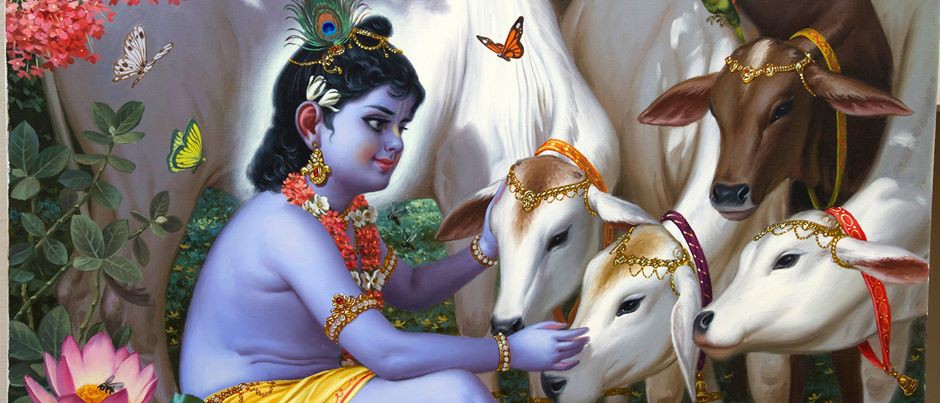
Krishna is known as Govinda and Gopala. Among Krishna’s most beloved “people” are His dear cows, calves and bulls. We hear from the sages of ancient India that the Earth herself (Goddess Bhumi) frequently assumes the form of a cow, and righteousness personified (Dharma) takes the form of a bull. This indicates that humans cannot be proper custodians of earth, or of justice and morality, unless they properly treat, respect and protect cows.
People may be vegans for some time, but in the history of the world there is no sustained civilization that has abandoned consumption of animal flesh without consuming milk products. Nature’s arrangement is that a cow will produce enough milk for her calves and also to feed humans. Cow’s milk is a miracle food that can be made into many nutritious and delicious foods and sweetmeats.
Ethics entails acting responsibly and gratefully with respect to nature and all living creatures. Nature has arranged for humans to drink the milk of cows, and in turn it falls on us to show kindness and compassion to cows. To take the milk and then butcher the older, non-productive cows is cruel and heartless. Such selfish behavior infects the way people treat other humans, too. One who sees a spirit soul in all living beings cannot act immorally, and those sworn to such immoral behavior (pasu-ghna) become killers of their own souls.
ISKCON’s primary mission is to disseminate the chanting of Hare Krishna and hearing Bhagavad-gita and Srimad-Bhagavatam, but if we do that well, then automatically people will see that cow protection is essential to godly life.
It is not surprising that ISKCON has not yet met with much success in its cow protection programs. ISKCON is young, it has few resources, and is a much smaller organization than many of the major churches or governments in the world.
Rather than focus on our failures of the past it would be better to see these as opportunities for improvement. “Failure is the pillar of success.”
Creating a sustainable, functional, peaceful and successful social and economic model for the whole world to follow is a great challenge. No one should realistically expect us to succeed overnight. But if we slowly but surely accomplish it, that will be a great achievement.
Critics of Vaisnavism (and religion in general) argue that other-worldliness saps the will and energy of humans to make needed improvements in the world. To a certain extent we can learn from such criticism. The message of Bhagavad-gita, with its emphasis on Arjuna performing his “worldly” duty in a spirit of complete submission and dedication to Krishna (thereby transcending materialism while externally acting positively), shows us that real Vaisnavas should not use other-worldliness as an excuse to shirk our prescribed duties. Krishna really has a design for how the world should go on, and each of us has a role to play in this world, just as Arjuna did. The perfection of yoga is to play our specific roles in Krishna consciousness, not to go live in the forest to make a show of renunciation.
And a big part of how human society should go on is through kindness to cows. Cows are dependent, and how we treat our dependents says a lot about our character.
We are now faced with an incredible opportunity in the history of the world to demonstrate that the real teaching of Bhagavad-gita is not impractical or unsustainable. We can show that the answer to the age-old question “What if everyone became a Hare Krishna?” is: “In that case the whole world would become like a wonderful paradise in which the miseries of old age and death and war and famine and plague would become insignificant, practically nonexistent.”
So rather than worrying about how others have failed, we should use our energy to generate positive support for a successful, exemplary model of society in which advanced Vaisnavas can teach by their own behavior as well as their words how to cure the ills of society, through Krishna consciousness and cow protection.