
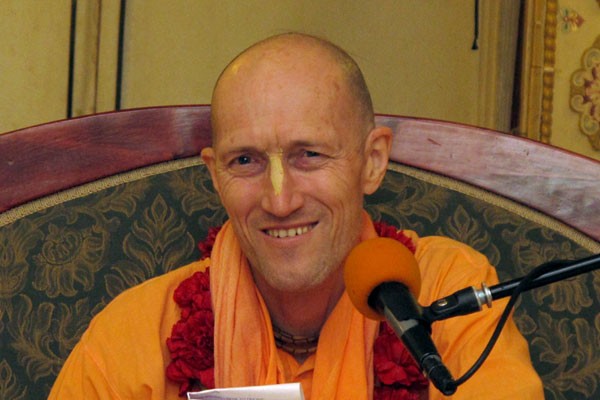
By Bhaktivikasa Swami
The article “Husband as Guru” (http://www.dandavats.com/?p=12637) presents much of what could be considered common-sense advice for husbands struggling to come to the human platform. However, some grave faults mar what otherwise might in some contexts have been valuable suggestions.
By predicting “that some men will not agree with me (although I doubt any woman will disagree)” the author anticipatingly dismisses any opposition from males as being mere chauvinism. I am currently imprisoned in a male body, but it is not on such flimsy grounds that I perceive significant blemishes in what he calls his “illumination.”
The author constructs his thesis on a series of assertions (for instance, that “we have a higher divorce rate in ISKCON than in the outside society”) for which he submits no evidence. Presumably the reader is supposed to accept everything he says just because he says it. However, no serious scholar in any field would give credence to a series of opinions built on unsubstantiated pronouncements. Such is the stuff of cultism and propaganda, not intelligent journalism.
Also in short supply are quotations from guru, sadhu, and sastra – a triad that defines gender issues quite differently to the manner prevalent in today’s world.
But by far the most disturbing element of the article is that the author contradicts Srila Prabhupada. He poses the question, “Is it the woman’s fault?” then paraphrases Srila Prabhupada by stating that “a failed marriage is usually the woman’s fault,” and follows with his own opinion: “if a woman has a good husband, she will stay loyal.” (Noticeably, the comment of Srila Prabhupada’s that the author feels compelled to oppose is directly derived from sastra – Srimad-Bhagavatam 4.4.3 – and concerns Sati’s disobedience to Lord Siva, whom I hope the author does not adjudge to have been “unreasonably demanding”).
In effect, the author declares that he is right in this matter, and that Srila Prabhupada and sastra (and maybe Lord Siva also) are wrong. As if to emphasize his point, he twice states his assertion in exactly the same words.
The underlying theme of the article, that disloyalty in women is caused by bad husbands, is observably not always true (I will refrain from providing sad stories here, so as not to add more pain and embarrassment to the concerned ex-husbands).
Surely the main qualification of a husband as guru is that he himself be a strict follower of his own guru. Only a faithful disciple is fit to be a guru; to uphold the opposite to one’s guru places one outside the parampara and renders one disqualified to instruct anyone. To misuse the status of being a disciple of Srila Prabhupada to instruct others contrary to Srila Prabhupada’s teachings is clearly a type of cheating and a betrayal of Srila Prabhupada.
In the following purport, to SB 9.3.10, Srila Prabhupada offers guidance to wives who feel their husbands to be difficult and incompatible. Unlike at least one of his seemingly more enlightened disciples, Srila Prabhupada does not offer grounds for a woman to abandon a husband who she supposes to be not “good.” Being based on sastra and dispensed by an indisputably realized acarya, Srila Prabhupada’s advice is certainly more valuable and authoritative than the “illuminations” of anyone who has the audacity to contradict him.
— QUOTE —
“This is an indication of the relationship between husband and wife. A great personality like Cyavana Muni has the temperament of always wanting to be in a superior position. Such a person cannot submit to anyone. Therefore, Cyavana Muni had an irritable temperament. His wife, Sukanya, could understand his attitude, and under the circumstances she treated him accordingly. If any wife wants to be happy with her husband, she must try to understand her husband’s temperament and please him. This is victory for a woman. Even in the dealings of Lord Krsna with His different queens, it has been seen that although the queens were the daughters of great kings, they placed themselves before Lord Krsna as His maidservants. However great a woman may be, she must place herself before her husband in this way; that is to say, she must be ready to carry out her husband’s orders and please him in all circumstances. Then her life will be successful. When the wife becomes as irritable as the husband, their life at home is sure to be disturbed or ultimately completely broken. In the modern day, the wife is never submissive, and therefore home life is broken even by slight incidents. Either the wife or the husband may take advantage of the divorce laws. According to the Vedic law, however, there is no such thing as divorce laws, and a woman must be trained to be submissive to the will of her husband. Westerners contend that this is a slave mentality for the wife, but factually it is not; it is the tactic by which a woman can conquer the heart of her husband, however irritable or cruel he may be. In this case we clearly see that although Cyavana Muni was not young but indeed old enough to be Sukanya’s grandfather and was also very irritable, Sukanya, the beautiful young daughter of a king, submitted herself to her old husband and tried to please him in all respects. Thus she was a faithful and chaste wife.
— END OF QUOTE —
Not all instructions of Srila Prabhupada were meant to be fully applicable in all times, places, and circumstances, and a responsibility of astute disciples is to point out exceptions and how to deal with them. Such guidance can be actually valuable if it is based on guru, sadhu, and sastra, not on hearsay and personal opinions. Members of ISKCON are duty-bound to uphold the authority and dignity of Srila Prabhupada, and should be careful to not even unwittingly position themselves as more knowledgeable, wise, and expert than he.
Kudos to HH Bhaktivikas Swami for his astute analysis of Mahatma Prabhu’s “illuminations.” He nicely articulated many of my own thoughts on the matter.
One of the subtexts of Mahatma’s article was that the majority of men in ISKCON are sub-human jerks that need to be domesticated and civilized by their long-suffering but morally superior and saintly wives. But, as Srila Prabhupada writes in his purport to Bhagavad-gita 16.7:
“But modern education has artificially devised a puffed-up concept of womanly life, and therefore marriage is practically now an imagination in human society.”
And, in Srimad Bhagavatam 9.3.10: “In the modern day, the wife is never submissive, and therefore home life is broken even by slight incidents.”
Srila Prabhupada had abundant experience of dealing with his disciple’s marriages. As Srila Prabhupada warned Gopala Krsna Swami (then Prabhu) when he wanted to get married to a devotee girl.
The message is clear — modern women — devotee or not, are not inclined to be submissive making peaceful marriage an imagination. Thus, Mahatma Prabhu is flagrantly contradicting the founder acarya by saying the opposite and putting himself in a superior position that Srila Prabhupada as rightly pointed out by BVKS. He may hope to become popular with a certain group of women but this is not the behavior of someone dedicated to preserving the teachings of the guru parampara. I hope that the GBC EC will take steps to correct Mahatma Prabhu’s deviant teachings or stop him from being a guru, a role he seems unqualified for.
Mahatma Prabhu said “don’t make unreasonable demands of your wife.” But to an unsubmisive wife any request from her husband is unreasonable.
I thought it was very funny that Mahatma uses Srila Prabhupada’s comment in regard to Sati’s disobedience of Lord Siva as an example to prove that Srila Prabhupada and sastra are wrong and that women are disloyal because the husband is bad. Lord Siva is the perfect husband and to this day young women here in India pray to Lord Siva to get a good husband like him. Yet Sati was disloyal and disobeyed her perfect husband. Disloyalty is the fault of the disloyal.
Recently the GBC published a paper “A GBC Foundational Document – Srila Prabhupada: The Founder-Ācārya of ISKCON” by Ravindra Swarupa Prabhu http://www.dandavats.com/?p=12375
In the introduction the GBC EC writes:
Yet Mahatma Prabhu an initiating guru in ISKCON publicly contradicted Srila Prabhupada in his text, thus undermining Srila Prabhupada’s position. If the GBC is serious about its commitment to Srila Prabhupada as the founder acarya then some public correction of Mahatma Prabhu needs to be made so the message is clear.
As Bhaktivikasa Swami pointed out:
“Surely the main qualification of a husband as guru is that he himself be a strict follower of his own guru. Only a faithful disciple is fit to be a guru; to uphold the opposite to one’s guru places one outside the parampara and renders one disqualified to instruct anyone. To misuse the status of being a disciple of Srila Prabhupada to instruct others contrary to Srila Prabhupada’s teachings is clearly a type of cheating and a betrayal of Srila Prabhupada.”
If Mahatma’s egregious behavior of betraying his guru is not publicly corrected then the whole statement of the GBC EC is a farce.
Thank you, Your Holiness, for your comments on the article “Guru as Husband.” Certainly, it is hard for Western minds to always cheerfully accept Srila Prabhupada’s comments on women. But then it usually comes from not understanding the context in which his statements are made—for example, the famous (or rather infamous) statement that women like to be raped. I discussed the matter with Srila Prabhupada’s disciple Visakha Devi, and she told me that in one of her old dictionaries, one of the synonyms for the word “rape” is “kidnap,” which perfectly fits in with the story Srila Prabhupada comments on. From another point of view, I always took solace in Srila Prabhupada’s response to Jadurani and (I think) Govinda dasi when they inquired from him whether it was true that they couldn’t make as much advancement as the men because they were women. And Srila Prabhupada replied, “Yes!… If you think that you are women.”
One thing I would like to emphasize is that although Srila Prabhupada is sometimes considered to be a chauvinist by certain standards, it is actually not the case, as exemplified in the following verse and purport of Srimad-Bhagavatam (SB 7.11.28):
A chaste woman should not be greedy, but satisfied in all circumstances. She must be very expert in handling household affairs and should be fully conversant with religious principles. She should speak pleasingly and truthfully and should be very careful and always clean and pure. Thus a chaste woman should engage with affection in the service of a husband who is not fallen.
PURPORT
According to the injunction of Yajnavalkya, an authority on religious principles, asuddheh sampratiksyo hi mahapataka-dusitah. One is considered contaminated by the reactions of great sinful activities when one has not been purified according to the methods of the dasa-vidha-samskara. In Bhagavad-gita, however, the Lord says, na mam duskrtino mudhah prapadyante naradhamah: [Bg. 7.15] “Those miscreants who do not surrender unto Me are the lowest of mankind.” The word naradhama means “nondevotee.” Sri Caitanya Mahaprabhu also said, yei bhaje sei bada, abhakta-hina [Cc. Antya 4.67], chara. Anyone who is a devotee is sinless. One who is not a devotee, however, is the most fallen and condemned.
Continued in next post
… SB 7.11.28. Purport continued:
It is recommended, therefore, that a chaste wife not associate with a fallen husband. A fallen husband is one who is addicted to the four principles of sinful activity — namely illicit sex, meat-eating, gambling and intoxication. Specifically, if one is not a soul surrendered to the Supreme Personality of Godhead, he is understood to be contaminated. Thus a chaste woman is advised not to agree to serve such a husband. It is not that a chaste woman should be like a slave while her husband is naradhama, the lowest of men. Although the duties of a woman are different from those of a man, a chaste woman is not meant to serve a fallen husband. If her husband is fallen, it is recommended that she give up his association. Giving up the association of her husband does not mean, however, that a woman should marry again and thus indulge in prostitution. If a chaste woman unfortunately marries a husband who is fallen, she should live separately from him. Similarly, a husband can separate himself from a woman who is not chaste according to the description of the sastra. The conclusion is that a husband should be a pure Vaisnava and that a woman should be a chaste wife with all the symptoms described in this regard. Then both of them will be happy and make spiritual progress in Krsna consciousness.
Hare Krsna Hare Krsna
Krsna Krsna Hare Hare
Hare Rama Hare Rama
Rama Rama Hare Hare
Your servant,
Visakha Priya dasi
Seems like I invariably agree with the articles of His Holiness Bhaktivikas Swami Maharaja. He toes the same line as His Divine Grace Srila Prabhupada and doesn’t sway and bend to appease popular opinion. Thank you for publishing this.
I think Mahatma prabhu’s article was wonderful. Bhakti Vikas Maharaj has quoted from Srila Prabhupad’s purport but he misses the point by a mile! This article really reads like a Chauvinistic rant.
Mahatma Prabhu in his article is talking about disloyal husbands not ones that have a bad temperament Chyavana Muni. There’s a lot of difference between a husband who is irritable and one who is cheating!
Dear Bhaktivikasa Swami Maharaja,
Please accept my humble obeisances,
All glories to Sri Guru and Sri Gauranga.
All glories to Srila Prabhupada.
I am very afraid here to be perceived as defending the article of Mahatma prabhu (http://www.dandavats.com/?p=12637) but it is not the case.
I actually appreciate your holiness article and this whole discussion about marriage.
One question I have and I would appreciate if your holiness could help me with is following.
A quote of interest for this discussion is:
(…) Generally, separation between husband and wife is due to womanly behavior; divorce takes place due to womanly weakness. (…) [extract from Srila Prabhupada’s purport of SB 4.4.3]
My question is: what is meant by generally?
is it 51% of the time?
51% would be consider majority and therefore the term “generally” could be applied to 51%…
Or is it 60% of the time, 70%, 80%, 90% or 99% ???
Of course, Srila Prabhupada then goes on saying:
“The best course for a woman is to abide by the orders of her husband. That makes family life very peaceful. Sometimes there may be misunderstandings between husband and wife, as found even in such an elevated family relationship as that of Satī and Lord Śiva, but a wife should not leave her husband’s protection because of such a misunderstanding. If she does so, it is understood to be due to her womanly weakness.”
But if 51% or even 55% or 60% is accepted as generally, would that indicate that in 40% of the case, the men is guilty of a weakness and is the source cause of the divorce?
Out of, let’s say 500 divorces, 300 would have been caused by the womenly weakness and 200 would have been caused by the menly weakness.
Would that be a fair vision of the word “generally” used in Srila Prabhupada’s purport of SB 4.4.3 ?
your very fallen unworthy aspiring servant,
Kanai Krsna Dasa.
Part 1 of 2.
I do not intend to disagree with either Bhaktivikasa Maharaja or Mahatma Prabhu who are both very senior, and experienced Srila Prabhupada disciples. But, for a long time, I have had some thoughts about SrilaPrabhupada’s statements in the verse alluded to and I would like to reveal them here.
SB 4.4.3:
Translation:
Thereafter Saté left her husband, Lord Çiva, who had given her half his body due to affection. Breathing very heavily because of anger and bereavement, she went to the house of her father. This less intelligent act was due to her being a weak woman.
Purport:
According to the Vedic conception of family life, the husband gives half his body to his wife, and the wife gives half of her body to her husband. In other words, a husband without a wife or a wife without a husband is incomplete. Vedic marital relationship existed between Lord Çiva and Saté, but sometimes, due to weakness, a woman becomes very much attracted by the members of her father’s house, and this happened to Saté. In this verse it is specifically mentioned that she wanted to leave such a great husband as Çiva because of her womanly weakness. In other words, womanly weakness exists even in the relationship between husband and wife. Generally, separation between husband and wife is due to womanly behavior; divorce takes place due to womanly weakness. The best course for a woman is to abide by the orders of her husband. That makes family life very peaceful. Sometimes there may be misunderstandings between husband and wife, as found even in such an elevated family relationship as that of Saté and Lord Çiva, but a wife should not leave her husband’s protection because of such a misunderstanding. If she does so, it is understood to be due to her womanly weakness.
With all due respect, I would like to point out that if one said, GENERALLY divorce takes place due to womanly WEAKNESS, this would be more accurate paraphrasing than saying, “usually a failed marriage is a woman’s fault”.
There is no need to justify this statement of the Founder Acharya. But to assure an audience that we are accepting this literally (and properly) we might add that this statement is not justification for assuming a failed marriage is the woman’s fault. Srila Prabhupada says, “generally”, this means the odds are that this is the reason, but it would be speculation to assume it is the reason in a specific case without looking at the details.
Part 2 of 2.
And even then we would have to question ourselves as to whether it is our duty to make such a judgment. If it is our duty to judge and we determine an act is due to weakness, this might mitigate, to some degree, the level of blameworthiness of a particular transgression. Therefore this knowledge of, “womanly weakness” is needed to avoid judging a woman too harshly.
Although it may be off the topic, I think it is interesting that, in a verse shortly after the one cited above, Srila Prabhupada again brings up the topic of gender temperaments.
“The mother and sisters of Saté could not follow the others, who did not receive Saté very well. Due to natural affection, they immediately embraced her with tears in their eyes and with loving feelings. This shows that women as a class are very softhearted; their natural affection and love cannot be checked by artificial means. Although the men present were very learned brähmaëas and demigods, they were afraid of their superior, Dakña, and because they knew that their welcoming Saté would displease him, although in their minds they wanted to receive her, they could not do so. Women are naturally softhearted, but men are sometimes very hardhearted.(SB 4,4,7).”
So in this case, the womanly nature gave Sati’s mother and sister the strength to do the right thing. In this case it was right for a wife( Sati’s mother) to disobey the tacit orders of her great husband, Daksa. In this case the general nature of men caused them to be weak; they failed to act properly. Out of fear of Daksa they repressed their feeling and due to hard heartedness they did not give proper respect to a great person.
If we accept Srila Prabhpada cannot deny that, for the most part, the tendencies are consistent with the gender of the individual; but no one says this is 100% Sometimes a most manly man can exhibit excessive attachment for family members(womanly weakness) For example of Arjuna, was crying on the battlefield due to this sentiment. And we all know the anecdote of the Queen properly acting in a hardhearted way by forbidding the King to enter the palace when a war was taking place. So when Srila Prabhupada says generally I accept it very literally. You cannot dissolve it and say there is no general distinction between the temperaments of each. And you cannot say that it is impossible. or even rare for one gender to exhibit tendencies usually associated with the opposite gender.
Thank you
Here is a quotation that supports Maharaja’s points. Actually there are very many such references in Srila Prabhupada’s books to support Maharaja.
Please note that Srila Prabhupada is here referring to those who are practicing “bhakti-yoga, or devotional service”. So we should conclude that he is making this point for us, not as it is sometimes portrayed, for the non-devotees or ordinary people.
SB 4.27.1
Purport (excerpt)
Generally women are very much passionate and are less intelligent; therefore somehow or other a man should not be under the control of their passion and ignorance. By performing bhakti-yoga, or devotional service, a man can be raised to the platform of goodness. If a husband situated in the mode of goodness can control his wife, who is in passion and ignorance, the woman is benefited. Forgetting her natural inclination for passion and ignorance, the woman becomes obedient and faithful to her husband, who is situated in goodness. Such a life becomes very welcome. The intelligence of the man and woman may then work very nicely together, and they can make a progressive march toward spiritual realization. Otherwise, the husband, coming under the control of the wife, sacrifices his quality of goodness and becomes subservient to the qualities of passion and ignorance. In this way the whole situation becomes polluted.
The conclusion is that a household life is better than a sinful life devoid of responsibility, but if in the household life the husband becomes subordinate to the wife, involvement in materialistic life again becomes prominent. In this way a man’s material bondage becomes enhanced. Because of this, according to the Vedic system, after a certain age a man is recommended to abandon his family life for the stages of varnaprastha and sannyasa.
It’s better to approach a realised disciple than just an astute disciple. A realised disciple is automatically astute but an astute disciple is not automatically realised. One should therefore become person Bhagavata. Then one understands where actual movement takes place. Bhagavad-Gita 4.18 explains this very nicely.