
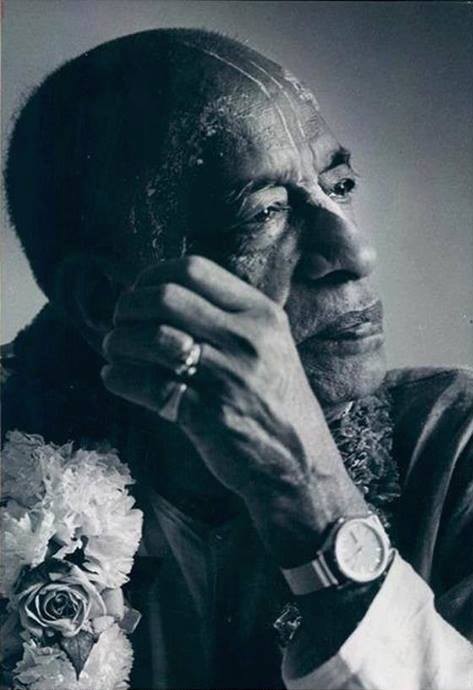
By Kesava Krsna Dasa
It is known that Srila Prabhupada was not fond of ambiguities like “maybe, perhaps, could be…” and so on, and we often follow suit to express ourselves in absolutist terms, convinced of our infallible statements. The problem with this is that in the face of Srila Prabhupada’s varied and nuanced teachings our utmost one-sided certainties can expose us as certain and total fools who actually expose our political and biased natures. Srila Bhaktisiddhanta says this:
“Those, whose judgment is made of mundane stuff, being unable to enter into the spirit of the all-loving controversies among pure devotees, due to their own want of unalloyed devotion, are apt to impute to the devotees their own defects of partisanship and opposing views.” (Brahma-samhita 5.37 purport, p.72, BBT edition)
We generally do not like it when devotees disagree with us, especially if we think that we have the backing of guru, sadhu and Sastra – our air of infallibility can be rudely tested in front of a Vaisnava audience. This leads us to either robustly defend our stance or for others to take sides in ensuing debates. Intransigence sets in to the point of stubbornness. Again, faced with variations in Srila Prabhupada’s output, our one-sided defence can mean defending the indefensible or literally Bow-wowing as a dog might, automatically – as in being dogmatic.
Taking sides in intractable ‘disputes’ is a “defect” if they originate with pure devotees and acaryas. We are allowed to discuss the merits of each side but not to impose our “mundane stuff” with “partisanship”, even if we are all-knowing. Even if we favour one side because it might be a practical solution or help resolve some misunderstanding, we should do it in such a way that the other side remains valid and is not minimised.
It is good to be sure of ourselves, but when two opposing assured viewpoints fortified with certainty clash for all to read or hear, it can give the impression of us belonging to a society of one-siders. The thinking seems to be that we have a little grasp of Krishna conscious philosophy and therefore we ‘know’ everything. How impudent!
Such is the way we judge individuals and link them with levels of spiritual advancement that it is hard for devotees to express themselves if a weakness persists, or that there is actually something else that Srila Prabhupada said that contradicts what they say. We do not often see devotees say, “I do not know” if confronted with a genuine conundrum question, or to admit, “you are right”, or even to say, “aren’t we both right?” And when we see ‘differences’ between acaryas we have to say both or all are right. Who are we to say, “Both sides or all sides cannot be right?”
It is not blind obedience to agree to apparently opposing enlightened views, it is revealing our equitable respect. For example, on a mundane level we all have experience of when we say something to a group of people; some will agree with us and some not. Our human side will tell us that those who agree with us are more likely to be our friends and favour us. Those who disagree might bear our grudges.
If we are still un-conditioning in spiritual progress it will be risky for us to attribute the same human behaviour towards those who transcend human conditioning. Would this mean that we shall remain inconclusive by not favouring one side (opinion) or another? In answer to this, we need to wonder if we are capable of prising reasons for such ‘differences’ if we are sadhakas.
Although Srila Prabhupada was more than a sadhaka he nonetheless placed himself in a position of informed obedience to our previous acaryas by amicably avoiding “partisanship” in some of his purports. We should note how, in the next quotation, he still acknowledges Srila Sridhara Swani as the original commentator on Srimad Bhagavatam, yet at the same time according merit to other subsequent commentaries on a particular issue. He resolves it in a mature Vaisnava way:
“According to Sripada Sridhara Svami, the original commentator on the Bhagavatam, there is not always a devastation after the change of every Manu. And yet this inundation after the period of Caksusa Manu took place in order to show some wonders to Satyavrata. But Sri Jiva Gosvami has given definite proofs from authoritative scriptures (like Visnu-dharmottara, Markandeya Purana, Harivamsa, etc.) that there is always a devastation after the end of each and every Manu. Srila Visvanatha Cakravarti has also supported Srila Jiva Gosvami, and he (Sri Cakravarti) has also quoted from Bhagavatamrta about this inundation after each Manu. Apart from this, the Lord, in order to show special favour to Satyavrata, a devotee of the Lord, in this particular period, incarnated Himself.” (SB 1.3.15 purport)
We do not see Srila Prabhupada saying that Srila Sridhara Swami is incorrect. Rather he acknowledges all sides. With additional Sastric evidence cited by subsequent commentators he seems to favour these but without minimising Srila Sridhara Swami – all points are valid. We, on the other hand are apt to take sides more brazenly.
For instance, here is a true case of a relatively senior devotee who has a disagreement with senior management. The devotee writes the grievances on a Facebook page which inevitably invites comments. New and uninformed readers of that post click ‘Like’ and agree with a one-sided version of events via comments. Aren’t they unwittingly committing offence, when Vaisnava etiquette dictates that juniors should not take sides when seniors have differences?
We may cite democracy or freedom of expression, but a climate exists that makes such dealings normal and acceptable. In his diary on Srila Prabhupada, Tamal Krishna Maharaja mentioned how he engaged in energetic discussions with his spiritual master on ‘implausible’ cosmological information concerning the position of the earthly realm. Afterwards, Tamal Krishna Maharaja went to Srila Prabhupada and begged forgiveness for his robustness. Tamal Krishna Maharaja noted that Srila Prabhupada was disturbed by this asking for forgiveness, saying that it was a discussion, however heated. In light of this, are we being oversensitive when calling for discussion standards?
It is not the energy we are concerned about, within reason, but being reasonable. Reasonable also means to be sensible, realistic, rational, even-minded and equitable when positing a viewpoint or acknowledging obvious disagreements, especially when we are still learning, as all of us are. It is fairly unusual for devotees to accommodate possible alternative viewpoints other than their own. This can be unreasonable and imbalanced.
Many of our discussions pertain to immediate and practical matters. Others obviate that both sides are right in the bigger scheme of things. Another problem we find is where Srila Prabhupada might have said things in private or to a small number of followers not meant for public consumption, i.e.; Sunday class.
It might be difficult to gauge what is ‘off-the-record’ when most things he said were recorded. Without consideration of possible cultural ramifications, some devotees brandish such ‘in-house’ sayings as headline news or frontline internet presentations. This is where responsibility in preaching and outreach arises – we should resist being indiscriminate.
Devotees will ask to what extent can support for either side of a personal difference or ongoing debate go? Are we allowed to show faithful allegiance? Are we unknowingly revealing some hidden motives by taking sides? How about this occurrence where sometimes a senior devotee by dint of being ‘senior’ can participate in a discussion or debate and belittle and tosh all fair contributions made by those younger? And this does happen…It can amount to abuse of seniority. Srila Bhaktisiddhanta warns:
“While inquiring into the Absolute Truth, we cannot remain steady in one conclusion after hearing various apparently opposing statements of many acaryas. Considering the weakness of the audiences, the instructing acarya often does not have the opportunity to disclose many subjects”. (Sri Gaudiya Bhasya of Sri Caitanya Bhagavata)
In our efforts to defend ISKCON there has been problems. Such defence will hurt Vaisnava sensibilities and sometimes it is unavoidable. Defending ISKCON also means to take sides. Despite this, Srila Prabhupada would warn of such dangers to spiritual progress and to lend a broader perspective, like here:
“So far as your question about controversy amongst the disciples of Bhaktisiddhanta Sarasvati Goswami Maharaja, that is a fact. But this controversy is not material. Just like in a national program, different political parties are sometimes in conflict and make propaganda against each other, but their central point is always service to the country. Similarly, amongst the disciples of Bhaktisiddhanta Sarasvati there may be some controversy, but the central point is how to preach the mission of His Divine Grace. If the central point is fixed up then there is no harm in such controversy. Every individual being must have his opinion; that is the significance of individuality, but all such differences of opinions must coincide in Krishna.” (Letter to Mandali Bhadra / 28 July 1969)
As we know, Srila Prabhupada would caution and warn at the same time on the same issue. Now that his disciples have matured more, there is an expectation that ‘cross-border’ Vaisnava institutional interactions should be a trouble-free affair, but recent history has shown otherwise.
As the founder of ISKCON Srila Prabhupada was honest in that if he was not sure about something, he would say so. He certainly did not impose himself as all-knowing in an arrogant seniority sense. He readily instructed that we try not to be inflexible and rigid:
“As for your question about Santa Rasa and the opinions of Rupa Goswami and Sridhara Swami, I don’t remember. You can send me the appropriate passages. There is no reason why Acaryas cannot differ on certain points.” (Letter to Upendra / 19 February 1972)
Devotees might think it is a sort of crime if we explore many angles of vision on any given subject. Such exploratory methods may appear inconclusive. But really, by doing this we absorb more and learn. Chances will increase that we see harmony in contradictions and unity in opposites and be able to “enter into the spirit of the all-loving controversies among pure devotees…”
Devotees are naturally biased towards Krishna, though we temper that sometimes with sama-darsinah outreach appealing to all people of cultures, religion and traditions. While this appears to be soft-peddling, we can be pretty hard on each other as devotees. There is no wrong in offering valid opinions and acknowledging that there are other equally valid opinions besides our own. The sooner we reasonably acquiesce to this the sooner we shall open up to learn and grow towards that transcendent realm where all contradictions and opposites harmonise effortlessly. If we cannot do that here, how will we do that there?
Ys Kesava Krsna Dasa.
Kesava Krsna Dasa
You say, ” It is fairly unusual for devotees to accommodate possible alternative viewpoints other than their own. This can be unreasonable and imbalanced”.
I am not sure how unusual it is for devotees to accommodate alternative viewpoints. But the main problem I have with your article is that I only see one side presented;that we should accommodate alternative views. The fact is, sometimes it is appropriate to accommodate alternative views and sometimes it is not.
Of course dialogue is more desirable than competitive debate. Dialogue means both sides accept the view of the other; this results in a more complete understanding.
But dialogue is not always possible, and competitive debate is also useful if it is done in a rational manner. If someone can answer objections, to their view in a rational way, their position becomes more valid and intellectually justifiable.
I find that, usually, while engaged in competitive debate devotees are guilty of some logical fallacies, but overall the arguments are on a rational basis. We should not try to discourage competitive debate simple because of a few imperfections.
To say there is something wrong, in principal, with rejecting a certain viewpoint is, in itself, a fallacious argument. The onus is on the debater to show why the alternative view should be accepted or at least acknowledged.
Part One:
Sita Rama Prabhu,
Thank you for your compliments in placing me as a “both-sider” or “multi-sider”. I deliberately choose to be a both-sider or multi-sider in certain circumstances, not all.
Cases where we can demonstrate “one-sidedness” are in situations where none-negotiable issues surface, like challenging the minimum of 16 rounds daily, warning of prematurely jumping to raga-bhatki when not qualified, and the need in pointing out mayavada tendencies and so on.
In cases where there are ongoing debates in which our acaryas have lent opinion, like this jiva fall case and others, it is wise that we remain both-siders or multi-siders. To be a one-sider in the face of acarya evidence differing from us can reveal our foolishness.
This is where your “competitive debate” position needs to be corrected. If we choose to be competitive where acaryas have supported both sides of a discussion by being one-sided and favouring one side only, in a competitive way – that is also foolish.
Srila Prabhupada often cited the example of the gopis of Vrndvaana in terms of ideal competitiveness. Do we ever read where ‘rivals’ gopis complain, “Oh no! Srimati Radharani has pleased Krishna first?” Spiritual rendition of competition is where all others are acknowledged and glorified for pleasing Krishna.
If we transfer this rendition to how we can properly hold “competitive” debates, then we shall see more of, “Valid point Prabhu, but how does that reconcile with my position?…Really good observation Mataji, and you quoted such and such acarya, but how does that fit in with this that is also quoted by such and such acarya?…I guess we’ll have to accept both points…I am still not fully purified in consciousness yet to give a definitive stance…perhaps if I attain bhava I might have a totally different perspective…but let us acknowledge all those differing opinions…they can help broaden my own outlook…”
Ys Kesava Krsna Dasa.
Part Two:
Compare the above reasonableness with mode of passion competitiveness: “But such and such acarya said this, therefore it is correct…No matter what acarya you quoted, this is the answer…that is nonsense, you have destroyed your credibility because all the evidence points to this…all the rest of the devotees are gullible and naïve for believing in that, when the obvious conclusion is right here before your eyes…”
How can we pit our one-sidedness against the enlightened opinions of acaryas who say differently on different matters? So what type of “competitive debating” are you referring to? One can be competive in none-negotiable situations, but not where acaryas have sided on both sides.
If your idea of competitiveness is used to justify winning just for the sake of it, that is also raja-guna. Because to be competitive means to compete, the question is, to compete for what? How can we compete with the opinions of our acaryas? However, we can consider the differing opinions made and not minimise them. If we become one-sided in these situations, we minimise one or other acaryas.
If we compete against the opinions of our acaryas, our competitiveness ceases to be competitive – it becomes tamo-guna offence-laden reputation upkeep that exposes our lack of Vaisnava discretion. If you intend to be competitive, it has to applied to the correct circumstance.
Ys Kesava Krsna Dasa.
Kesava Krishna Prabhu
Both sides have been addressed see comments 185, 186, 188, Resting the Jiva fall-no Fall case.
Srila Prabhupada explains we never fall because our conditioned life is simply a dream. When we awake from the dream we are in Vaikuntha. So the answer is yes, we never fall and yes, we were in Vaikuntha before becoming conditioned ( jiv jago). That is seeing both sides.
It is not practical to qualify every statement and deny conventional speech. Srila Prabhupada and devotees usually use the word, fallen, fell, etc, to indicate the conditioned state of forgetting Krishna.We are supposed to know that anything that sounds like we have developed material qualities is just a manner of speaking. There SHOULD be no need to qualify that this is not contradicting the first lesson-that the soul is always pure, it cannot develop any material quality, it just contacts matter the way air contacts aromas. When the air contacts aromas it’s elemental structure does not change; however its un- aromatic nature is not manifest. We never REALLY fall.
It is easy to explain how we can say we are fallen when in reality no one can ever fall. That is the fall position. It is not taking one side and denying another. Rather it is using a little intelligence to understand that Srila Prabhupada does not contradict himself.
What, exactly, is the problem you see with this understanding?
Sita Rama Prabhu,
You asked what I thought of your latest ‘both-sides’ comments. I say they are a refreshing and welcome addition to that discussion. This can create a platform from where an official stance on the fall / no fall issue can appease and satisfy both sides. Well done!
Ys Kesava Krsna Dasa.
I agree with Sita Rama.
Srila Prabhupada is not speaking anything against the previous acaryas and he doesn’t present two opposing views. He presents how we should understand the topic at hand and the only thing we have to do is to study what Srila Prabhupada says and then we will realize how there is no opposing views neither within Srila Prabhupada’s teachings or between Srila Prabhupada’s teachings and the previous acaryas teachings. Srila Prabhupada has cleared the missunderstanding that there exist two opposing ideas.
Now there might be persons who think that the teachings “mean” that the fallen conditioned souls who are in this material world have never ever been engaged in loving devotianal service to the Supreme Personality of Godhead in the spiritual World. Not even originally. That is another topic.
In that case if someone thinks that the teachings “mean” that, then I would like to challenge such persons to present at least one quote from Srila Prabhupada or any of the previous acaryas or the scripture, which says exactly that. Then that would be something which would make at least me suprised.
In other words if that understanding would be a fact then I would expect at least one quote which says something like.
“No one of the fallen conditioned souls have never ever been engaged in pure devotional service in the spiritual world, not even originally.”
If someone could present at least one such quote then we would have an issue, but so far I have not seen any.
Regarding Srila Prabhupad’s style of teaching his disciples when they might be speculating:
a disciple might say, for example, “I think….”. Srila Prabhupad would interject: “What is the value of your thinking?!” His idea was to break us of the tendency toward speculation. If one is discussing philosophical points, we always have the books/shastra to refer to. That is the most straightforward and “parampara” was to proceed.
With procedural things, it is best not to be too overbearing…ie, if we recognize that Krishna is the ultimate controller, the ultimate sanctioner, the One who arranges the environment for each soul…then our “suggestions” are really only submitted for ultimate approval by Krishna. Hence, we often heard…”let’s see what Krishna wants”. This implies many things, the first of which is that “I am not the controller”. Humility in these relative matters is therefore mandatory. We must always guard our treasure of Krishna consciousness, and not strive to become ‘demigod controllers’ in this world.
Pusta Krishna das
Dear Pusta Krishna Prabhu, you are right in your analysis.
“Humility; pridelessness; nonviolence; … all these I declare to be knowledge, and besides this whatever there may be is ignorance.”
Bg 13.8-12
This is also one reason why I percive that Srila Prabhupada seems to be very keen on that we understand the original spiritual position of all living entites.
If we see the living entites here in this material existense as some people who some time in the past popped out of the Brahman and started their existens with making a very, very foolish choice, then we might not have the same respect and humility in our dealings with them than we would have if we realized that theese living entities in front of me are eternal servants of Krsna who have been serving Krsna for eternety but now for the time of just a few breaths of Maha-Visnu have become a little bewildered about who he is.
It is said that if we do not respect and love all living enteties then it becomes very difficult for us to develop love for Krsna.
Srila Prabhupada states:
“We should be Always ready to offer respect to all, not only devotees, but everyone. Everyone. Because every living entity is originally a devotee of Krsna. But circumstantially, being covered by the coat of maya, he’s playing like demon.”
Nectar of Devotion Lecture — Vrndavana, October 23, 1972