I’m not sure where this class was held, but I’m grateful to whoever asked Vraja Vihari to address this. I think he made a good start, and I’d like to see more public discussions of issues like this. This is a sample of the kind of civil discourse I’ve advocated among devotees for a very long time. Thanks so much for sharing it.
“Prabhupada said, ‘A devotee is thoughtful as much as a non-devotee is speculative.’ So we think deeply about these things. And in that way, whenever practical, we’re in a creative mindset.
“There’s two different kinds of arguments, creative and fixed. Now if we’re talking to somebody who’s saying ‘There is no God’ or, you know, ‘Who is this Krishna anyway?’, we’re not gonna say, ‘Well maybe you’re right; maybe Krishna’s not so important. Let’s compromise.’ You know, ‘We say Krishna is God, you say there is no God, let’s compromise. Let’s just say ‘Maybe He’s a demigod or a really smart person.’
“We don’t do stuff like that, because its a fixed… there’s some fixed things, ‘Krsnas tu bhagavan svayam’. So that’s a fixed argument. And certainly we have those sometimes, you know, when we are out…
“But when we’re talking within the confines of guru, sadhu and sastra, within Vaisnava sanga, we have the luxury of being more creative, and being able to weigh both sides, or maybe five different sides, and considering what’s the best.”
–Vraja Vihari dasa
Very important point.
And of course it takes some wisdom, experience and realization to understand whether we are dealing with a “fixed” type of proposition on which there can only one acceptable position or opinion, or one on which reasonable Vaisnavas of good will may transcendentally disagree.
Some might consider the whole approach described above as “liberal”, whereas the “conservative” position is that there is never any ground for differences of opinion between pure Vaisnavas on any subject. But I think Vraja Vihari Prabhu has pretty well established in tis lecture that such a view would be a kind of “fanaticism” and not a positive thing. There really are situations in which Vaisnava etiquette demands that we acknowledge that other devotees may have opinions or points of view different from our own, and that we should listen, be thoughtful, re-evaluate our own positions, and be willing to compromise if necessary for the sake of cooperation and unity and maintaining good relations.
Not everyone is going to agree with every other devotee about every little detail. We are persons, and different persons have different points of view. We do not negate variety. The spiritual world is full of variety. Sometimes Krishna disagrees with Balarama. But in the Vaikuntha atmosphere such disagreements only make everything more beautiful and splendid.
I have not personally listened to this talk as it is much too long, a transcript would have been better. But here is the comment of a friend of mine about this video.
I just listened to the presentation. I characterize it as descriptive, not analytical. That is, he describes things that we see, for example, that liberal and conservative devotees disagree with each other. He quotes William Blake’s aphorism, “both read the Bible day and night one reads black while the other reads white.” However he does not try to explain the gulf of difference between liberal and conservative devotees outside of saying that there extremes on both sides and that we shouldn’t be extreme. This is pretty much the substance of what he says.
What I would like to see however is an account from a particular point of view, liberal or conservative, both preferably, but either one would be acceptable, in accounting for why the difference exists. For example, a liberal trying to explain why he thinks the conservatives different from them, and vice versa.
What will eventually become clear is that the liberals and conservatives in fact do have fundamentally different approaches to epistemology. We both read scripture in different ways because we differ substantially in the way they think that something can be understood. The answer to the question of who is right and who is not right can be settled by analyzing the different approaches of the different camps.
This is overall a good thing because it opens up the possibility of being able to objectively assess the different approaches to understanding by the different camps and comparing them to the tradition. In other words how close is this particular camp in its way of reading srila prabhupada or shastra, how close are they to what the tradition actually describes. And you will probably find that one camp is closer to the tradition than the other.
It also opens up the possibility of finding one camp mostly close to the tradition but its approach to understanding could be adjusted a little more to bring it in line with tradition. It can also help determine whether a particular approach is just fundamentally at too far a distance from the tradition to be useful at all. So this is what an analytical approach to understanding liberal / conservative differences could bring to resolving some of the important issues at hand.

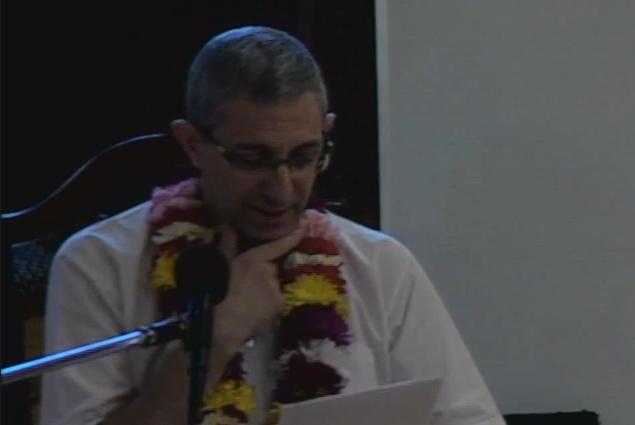
I’m not sure where this class was held, but I’m grateful to whoever asked Vraja Vihari to address this. I think he made a good start, and I’d like to see more public discussions of issues like this. This is a sample of the kind of civil discourse I’ve advocated among devotees for a very long time. Thanks so much for sharing it.
“Prabhupada said, ‘A devotee is thoughtful as much as a non-devotee is speculative.’ So we think deeply about these things. And in that way, whenever practical, we’re in a creative mindset.
“There’s two different kinds of arguments, creative and fixed. Now if we’re talking to somebody who’s saying ‘There is no God’ or, you know, ‘Who is this Krishna anyway?’, we’re not gonna say, ‘Well maybe you’re right; maybe Krishna’s not so important. Let’s compromise.’ You know, ‘We say Krishna is God, you say there is no God, let’s compromise. Let’s just say ‘Maybe He’s a demigod or a really smart person.’
“We don’t do stuff like that, because its a fixed… there’s some fixed things, ‘Krsnas tu bhagavan svayam’. So that’s a fixed argument. And certainly we have those sometimes, you know, when we are out…
“But when we’re talking within the confines of guru, sadhu and sastra, within Vaisnava sanga, we have the luxury of being more creative, and being able to weigh both sides, or maybe five different sides, and considering what’s the best.”
–Vraja Vihari dasa
Very important point.
And of course it takes some wisdom, experience and realization to understand whether we are dealing with a “fixed” type of proposition on which there can only one acceptable position or opinion, or one on which reasonable Vaisnavas of good will may transcendentally disagree.
Some might consider the whole approach described above as “liberal”, whereas the “conservative” position is that there is never any ground for differences of opinion between pure Vaisnavas on any subject. But I think Vraja Vihari Prabhu has pretty well established in tis lecture that such a view would be a kind of “fanaticism” and not a positive thing. There really are situations in which Vaisnava etiquette demands that we acknowledge that other devotees may have opinions or points of view different from our own, and that we should listen, be thoughtful, re-evaluate our own positions, and be willing to compromise if necessary for the sake of cooperation and unity and maintaining good relations.
Not everyone is going to agree with every other devotee about every little detail. We are persons, and different persons have different points of view. We do not negate variety. The spiritual world is full of variety. Sometimes Krishna disagrees with Balarama. But in the Vaikuntha atmosphere such disagreements only make everything more beautiful and splendid.
I have not personally listened to this talk as it is much too long, a transcript would have been better. But here is the comment of a friend of mine about this video.