
By Dusyanta dasa
If this were a boxing contest in a fight between the two opponents “margarine” and “butter” it would not be a fair contest. It’s like trying to compare a little girl or boy fighting against Muhammad Ali. In this example “butter” is Muhammad Ali because butter is a natural food product. Not only is butter a natural food product but more importantly the body recognises butter when butter is ingested. Because margarine spreads are not natural, when it is ingested into the body it is not recognised as a natural product by the body.
These two points are of huge consideration and consequence when it comes to choosing your foods. The first being how food is manufactured, processed and made, from its raw products, and the second being how it reacts inside the body and how the body recognises what is food and what is toxic so it can be dealt with properly by the body.
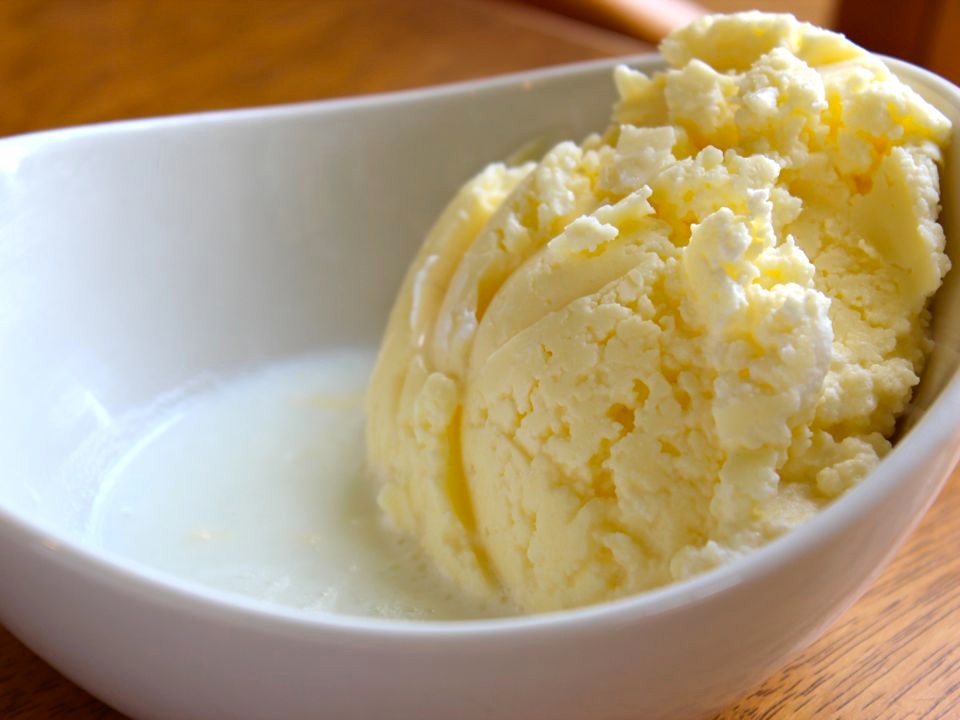
How butter is manufactured is common knowledge. We start off with protected Cows that are milking that eat green lush grass. The milk is processed into butter by a method called churning, which ends up with two products; butter and buttermilk. And as far as that there is nothing more to report about making butter. The only variations in butter are directly related to the diet of the milking cows. The more the cow eats fresh green grass during a full moon period the resultant butter takes on an appearance more or less yellow. Some butter has salt added and some don’t. Because butter is not artificially processed, and made from milk, which is a natural product and the human body easily recognises it as such, it is able to digest it accordingly.
The process of manufacture of margarines and other oil based spreads is entirely a different story. Spreads originate from the Industrial Revolution period when just about everything was changed into an industrial method of approaching foods. It was originally manufactured as a food to fatten up turkeys for Christmas in the USA. It killed all the turkeys. So back to the drawing board. Margarine is but one molecule away from being plastic and shares 27 ingredients with paint. Because originally it was white they added pigments to make it yellow like butter.
Then they add artificial flavours and synthetic vitamins. To harden the original oils that make up the bulk of spreads they have to partially hydrogenate it. The oils are extracted from seeds, nuts and vegetables through high temperature and pressure with hexane solvents. Hexane is a petro-chemical solvent used as glue in the car manufacturing industry. The oils then go into another high pressure and high temperature container and mixed with a nickel catalyst. Out of the container comes a grey cottage cheese looking substance, which has to have emulsifiers added to iron out the lumps. The product is steam cleaned twice to help smooth it out and remove the horrible aromas. Then it is bleached to get rid of the grey colour. At this point the spread can be used as a vegetable shortening. After adding annatto or some other natural colouring it’s then packaged into blocks or tubs for sale as margarine or spreads.
What we can do as an experiment is to buy some margarine and some butter. Leave them open in a shaded place in your garage or garden shed and within a couple of days you will notice a couple of things.
No flies, not even those annoying flies will go near the margarine, which should tell you something straight away. Margarine does not rot or decompose or smell because it does not contain any nutritional value; nothing will grow on it. Even micro-organisms will not find a home to grow because margarine is nearly a plastic. The process transforming the oils to a solid state spread is called Hydrogenation. You see it all the time in the ingredients list on tubs of spreads. Hydrogenation is a process using extremely high temperatures to change the structures of fat molecules from fluid to solid, which also prevents the fats from becoming rancid and simultaneously strips all the nutrients out.
The false propaganda attached to all these modern foods is an amazing non-truth that we have all bought in to. It’s another graphic scenario of the “cheaters” and the “cheated”. Mostly the propaganda has been aimed at converting people to believe that margarines and spreads are a healthy option to the traditional butters and olive oils. Their false argument was that animal fats such as butter had high levels of the wrong sorts of cholesterol, a contributing factor to heart disease and that vegetable fats were a better fat for the body to digest and had low levels of good cholesterol. In fact the total opposite is now largely recognised as true. Because the oils in spreads have had to been processed into Transfats or Hydrogenated Oils/Fats, the chemical molecules of that original fat transformed the essential fatty acids into a form of fat that the human body does not even recognise as food. Essentially what happens is that the vegetable fats are “oxidised” by the process they are put through, the “oxidised” fats that contain the cholesterol are the ones that are not healthy, whereas in butter the fats remain originally natural which the body deals with accordingly.
The body therefore naturally treats the Transfats as toxins and dumps them around the body in stores and in some organs like the liver and blocks them up. The Transfats are just like “plastic fats” since they do not resemble food anymore. And the critical melting point of these fats is 9 degrees above human body temperature, which means that these fats do not break down inside the human body. Consequently the Hydrogenated fats are unrecognisable as natural food products by the body because they are not made up of the same components as the body. When we use the word “natural” in the context of food it means what is natural for the body and what is recognisable by the body as food. We can analyse products that are called “food” until the cows come home but the important factor in “food” is how the body recognises it, then how the body deals with it and then the effect it has on the health of the body, and the immune system.
On a label of a plastic bottle of milk there is information as to what is contained and any processes the product has received. In a British supermarket called Morrisons, and it does duplicate to all supermarkets, it is labelled as British Whole milk. Organic, delicious naturally. So by that information it looks like we are doing well, it’s naturally whole milk and delicious but then in small print the Organic whole milk has been processed. Organically produced standardised pasteurised homogenised whole milk. Now the product that started off life as Organic Whole milk has been heat-treated to 161 degrees Fahrenheit and then high-pressurised treatment to bombard the fat molecules to merge with the milk.
Once milk is pasteurised the nutritional value in the milk is destroyed and all that is left is a delicious sanitized liquid of oxidised fat that causes more health problems than the miraculous elixir of Mother Nature’s perfect milk ever did. Throughout the board in modern industrialised food production is the way our food is processed. Practically speaking all the processes destroy the original nutritional food, organic wholesome milk is destroyed by the processes of pasteurisation and homogenisation. Not only is it destroyed but the fats have now become oxidised which is why the foods become a health hazard. In the story of the processing of seeds, maize, cottonseed and nuts etc into oils the facts are exactly the same. From natural nutritional seeds, nuts and maize, cooking oils are produced that strip out all vestiges of nutrition and also make the product a health problem. Then these poor products are then transformed to Margarines and Soy spreads by horrendously damaging processes like Transfats and Hydrogenated fats with added synthetic vitamins and colours and emulsifiers. The end products are closer to a plastic than food.
All through modern processes of this industrialized approach to food production the similar story is found. Grains are extruded, the germ of grains is removed where all the nutrient value is found, juices are produced from good wholesome fruit by high pressure extrusion so that all the nutrients are oxidised and the flavour has to be replaced artificially by chemical enhancement. And we should not even talk about white sugar, white flour and white rice. These processes have altered all our main foods. What we think of as healthy food just does not exist anymore. And what should make us worry even more is that food is promoted not buy nutritionists and farmers but by experts, scientists, legal professionals and doctors, the pharmaceutical business.
Behind the scenes of this transformation is the culture of capitalism, greedy tradesmen, commerce and industrialisation and Srila Prabhupada noted all these problems years ago and thus directed devotees to embrace the simple living and high thinking culture, which has at its heart cow protection, so we can by-pass all these problems and focus on the real job at hand – Sankirtana. By growing all our own food and depending on our own sattvic efforts we will harvest wholesome food, it wont be touched by invasive processes designed to strip all the nutrients out. We will grow wholesome food that will keep us healthy, it will energize our bodies and pacify our minds, and by such diets as these the mode of passion is controlled so that community and society will function in harmonious ways—just by eating, growing and culturing a better way of life through wholesome un processed foods.
“ A picturesque scene of green paddy fields enlivens the heart of the poor agriculturist, but it brings gloom to the face of the capitalist who lives by exploiting the poor farmers.
With good rains, the farmer’s business in agriculture flourishes. Agriculture is the noblest profession. It makes society happy, wealthy, healthy, honest and spiritually advanced for a better life after death. The Vaisya community, or the mercantile class of men, take to this profession. In Bhagavad-gita As It Is the Vaisyas are described as the natural agriculturalists, the protector of cows, and the general traders. When Lord Krishna incarnated Himself at Vrindavana, He took pleasure in becoming a beloved son of such a Vaisya family. Nanda Maharaja was a big protector of cows, and at the time of Lord Krishna (about 5000 years ago) the tract of land known as Vrindavana was flooded with milk and butter. Therefore God’s gifted professions for mankind are agriculture and cow protection.
Trade is only meant for transporting surplus produce to places where the produce is scanty. But when traders become too greedy and materialistic they take to large-scale commerce and industry and allure the poor agriculturalist to unsanitary industrial towns with a false hope of earning more money. The industrialist and capitalist do not want the farmer to remain at home, satisfied with his agricultural produce. When the farmers are satisfied by the luxuriant growth of food grains, the capitalist becomes gloomy at heart. But the real fact is that humanity must depend on agriculture and subsist on agricultural produce.
No one can produce rice and wheat in big iron factories. The industrialist goes to the villagers to purchase the food grains he is unable to produce in his factory. The poor agriculturalist takes advances from the capitalist and sells his produce at a lower price. Hence when food grains are produced abundantly the farmers become financially stronger, and thus the capitalist becomes morose at being unable to exploit them.”
Srila Prabhupada, Light of the Bhagavata, verse 10.
For me the line that sticks out the most is, “Agriculture is the noblest profession. It makes society happy, wealthy, healthy, honest and spiritually advanced for a better life after death….”
Agriculture is the basis of community/society otherwise what foundation do we have? Agriculture makes us wealthy, that’s all of us and through those wholesome products that have neither been refined nor processed beyond belief, community/society is healthy. And agriculture makes community spiritually advanced just by its nature, because we cultivate a real connection to our food. The capitalistic route of purchasing food in exchange for money does not connect us to this basic foundational relationship with food and agriculture, that’s why agriculture is so important for society and community—connection to Krishna’s nature.
In His writings Srila Prabhupada describes the industrialist and capitalist in a bad light as exploiters. And when agricultural produce is abundant the capitalists become morose. When trade is exploited through making profits where it is not needed then this illustrates the beginnings of capitalism and materialistic trends. Trade is for transporting produce to places where there is scarcity of produce not to make profits or money. And today we can see exactly how the industrial revolution based their actions on being greedy traders to such an extent that they even introduced foods that are unhealthy and are marketed with false propaganda. Not only is it false propaganda but also we have been forcibly made to believe it by politicians, food experts, legal professionals, capitalists and industrialists.
But finally the rank and file commoners have realised this is not the truth. That we have been conned, that the health of the world is going down hill because of the food changes that have taken place, that heart diseases are increasing even though butter is consumed less and these rancid ill gotten margarines and spreads have become common place. Still world health is reducing. In all aspects of health the populations are getting worse, there is more mental health issues, there is more problems with bone related illnesses, there is more coronary infarction, there is more social instability, there is more diabetes, there is more weight issues and these are all related to diet since the early 1900’s in the western worlds. And these facts speak for themselves. Even though butter practically is not eaten any where near where it used to be and vegetable fats are commonplace in spreads and cooking, still the health of the population is worse than it was over 150 years ago. Modern diet is to blame because of the modern processes of stripping out of all nutrients in the name of refining, shelf life and greedy traders, which converts wholesome food into toxicity.
So in one sense when we look at the whole cycle of modern food production it does not really matter about the violence in growing the product originally because it takes on an insignificant role compared to the toxicity of modern foods, why should a bit of violence matter. The products such as fats and oils, sugars and grains, milk and dairy produce, juices and cereals and a host of other combinations, what we wind up with is a stripped non-food. We can put all that extra effort in to reduce all that violence, to try and steer clear of pesticides, herbicides, fungicides and chemical fertilisers, and then avoid all that massive mechanisation that farms the land, the huge carbon footprints of world distribution of raw materials, the politically correct health and safety rules for animal husbandry, just to produce a food product so that we can ruin all that positive work, by industrialisation in food production. A farmer produces organic wholesome milk say from protected cows and puts all that extra effort in to try to be sensitive in all aspects of animal husbandry and protection just so the final product, milk, has to be legally pasteurised, and homogenised, and standardised which leaves it redundant of nutrients, which is why we are producing milk to start with; as a nutritious food. So why bother to start with?
By observing, living and understanding a devotee’s lifestyle with all those extra activities in devotional service that other people don’t perform means that it is mandatory/obligatory for us as devotees to by-pass everything modern in food production. Why would we want to support any of this anyway? The whole world food production is an integrated system that is totally dependent on violence in every aspect of its existence, why would we want to support it? Its not changing what food we put into our mouths as vegetarians/vegans that counts, that’s way to superficial to be of any importance and significance, what’s important is how we produce and farm the lands and how we deal with the raw products once we have produced them sensitively, self –sustainingly and self-sufficiently. Following that holistic lifestyle means we would naturally eat healthy unprocessed food. It would automatically be less violent, as devotees farming; we would not need a choice.
Firstly as devotees we need to establish cow protection projects that satisfy their reason for existence, that is to produce good wholesome milk, natural food grains, and vegetables and fruit. There is no point in having cow protection projects that don’t serve that purpose. With a community of devotees that relate to cow protection then the components for success are present. Just by adding a tablespoon of mode of goodness then the right ingredients are added to the mix. Then we can make our own butters, harvest our own grains, produce our own vegetables, fruits and flowers and still make cooking oils in the traditional ways, by cold pressing. Then all devotees are satisfied, who is not?
We can’t subscribe to industrial “oxidised” margarine spreads because it is inherently processed and industrialised in its existence with no nutrients, we can’t subscribe to industrialised produced cooking oils because of the same reasons, only foods that are produced through the process of the mode of goodness are good enough to be offered to Lord Krishna and Srila Prabhupada and our dietary concerns take second place. Otherwise what is next on the list of acceptable practises? And is that not exactly how the industrial attitudes to food slipped down that slippery slope to ignorance anyways?
Our diets are dictated to us as devotees by what we can offer to Srila Prabhupada and Lord Krishna. If we let the industrial attitudes to agriculture dictate to us what our diets are as devotees then we have let the materialistic industrial food production business win. What we have to do is to satisfy devotees needs not let violent procedures in milk production sway our decisions. We have to set up cow protection projects that satisfy devotee’s needs for food. If they need protected minimum violent milk then we have to do that not abstain from those products. We have to proactively positively produce them ourselves not avoid them by not subscribing to them, that’s akin to putting our heads in the sand. “Oh I am ok I am not accepting those violent products”, but that does not deal with the problem that just hides from the problem.
Even if a devotee cannot accept dairy products we still must all protect cows because that is part of our culture as a devotee. It’s scriptural. And the positive outcome is that we protect our own cows, farm our own lands, produce all our own foods, by-pass all the industrialised techniques that ruin food, cold-press our own raw products to make alternative oils and fats and we accept our own dairy products from the cows. And to make that work as it is intended to work, so that all devotees have access to protected dairy products, we must all support proactively cow protection. Don’t bury your heads in the sand, that does not solve a thing!
In your contribution on the virtues of milk vs. margarine, you mention that pasteurizing milk destroys all the nutritional value of the milk, leaving it as a fatty substance. I would be interested to hear your explanation of this. Naturally, we know that pasteurization (heating the milk) was introduced to kill some of the microbes that were found in milk and could cause illness amongst humans. Again, I am interested to hear the science behind this if you are aware of it. Pusta Krishna das
Hare Krishna Prabhu,
The story of Pasteurization is another one of being fed mis information by the “establishment”. previous to the middle of the 20th century milk was never pasteurized for thousands of years. But what happened was that the industrial revolution spurred on farmers to produce more. So in the struggle and greed of capitalists to make money from farm products the mechanisation of milk production came into being. And because the people producing the milk were especially un clean with particularly unclean mechanisation milking hundreds of cows the milk was especially “dirty” . The government of the day were unable to clean up the dairy industry as it had become only up to 50-60 years ago so they invented the process for cleaning the milk called pasteuization which takes the milk to above 161 degrees F. And at that time it was fairly inaccurate and the milk was taken to higher temperatures than that. For example sterile milk keeps without refrigeration because there is nothing left in the milk to go off. Milk goes off because of the nutrients in milk, fresh food goes off because of oxidisation.
back in the 1940’s-1950’s milk produced industrially was hardly fit for human consumption unless it was heat treated to kill off all the bacteria in the milk from dirty animal husbandry practices. But that heat also kills off the nutrients in milk. The proteins especially are vulnerable to heat and when we get to temperatures of 161 degrees-200F degrees then the nutrients are transformed to “oxidised” fats and proteins.Todays commercial milk is produced at much higher standards than those of the last century making pasteurization totally unnecessary but it is a legal requirment in many countries.
Studies back in the Uk in the 1940’s-1950’s showed the superiority of raw milk over pasteurized milk in building strong bones, healthy organs and stronger nervous system.
Actually raw milk is making a comeback and pasture fed milking cows that produce raw milk with no pasteurization, no homogenization and no processing is becoming more available.
The process used for pasteurization means that milk is forced through a tiny hole at high pressure and heat treatment..This causes alot of nitrates to form and oxidises the cholestorol, which means you are drinking oxidised cholesterol which initiates the process of heart disease. your servant, Dusyanta dasa.
You wrote:
While I certainly agree that homogenization of milk is a major blunder completely destroying the structure of the milk; I disagree regarding pasteurization.
I have lived in India for almost 15 years over the last 40 years, and especially during my early stay from 1977-83 practically no homes in the cities, what to speak of the villages had refrigerators (now common in cities). This was the way it had been for thousands of years — no fridges, yet India was the land of the cow and lots of milk. So how was milk handled in India, a very hot country where milk will spoil very easily if not handled properly?
I was in charge of the ashram kitchen at the Hyderabad temple as well as the Deity kitchen in Mumbai where I was trained to deal with milk in the time-honored system of ancient Indian villages.
Typically after the cows were milked and distributed to the homes the milk would be heated and brought to a boil three (3) times thus being kept at a sustained heat much higher and longer than in pasteurization. (In pasteurization milk is heated to 72C for 15 seconds, while bringing milk to a boil three times would raise the temperature to 100C for about 60-90 seconds.) The milk would then be covered and ether set aside or kept on a very low flame for the rest of the day and milk would be drawn from that supply all day as needed until evening when a another batch of milk would be delivered which in turn would be brought to a boil 3 times. After taking any milk for consumption at night the evening and morning milk (if any remained) would be merged together and either made into yogurt or paneer (or both) as the need required.
continued ->
part 2
In the morning of course new fresh milk arrived and the cycle started again. In mean time the yogurt had formed over night and it had cultured cream at the top, which was skimmed off and churned into butter having buttermilk as a by-product. Any excess butter would then be turned into ghee. (It should be noted that butter and ghee made from cultured cream has different properties than that made from uncultured cream.) So the next day there would be yoghurt, buttermilk, butter, ghee, paneer, plus more milk. And the cycle would continue as long as the cows gave milk. Cows are indeed our mothers.
No one drank cold milk, or milk from a cow who had given birth within 10-12 days. You could drink fresh milk directly from the udder but only if you knew the cow was healthy. I have on occasion put the glass right under the cow and drank it from there.
The process that I have described above is approved of in the Ayurveda.
We never boiled milk for more than 1-2 minutes except in the process of making payasam (sweet rice).
An exception to the long boiling process would be in the case of milk based ayurvedic decoctions (kashayams) in which milk and herbs were mixed together and boiled for long period to reduce the volume. But such milk would no longer be milk but take on the character of the herbs.
I would never drink milk that has not been boiled unless I was standing with a glass underneath the udder of a healthy cow.
In conclusion pasteurization of milk is not a problem, Ayurveda recommends heating to even higher temperatures and for longer.
https://en.wikipedia.org/wiki/Pasteurization#Process
Hare Krishna Prabhu,
I think that you dont need a refrigerator to keep milk cold, it can be kept in containers under water away from the heat and the sun. And in victorian times ice was harvested during the Winter and stored in deep caverns as ice all year round so milk was also stored in very cold conditions in these stores.How do you think products were kept cold before fridges were invented. Ice has been around since time immemoria and humans have been harvesting ice likewise.
Also milk will store for 24hour without going off anyways and in India milk was used daily and then replenished the next day after milking the cows. Alot of milk was processed straight away making the need for pasteurisation and refridgerating redundant.
But the modern method of pasteurisation is not the same as the one described above. And boiling the milk at 100 degrees for 60-90 seconds does destroy the nutrients. Just because it has been done like this in India does not mean the nutrients are not destroyed, cooking anything destroys nutrients, period. Thats why raw milk is better than processed milk.
The modern method not only destroys nutrients but positively contributes to creating toxicity in the milk. By the method of extrusion using high temperatures and high pressure it creates nitrates in the milk and oxidises the cholesterol , this is undisputable. Oxidised cholesterol is particularly bad for the body and causes heart infarcation which leads to heart attacks. Oxidised cholesterol lines the blood stream with platelets of “bad” LDL type cholesterol which eventually blocks up the blood flow and causes heart attacks. Skimmed milk, and semi skimmed milk are particularly bad types of milk to drink because of the way they are processed to make them. They are also subjected to extrusion type methods of production and what you think is a healthy food is actually the worst.
Best to drink wholesome raw milk that has not been processed and if you have to boil milk then do it for the shortest time possible. In fact it is impossible to get away from processed foods unless you grow the food yourself.
How do you think grains are milled, how cereals are processed for your breakfast, how juice is extracted from fruit, how oils are seperated from seeds and nuts, the three main foods are made in this way of extrusion. grains that are flaked, how do you think they process the original grain into flakes, its by extrusion.And this adversely affects the food.
Dear Ananda dd,
Hare Krsrna. For some reason only the first part of my comment was published yesterday not the second in which I quote from the ayurveda stating that uncooked milk has defects unless it is taken directly from the teat of a healthy cow with very little time lag, you can read it for your self.
The Ayurveda tells us that properly cooked milk is the healthiest way to drink milk. Prabhupada accepted this pramana, that is why hot milk is a staple in ISKCON. I never had hot milk before joining ISKCON.
Raw food is generally avoided in Ayurveda as it creates undue burden on the fire of digestion which will have to cook it anyway. We don’t just eat raw dough balls but cook them into chappatis, though some foods like fruit and certain vegetables can be eaten raw or cooked.
I follow the ayurvedic system given by Lord Dhanvantari because that is the system followed by Srila Prabhupada my guru and other propagators of Vedic civilization – the guru parampara. The ayurveda promotes boiling milk for greater digestibility and reduced sleshma (mucus), etc.
And we are reminded that the residents of Vrndavana drank boiled milk.
I am of course aware that there are some people who think we should jettison Vedic culture and just follow Western values with a spray coating of KC. I prefer to get deeper into Krsna’s culture not further away.