
1. Robin’s Devotee Qualities
Patita Pavana das Adhikary
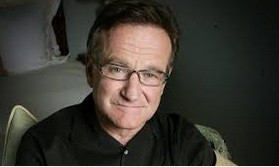
When Robins Williams died of apparent suicide on 11 August 2014, many of the devotee community were shaken. It was as though a fellow member of the Vaishnava community had passed away. Usually the death of a celebrity or politician or other famous person is greeted with a crescendo of indifference from the devotees, since as philosophers we understand that ultimate death is merely a natural consequence of living here in this martya–loka. I was able to empathize with the feelings of the devotees because I knew Robin back in San Francisco where occasionally ran into him. I often passed by his house at Sea Cliff which was recognizable by the Greek theater masks portraying both comedy and tragedy that adorned the outside wall. I would learn through my brief acquaintances with Robin that those masks held the secrets to both his inner and outer psyche. They spoke of his life as a comic to the world as well as a deeply troubled and silently disillusioned searcher looking for something better. To me it appeared that Robin was two separate personalities. One side of the comic’s face showed a message of wit while a sense of heartbreak seemed to emerge from the other. He was crying out for help but his pleas were obscured by the laughter of his audience.
The first time I saw Robin was on Columbus Ave. at Fisherman’s Wharf where I lived at the time. When a homeless man asked him for spare change, Robin immediately handed him a twenty dollar bill displaying his charitable and compassionate nature. However, the first time we spoke was at his son’s school up on Pacific Heights. Dutiful dad that he was, he had come to pick the lad up. I happened to have an issue of Back to Godhead with me, an issue for which I had written an article about my “discovery” of Parashurama Kunda in Madhya Pradesh.* Though ours was a brief exchange that day, I gave him a copy of the BTG which he was very thankful to receive. He struck me as a humble and kind person at heart; unlike most of Hollywood’s other mega-celebrities.
*Read the article “Journey to Unknown India” here: http://backtogodhead.in/parasurama-kunda-a-journey-into-unknown-india-by-patita-pavana-dasa-adhikari/.
The second time I met Robin was at City Lights Book Store in North Beach where he was browsing for something to read. I asked him if he had found time to look through the BTG magazine I had given him. Then I told him that City Lights sold my book Motorcycle Yoga.* I offered to buy him a copy from the store, but he declared, “No I want your book. Let me pay.” So he did, and he even let me sign it. “Oh yes, your autograph,” he declared, chuckling, since undoubtedly not many people had given Robin their autograph. Then he invited me to join him at the famous Tosca Cafe across the street. In the cafe he charmed every person at every table. It was interesting that he was so willing to entertain even perfect strangers, which made him widely loved by everyone. This was his devotee quality; he was a friend to everybody. It was strange that he did not try to charm or entertain me, but rather looked at me respectfully and with a sense of reaching out for something. Every time we met he would look at me silently as though I was supposed to give him something … which I tried to do.
The third and last time I met Robin he was sauntering down Columbus Ave where I had a small business. I asked him if he had gotten around to reading Motorcycle Yoga* yet, and he replied that the book was sitting on his night lamp table and he was just now finding the time to get to it. I had a small altar to Lord Krishna inside my shop, so I invited him in for darshan. He immediately followed me inside with no sign of self-importance whatsoever. Then after offering prayers at the altar, I took a small Shiva-linga that I had found in the Narmada River some years earlier. Handing it to him, I asked Robin if he knew what it was, and he replied matter-of-factly, “Of course, it’s a Shiva-linga.” I told him to take Lord Shiva home with him and gave him some incense for the offering and “installation.” He gladly accepted it, taking the deity silently and reverently like a pilgrim receiving a blessing at a holy shrine.
Given that on different occasions Robin had taken from me a BTG, my book and a Narmadeshwara, I always felt a certain devotional kinship with him. I had observed that he was dissatisfied behind the Hollywood mask of laughter. It could be read it on his face. He was desperately in need of something higher than merely being the funniest person in the world. His dual persona caused me to reflect back to the Greek theater masks that adorned his Sea Cliff mansion. The funny side of Robin Williams was apparent to his hundreds of millions of fans and to his fellow celebrities who laughed at his antics; but to me (and apparently to other devotees, too) the other Robin was visible. He was a tragic seeker somehow cast by fate into a funny, high life of opulence and fame, but always crying within for knowledge of something higher, which as we know is the Supreme Absolute Truth Who is personified as Lord Krishna. To me this appeared to be the essence of this great yet humble man’s frustration. (And recognizing this makes us realize all the more the value of our position as recipients of Prabhupada’s blessings.)
On the Ekadashi following the tragic death of Robin Williams, Mother Abhaya Mudra and I offered the benefits our fasts to him. When the vrata was over, I turned to the computer news and saw that he had been cremated with his ashes spread over the San Francisco Bay. The waters of that bay—like the great Narmada and other holy rivers—join Sagar, the husband of all sacred streams. We devotees know that death by suicide can produce terrible suffering in the next life, perhaps even in a ghostly body. And neither is Yamaraja impressed with wealth, fame or talents. But did not Shrila Prabhupada encourage his sankirtana army of book distributors, saying that anyone who received a BTG would become elevated, and that Krishna would never forget their service. We join our Godbrothers and Godsisters in praying that Robin Williams has moved towards taking a better birth in a devotional family wherein his vast talent and wit can be meaningfully engaged in the service of Lord Krishna’s lotus feet.
*Motorcycle Yoga by Miles Davis (Patita Pavana dasa) is in print and available from the publishers here http://www.royalenfieldbooks.com/motorcycle_yoga.html
In the second part of this article on Robin Williams, Abhaya Mudra Dasi offers some astrological insight into this rare talent.
2. Life and Death of Robin Williams
Abhaya Mudra Dasi
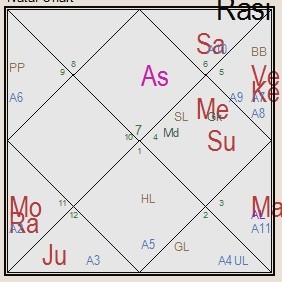
Robin Williams was born on 21 July 1951 at 1:34 pm in Chicago. Rising to great heights from an early age, his astrological periods up till his demise were positive for his career.
In his horoscope he had a nicely positioned Sun and Mercury in the 10th house of career—the karmastan. This shows that he was very smart, as well as expert, in his choice of roles. Mercury, the planet of communication, rules his 9th house of spirituality, which demonstrates that he tried in odd ways to insert some sublime messages in his performances. His manner of speech was influenced by Jupiter, Mars and Saturn: Jupiter aspects his 2nd house of speech while Mars owns it. Next, Mars aspects Saturn who in his turn places his vision back upon his house of speech. This was his yoga for spoken wit. The combination of Mars, Jupiter and Saturn influencing his house of speech explains Robin’s means of communication that was at once both philosophical and passionate. Yet his dialogue was influenced by the conjunction of Rahu and Moon in the 5th house in Aquarius showing the meaning and weight of his words. Due to the influence of Rahu, his style was often unrefined and even coarse. His Moon sign was Aquarius ruled by Saturn, and his Shatabhisha nakshatra was under Rahu’s control. Jupiter as lord of the 6th in the 6th creates harsha yoga for happiness. Hence, Jupiter’s influence brought him happiness although due to the exchange of aspects between Saturn and Jupiter he could appear sad and philosophical.
Because both Jupiter and Saturn aspected his 2nd house—which rules the face and the mouth—he had a very specific expression like a jester who is laughing and crying at the same time. Though divorced twice, he did have luck in marriage as the lord of the 7th house of partners had gone to the lucky 9th house. As far as his children are concerned, to a greater degree they are a reflection of their father’s talents. In real life his children may also appear a bit eccentric as well. Although his chart shows no strong indication for illnesses, he created some health issues due to his innate dissatisfaction with the world. This fact is again seen by the strong position of Jupiter in the 6th house of health under aspect from Saturn. Saturn, who is the lord of the house of happiness, has gone astray to the 12th house of loss. This gave him a sense of being trapped in his fame and wealth. He wanted out and needed a guide to show him the way. His life was not destined to be very long as Venus, the lord of the 8th house of life and death, is positioned in an enemy sign with malefic Ketu. When Robin left the world he was running the final sub-period of the major period of Ketu. It is actually not uncommon for death to occur at the end of Ketu dasha as the South Node of the Moon carries poison in his tail just like a scorpion.
Ketu is positioned in the 11th house of gains along with the lord of the house of death, Venus. Thus, he gained death in the planetary period of Ketu through self inflicted means related to pleasure. In fact he died in his mansion at Paradise Cay in Marin County, one of America’s most beautiful locations. Venus not only ruled the house of death but also ruled his house of self. Venus is astrology’s natural significator for pleasures. At the time of his death he was running Mercury sub-period in Ketu dasha. Mercury is positioned alongside the Sun, lord of the house where Ketu is found in his chart. Thus, his death became very much discussed in the media as Sun is in the most visible house of the horoscope. It is very likely that after his death his fame and influence will continue for a long, long time to come.
That is a good example of treating someone like a person, personalism. Impersonalism happens when we are unwilling to give someone the credit for the good things they did, for trying (and failing), and instead we just dish out our philosophy with indifference and lack of compassion. There are so many people out there who could use our help and we need to treat them as real persons even if they do not have a Hollywood star status, or who may not even be very likable. It may not be easy at times, but they are all deserving of our personalism.