
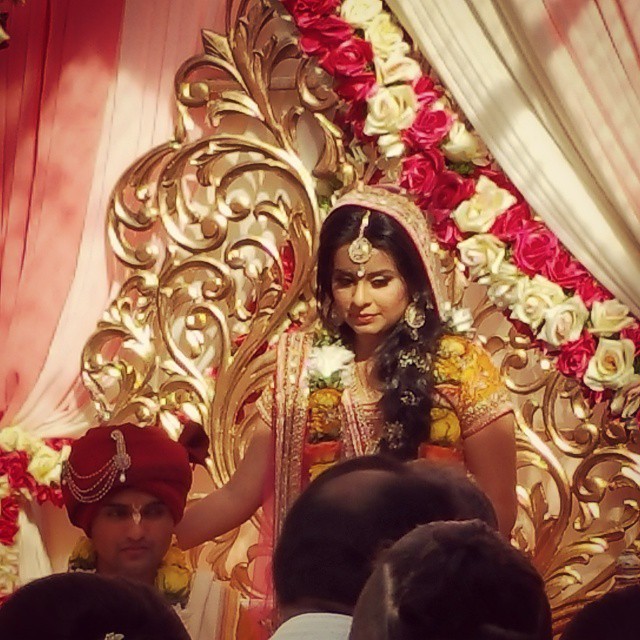
 Talks by HH Indradyumna Swami and HH Giriraj Swami during the wedding ceremony of Piyush and Lalita-devi dasi, June 3, 2006 Carpinteria, CA
* * *
“Give More Than You Take” by HH Indradyumna Swami
Samskaras are Vedic purificatory ceremonies for advancing in spiritual life. One of them is vivaha-samskara, the wedding rite.
Before I begin, I would like to thank the Supreme Lord for providing such a beautiful day, by His grace, a warm and sunny day. I don’t know what would have happened if it had rained. We didn’t actually have an alternative plan, so we depended on Krsna. I would also like to thank Giriraj Maharaja’s staff, especially Mother Kunti, who worked so hard for many weeks to prepare this marriage ceremony. There are quite a number of devotees on the staff, and they have done a wonderful job.
When, several weeks ago, I was invited to speak at this auspicious function, I was considering what I would talk about, what I would say. I am a monk in the renounced order, so marriage is not my best subject, but Krsna helped me. Yoga-ksemam vahamy aham. It says for His devotee, He protects whatever they have and He provides whatever they require. So I was thinking, “What will I speak about at this auspicious function, the marriage of this young couple?” I was on a flight from New York City to Los Angeles, and somehow or other I had the middle seat. I usually get the aisle or the window seat, but I had the middle seat. And another arrangement was that there was an elderly couple–the man was on my left and the lady was on my right. They didn’t even ask to switch seats so that they could sit together. They were very duty conscious. They had received their seat numbers and they weren’t going to move.
They were elderly and they were also partly deaf, so they were having a very animated conversation, with me in the middle, in between. [laughter] I was trying to study Bhagavad-gita and find some verse that would be relevant for this ceremony, but they were speaking so loud and so animatedly. There is a saying, “If you can’t beat them, join them,” so I started speaking to them. I was inquiring from them, and at one point I just asked, “How long have you been married?” The man said, “Very long time.” He said, “Why don’t you ask first how old we are?” So I asked, “Well, how old are you?” He replied, “We are ninety-two.” “You are ninety-two? You are traveling unassisted on the plane?” “Yes, we are capable.” I asked, “How long have you been married?” And together, at the same time, they said, “Seventy years.” I said, “Oh!” It was very interesting, because I had read a report that in our modern America, three out of four marriages end in divorce, unfortunately. So, I said, “You know, I am on my way to California to take a little break and study. And I am going to be giving a talk at a marriage. Could you give me any tips, some advice that I can offer to the couple? What is the secret of your marriage? In seventy years you haven’t separated. It is quite amazing. What is the secret?” It was funny, because they both spoke at the same time, one in my left ear and one in my right ear. And they both said the same thing at the same time: “You have to give more than you take.” I said, “Thank you very much,” and then I wrote that down: “You have to give more than you take.” They went back to talking; they talked the whole way. And I thought that was symptomatic of love, and a marriage, of course, is based on love.
Our spiritual master said that in this material world a boy naturally desires a girl and a girl naturally desires a boy, and they come together in holy matrimony to make it sacred, and they advance in material prosperity and spiritual prosperity together. I think that is a nice definition of love: to be concerned about the needs of your beloved. Actually, in our Gaudiya Vaisnava philosophy that is the pinnacle of our siddhanta in understanding our relationship with God, with Krsna. There is a very nice verse in the Bhakti-rasamrta-sindhu by Srila Rupa Gosvami:
anyabhilasita-sunyam jnana-karmady-anavrtam anukulyena krsnanu- silanam bhaktir uttama
He is talking about awakening our love for the Supreme Lord, the Supreme Personality of Godhead, and he defines that love in the paribhasa sutra, the verse in that scripture upon which all the other verses are developed, from which they evolve–the seed verse of that important scripture. And he says that one should approach God, one should approach the Lord, the ultimate lovable object, personality, without any selfish desires, any material desires. He says that neither should one desire to merge into His form–seek impersonal liberation. And then he says that this devotional service, this love for God, this service, must be done according to Krsna’s desires, as He desires to be served. God is a person, and we learn what God wants through our guru-parampara, through our chain of disciplic succession, specifically from the spiritual master, who is considered to be an intimate associate of the Lord. We ask him, “How can we serve God in such a way that He will be pleased?” This is love. But a Vaisnava, a devotee, his love is not exclusive, only for Krsna. It is also for the person who takes him to Krsna: the guru, the spiritual master. It is also for the devotees of the Lord, with whom, in whose association, he worships the spiritual master and Krsna. So, a devotee loves the Vaisnavas, he loves the guru, he loves God. Actually, he loves all living entities in the sense that he sees every living entity as part and parcel of God, every living entity as ultimately a servant of God. This is his vision.
That instruction, to be concerned more about the needs of the other than about the needs of oneself, is a very nice definition of love. So, how does it apply to this couple today? They are both Vaisnavas. They are both devotees of the Lord, and they have to know what are the needs of their partner. That is love, and one must act accordingly. So what needs do we have as devotees of the Lord? What needs do we have–let us speak very basic–as human beings? What are our responsibilities in marriage, as the husband and as the wife? What needs should we be concerned about for our partner?
We have two needs. We have our material needs and we have our spiritual needs, because at this stage we have those two obligations. Unfortunately, we have this body. It has its needs. We can’t deny them. Even being transcendentalists, we cannot deny the needs of the body, because the body is the vehicle that ultimately can take us back home, back to the spiritual world. So we have our material needs and we have our spiritual needs.
This is the first step in the science of self-realization: to understand the difference between matter and spirit, the difference between the body and the soul. I am not this body. I am the particle of life–the spirit, the soul–within the body. That is my actual definition. We never say, “I hand” or “I arm” or “I head” or “I body.” We say, “This is my body. It belongs to me.” Who am I? Jivera ’svarupa’ haya–krsnera ‘nitya-dasa’: “I am the eternal servant of Krsna.” I am the soul.
So we have to see to the needs of both the body and the soul; we have to find the balance. If we just focus on the needs of the body but neglect the soul, we will never find perfect happiness. That is a fact. No matter what our modern society proposes–that the more material enjoyment you have, the more sense gratification you have, the more happy you will be–my experience is as a world traveler: I have met kings and queens and presidents and rich men and entertainers, and sometimes I think they are in the most anxiety of everyone. They have all the material opulence, but they are not happy. In fact, even in my study of sastra I have never come across a person who has it all but is happy. There was a song a few years ago, “I want it all and I want it now.” I don’t think anybody right now has it all. I know of one person who did–he is mentioned in the Seventh Canto of Srimad-Bhagavatam. His name was Hiranyakasipu. He conquered the lower planetary systems, the middle planetary systems, the higher planetary systems. He had everything, but the Bhagavatam says that he wasn’t happy, because he could not control his senses. The point is that he was neglecting the soul within. You have to find a balance. You have to meet the basic needs of the body. Prabhupada said, “Keep the body and soul together for the purpose of self-realization, taking advantage of the human form of life.” We need to meet the basic needs of the body. The Vedas also give that knowledge; it is a vast body of knowledge. So we learn to live a simple life, but with high thinking. But if we deny the needs of the soul, we will be miserable. The soul has desires. You cannot deny the desires of the soul. It has spiritual desires, and we have to learn the art of satisfying those desires.
How do we satisfy the desires of the inner self, the soul? By engaging in our eternal constitutional position as servants of God. As soon as we begin to serve God we feel a natural peacefulness come over us, and as we continue that service, a natural joy. And as we become more detached from material life, more absorbed in our service to God, we begin to feel ecstasy. This is actually what every soul is looking for.
So both husband and wife have to be learned in the subject–especially the husband, because he is called pati-guru. Generally in Western society, when people hear the word “guru” they think, “Oh, it is a singular term. We have one guru.” But actually, in the Bhagavad-gita Krsna says differently. He says:
tad viddhi pranipatena pariprasnena sevaya upadeksyanti te jnanam jnaninas tattva-darsinah
“Just try to learn the truth by approaching a spiritual master. Inquire from him submissively and render service to him. The self-realized souls”–it is plural–”The self-realized souls can give you knowledge because they have seen the truth.”
So it is a science. We have one diksa-guru, that person who initiates us into the sampradaya, who gives us mantra, who trains us, who helps us back to the spiritual world. But one can have many siksa-gurus. Anyone who helps us on the spiritual path in a significant way, who gives us spiritual instruction, becomes a siksa-guru. And the husband plays that role in a marriage. He is the pati-guru. He must be learned in the sastras, like any guru. He must be exemplary in his behavior. He can’t say one thing and do something else; otherwise the wife will lose faith in her pati-guru. He has to be very exemplary. He has to know the sastra, and he has to be very expert at engaging his wife and later their children in devotional service to God. This is his ultimate responsibility. In fact, so important is this duty of the husband that sastra–the Bhagavatam, the Bhagavata Purana–says that no one should become a demigod, no one should become a guru, no one should become a king, no one should become a teacher, no one should become a husband, a wife, or a parent, unless they are capable of delivering their dependants from the repetition of birth and death, from samsara, from reincarnation, from being born again and again and again. Ultimately, the only way we can become free from this samsara, this cycle of birth and death, is by going back to the kingdom of God, to the spiritual world. Krsna says, punar janma na vidyate. He says, “Once having come back, My devotee never returns to this material world.” So this is the ultimate duty of the husband. He has to be a transcendentalist. We sometimes think of a transcendentalist as a skinny yogi living in the jungle eating just berries and fruits, not shaving and not cutting his nails, absorbed in chanting “Om.” But not necessarily. As Narottama dasa Thakura says, grhe thako, vane thako: “Whether one is a renunciant or one is a householder living in a big house with lots of furniture and a beautiful wife and children, if that person has at heart service to God, service to Caitanya Mahaprabhu, who is the most recent incarnation of God, in this age, I take the dust of that person and put it upon my head.”
So transcendentalists can also live in this world. Jesus Christ instructed us in the Bible to be “in this world but not of this world.” In our Vedic culture, we use the example of the lotus flower. The lotus flower is in the lake–the stem of the lotus flower goes into the water, into the mud, and that is where the roots are. But if you look very carefully, you can see that the flower itself is always a little above the water. It is never actually in the water; it is a couple of inches above. So we have to learn to be in this world but not be of this world.
How do we do that? We are all stuck in these bodies. We are living in this world. We have to work. We have this and that and everything. Still, we can engage in the devotional service of God, and by engaging in the devotional service of God our consciousness becomes so elevated that it is as if we are not in this world. This is the responsibility of the husband: to ensure that his wife is learning the science of Krsna consciousness along with him and educating the children in Krsna consciousness, delivering all of them back home, back to Godhead. This is his most important service.
On the spiritual platform, the wife serves her husband. In this modern age the word “service” is not very much appreciated, because often when we serve somebody, we feel exploited: “My boss is just using me.” “My country is just sending me to war for the politicians.” But when you come to Krsna consciousness, you learn the beauty of devotional service, how nice it is to serve a glorious master, a master who has your real interest at heart, to take you back home, back to Godhead, who teaches you how happy you can be serving God. So the wife, she is the happy servant of her husband.
Traditionally in Vedic culture, the wife’s work is at home. She stays home and takes care of the house. “Oh, how boring to stay home all day. My husband is out and I am home in the house.” But if your house is like Vaikuntha, that place where there is no anxiety, if your house is like the spiritual world, it does not matter if you are here or there. You are in the spiritual world. If you have the deity of the Lord established, are reciting the mantras and the prayers, and are studying the scripture, and if you are cooking for and offering food to the deity, it becomes just like Vaikuntha. And when the husband comes home from working in the world, he feels very refreshed. There is no anxiety. It is very peaceful. It is a spiritual atmosphere.
So in this way the husband and the wife have their spiritual duties. They have their material duties as well. The husband has to make money. He is the breadwinner. And the wife, does she just spend the money? No, she utilizes that money favorably in the service of the Lord.
The husband has to work. A few weeks ago a brahmacari came up to me and said, “Guru Maharaja, I think it is time for me to marry.” I said, “Really. How did you come to that decision?” He said, “I saw this most beautiful girl.” I said, “Well, okay. Do you know the responsibilities that come along with marriage?” He answered, “Yes. We will read Krsna book together. We will chant Hare Krsna. We will go to the temple.” And I said, “Yes, and you will work nine hours a day. Did you think of that?” “Well, no, I didn’t really consider that.” So I said, “Yes. You have that responsibility. You have to work and provide for the grha, for the home. And your wife will have to clean the home. And you will have to work and raise the children. It’s not easy. Think about this very carefully. Do not just be enamored by the beauty, but understand that the real beauty is the beauty of the soul. Ultimately you have the responsibility to liberate that person back to the spiritual world.”
So if one follows these basic guidelines, knowing that marriage is a spiritual relationship that entails responsibilities for both the husband and wife, then the marriage will succeed. Of course, one marries for the happiness of living with the opposite sex. That cannot be denied. It is something that ultimately we have to give up, when we go back to the spiritual world and will be fascinated only with Krsna, but we can’t be artificial. Men and women have a natural desire to live together, so that affection is there, that attraction is there. But if you can understand that your partner is not the body, that your partner is ultimately the soul within the body, and if you relate to your partner like that, you will always be happy in marriage. In Vedic culture there was no divorce. How is that possible, when in our society three out of four marriages end in divorce? Because they went very deep, they went to the spiritual essence. They related on the spiritual platform, which is ultimately fulfilling.
Of course, we shouldn’t be naïve. There will sometimes be arguments. I know. I am a Maharaja, a sannyasi, but let me tell you, I was married eleven years. Yes. And I will tell you, I had a very good wife, a very chaste woman, a nice devotee–but we had plenty of fights. Because as long as we are not pure, there are going to be some differences. As long as we are contaminated by the false ego and are not fully enlightened, there are going to be clashes; there are going to be differences. When we all become pure devotees of the Lord, our attention will be fixed on God, and there won’t be any arguments. We will live very peacefully and happily forever in the spiritual world.
But as long as we are here, there will be some fighting. I am just being practical. We are getting down to the nuts and bolts of a marriage. How to deal with that? Titiksava. You have to be very tolerant. You have to always consider your spouse’s good qualities. When you live together for a long time with one person, you may see his or her weaknesses, but have faith that by the process of Krsna consciousness, the process of devotional service, we can overcome our material frailties, our weaknesses, our doubts, our material desires. We will come to the transcendental platform. Have faith, and in the meantime always see the good qualities of your husband or wife. See them as outstanding.
A sadhu once told me, “In dealing with people you have to have one good eye and one bad eye.” I said, “What?” “One good eye to always appreciate their good qualities and one bad eye to see their faults.” I said, “Sir, why I should see the faults?” He said, “If you are going to train them you have to know what their weakness is. Otherwise, how can you train them to rise above that fault?” So you have to also see the fault. But you don’t see it in a mischievous way. You recognize it and you try to help. So always see the good qualities. And if there is some fighting, it is always temporary. Canakya Pandita says in the Niti-sastra, “Just like a bolt of lightening from the sky and the clash of thunder, just like two rams butting their heads together in play, just like the funeral of a sage in the forest, so too a fight between a husband and wife makes a big noise–they all start out in a grand way, but the outcome is very insignificant.” If we are Krsna conscious we can understand this. If we have that deep spiritual strength and love for our partner as a devotee of God and we want them to advance on the spiritual path, these little things can be solved.
One last note. The natural result of marriage is children. Our spiritual master said, “What is family life without children?” So children will come; that is nature’s way. But there is a special significance to bringing up children in our Krsna consciousness movement, that we want to train these children to go back to the spiritual world, that this will be their last birth. We are very happy when our children take birth, but we should think, “Let this be their last birth. The success of my household life will be when my children become so spiritually enlightened that they don’t have to take birth again, when they go back to the kingdom of God.” Such children are very valuable in human society, because nowadays saintly persons are very rare. The world in this modern era is actually bereft of saintly persons. And without saintly persons, who will guide us back to the spiritual world? Who will show the example? Who will give us blessings? Saintly persons are most important. Canakya Pandita says, “You will not find a pearl on the head of every elephant. You will not find rubies in every mountain. You will not find sandalwood trees in every forest. You will not find sadhus, saintly persons, in every birth.” They are very rare. But we need them. So although our grhasthas, our householders, may not be out there distributing books and giving lectures in universities and running big temples and so on, they shouldn’t think that they cannot do a most significant service–the most significant service–in raising their children to become pure devotees, the most valuable assets in society.
So, a few words with a little wisdom from a renounced monk. I wish you the very best in your marriage. All material prosperity will be yours, and all spiritual prosperity will be yours, and you and all of your children will one day go home, back to Godhead.
Hare Krsna.
* * *
next part: “We Are Always With You” by HH Giriraja Swami