
By Kesava Krsna Dasa
The contentious discussion on human placements resurfaced recently, though it is ongoing. The involvement of devotee doctors serving at Bhaktivedanta Hospital in Mumbai has added extra range to it. Suddenly it seems, we are confronted with samples of varnashrama-dharma being practiced ‘outside’ of our ISKCON world. Some devotees are opposed to this because they say it does not conform to Srila Prabhupada’s ideal of ISKCON being a preaching movement. Others contend that everyone has a right to serve Krishna through their human orientation.
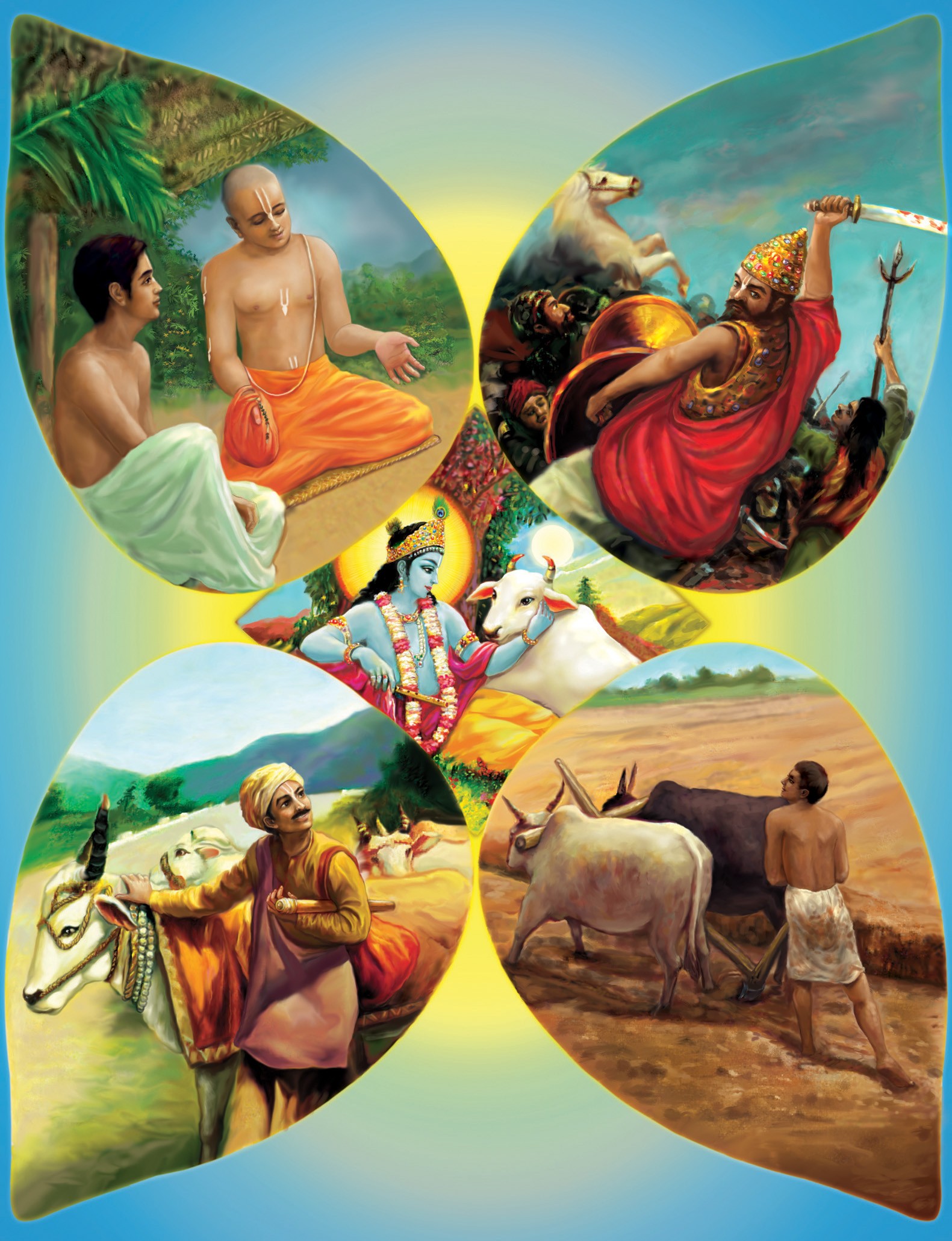
Alongside the two above positions there are others seriously intent on dividing our devotee communities into four varna (guna-karma) sections. With our ashrama sectors more developed we should say that the real issue for the proponents is how to introduce varna classifications or dharma – VD. There are attempts to get a VD footing on some of our farms or in regions of ISKCON favourable to the idea.
The Bhaktivedanta Hospital situation presents ranges of possibilities that might circumvent what VD specialists hope to achieve within ISKCON. If ISKCON is clearly not ready for VD or VAD implementation within our village, towns and city devotee communities, let alone a few small and biased samples out on the land, it seems that the proponents could look at places where human divisions already exist – the whole wide world.
We might forget that because everyone is born a sudra in Kali-yuga it does not mean that everyone remains a sudra as they grow up and take on qualities, either through association or prominent traits exerted from previous lives. Although everyone outside of the four established varna orders (brahmanas, ksatriyas, vaisyas and sudras) are deemed sub-human by behaviour and qualities, we cannot deny that Krishna’s catur- varnam presence is ever active among them, even outside of ISKCON.
All around us in the cities, towns and villages, Krishna’s catur-varnam is undeniably there. What makes us think we can set up a ‘different’ or ‘bona-fide’ version of VAD only within ISKCON? Certainly, Srila Prabhupada had aims for devotee participation within this, but are we sure about why he wanted it? Do we have utmost certainty that Srila Prabhupada would probably not be interested in VAD for ISKCON if it were not for the number of sannyasis that were falling down at the time, that disappointed him?
In other words, how sure are we that Srila Prabhupada’s ideas for VAD were not reactionary to lowered expectations for devotees in general? Many VAD proponents use an argument to say that it is impossible for any devotee to be Krishna conscious in a city and therefore we need VAD out on a farm. Getting back to the lowered expectations, we must remember how Srila Prabhupada must have had high hopes for ISKCON members initially when he requested his early disciples to chant 64 rounds. In context of this, are we to say that VAD is another concessionary introduction – a social or institutional equivalent of the reduction from 64 to 16 rounds minimum?
Is this ‘lowering of the bar’ really what Srila Prabhupada wants? Wouldn’t he have preferred it if we did not concern ourselves with VAD and simply focus on being Vaisnava brahmanas? If we are left with knowing what our Founder Acarya prefers, then how many devotees qualify as brahmanas? – The proponents ask. They say that no devotees can be Krishna conscious living within a city, what to speak of being qualified as brahmanas, except a very few.
Trying ro place our own devotees into human categories in social experiments – and they are experiments – when human divisions are already there, all around us, must be like trying to do better than what Krishna is already doing. “But Srila Prabhupada said so…”, is the refrain. Is there a difference between doing what Srila Prabhupada wants later, when the timing is right, instead of hastily pushing for it now, because, “It’s the right thing to do?”
Should we not expect a better impact with VAD experimentation if they were conducted in our cities where by far the majority of citizens live? That is the hard part and it is probably not feasible. It is not very feasible in any case if we are going to compete with Krishna’s catur varnam. There must be reasons why implementation is difficult.
An observation of ‘ISKCON VAD’ along with the ‘Bhaktivedanta Hospital type of VAD’ occurring ‘outside’ of ISKCON reveals how different schools of thought react. Internal ISKCON VAD implementation is seen as something pursued by ‘conservative’ minded devotees – it has brighter prospects in India for known historical, cultural and social reasons.
The practice of devotee doctors plying their trade ‘outside’ of ISKCON at Bhaktivedanta Hospital presents challenges for those who only want VAD inside of ISKCON, at least to begin with. Is there a concern that if there are many more facilities like this – not just medical – that it might expand ‘out of control?” Out of whose control? Can ISKCON which has no sovereign state power or legislation be able to control it? Why should we want to control it? How can we exert control over Krishna’s catur varnam when it is already everywhere?
Not long ago a devotee wrote a book on the holy name and how the chanting of the Hare Krishna mantra was also sung by ‘suspect’ mayavadis. In response to this, some devotees thought it wise to copy write the Hare Krishna mantra. This would have been a futile attempt to control Krishna as the holy name. We can ask the same for our ideas for VAD. How can we control people who have a right to engage in Krishna’s service from any position or social background?
How can we control people who do not even follow the four regulative principles and who want to engage in Krishna’s service? These people already have varna positions as plumbers, financiers, expert artisans or whatever. If such people form more facilities like that of Bhaktivedanta Hospital, how can ISKCON legislate their service input? We have to be repeatedly reminded that there is a big world out there besides our own. Somehow we have to be a part of it.
If we are unable to or unwilling to cooperate with Krishna’s social placements and more liberally engage people in their eternal right of service, then we shall remain in isolationist streams of thought and deed. To be able to allow this we have to broaden and liberalise our scope of service opportunities – what we offer is quite limiting.
We need look no further than our devotee congregations worldwide for evidence of Krishna’s natural human placements. Our congregation members are already doctors, nurses, clerks, artisans, physicists and the rest. Though they are engaged in occupations they yet practice Vaisnava principles of living. Each of these congregation devotees can go to a temple to engage in exalted menial service for the Lord. What more do we need to do on top of this? Are we going to reclassify those who are already classified?
Since all of these congregational devotees have specific occupations and are also living Vaisnava lifestyles, it makes it a form of Daivi-varnashrama. It may not be perfect for our purist proponents, but when are we ever going to have strictly Vedic standards of VAD? VAD implementation will not be perfect either as long as vestiges of modern technology remain. One certain answer is that it will not happen so long as we have technology that takes the place of human occupations. We have to wait for a future time if and when technology collapses along with the civilisation that depends on it.
For instance, the occupation of washing clothes is done by washing machines in developed and developing countries. To properly engage a class of men and women in laundry services means to do away with machines that wash clothes. Are we going to eliminate technology in order to facilitate this ‘caste?’ And if we choose to designate certain of our Vaisnavas as Dhobi men and women within our ranks, are fellow Vaisnavas going to accept their services? What right thinking Vaisnava can take service from other Vaisnavas this way? Exploitation is waiting to rear its ugly head. Some congregation members own and run laundrettes – they are already there,
Another class of occupation is to be a messenger. Are we going to ban cell phones and computers in order to employ human messengers? Will we wait for days and weeks for a human messenger to accomplish his task (long distance) rather than wait a matter of seconds with a cell phone, because it’s VAD? Our use of technology will not allow VAD to work, and neither can we abandon technology because it would violate the “Utility is the principle” ethic.
For devotees who are banking on a future time when a civilisation collapse might herald the dawning of real VAD implementation, it would be worth looking at something which may reveal how in fact, the lifeblood (oil) of present civilisation might never be in short supply – it is a renewable resource. It may not be a dossil fuel. Some sources report that old oil wells which have supposedly dried up are refilling again. If we are to remain with technology derived from and dependent on oil related resources that mimic human occupations, how can VAD function effectively?
Undoubtedly a lot of effort and study has gone into trying to implement VAD within ISKCON, but considering other factors clearly visible to us, is it not better that we adapt rather than cling to being ‘enemies’ of world modernity. VAD is not really antiquated, but in terms of our use of technology for Krishna’s service and the visible presence of human divisions within our numerous devotee congregations, we can try to make the Vedic past our future.
Are we not supposed to present an alternative to technology that takes away the livelihood of people and destroys our environment and eco-systems? Yes, of course. We are simply trying to say that there is another way of doing it, by being part of this world and transforming hearts. Society has to transform first before being able to withstand the revolutionary undertones of VAD.
Ys Kesava Krsna Dasa – GRS
Some of the “arguments” identified in this article sound really strange to me. I do not think anyone would suggest that *only* members of ISKCON can be devotees of Krishna, or belong to varnas and asramas, or observe (or violate) rules of dharma.
Lots of ISKCON devotees have jobs outside of ISKCON (why is Bhaktivedanta Hospital being singled out in this article)?
Lots of people are devotees of Krishna who may not even have been in contact with ISKCON. And certainly people observe (or violate) dharma who are not members of ISKCON.
Also, if Srila Prabhupada “reacted” to devotees in ISKCON falling down by instructing that we should establish varnas among our ISKCON members, how would that give grounds for disregarding those instructions? I mean, it is not as if devotees have stopped falling down.
The thing about dharma is, it does not only exist within ISKCON or any other spiritual organization or church or creed. Dharma is everywhere. If you touch fire it will burn you. You cannot say, “Oh, this fire burns Hindus, that fire burns Christians, that one over there is for the Buddhists”. Yamaraja knows everything and if someone violates the universal rules of dharma, there is a reaction.
[In the story of Ajamila, we learn that Vaisnavas are beyond the jurisdiction of Yamaraja. We should not think this absolves us, as Vaisnavas, from acting in accordance with dharma, or gives us a license to act incorrectly. That would be the seventh offense to the holy name. We should not think ourselves exalted Vaisnavas, beyond the rules of decency, honesty, righteousness, etc. On the contrary, we should think that real Vaisnavas have all the divine qualities, and that we aspire to serve such Vaisnavas. We do not become such “Vaisnava” by external changes like shaving our head or wearing a saree or neck beads. We have to always remember Krishna and develop such qualities from within.]
Everyone has some essential quality and must behave accordingly. We cannot help it. Nature forces us to act (see, B.G. 3.5).
In ISKCON, some devotees can serve on the altar because they have been twice initiated and are called “brahmanas”. They have to strictly observe the four rules and chant their 16 rounds each day. Otherwise, they are not really worthy of the name “brahmanas” and they should not touch the Deities. They should find a more suitable occupation.
Married devotees are expected to observe the rules for grhasthas. Married brahmanas are expected to retire as vanaprasthas and sannyasis (and observe the rules according to their station).
People outside ISKCON also must follow such rules. If one steals or commits adultery there will be a reaction.
A person with sudra qualities should work as a sudra (there is no shame in that). Arjuna was meant to work as a Ksatriya and not be a false sannyasi or try to act as a priest would.
ISKCON is a movement for *training* perfect Vaisnavas (who may be married and earn an honest living). It is not that by joining we become automatically paramahamsas.
We should keep the ideal of paramahamsas (like Haridas Thakur and Rupa Gioswami) as something very rare and exalted. Most devotees have to become grhastha and work in some occupation according to their qualities. They should donate a portion of their income and must chant Hare Krishna and read Srila Prabhupada’s books. They should not be make-believe paramahamsas. Krishna does not favor “pretenders” (See, B.G. 3.6-8)
Please accept my humble obeisances. All glories to Srila Prabhupada. All glories to the Devotees on the farms.
sadhana-kale ye paryanta
hrdaya kama ache
se paryanta varnasramadi
dharmera apeksa thake
At the time of practicing sadhana-bhakti, so long as there is material desire within the heart, one should remain within the confines of the varnasrama system.
PURPORT
The relationship between the aforementioned varnasrama-dharma and vaidhi-bhakti ought to be examined. The question is, is the varnasrama institution negated, or should it be abandoned when one takes to the process of bhakti, or should the rules and regulations of varnasrama be followed in order to properly cultivate vaidhi-bhakti?
As we have said, the main reason for the cultivation of varnasrama a is that maintaining the body in good health, improving the faculty of the mind, promoting social well-being, and learning the science of the Self are all conducive to the practice of pure devotional service.
Who can deny the necessity of the varnasrama institution as long as the living being is bound up in the human body? If it is abandoned, and the above-mentioned four principles are lacking, the jiva will go astray and no good whatsoever will accrue to him. One should, therefore, strictly adhere to the rules governing varnasrama for the sake of the mind, society, and one’s advancement in Krsna consciousness.
>>> Ref. VedaBase => Srila Bhaktivinoda Thakura: Varnasrama and Vaidhi-Bhakti
My Dear Murari Prabhu,
Thank you very much for your elucidating piece on Varnasrama and devotional service. This is actually the siddhanta. Without daiva-varnasrama dharma, we are totally lost as devotees or non-devotees. daiva-varnasrama dharma is absolutely essential for the individual and in society as a whole for it’s smooth running. Without it, we are completely doomed. daiva-varnasrama dharma is the only thing that will save our Iskcon society. Anyone who thinks otherwise is living in a fool’s paradise and he cannot progress in his spiritual life. Thank you, Prabhu, once again.
Akruranatha Prabhu,
Thank you. Bhaktivedanta Hospital was brought up because there was a previous discussion about it on Dandavats. This was the “resurfacing” I referred to.
In case you might have misunderstood my intentions on Varnashrama-dharma, the position I take is, are we ready for VAD, and would it better to try and implement at a later time when society is ready – not to “how would that give grounds for disregarding those instructions?”, as you stated in your third paragraph.
If anyone thinks that I wish to disregard or to do away with Varnashrama-dharma are mistaken.
Murari Prabhu,
Thank you for the quote. Now, can you tell us how to implement Varnashrama-dharma within our city temples where the majority of people visit please?
Karanodakasayi.Visnu Prabhu,
Can you also tell us how to implement Varnashrama-dharma with immediate effect please?
Yes, the numerous quotes are there from Srila Prabhupada. Where is the practical application for them? Theory is one thing – to be idealistic, but where is the action? To simply quote Srila Prabhupada on VAD and not yet offer practical applications, is that not foolish?
Ys Kesava Krsna Dasa.
I guess my take on it is, there are different ways to look at Varnasrama-Dharma: one way is prescriptive, another way is descriptive.
In “descriptive” mode, Srila Prabhupada would sometimes point out that in every society these different kinds of occupations already exist, such as intellectuals, political leaders who protect citizens, enterprise managers who produce and distribute food and other wealth, and laborers who serve and supply the manpower. These are just the natural divisions of society. Social scientists may talk about different sectors of the economy or different social classes and the development of class consciousness (bourgeoisie, aristocracy, royalty, proletariat, rural peasants, “middle class”, etc.) In descriptive mode Varnasrama Dharma is social science. What do people do? How do humans behave in society? Asking whether we are ready for it is like asking whether we are ready for economics, meteorology or mathematics. It is a branch of descriptive scientific knowledge.
In a prescriptive sense, Varnasrama Dharma is ethics. It has a normative component. A person should know what his or her role in the social body is and behave accordingly. Not everyone has the same duties, and an action that might be right for one kind of person might be wrong for another. a wrote a nice article on Immanuel Kant and deontological versus utilitarian ethics recently on Dandavats. The ethics taught by Krishna in Bhagavad-gita is of a piece with and directly related to His other teachings about metaphysics and cosmology and theology. So again, it makes little sense in this mode of understanding Varnasrama Dharma to ask whether we are ready for it. Ready or not, Varnasrama Dharma is all around us; it is the moral world we inhabit. Varnasrama Dharma is dharma: it defines right from wrong action, it defines what it means to be a successful human, a righteous human, whether we know it or not.*
Now, recorded history is fraught with examples of class injustice and the tyranny of various cruel kings and dictators, so much so that the modern political consensus is egalitarian and democratic. The philosophy of Varnasrama Dharma recognizes the existence of social classes and as such could be erroneously viewed as some kind of anachronistic effort to revive the class structure of the “ancien regime” in Europe, or of Tokugawa Japan or the Chinese Qing dynasty or serfdom in Russia and chattel slavery and de jure segregation in America. But that is not what it is. Nor is it a revival of the vitiated “caste by birth” system in Hinduism (which found its ideological justification in misinterpretation of Vedic descriptions of Varnasrama Dharma). If we think of the idea of Varnasrama Dharma as a reactionary political ideology aimed at reviving the social values of the 18th or 19th century, we will not only be mistaken, but will be doomed to failure. We are “not ready” for that kind of Varnasrama Dharma.
But dharma is dharma is dharma. We cannot divorce varnasrama dharma from some other kind of dharma. If it is not varnasrama dharma it is adharma (there is also such a thing as emergency dharma, or how to behave in unusual social situations, but even the theory of such emergency dharma is embraced in the greater philosophy of varnasrama dharma, for to know any subject well is to know not only the rules, but the exceptions, and the reasons behind them).
I remember being told by a Hindu man who had taken to eating beef and drinking whiskey in America: “The cows in India are sacred and not to be killed, but the cows here in America are different. They are raised for slaughter and there is no sin in eating them.” The idea that we are not “ready” for varnasrama dharma seems to be the same kind of fallacy. It may be based on a misunderstanding of what varnasrama dharma means and how it works.
*As devotees we know that success in human life means reviving our dormant love of Krishna and at the end of this life going back to Godhead (“ante narayana smrti”). But externally also there are competing ideas of what it means to be a successful person. Materialistic modern society puts great stock in becoming wealthy and powerful, or becoming learned and respected. Vedic ethics emphasizes doing one’s proper duty properly, playing the role one is meant to play in the universal drama, and playing it correctly. One must give (or receive) charity correctly, observe samskaras correctly, observe austerity and vratas like ekadasi and janmasthami, offer sacrifice, obey parents, teachers and authorities and please them, show mercy and due care for subordinates, etc. Of course all these things must be done with the right reason and motivation: to please Krishna, knowing this is what He wants from us. But they are also what we are supposed to do from a material standpoint (to be elevated to the mode of goodness and avoid sinful reactions, and to play our role in a peaceful, harmonious, prosperous and successful society.)
Whether we are ready or not, for Varnashrama-dharma, as underscored in the article, pertains to the implementation of it within ISKCON. This is why I posed the questions to Murari and Karanadaksayi Visnu Prabhus – row to implement VAD with immediate effect (An unrealistic proposition). Why? Because it is plain obvious that Krishna’s catur varnam placements are already everywhere.
We sense there is some inconsistency with some devotees who want VAD within ISKCON which seeks to designate Vaisnavas as belonging to various social orders – an offensive motion, yet at the same time when the matter of female Diksa guru arises, they plead that we should all see each other as being beyond bodily identifications.
On one hand plead that we are not male or female, yet at the same time plead that that Vaisnavas must conform to bodily social VAD norms. The first pleading is our real outlook, the second one is already in place worldwide by Krishna’s arrangement. What can we do to add to Krishna’s divine order?
All these discussions are symptomatic of an institution like ISKCON trying to adapt and stabilise in a Post Charismatic phase of duration. Social scientists like Max Weber and more recently Oday, even though their writings and observations were made before ISKCON came into existence, are able to predict what movements do after the loss of an original charismatic founder.
What hundreds of other Christian groups and splinter groups go through with schismatic outcomes, group levels of conformity, social and moral applications and the rest, we are also experiencing within ISKCON. Though we are divinely linked with our parampara we yet display very human traits in Post Charismatic responses.
In the past, even post charismatic groups being on the same side of an issue, would be willing to kill over such differences. Fortunately within ISKCON we can discuss these same differences in relative peace. We should be mature enough to respect one another’s viewpoints and simultaneously be able to postulate alternative views without resort to emotional reactions typical of group-within-groups biasness.
We need to show the world that we can make a difference and be able to work with our differences differently, otherwise we become additional specimens of social observations for social scientists. Writing comments on such issues between ourselves is not the best forum for expression. It is so easy to give opinions with clinical prompts that bely our true sense of identity within a part of the ISKCON world.
Ys Kesava Krsna Dasa.
Author writes in his conclusion: “Are we not supposed to present an alternative to technology that takes away the livelihood of people and destroys our environment and eco-systems? Yes, of course. We are simply trying to say that there is another way of doing it, by being part of this world and transforming hearts.”
I fully agree: we should be presenting such an alternative. Unfortunately right now it is all mostly talk and theory, with very few practical projects and examples.
I also like the point of “being part of this world”, and not just simply being an escapist movement, living in the future of life after death. That again is focus on practical life here and now, and not just theory.
I would say that it is not so much about VAD as it is about giving the world PRACTICAL EXAMPLES of life in the mode of goodness, sustainable living, and happy members of our society. People are sick and tired of theories, promises, excuses, and arguments. We need to deliver the goods.
I know that some bhaktas are very, very determined to promote varnashrama dharma, and others are less so. The important point is that Srila Prabhupad presented Varnashrama Dharma as a beacon for civilized human society, one that could lead to a more God-centric society. The varnas are created by Krishna to begin with. The great difficulty is that lust, anger, and greed are predominant in the animalistic human society at present. People are envious of those who have more opulence, ultimately Krishna is the reservoir of the 6 attractive opulences. Thus, envy of God as the Creator, Proprietor, Enjoyer. Ideally, envy must be suppressed and replaced by gratitude and a feeling for recognition of God. God is not the “opiate of the people”. Rather, people are already intoxicated by lust, etc. If they are “crooked”, then the possibility is there for throwing out the baby with the bathwater. Ksatriyas are protectors/administrators…the arms of the human society. Naturally, if they oppress people, there will ultimately be rebellion. The stomach of the human society is the vaisyas (producers, bankers). If greed overtakes them, they might hoard to raise prices which causes havoc. Shudras are the legs of the social body, providing manual labor. Nietzche thought that most revolutions were brought about by shudras, resulting in a lesser outcome then the original problem.
So, Varna-ashram covers the work (varnas) and also the ashrams (stages of spiritual practices). In all of this, there should be lessening of envy and cultivation of service and evolution of the consciousness.
If ISKCON were to try to present an example of this, it certainly must go beyond simple farming communities. Desha, kala, patra. The time, place, and circumstances must be accepted. We do not currently live in an agrarian society. There is always theory, then anti-theory (thesis and antithesis) which form new synthesis…which becomes new thesis…and so on. We do not wish to create a reactionary premodern example, but rather a practical example of God-centric values. The chanting of the Holy Names is