
By Rajesh Sridhar
There is a saying in English: Opportunity knocks your door only once. This essentially conveys the need to seize it and convert the situation to one’s advantage. On the material plane, this is true to a great extent. But, on the spiritual platform, I believe it’s different. Understanding this difference has been my deepest realisation after participating in a week long yatra to Hampi and Udupi organised by the Shri Shri Radha Gopinath Temple, ISKCON Chowpatty, Mumbai.
I understood that on the spiritual plane, opportunity (read mercy) is available at your door always. In other words, the compassion of Vaishnavas to share Krishna’s message and His love with fellow living beings, irrespective of the body covering, is continuous. However, it’s the nature of the soul covered with so much filth under the influence of Maya that it fails to acknowledge the opportunity and remains foolish to not avail the opportunity. Still, the Vaishnava persists to take you along in the journey back home, back to Godhead. During the entire course of the yatra, I would have wondered at least a hundred times: “what punya did I do in the past? Why so much love for me, Krishna! Why such abundant mercy on me! How may I repay you?” In this write–up, let me try to share the mercy and throw light on the greatness of the compassionate Vaishnava.
A pleasant morning filled with bright sunlight welcomed me as I stepped foot on the Hospet railway station platform enroute Hampi, located a few miles away. As I uttered the name of the venue to the autowala outside the station, with a smile, he quipped: “Aap Hare Krishna log hai kya?” With a broader smile, I replied “Haan.” Such had been the impact of the congregation of devotees on this small town over the previous two days, since the start of the yatra. We rode to the municipal college ground where a huge pandal had been erected for housing the 4000+ devotees in attendance. Welcoming me at the entrance was the source of the abundant mercy that I mentioned above – His Grace Revatipati Prabhu. My Friend. My Philosopher. My Guide. In whose companionship I feel brave, cared for and truly blessed. As I met him in person after more than three months, he welcomed me in his idiosyncratic simple, effervescent style: with hands folded, he blessed me, “Hare Krishna, Rajesh Prabhu.”
After a quick shower at our venue of stay, we returned to the pandal to board the bus to the first site for the day: Anjaneya parvat, the birthplace of Lord Hanuman. After we reached the venue, as I alighted down the bus and took a few paces forward, I could sense commotion in response to the arrival of a white coloured Innova car. Out of curiosity, I looked around, only to notice the leader of the yatra seated inside: His Holiness Radhanath Swami Maharaj. The sea of devotees present immediately paid their humble obeisance by bowing down to one of the most exalted Vaishnavas to have graced the planet. The continuous nature of the mercy that started to shower upon me at the ground accelerated its pace at the parvat as we devotees got an opportunity to climb the hill following the footsteps of the great soul. The saint walked so fast effortlessly that it was difficult for me to keep pace with him despite my tiring efforts. We took darshan of the lord after spending more than half hour in the queue and proceeded to the Pampa Sarovar near the Shabari cave. Otherwise known as the Kishkinda kshetra, it’s here where lord Hanuman first met his master, The Supreme Lord, Shri Ram. The Shabari cave is where the fruit seller sought the divine blessings of the Supreme Lord before attaining moksha. This was also the venue for my attending the first lecture by Maharaj during the yatra.
Maharaj, true to his tall reputation, captivated the thousands of devotees, nativity spanning all inhabitable continents, with rapt attention. He urged us to put deep faith to realise the divinity of the surrounding place, graced by none other than the Supreme Lord Himself millions of years ago. Sadly, my eyes couldn’t look beyond the few rocks and the pond of water present. While I believed that the Supreme Lord had walked this setting, I couldn’t appreciate the divinity totally but only feel good that I could get an opportunity to visit this place to seek the lord’s blessings. The two hour long lecture was punctuated by intermittent loud chanting of ‘Jai Shri Ram’ by devotees on the instruction of Maharaj. The summary of the lecture was the need to inculcate in each one of us the mountain of faith in the divine, comparable to what Hanuman possessed – unconditional love for the Supreme Lord that manifests as a result of the faith and thereby, the service attitude. It’s said that faith can move mountains. Hanuman truly exemplified this adage when he carried the Sanjeevini hill to save the lives of His Master and the fellow vaanara devotees.
It’s believed that the best way to reach a man’s heart is through his stomach. My four years long deep association with ISKCON is a testimony to the above saying. However, this prasadam, spiritualized food honoured by Krishna Himself, didn’t just reach my heart but transformed it further. Further, I affirm that a significant contributor to the minuscule spiritual progress that I’ve made over the last few years is this prasadam that I’ve feasted on both at the temples and at different devotees’ houses in Pune. True to its standard, the feast served during the yatra provided variety across delicacies that suppressed my insatiable tongue. The ISKCON bullet, as referred to the gulab jamun by Srila Prabhupada, was truly mouth–watering.
We returned to the pandal an hour before the start of Maharaj’s evening class on the occasion of Govardhan puja. A glass of Herbal tea provided the perfect refresher for the mind and set the tone for another intense hearing session from the master storyteller. He narrated Krishna’s pastime connected with the celebration of Govardhan puja. The takeaway from this lecture was that if we water the root of the tree, Krishna, all parts of the tree, the demigods, the forefathers and all are satisfied.
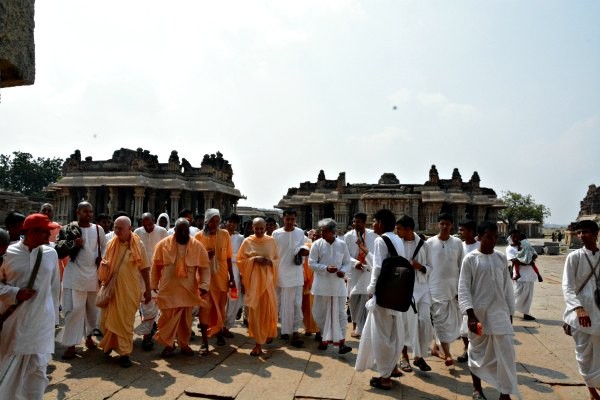
The second day of the yatra was visit to the erstwhile Hampi–Vijayanagar kingdom. This was after honouring a truly delicious upma with rasam on a pleasant rainy morning. Travel around the kingdom included a 6 km long walk as no vehicles were permitted entry so as to keep away further destruction in the form of vehicular pollution to this UNESCO world heritage site. The remains were picturesque of the 15th century kingdom and reflected the glorious days of the then region called Bharat. The remains included temples, streams of water interjected by majestic mountains surrounded by lavish greenery. Rides on basket like boats were made available. The walk ended with darshan of the tall sculptures of Lakshmi Narasimha and Shiva Linga. After we returned to the pandal, Maharaj entertained us all with another engrossing lecture that evening. During Karthik yatras, I’m told that his lectures are incomplete without kirtan and dancing. The more than 40 minute long kirtan that followed the lecture was intense and the cry of Maharaj calling out the names of Krishna for sure made even a recluse shake a leg. The presence of the giant screen at the venue ensured that every devotee sought the desired inspiration by watching the intensity on Maharaj’s face as he led the kirtan. Enthusiastic participants included devotees across age groups, from toddlers to children to youth to middle aged to old. On observing the diversity across age, gender, ethnicity, country of origin, race and family background, I was reminded of a book written by Satsvarupa Dasa Goswami, a senior disciple of Srila Prabhupada: “Srila Prabhupada: He built a house in which the whole world can live.” I acknowledged that I was just witnessing this statement in front of my eyes, which had turned moist as I told myself that the venue where I was present was not ordinary and that the mercy being showered upon me by Maharaj and other Vaishnavas was unparalleled and one that manifested out of pure unconditional love and blessings for the fallen soul. Further, I affirmed to myself that the only way to reciprocate was to chant the holy name with sincerity and aloud with no self-inhibition. Radhanath Maharaj often instructs that one should chant the Holy Names like a baby crying out for his mother. After the long intense kirtan, Maharaj ended with his trademark “Thank you very much.” in a deep hoarse voice. Recital of Shri Damodar Ashtakam followed with devotees offering oil lamps to the deities of Krishna and Yashoda installed on stage.
The following morning was time to pack up and to begin the second leg of the yatra – to Udupi. We boarded the buses to embark on a 14 hour long journey spread across inundated roads, narrow lanes, polluting industrial areas, lush greenery, huge mountains, valleys, peaks and waterfalls at different laps of the drive. A hater of the suffocation and the restlessness that builds in me during bus journeys, I was totally exhausted after a little over 5 hours of travel, around noon time. A simple yet delicious lunch prasadam of paratha with mango jam did its bit to pacify me but not beyond a 2 hour long nap. Finally, after exercising much tolerance and patience, the venue approached at 8 p.m. After freshening up, I sought energy in the delicious dinner prasadam – dal rice with chips – which within minutes made me forget the exertion that I had been subjected to physically and mentally. We retired for the day at our respective places of stay.
As I walked out of the venue the next morning, I was amazed by the plush greenery surrounding the pathway to the main road. A stream of water poured under a short bridge constructed to connect two ends of the road. Different birds chirped, the cock alarmed the sign of dawn, the cuckoo cooed, the bells around the neck of cows dangled to complement their own maas and the sun had just found his way out of the grey clouds. The silence in the surrounding echoed a million voices in my mind. Such a setting reminded me of the childhood visit to my native village in Trichy, Valady. Life was simple, calm, pleasant and closer to the heart, where the divine is present. Wrapped in a dhoti and heart wrenched by the pleasure of witnessing the scenic beauty and the nostalgia pervading my heart, I joined fellow devotees to board the bus to the pandal. The occasion was to remember Srila Prabhupada on his disappearance day.
The event kicked off with kirtan, which is a standard inaugural practice at all ISKCON programmes. After an hour of it, various devotees who had met Srila Prabhupada during his lifetime shared their experiences and paid their offerings. The list included Srinathji Das Adikari, Mandakini Mathaji, Dwarakdish Prabhu, Radheshyam Prabhu, Chandramouli Maharaja and many others whose names I do not recall. The offerings continued in the evening as well with the final offering by Radhanath Maharaj. Let me share the highlights of the offerings.
Srinathji Das Adhikari, a senior member in the congregation at the Chowpatty temple and son of a former MLA of Bombay City, narrated Prabhupada’s visit to his house in the early 1970s and how he pulled the speaker out of the Mayavad association of his ‘Guru’. He narrated humorously his failed attempt as messenger to make his ‘Guru’ accept Prabhupada’s invite for a philosophical debate. Mandakini Mataji, the wife of the only devotee that Prabhupada preached to and initiated in Russia, blessed us all with an inspiring talk. The miraculous incidents that she had been part of and the sincerity of her service to Srila Prabhupada and his mission inspired me. Serving at the Shri Shri Radha Parisishvara temple in Paris, she had prayed to the Lord to give her an opportunity to serve Prabhupada in a better way that could please him. Within a few days of her sincere prayer, on the day that Prabhupada reached Paris from Moscow, he met Mataji right away. He requested her if she would marry this devotee that he had preached to in Russia so as to spread the movement more effectively. Prabhupada’s request truly quenched the thirst of service in her heart; she remembered and thanked Krishna before obliging Prabhupada instantly.
The audience were stunned by her submissiveness and her faith in Prabhupada’s instructions. It immediately struck me if this submissiveness to one’s Guru and respect for the sacred institution called marriage is what forms the essence of an arranged marriage, something that most 21st century youth mock as a nonsensical ‘sex–with–a–stranger’ arrangement. Marriage should be seen not as an authorised arrangement to indulge in sex but to live with a partner for making combined spiritual progress under the guidance of Guru. To put it simply, it’s about learning from each other and seeking inspiration from each other. The combined efforts of Mandakini Mataji and her devotee husband in the years that followed their marriage set Russia ablaze with Krishna Consciousness – the Holy names chanted with great devotion to attract millions of devotees, a few hundreds of them present at the yatra along with me. The couple took the biggest risk of preaching Krishna Consciousness in the then communist state of USSR, at the expense of their lives, to serve Srila Prabhupada, their Guru Maharaj and Krishna’s representative. Because they found the highest protection in Krishna, they proceeded with no fear. As Mataji narrated these incidents, we applauded thunderously for her courage and devotion. However, the submissive and elevated soul that she is viewed it as an appreciation for Prabhupada; hence turned right to his vigraha and joined us in the clapping.
Radheshyam Prabhu highlighted Prabhupada’s ability and mercy to explain the highest philosophy in a language and with analogies that modern man can understand and accept. Dwarakdish Prabhu narrated how Prabhupada’s words were bullet like – short, sharp, pointed and impactful. He referred to Prabhupada’s single question to Alfred Ford (now Ambarish Dasa), great grandson of the legendary businessman Henry Ford. During their first meeting, Prabhupada asked: “where is Henry Ford now?” These words shook the man that he later joined Prabhupada’s mission to serve at his dream project of constructing the Vedic planetarium in Mayapur. Later that evening, the Acharya of the Pejawar mutt, one of the eight established by Madhvacharya on the instructions of Veda Vyas, made his august presence at the pandal and blessed us all. It’s notable that he attained sanyasa at the age of eight and is the most experienced and the most sagacious in the Madhva parampara. In his talk, he spoke highly of Srila Prabhupada and his immense contribution to Vaishnavism by spreading the holy name to every corner of the world. He also shared his admiration for Mahaprabhu and his acintya bheda abheda tatva, the final conclusion of the Vedanta. He re–emphasized the position of Krishna as the Supreme Personality of Godhead and concluded the talk urging every one of us to make progress in spiritual life. Radhanath Maharaj as the final speaker for the day spoke briefly about the immense faith that Prabhupada had in Krishna. He referred to Mandakini Mataji’s talk and described how he saw a window of hope and opportunity in one boy to spread Krishna Consciousness in the then communistic USSR, a place where he wasn’t allowed to visit a single school/college or to speak to any citizen. Prabhupada met this boy at the Indian Embassy through an acquaintance and invested his full energy in him and believed that Krishna will guide him in his mission to spread Krishna Consciousness in Russia. At 7:28 p.m., the exact time of Prabhupada’s departure from the material world, Radhanath Maharaj led the samsara–dava prayers and aarti was performed to the saint who set the foundation for the holy name to be chanted in every town and village of the world during the golden age spanning 10000 years of Kali Yuga, more than 500 years of which have passed, since the appearance of Chaitanya Mahaprabhu. Following the aarti was ecstatic kirtan led by Maharaj.
The following day we visited The Pajaka Kshetra, the birthplace of Madhvacharya; here is where he performed his childhood pastimes. After an hour long lecture glorifying the saint who propounded the Dvaita philosophy and thereby set the foundation for Chaitanya Mahaprabhu to preach the Yuga dharma – Congregational Chanting of the Hare Krishna Mahamantra – we strolled around the kshetra and later visited the Durga Devi temple and the Parasurama temple situated on two hills opposite each other. For the physically unfit me, climbing the two hills back to back was indeed a challenger. Evening was lecture time with Radhanath Maharaj who spoke about the life and times of Madhvacharya. The lecture was spread over two days. On the second day, we visited the Chandramoulishvar temple followed by the Ananteshvar temple and finally, the renowned Udupi Krishna temple. Visiting the temples after having learnt about its historical and spiritual significance enabled me appreciate the divinity associated with the darshan.
It was indeed inspiring to learn that the tradition of worship at these temples had been continuing for close to a millennium now. The Ananteshvar temple was unique in a sense that the deity is a Shiva Linga surmounted by Ananta Sesha. The Linga is worshipped as Lord Vishnu Himself and the puja is performed like the way it’s done for Vishnu. It was beyond my level of conceivability to believe that the deity of Krishna at the Udupi Krishna temple was the same as installed by Madhvacharya many centuries ago. It was far more mind boggling to note that this was the deity that Goddess Rukmini, the consort of Krishna, had worshipped at Dvarka in Dvapar Yuga, the yuga spanning 864000 years that preceded Kali Yuga. It’s interesting, and let me confess that my belief in such a miracle was at a heightened state when Maharaj described about it in the class the previous evening. Come next morning, I stand right in front of the nine holes through which I take darshan of the lord and my level of appreciation was not as high as it should have been. “That’s the nature of the fallen soul under the influence of Maya.” – I smiled to myself. From the main altar, we proceeded to the goshala and the Gita mandir that had been constructed.
The last day of the yatra dawned with the regular Mangala aarti at 5:30 a.m. followed by Narasimha pranam and Tulsi puja. Breakfast was wrapped up by 7 a.m. and we proceeded to the bus area enroute the Malpe beach along the Konkan coast. Here was where Madhvacharya picked up two deities of Krishna and Balrama from a sailor who unknowingly had them in his boat, which was saved by the saint after the onslaught of a fierce storm. While the Krishna deity was installed at the earlier mentioned temple, the Balaram deity was installed at a temple built adjoining the shore. It was again disbelief in a positive sense that gripped me as took darshan of that same deity installed by the great saint many centuries ago. The Balaram temple that day was host to a humourous lecture by Shyamananda Prabhu, a senior Brahmachari from the Chowpatty temple. He narrated the pivotal role played by Madhva in removing from the minds of people, Nirvisesha and Shunyavad. Nirvisesha – the advaita philosophy propagated by Shankacharya to re-establish the Vedas after Buddha, Lord Vishnu Himself, belittled them by propounding Shunyavad – the philosophy of void – to establish the primacy of nonviolence.
While I had learnt about the true nature of the advaita philosophy, it was during the course of this lecture that I truly comprehended its psyche and the openness associated with the philosophy that in turn helped me fathom the mushrooming of a plethora of God men and God women the world over. This, after five years of my association with ISKCON, and after twenty five years of my identification as Smarta Brahmin! Proponent being the great saint Shankaracharya himself. In retrospect, I’m glad neither me nor my parents ever indulged in a deep understanding of the advaita philosophy. That could have laid a trap, out of which I could have perhaps never crept out for millions of life times to come; what to speak of embracing Krishna Consciousness as the eternal way of life. I’m thankful to my parents, my mother particularly, who introduced me to the different Gods but never went beyond a point; so to say that all of them merge into one Brahman, the trap that I’ve referred to above. I always believed that the different Gods are different in every sense; however, I was sceptical about the concept of polytheism, which unravelled as a result of my belief in multitude of Gods. Subsequently, within me, there sprouted an argument/notion that there ought to be only one Supreme (monotheism) among them all. However, that thought remained latent and never really translated into a vigorous search through inquiry or by knowledge acquisition through hearing or reading. The philosophical treasure that I should have searched for approached me on its own, mercifully, in the form of a series of events that unfolded in late 2009 culminating in a strengthened faith 2010 onwards. That can be an article in itself – so many thoughts pop out of my mind as I ponder – but for some other time.
Coming back, the lecture at the Balarama temple concluded before noon time and we were set to return to the pandal for my last prasadam at the yatra. I was to board the return train to Bangalore that evening and hence had to lose out on Maharaj’s evening class, considered to be his thanksgiving to all selfless devotees that made the yatra possible in the first place and to top it, a huge success as a result of their untiring relentless services.
As I look back at this yatra and the different events that shaped my experience, if I needed to pick the most touching of all, it is without doubt the journey to and from the Balaram temple on the last day. Deservedly, I reserve its narration for the concluding section of this write–up. In fact, such an event was something I keenly looked forward to when I first imagined myself to be part of this special yatra; this was in late August. Just like how you, the reader, needed to wait till the end of this write–up to know about it, even I needed to wait until the last day to experience it.
I believe that whatever little progress that I’ve made in spiritual life is courtesy the mercy of my Siksa Guru, His Grace Revatipati Prabhu. If I ever regress on this path, it would be, sadly, despite his mercy. After having had to wait for more than a week, I got to steal some of his personal time for my benefit – to learn spiritual matters directly from the saintly person that he is, to absorb his experiences to understand what the spiritual path ahead of me looks like, to perceive the taste of humility first hand, and to listen to him elucidate on a deep subject at a height that makes me self-condemn my obsession for materialism. My very participation in the conversations was with a selfish desire to grab the free flowing mercy with both hands to steer my spiritual progress further. While I do not want to get into the specifics of the conversations so as to respect our privacy, I affirm that it is his more than 12 years of sincere spiritual practice and service pleasing his Guru and Krishna that has elevated him to a level that he could effortlessly transform the heart of this fallen soul.
Over the last many months, I had heard a lot about his greatness from many devotees based in the Pune temple. I had to come to know of a lot of incidents in which he had taken so much time out of his busy schedule as an administrator of temple affairs to guide devotees on the spiritual path; while in tandem steering his ship of spiritual service to Guru and Krishna. The more I hear about his greatness, the guiltier I feel as I realise that neither do I deserve his association nor am I advancing myself spiritually so as to deserve it at a later point of time. Those minutes of intimate association that he awarded to me is something that I shall never be able to repay for. To cite one, in the middle of his hectic schedule and line-up of seva at the yatra, he never forgot to inquire about my comfortable stay. Let me admit that both materially and spiritually, I’m a person who can withstand a greater degree of sadness (viewing it as a reaction to bad karma) but not an extended degree of happiness. Beyond the tipping point, that quantum of happiness makes me feel unqualified thereby transforming me apologetic, regretful and indebted to the divine. It’s oxymoronic so to say; and over the previous four years that I had known Prabhuji, he has given me many such experiences, some of which I realised and repented many months later. I recall, during the initial days of our association, I used to selfishly steal his time, giving preference to satiating my curiosity for spiritual understanding over his sleeping hours. Discussing and debating at the temple gate for an hour close to midnight with him, who needed to wake up at 3:30 a.m. for the Mangala aarti is plain atrocity. This best exemplifies his greatness! The ability to tolerate provoking situations – as defined by Srila Prabhupada.
Prabhuji, I once again thank you from the bottom of my heart for having taught me the path to self-discovery. This journey of a million chanting of the holy names has just begun with a few, thanks to your inspiration, mentoring and guidance. I pray to never let go off your merciful hand – the same that unconditionally pulled me, when I was sunk in the material ocean in search of nothing. Yes, in search of nothing! That was my level of ignorance! In other words, plain living, because life had been provided to me (read my body)! Such a thought evokes laughter in me now. Not an iota of knowledge I had about the danger associated with the material world, well encapsulated by Govinda Dasa: kamala–dala–jala, jīvana ṭalamala, in the famous song ‘Bhaja Hu Re Mana…’ This line translates to this life is tottering like a drop of water on a lotus petal. In fact, this knowledge forms the fulcrum of Sripada Shankaracharya’s Bhaja Govindam.
I’m aware that I’ll get lost during the journey should I walk alone; there are only a few hands that I trust, the principal being yours.
While I did have the intention to write this article sharing my experiences of the yatra, the mood got strengthened on the last afternoon when Prabhuji instructed as a parting note: “Write an article about the yatra. Krishna has given you the ability to write.”
What you’ve witnessed over the last few pages is the ability that he believes in. Hare Krishna!
I Rajesh Sridhar’s comments with interest. As a philosophical man, you must cross the threshold of bhakti to have realization, which is the causeless mercy of Krishna alone. The guru is a transparent via medium to Krishna. He does not obstruct the vision of Krishna in any way. He is a gateway.
When I first met Srila Prabhupad in 1971 in Bombay, I said to him, “you are the only person I trust in the world.” Srila Prabhupad with utter humility spoke to me in private, “Do not trust me, I may let you down. Trust Krishna, He will never let you down.” I knew for certain that Srila Prabhupad was a genuine guru or spiritual guide. Krishna says to surrender to Him, and the Guru says to surrender to Krishna. The same! Krishna consciousness involves philosophical wrangling in the beginning, but once one accepts Krishna’s advice, then surrender is the predominating mood, thought, direction. Doubt goes out the window. Still, one can apply the intellect fully to understanding the shastra, and to serving Guru-Gauranga with one’s Krishna supported intellect. Krishna can reveal Himself to a sincere seeker if He so chooses. It is in His hands. Our choice remains to surrender.
There is a Srila Sridhar Maharaj who was a godbrother of Srila Prabhupad. He gave the example that once one is rescued in the lifeboat provided by the Vaishnava, and lands on the island of Krishna consciousness, then, with faith, one must burn that lifeboat, being committed to Krishna consciousness forever. Pusta Krishna das