



By Devaki Devi Dasi
Ukraine is certainly one of the most dynamic preaching fields in this world. Over the last fifteen years I have been giving the yatra of Kharkov a lot of attention – we have so many sincere and sweet devotees here, who deserve all the care and encouragement they can get.
Even though Kharkov is in the very East of Ukraine – only 180 km’s away from the war zone and 60 km’s from the Russian border, nevertheless life here is basically going on as usual. The only noticable effect of the war is the bad economy – a huge inflation with the Euro being 25 Hgr’s now, whereas it was 8 Hgr’s last year. Prices are constantly increasing, but wages remaining the same. The gas for heating has increased six times in comparison to last year – people don’t know how to survive the next winter. Also our devotees are struggling, and we are planning to switch over the temple heating system from gas to wood….
Especially in such difficult times the devotees need association and encouragement. Naturally, foreign preachers are not so eager to visit this part of Ukraine at the moment, being afraid of instability, crime and violence.
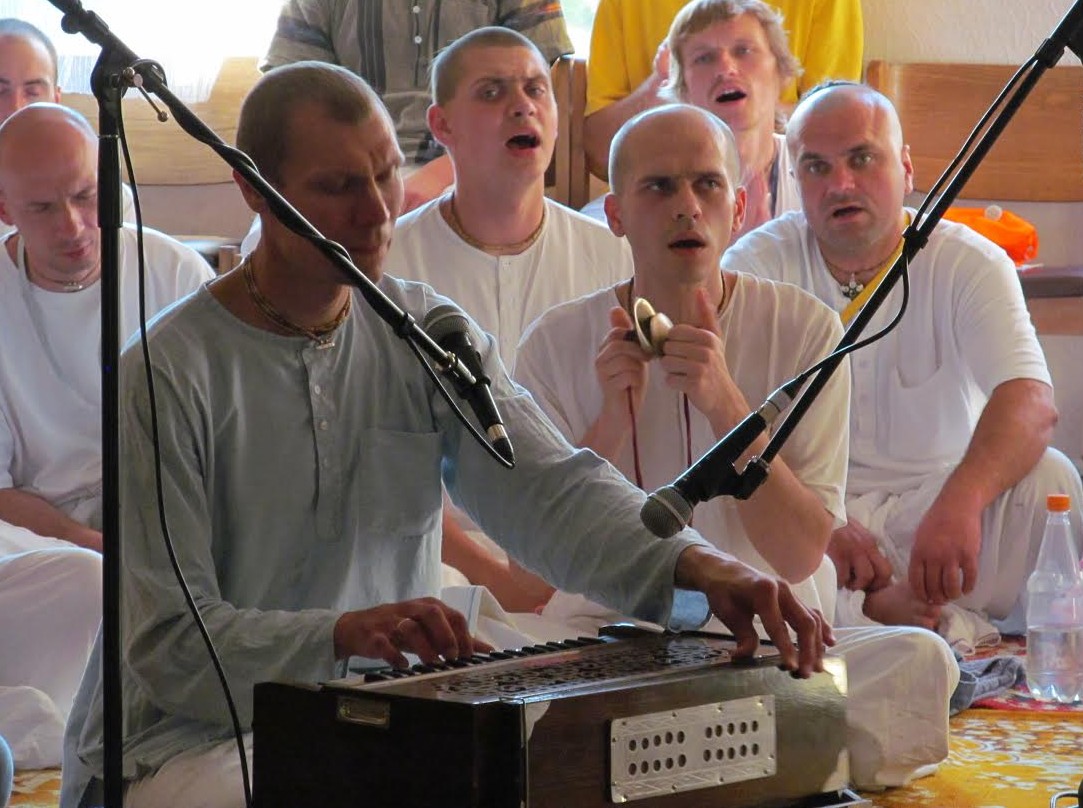
We had scheduled a four-day Holy Name Retreat at the end of June. Like two years ago, we rented the same holiday camp 45 km’s outside of the city. Around one hundred devotees participated – many young devotees who had taken up the process of devotional service over the last two years. Also senior devotees attended the retreat, welcoming it as a wonderful opportunity to go into seclusion for four days and polish up their chanting habits in order to ongoingly deepen their relationship with the holy name.
The atmosphere was sweet and harmonious, and devotees gained valuable insights into deeper levels of chanting – in japa aswell as in kirtan. One day of mauna vrata helped us to become more introspective and do some internal work on our hearts. The holy name carries an echo called dvani, and even after chanting this echo still affects our heart. However, what immediately destroys this transcendental echo is unnecessary talk, or prajalpa. And little do we realize how much of our daily talking is unnecessary! Prajalpa immediately switches on the mundane mind, whereas the holy name stops the mind from rambling on and on.
As we know, overeating creates toxins within our gross body, and thus it is healthy to fast sometimes – simply in order to give the body a detoxifying break. In the same way, unnecessary talk creates toxins within our subtle body, especially the mind, and thus it is very beneficial to observe a little mauna vrata sometimes – simply in order to give the subtle body a detoxifying break!
Sometimes on such retreats the widely discussed question arises how we should chant – Hare Rama or Hare Ramo? In this regard it is interesting to note that in Bengali language the ‘a’ is often pronounced as ‘o’. In Bangladesh the devotees very commonly spell my name as ‘Deboki’, and they also pronounce it in this way. And of course they also pronounce the maha mantra as ‘Hore Ramo’. It is simply a linguistic matter. And when we hear German or Chinese devotees chant the maha mantra, it again sounds completely different. Infact, when we learn to speak as a young child the palate within our mouth even develops differently, according to our language. So obviously we would not do right by telling the Bengali devotees that they have to change their chanting now and cannot chant ‘Hore Ramo’ any longer.
However, what will ruin our movement is the tendency of introducing new fashions, especially in regards to chanting the holy name. Once we get on deeper levels of chanting we will feel an ever increasing satisfaction. We will no longer feel the need to introduce new fashions – Radhe Radhe Syam Syam, or Hare Ramo, or whatever it may be. The mundane senses always demand a new kind of stimulation and satisfaction. And if this tendency enters our chanting, then it will remain on an external level. We will not be able to receive the ultimate benefits which the chanting of the holy name can give. We will fall victim to this most dangerous mentality of thinking we have to come up with newer and newer ideas and practices, which will eventually water down the process of bhakti. Srila Prabhupada was repeatedly warning us of this tendency. And it is exactly this mentality, which will ruin our movement….
For further information please visit www.theholynameretreat.net
Your servant, Devaki dd
I have mentioned this before on Dandavats. At least twice when I was chanting Japa in the presence of Srila Prabhupad, and he heard me enunciate “Hare Ram”, instead of Hare “Rama”, he took his time to interject, “say the whole mantra, Rama, not Ram.” Just sharing this experience with the readers.
Pusta Krishna das
The pronunciation is only important to the effect as it shows attentiveness/inattentiveness, or the tendency to show off and introduce new fashions. So this is why Prabhupada was correcting the “Hare Ram”, because he could see the inattentiveness behind it. Otherwise, the mere pronunciation is not really important, since it is a matter of the language. Anybody who travels a lot for preaching will have observed that the same maha mantra sounds very different in many parts of the world. So let it be like this – let everybody simply pronounce the maha mantra as it is spelled, to the best of their ability, with attention, according to their language and the palete which has developed within their mouth….!
Much more important is the quality of feeling, with which we chant! Bhaktisiddhanta instructs us that any chanting which is devoid of the longing to serve is useless! Yes, useless – whether it is pronounced as Hare Rama or Hare Ram, or Hare Ramo….!! It is still useless!
Your servant, Devaki dd
From another webpage here on Dandavats.com ( http://www.dandavats.com/?p=11965 ):
“In this connection, there is a not so publicized pastime which took place between Srila Prabhupada and his leading kirtan man, Vishnujana Swami, which now should be told.
“Vishnujana Swami was singing the Hare Krsna mantra where he had deliberately changed Hare Rama to Hare Ramo because he had heard it being sung that way in India. When Srila Prabhupada noticed this change, he immediately stopped him by asking ‘Who is this Ramo?’.
“Vishnujana Swami looked up and said nothing as Srila Prabhupada rebuked his disciple with these exact words, ‘YOU ARE RUINING OUR MOVEMENT’. With that, Srila Prabhupada continued to correct Vishnujana Swami by saying, ‘It’s Rama’ and then went on his way. (told by Vishnujana Swami to Mahamuni das)”
Yes, because Prabhupada could detect Vishnujana Swami’s mood of imitating the locals in India, and trying to introduce a new fashion. And exactly this will ruin our movement! I don’t think Prabhupada would have rebuked devotees in those parts of India or Bangladesh where they are naturally pronouncing the ‘a’ as what sounds to our ears as an ‘o’.
Your servant, Devaki dd