
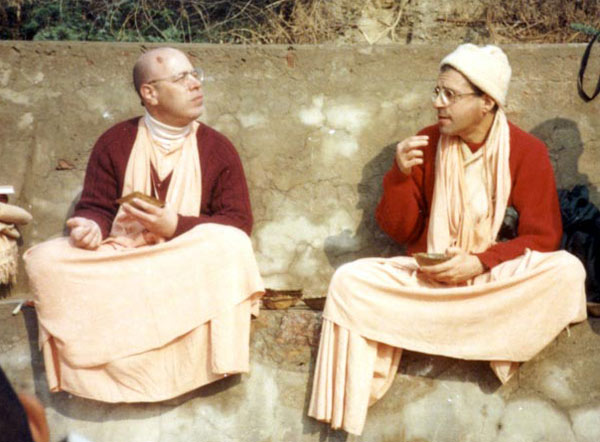
A Talk by Giriraj Swami and Syamasundara Dasa on July 19, 2005, in Los Angeles
Syamasundara dasa: Because we have not seen each other for so many years, Giriraj Maharaja and I thought we would take a little walk down memory lane this morning and try to remember some of the incredible times we had with Srila Prabhupada and put everyone in the mood of appreciating those times.
We must take our minds back a little, to around 1970. I had never met Giriraj before. I was active more on the West Coast and in Europe, and he was on the East Coast. Srila Prabhupada had been in America for about four years and had from day one inculcated in his disciples here the intense desire to spread Krsna consciousness. The devotees had no activity other than to spread Prabhupada’s message. We did not have so many books then; Srila Prabhupada’s books were just beginning to trickle in. And we did not have knowledge of the Vedic tradition. We had only recently even begun to wear dhotis and shave our heads and get rid of our dogs. So, Prabhupada more or less harnessed our energy to do something. He wanted us to spread Krsna consciousness; that much we could understand. And he more or less left it to us. In some ways, Prabhupada in the early days in America did not know that much about how we do things here. He was learning from us how our society worked, and he gave only this one command: “Spread Hare Krsna as fast and hard as you can.” And then he guided us, of course, and managed to some extent, but he gave us long leashes to do whatever we felt we could to spread Krsna consciousness. After some time—three or four years of this—several temples became very strong and the movement was spreading and it became quite well known and stable. So Srila Prabhupada decided at that time—and of course we do not know the depths of his thought—but my sense is that he was always thinking that some day he would bring this movement back to his own country. He used to talk about that even in the early times, that “My country has forgotten Krsna. When we are ready we will go there and teach them again.”
So, several of us, maybe twenty, got notices Srila Prabhupada sent out that he had decided to take some of his disciples to India and that we should meet him there one way or another. In those days we had no organized financing or anything. Everyone was on their own: “However you can get there, you try to get there. I will be there.” So Giriraj went, via Belgium. Gurudas had a friend who worked for a very small airline that had only one airplane, with two propellers. It was called Basco Airlines, and they did fly to Bombay, but their route was via Aden and Cairo. They had to refuel. Now, this was a converted cargo carrier. It had no passenger seats; they had put temporary seats in. And we were all so thrilled. We were going to India. We were going to India to meet Srila Prabhupada. He was already there; he had come around from the Los Angeles side. No one had any plan, any idea, of what was going to happen. No one knew anything about India. Prabhupada was the first Indian man I had ever seen in my life. There were no Indian immigrants here. India was a far-off place of magic and color, but we really knew nothing about it except that Srila Prabhupada was from there and that his knowledge was radically changing our lives. Whatever he said, we would do without question. So the excitement began to build. We were free from our bonds, the things that were attaching us to America or Europe—our temple responsibilities and so on. We were flying off into the wind with Srila Prabhupada. I can remember flying through those Alps and looking out the little windows and seeing the mountains higher than the airplane. It was just skimming over the clouds. We stopped at Aden. It was so hot. We got off the plane, and it was around 110 degrees. There was just one palm tree. We had to wait many hours while they refueled this plane by hauling out barrels of fuel and filling it manually. The one palm tree cast a long shadow, so we were all kind of in a row behind this long tree. Then the next stop was Cairo. As we flew over the airport there, we saw three exploded jumbo jets on the tarmac. Our eyes were more or less fixed on the pyramids, but there were these three giant wrecks of planes that the terrorists had blown up right on the tarmac the week before. When we got out of the plane to rest while they refueled, men guarded us with machine guns.
So we got to India. We got to Bombay, and everything was overwhelming. Prabhupada’s role with us, his relationship with us, was all of a sudden very different. Now he was the commander-in-chief. From day one he guided everything we did in India. We had no clue what was going on. We saw all this wonderful color and activity, and we kept looking around the streets of Bombay to see pictures of Krsna or temples to Krsna, but there were none. Where was Krsna in this huge city? There was no visible evidence of all of this philosophy and wonderful culture that Prabhupada had been teaching us. Only noise, sound, and color. So Prabhupada immediately took charge and began to guide us, and he gave us the same message: now we had to bring Krsna consciousness back to India and revive it there.
This was the first time that Giriraj, I, and many of the other devotees were all together in a common effort. Srila Prabhupada immediately began to divide us into active groups. He began to travel quickly from place to place, two- or three-day trips—not long trips, but a few days here, a few days there—maintaining a base in Bombay, shifting from one house to another, constantly moving. It was a wonderful, wonderful period of seeing Srila Prabhupada in action as the commander-in-chief, rather than us taking the lead, as we had in America. Do you remember? What were your first impressions in those days?
Giriraj Swami: Like you, I saw India as very remote and exotic. Once in a while, as I was driving by the University of Chicago, I would see an Indian lady in a sari or an Indian gentleman with a turban. But I don’t think I had ever really met one until the Boston temple. One couple started to come. I remember that the gentleman had a thick accent. They came regularly. Years later, I found out that his wife had taken initiation from Srila Prabhupada—Sunita Mataji—but I guess he didn’t follow her. The only knowledge of India I had, if you want to call it knowledge, came from a documentary I’d been shown in school. All I remembered was seeing cows in the street—really hot, crowded city streets and cows—and I thought, “Oh, they worship the cow. They have cows in the streets.” It all looked quite backward. But when we arrived in Bombay, I was excited; I was enlivened. I did see cows in the street, but I was happy. I thought, “They are protecting the cows, as they should.” It seemed like a long drive from the airport to downtown Bombay, but it was exciting. Several cars had come to receive us at the airport. Kailash Seksaria showed us a letter that said he was supposed to receive us. All the cars were Ambassadors, all the same, but that was okay. We all wore the same dress, just that some were saffron and others white . . .
Syamasundara dasa: Or yellow.
Giriraj Swami: Yes, yellow. So that was okay. In India then there were only two makes of cars—Ambassadors and Fiats—and only one model of each. That was good, simple. You didn’t have to decide between too many choices. Do you want to take up from when we arrived at Seksaria Bhavan?
Syamasundara dasa: My memories really start from when Prabhupada arrived at Seksaria.
Giriraj Swami: Okay, I can continue until then. So, Seksaria Bhavan was a big mansion overlooking the Arabian Sea, and I was very impressed that the building was named after our host. There were five stories, and Srila Prabhupada was given quarters on the ground floor. The whole ground floor, or what here we would call the first floor, was a guesthouse. Also on the ground floor were a couple of large rooms where the men just lay down on the floor to take rest, and there was a large common bathroom. And as I recall, there was one room where Gurudas and Yamuna stayed. Mr. Seksaria himself lived on the third story, where he would host us for meals. There was an elevator to take you there, but I had not used an elevator since I had joined. I didn’t know if, as devotees, we were allowed to. [[laughter]] Somehow within myself I thought it was maya. I thought it was too easy, too comfortable. So the other devotees would take the elevator, but I would always take the stairs.
Every day, every meal was like a banquet. The Boston temple, where I came from, was especially austere. Satsvarupa Maharaja, Adhikari at the time, was temple president, and breakfast consisted of something like two slices of apple, between four and seven chickpeas, about three round slices of banana, and a little cereal. So it was very austere. Lunch was rice, dal, one vegetable, and chapatis. After about a year and a half, Srila Prabhupada said that a little sweet at the end of the meal was nice. I got worried: “We might get into sense gratification.” I came from that background. Now every day was a huge spread: almonds, cashews, pistachios, and all sorts of fruits. And the lunch—there were so many types of vegetables all cooked in ghee, dal, rice, puris or chapatis, savories such as samosas and kachoris, and then sweets. Every meal there would be so many sweets: burfi, pera, sandesa, rasagullas, gulabjamuns. So I was in a lot of anxiety, and I would basically just pick the items that we used to eat in Boston—no cashews, no almonds, no pistachios, no sweets. I tried to hold onto that, and for a while I did, but I was in anxiety. I saw the older devotees accept the sweets, but I thought that maybe it was okay for them because they were more senior than I—not only more senior in years but also more mature in Krsna consciousness. My first impression of them had been when we were in Belgium. Syamasundara and Malati, and Gurudas and Yamuna, had come from England; they were already there when we arrived. Our hosts had brought us to the flat where they were staying, and as soon as I walked in I felt a completely different atmosphere; it was palpable. They were so Prabhupada conscious. All they did was talk about Srila Prabhupada. I felt a very powerful spiritual atmosphere in that small flat in Brussels. So I knew that these were very mature devotees, very special devotees, but still, I could not take the elevator and I could not eat nuts and sweets, at least at first.
Syamasundara dasa: You can see how Srila Prabhupada pulled in all these diverse personalities from diverse backgrounds with diverse understandings of Krsna consciousness and threw us all together in the same room—I had not slept with twenty men in a room for many years, not since I’d become a devotee—and united us in one goal: to spread Krsna consciousness. That was it. We were there for that. We were his army, and we balanced each other out. We did not know each other; we had never met before. I knew only three or four out of the twenty. But Giriraj, with his quiet, calm, thinking manner, balanced out my crazy energy. I wanted to dash off and do this and that, but Giriraj would say, “Well, what about. . .” I always used to think, “How can this man speak so slowly?” He was just a boy and very thin. I think he looks good now with a little weight!
But then, when Prabhupada came to the Seksaria house, it was like the king had arrived. We began to feel that whole Indian thing with the reverence for the master and the opulences that he was able to command at his fingertips. He began arranging us—breaking into the scene in Bombay, arranging programs. The first one I recall was the big program we had on the beach, at Chowpatty. It was general—not interfaith, but it was all kinds of Hindu yogis speaking their bits. It was a conference, a seminar or something, of maybe ten yogis, something like that, ten sadhus. We’d been invited almost as an afterthought, and Prabhupada went up and sat on the dais with all the other yogis. And then we all started piling up, too. The host or moderator of the event came running up and said, “No, you can’t have all these people up there.” But Prabhupada said, “If they do not sit with me, I do not sit here.” So they allowed us all on the stage with him, and we just took over the whole show. We started chanting Hare Krsna and dancing. We began to get the feeling that “Oh yes, okay, Prabhupada wants to exhibit us. That’s what he is doing.” We were always trying to figure out what Prabhupada was trying to do. And then we danced and chanted. Pretty soon the whole beach started chanting and dancing. It was a several-day conference. All these yogis talked for days about the Mayavada stuff—merging with the void and this and that. But the culminating experience was chanting Hare Krsna for about an hour. Everybody just loved it.
That was our first hit in Bombay, and then we began to get some newspaper coverage and things like that. The Kalbadevi temple—we used to go down there. They kind of adopted us. This was really something. You have to realize the times. This was something so unique for Indian people to see. These great yogis had gone out into the world—Yogananda and people like that. I can’t even remember all their names, but at most they had made maybe one or two foreign disciples, and they were resting on those laurels. Maybe they even brought one or two foreigners back with them to India; I don’t know. But suddenly one of their own people brings back twenty Westerners who were completely Vaisnava looking and acting,full of enthusiasm, and thinking only about Krsna. This was startling for the people of Bombay. And to spread that more quickly, Prabhupada started accepting every invitation that came his way. Whenever people—from Gorakhpur, Indore, Surat, or wherever—said, “Oh please come to my city,” Prabhupada would be on the next train with a bunch of devotees. He always left a key group behind, because as he said from the beginning, “Bombay should be our base.” Well, it was undecided—Bombay, Calcutta, or Delhi—but when Prabhupada saw the kind of opulence and facilities available in Bombay for spreading Krsna consciousness, he began to target Bombay as the center, at least initially.
So, one by one, these cities fell to Prabhupada’s magic, and we began to feel a different level in our connection with Krsna. We could see it in a historical and traditional way now, rather than just loving Prabhupada and the culture and country he came from. Now we were becoming part of that same culture. We could see it. There was not much evidence of Krsna in Bombay. There were no Krsna temples and things set up, but at first Prabhupada did not grab us and take us to Vrndavana or Mayapur or any of those places. He wanted us to spread Krsna consciousness in a Western way, right there in the heart of the commercial activity of Bombay. And we met some characters.
One other important aspect of that whole period was the fun we had. This was the most fun I think I had ever had in my life. We were always joking. Because we were so diverse but so united with Prabhupada, we could see the humor in each other’s personalities, and we began to have these long running jokes about the people we met and became friends with. Whoever they were—major personalities in Bombay or just anyone—they became part of our amusement. The whole thing was so painless because it was so much fun. We didn’t have anything. We talk about those vast banquets and everything—but those came and went, and the next day we would eat a few chickpeas. But we had so much fun. And that fun hooked us; it drew us deeper and deeper into Prabhupada’s tender net. We could also see the joy he was experiencing while he did all this. We would go to some meeting and he would be all grave and stern, chastising his countrymen for allowing Krsna consciousness to drop, and then when we would get back to our place a few of us would be sitting around with Prabhupada and he would bring up something that happened there and we would all start laughing. Prabhupada would start making jokes about it.
He was so detached from the whole thing. It seemed like Krsna was writing the script. He always did with Prabhupada. With Prabhupada there was never a moment when you could guess what was going to happen. You could never predict even a moment in advance what he was going to do or say. He was a constant surprise. Even after years of being closely associated with Srila Prabhupada, even as his secretary, every time my hand went through that door to his room, it trembled with anticipation. There was this feeling of “Boy, I hope I’m ready for this.” Even after years of that, whatever was to happen inside that room in the next five minutes or five hours, you did not know. “It is going to be wonderful, but can I handle it?”—that feeling. Never before or since have I had that wonderful feeling of surprise that Prabhupada always brought to his magic world. And all of this was totally unorganized. Prabhupada was leaving it all in Krsna’s hands.
He had risked everything to come to us. Now he was relishing the fruits of Krsna’s gifts to him. And we were his dancing white elephants. They even said that in the newspaper: “He has brought his dancing white elephants.” In an interview Prabhupada had told them, “I have brought my dancing white elephants.” He gave us that name. So they put it in the newspaper.
You carry on. I could go on for months!
Giriraj Swami: I had met Srila Prabhupada twice in Boston, but being with him in India was a completely different experience. He was in Calcutta and was coming to meet us in Bombay. We kept getting telegrams saying when he was coming, but then we would get another telegram saying he was coming later. And Tamal Krishna Goswami—he had passed through Boston once, but I’d never really gotten a chance to know him—was describing to me how he was anticipating Srila Prabhupada’s arrival. He said that it was like watching a comet in the sky coming closer and closer and waiting for it to hit.
I remember one time when Dev Anand, a Hindi film star, came to meet Srila Prabhupada at Seksaria Bhavan. We were quite excited, and then two days later there was a picture in a film magazine, or a general magazine with news about prominent people, showing Dev Anand sitting with Srila Prabhupada. So we thought, “Wow—and we’ve only been here a week!”
In America we were used to just doing hari-nama-sankirtana and distributing books, but in Bombay Srila Prabhupada said that we could not do sankirtana like that, because people would think that we were beggars. In India some people go in the streets with karatalas, and they chant and want to get some money. But at first we did go. Each day, Kailash Seksaria would arrange a different part of the town, and we would go there. I especially remember Princess Street in Kalbadevi. It was the old section. There were all these laborers pulling carts loaded down with big sacks of grains and spices or whatever and just wearing these little gamchas and struggling. It looked like they were struggling. India was not very opulent in that sense. Where we were staying was practically the best locale in Bombay—Marine Drive, just along the sea.
Later, one of our godbrothers, Tulasi dasa, came to visit. That was at the time of the second Bombay pandal, in ’73. As he was driving along Marine Drive, which is like the golden mile, he was wondering, “When do the slums end?” Because from the outside they looked like old tenement buildings, a little dilapidated. But that also had to do with the tax structure. The rich people did not want to show their wealth; they were hiding it. They did not want to pay too much tax, so they kept the outside looking pretty old and dilapidated, but inside there was gold, diamonds, marble—very opulent. So we would go out on hari-nama, and Kailash Seksaria would arrange for a little entourage to follow us with nimbu pani, lime juice, in silver pitchers on silver platters with silver goblets; I felt so embarrassed.
Syamasundara dasa: And servants.
Giriraj Swami: Yes. We were in front of all these poor people on the streets of old Bombay, and we came in these cars. In those days only the richest people had cars. Then this entourage of servants with nimbu pani would come out. I felt very embarrassed. Then the preaching . . .
Syamasundara dasa: Prabhupada was always waiting for the report. Every evening, the leaders had to give him the report of what had happened that day. This was the most wonderful time of day—delivering your report to Srila Prabhupada. We would all go in his room, and he would hear what we had done. We would tell him what had happened, and he would give advice and make plans for the next day, the next week. There were not many long-term plans—just spreading Krsna consciousness as fast as we could. We were seeing Prabhupada in a new, different, and wonderful dimension that he just kept unfolding—as the commander-in-chief. This was a wonderful experience, to be part of an army that Prabhupada was putting together, as opposed to before, when we had all been on our own in our individual efforts to spread Krsna consciousness, with Prabhupada guiding us through letters, occasional phone calls, or telegrams. But this was the real thing. This was sitting with the commander-in-chief every day.
Where did you go from Bombay? Did you stay in Bombay?
Giriraj Swami: No. Srila Prabhupada had a friend who had established Prem Kutir, where Prabhupada had stayed before he came to America. This friend’s name was Hari Krishna Das Agarwal. I thought that was wonderful, that this was his name. So, Hari Krishna Das Agarwal arranged for us to go to the Vedanta Sammelan in Amritsar, but I think you stayed behind. And from there, on the way back to Bombay, Prabhupada dropped some of us off in Delhi. So we began the activities in Delhi. And then in December, when Prabhupada went to attend the Gita Jayanti celebration in Indore, we met him there. From Indore we went to Surat, and in Surat Rsi Kumara Prabhu, who was the only devotee I had known from before, pulled me aside and shared with me some very confidential information—that Srila Prabhupada wanted to start a new program called life membership and that anyone who did life membership would please him very much. So Rsi Kumara suggested, “Why don’t you and I go to Bombay and meet up with Syamasundara and do life membership.” That sounded very intriguing. Of course, I didn’t want to leave Srila Prabhupada, and I had also become very attached to Gurudas and Yamuna. But I thought, “Yes, we should do that.”
So we came to Bombay, and at that time Syamasundara Prabhu was living in the Sea Palace Hotel. They gave us one large room upstairs, where the men stayed, and maybe one or two rooms for the householders. The hotel was owned by Ramchand Chhabria. I thought that was a good name too. It was a pure vegetarian hotel. Mr. Chhabria had known Srila Prabhupada and the devotees from London, and he had extended the facility to us.
Once, earlier, when Gurudas, Yamuna, Gopala, and Bhakta Bruce (who later became Bhanu and is now Bhanu Swami), and I were in Delhi, I was walking down the street, and for some reason I just happened to notice the vendors. They would have newspapers and magazines on the sidewalk, and I don’t know why, but I just picked one up. And right on the back page was a huge report about Srila Prabhupada’s program on the top of Scindia House in Ballard Estate, the most prestigious section of the business district, and about how Prabhupada had gone to America penniless, getting free passage on a Scindia steamship, and then had come back like a triumphant hero with his American disciples. There was this whole report. I was really impressed; it was practically the whole back page. So, when I arrived in Bombay Syamasundara Prabhu, or someone, had gotten the list of invitees to the Scindia House program, because Sumati Morarji had invited all the elite of Bombay. One of the devotees told me that the guests had seemed to him like demigods, looking down from the terrace of this big office building on the ordinary people on the street.
One morning Syamasundara Prabhu wrote out a name and address on a piece of paper—“S.N. Nagpal”—and he said, “I want you to go to this man and make him a life member.” So I went. He was up in the Industrial Assurance Building right at Churchgate, near Churchgate station, and he had a petrochemical refinery. I was nervous, but I had faith in Prabhupada, and I had faith that Krsna was there. So, I went into his office and made the presentation, told him about our activities and showed him some pictures. And we had a few books. We showed him the books, explained the benefits, and asked him to become a life member. He seemed nice enough. He listened, and then he said, “I am not alone in the business. I will have to speak to my brother, and then I will let you know.” I thought that seemed reasonable enough, so I left. Back at the hotel, Syamasundara Prabhu asked, “What happened?” So I told him. He said, “Oh, that’s just an excuse. I would have made him a life member.” Then Syamasundara gave me some profound advice. He said, “Mr. Nagpal has plenty of money. He can easily afford to become a life member. He didn’t need to ask his brother, but he had some doubt in his mind. You have to be intelligent enough to understand what their doubts are even without them expressing them. You have to be able to address their concerns. Remove their doubts even without them expressing them and then they will become life members.” I thought that was very good advice. I thought, “He is really on a high level. He can know what they are thinking without them even saying it.”
But I must say, five days later Mr. Nagpal phoned back and said, “I spoke to my brother, and I will become your life member.” What I think happened—this I learned much later—is that his residence was in the next apartment building from Mr. Chhabria’s and they were friends, so he might have checked up on us. Anyway, he did become a life member. He was the first life member I made.
Syamasundara dasa: Giriraj at that time was just a young boy. How old were you—nineteen, twenty?
Giriraj Swami: Twenty-two, but maybe I looked younger.
Syamasundara dasa: Twenty-two—very cautious and deep thinking. It was amazing to watch Giriraj’s transition, as we pushed him, making him do certain things he had to do for Prabhupada. Prabhupada forced this new spirit out of you.
Giriraj Swami: Yes. Maybe I will just mention that briefly. I was always afraid to go out; I just wanted to stay back and chant. I was afraid that if I went out I would get into maya. Not get into maya, but that I would get attracted—not even attracted . . . diverted. Even in Boston, if I had to go to the store, if they wanted to send me to the store, I would not go out alone, because I thought that if I went out my eyes might go to a billboard or something and that would be a falldown; we were supposed to think only of Krsna and nothing else. I did not want to be tempted to look at a billboard or anything. And Bombay, as you said, was full of colors and textures and smells and all sorts of exotic things. So my inclination was to stay back and chant and do service from behind the lines, if you will.
Syamasundara Prabhu nudged me out the door. I remember going to see this man whose name was Vakaria. He had a textile shop on Old Hanuman Lane. I thought that was a good name too—“Old Hanuman Lane.” I was very nervous, and I was taking an auto rickshaw, sitting in the back chanting for dear life. I was chanting for dear life, and I was really relishing the chanting. Then I had a realization—that you could be Krsna conscious out in the world as well as in the protection of the temple, but that outside there was the added benefit of spreading the movement. So it just clicked: “This is it. You go outside. You chant. You be Krsna conscious outside and at the same time you spread Krsna consciousness. You do both at the same time.” That was a turning point in my spiritual life.
Syamasundara dasa: Prabhupada forced us against our personalities and normal hesitations and desires for privacy. He forced us to the frontlines. We would be sitting in some big meeting like this—I am not at all comfortable speaking in public—and he would say—there might be five thousand people out there—he would suddenly turn, without any warning, and say, “Syamasundara, you will say something?” He forced us like this.
I was reading the whole picture, and my perspective was that Prabhupada wanted centers in Bombay, Delhi, and Calcutta. We could see that, and I loved Bombay. When I first saw that place, I thought, “Wow, what a city!” It is close to Los Angeles, equivalent to an L.A. type of city. It is full of opulence and color and sunshine. There was the movie industry, and everything that I liked was there. I had heard stories about Delhi and Calcutta. Oh my God—what people told me about Calcutta! And I knew that he wanted Gurudas and me to take over management of one of those places, so I voluntarily stayed in Bombay to build up a kind of power base so that when the time came to assign us to different posts (we knew that was coming) Prabhupada would say, “You stay and head up things in Bombay.” I was hoping for that. I had to stay back even though he went traveling to all these wonderful places. I could have gone to Amritsar, I could have gone to Indore—all those places with Prabhupada—but I stayed behind and made life members and built whatever I could there. It came to pass as I had hoped, because on their way back from Amritsar, the train they were on stopped in Delhi, and Prabhupada said to Gurudas and Yamuna, “You get down here and start the center in Delhi.” I was so happy. I should not say that but . . . then I knew, “Ah, I get to stay in Bombay.”
But the key to Bombay was Prabhupada’s program of life members. He was so clever. If you read back in the books, the Lilamrta, you can understand that Prabhupada’s business life had carried him around to all these cities. Previously, in his middle years, he had done business in Bombay. He had done business in other cities, but he really liked Bombay. Although his business was not permanent there, he had always harbored the idea that Bombay should be the financial center for his spreading of Krsna consciousness in India. And this was a new idea. Looking back . . . thirty years later, you go to India and you see Krsna’s name everywhere—Krsna bicycle shop, Krsna this, Gopala that—but in those days you hardly saw Krsna’s name anywhere. Prabhupada single-handedly in our lifetimes switched the whole consciousness of that billion-person nation. It is very subtle, but he did it. Except in little pockets like Vrndavana, or if there were a few devotees of Krsna in a little town, Krsna was not a popular god. It was all Siva and Ganapati and other demigods—all hollow. The temples were unpeopled. Whatever temples were there were just ancient artifacts that people came to look at. Prabhupada brought back the spirit of Krsna and fanned the flames to such an extent that it was magnified hundreds and thousands of times. Now Krsna is very popular in India. Anything to do with Krsna is popular there. Anyone who has been to India can see that. Krsna’s name is everywhere. Rama and Sita also, but Krsna was never there to such an extent when we were first there. So this is Prabhupada’s potency.
There are so many stories of Prabhupada’s potency, how he changed the minds of people with just a small sentence, a small event. We saw it happen. We began to be invited from one man’s house to another. We gave programs almost every night. It was a grueling schedule even for us, what to speak of a seventy-year-old man. We were in our twenties and we were always exhausted. But Prabhupada never seemed to flag. Someone would say, “We have a program tonight at So-and-So’s house,” and we had just finished digesting the food from the program that midday. “Oh, okay.” So off we would go again. Prabhupada. We did not have books to distribute. We did not have much personal knowledge of the scriptures; we just had a basic grasp of the philosophy. So when we spoke it was always very simple: “I am not this body. I am pure spirit soul.” “Krsna is the Supreme Personality of Godhead.” That was a new idea in India, that Krsna is the Supreme Personality of Godhead. They did not even know that; it had been forgotten. And it was so simple to prove it to them: “Who do you think spoke Bhagavad-gita? It takes a person to speak Bhagavad-gita, right? You are all following Bhagavad-gita?” “Yes.” “Then who is the person speaking Bhagavad-gita?” “Well, that is Krsna.” “Then He is a person, right?” “Yes.” Like that. Gradually the whole idea of Krsna as a personality became implanted in India, re-implanted.
Prabhupada’s energy and vitality seemed to get stronger and stronger with each day. He was constantly talking to people. People would come. We never saw him sleep. He would take only a little food. He would encourage us to eat huge amounts, but he took only a little. These great personalities in Krsna consciousness whom we know now were just budding young people then, and we all grew up together in a family, with Prabhupada as our father. Of course, there were down periods when we all felt, “This is too hard for us to do; this is so hard. I just want to go home, go back where there is a dishwashing machine and hot water on demand.” But the upside of being with Prabhupada just made everything so easy, so light.
Giriraj Swami: Yes. Just to add one note, there was one important gentleman who started to come to see Srila Prabhupada—I think he was the first to really show interest consistently—named Sadajiwatlal. He was physically very big, a large Punjabi man, and he would always wear a nice white dhoti and kurta with little jeweled studs. He had a chain of almost twenty sweetshops in Bombay. So Prabhupada gave him the nickname “The Sweetball King.” He was a big businessman, and he was also an important Hindu leader—more of a Hindu than a Vaisnava—but he could see that Srila Prabhupada was spreading Hinduism like no one else ever before and he really wanted to support Prabhupada and ISKCON. Whenever he came we would all get excited because he was so big and imposing and we wanted to see how Srila Prabhupada would deal with him.
At that time so many people were inviting Srila Prabhupada and the devotees to do programs at their homes that Prabhupada finally said, “We will not accept any invitations unless they become life members.” So, one man, K. J. Somaiya, a prominent industrialist and Hindu, got a little annoyed. He complained about our policy, but in the end he did become a life member. Srila Prabhupada quipped, “We are making life members simply by eating.”
One of the programs that I remember best was a midday program at the home of Ramchand Chhabria. He invited a lot of big people, including Sadajiwatlal. Now, Sadajiwatlal was, in a nice way, a Hindu chauvinist. And while everyone was mingling, he somehow sat down next to me and began telling me about the glories of India’s heritage. He just went on about the superiority of Indian culture, focusing on Indian sweets. He said, “What do you have in America? Only chocolates and cake—that’s it. And we, just from milk and sugar, have burfi, pera, sandesa, rasagulla, rasamalai, rabri, gulabjamun—more than one hundred varieties.” He just went on and on. “And then with grains there is halava, malpura, jalebi, laddu, khir . . .” Just on that point he was completely smashing Western culture and establishing the superiority of India’s.
So, it was another one of those wonderful feasts. Everything was so well prepared, relatively light but exquisitely prepared. The table setting, the serving—everything was done expertly. And the Indian hospitality then was wonderful. It was very common that after a meal our hosts would invite us to take rest. They would make all the bedrooms in the house available, and sometimes Prabhupada would also take a little rest. Of course, he would have his own room, and we would go into some other room, talk about Srila Prabhupada, and take some rest. I don’t think we could sleep; at least I couldn’t sleep much. On this occasion it was such a great feast and the hosts were so hospitable that the devotees were really taking good rest. Prabhupada stayed awake, and after some time he told the hosts, “I think we have to wake them up now, because if we let them sleep much longer, when they wake up they will be hungry again, and you will have to feed them all over again.”
Syamasundara dasa: One aspect I recall from those days is that we were Americans and that many of the devotees who came were from New York and from the East Coast, which had a really intense modern lifestyle, and here was poor India that had never seen even Western advertising, what to speak of a bunch of pushy Western salesmen. Actually, we were just selling life memberships, but some of the pranks we pulled to advertise Krsna’s name around Bombay and to impress life members were really hilarious. We were not afraid to go into the biggest offices, because they all seemed so small and quaint to us after New York and LA. These so-called big businessmen may have had millions of dollars, but they lived very simple nineteenth-century lives. So we would go to see Tata, the biggest businessman in India, or Birla, or somebody like that, and just storm into his office—three or four guys from New York: Rsi Kumara and Tamal Krishna and some of these guys. The secretaries would all go like this: “Oh, no!” But “Boom! Boom! Boom!”—door after door we would go, right to the guy’s desk and throw the papers down and say, “You are becoming a life member.” And he would go, “Okay”—just to get rid of us. “And you will make ten of your friends life members.” I used to be fearless, because Prabhupada was like that. He said everything straight-out to his countrymen. He said, “You are all fallen down. You have forgotten everything. You are copying these Westerners.” He said, “You have a few cars. They have millions. You will never have as many cars as they have. You will never have as much opulence as they have. You have your own opulence, and that is your spiritual knowledge, and you have thrown it in the garbage heap. What is wrong with you people?” Like that. He just gave it to them straight in the face. In every one of those meetings where he said that, it was just silence afterwards, but people knew he was right. Prabhupada was so fearless. And that same fearlessness spread through us. It even got Giriraj, who was one of the quietest, most meditative devotees in the whole lot, storming the streets of Bombay making life members.
When it came time, in early 1971—we had been in Bombay what, not even a year . . .
Giriraj Swami: Yes; we arrived in October of 1970.
Syamasundara dasa: Yes, six months, and we thought, “Wow, Prabhupada really likes doing things big.” We had gradually learned a little bit about what really pleased him. Many things, of course, pleased Prabhupada, but what he liked most was big events. In the West or in India or anywhere, he liked Krsna’s name to be out there in prominent lights with big displays. So we had this idea to put on a big festival in the center of Bombay, at Cross Maidan. There were only about five or six of us; that was it. We were the only devotees in Bombay, and we had this huge agenda. We had reserved the grounds, so we had to do it; we were committed. “Wow,” we thought, “this could really get out of hand.” But I don’t think there was ever a moment when we didn’t think it could be done, because Prabhupada had taught us that if you take this kind of risk for Krsna, if you push and try to do more than you can possibly imagine, Krsna personally has to come and help you. This is what we wanted. We wanted to see Krsna. So Prabhupada was the example for that. He came. He risked everything to come to America and do what he did. So we took up that spirit. Obviously he had seen Krsna by doing that, and we saw how Krsna had removed all the obstacles from his path in the past, and we saw day to day how these obstacles would fall away as Prabhupada charged forward. We did not have any qualms about it. We just said, “Okay, we’ll put on this festival.” I think we spent two lakhs or something—way over our budget—and in those days that was a huge sum of money.
So where were we, six penniless men and women, going to get hold of that kind of money? Well, Giriraj almost single-handedly went out on the street, hit the streets and got the money for this whole festival. Tamal Krishna arranged the pandal and the physical aspects. I did the advertising. And somehow or other, in March ’71, it all came together, and it was the biggest festival in ISKCON history up to that point, and maybe ever since. Suddenly, every day, there were ten thousand people at a time hearing the maha-mantra and realizing what Prabhupada had done in the world. And Prabhupada loved that festival. Afterwards that was all he could talk about. He said, “Yes, this is the way. This is the way.” So it began a whole series of pandal programs—in Delhi, in Calcutta, and in other places.
But Prabhupada planted that idea in our heads—to do the biggest things we could possibly imagine without worrying about the consequences, because Krsna would personally come and help. And we saw it ourselves, time after time. The permits alone—to get all that stuff together seemed almost impossible. I think Rsi Kumara did the permits, didn’t he?
Giriraj Swami: Yes. And Gurudas was involved in that aspect of public relations.
Syamasundara dasa: And almost every time, somebody you couldn’t imagine signing a permit would suddenly get the inspiration to sign the permit. Only Krsna could have made that happen.
Giriraj Swami: Yes.
Syamasundara dasa: And we made a spectacle like they had never seen before. They had not yet been exposed to Western advertising techniques. We plastered all of Bombay with giant billboards that just said, “Hare Krsna” or “Prabhupada is Coming”—like that—real flashy colors right on the main intersections throughout the whole city. And we got a big balloon and had it flying on a string a hundred feet or so above the grounds with “Hare Krsna” written on it, and flashing lights at night. It was the first time that had ever been done in India. You could see it all over Bombay. They had never seen anything like it. We situated the pandal strategically, between two train stations, because in those days most Bombayites went everywhere by train, so they had to pass by the grounds just to get to their station. The impact was enormous. Prabhupada was so pleased, and his pleasure was our pleasure. Our only desire in those days was to see Prabhupada happy. That was our life. If Prabhupada was pleased, what more was there? Prabhupada’s pleasure lit up the world.
Giriraj Swami: I thought what you just said was a perfect conclusion. And because you gave the introduction, I’ll give the epilogue. After the great success of the Bombay pandal, Srila Prabhupada wanted to repeat the program in Calcutta, and because Syamasundara Prabhu was the temple president in Bombay and was in charge of all the activities there, Srila Prabhupada sent Tamal Krishna Goswami and me to Calcutta. One evening there, at the same temple we have now, at 3 Albert Road, Tamal Krishna Goswami and I were speaking together out on the veranda. The other devotees had gone to take rest, and soon he began to confide in me. Gurudas and Yamuna would speak to me a lot in a sort of family way, but he spoke in a very confidential way about Srila Prabhupada and Prabhupada’s relationship with him and with other devotees. He said that Srila Prabhupada had a few disciples who were confidential devotees, and I had not known that. To me they were all senior. Compared with me they were all senior, and Prabhupada loved them all. And then Goswami Maharaja mentioned himself, and I thought, “Wow, you are one of them!” I was really impressed, genuinely impressed. Then he started to glorify Syamasundara Prabhu, and he said, “Syamasundara Prabhu is one of the biggest preachers in the movement.” I was surprised when Goswami Maharaja said that, because I had not heard Syamasundara give class much. I don’t know if I’d ever heard him give class. So I said, “What do you mean? I don’t think I’ve heard him give even one class.” And Goswami said, “Preaching doesn’t mean just speaking about Krsna. Preaching really means engaging people in Krsna’s service, and by these huge programs that Syamasundara Prabhu has organized—the Cross Maidan pandal and the life membership program—he has engaged so many people in Krsna’s service. He has made such a tremendous impact. So he is one of the biggest preachers in the whole movement.” That was what Tamal Krishna Goswami said, and I accept that even now.
The other thing Tamal Krishna told me was his realization: The secret of advancement in spiritual life is service to the spiritual master. And that also struck me, because at the time I was so new. I had read about chanting, studying the Bhagavad-gita and Srimad-Bhagavatam, and worshiping the Deities; I had heard about all these things—and doing service, working, doing service—but to me they were all the same. There was no hierarchy. And when he said that—“service to the spiritual master”—that struck me. Somehow that went into my heart, and then it became the focal point, as it was for Syamasundara Prabhu already. From then on, I would chant, but it was so I could serve Prabhupada better. I would read so I could understand the mission better, the philosophy better, so that I could be a better servant of Srila Prabhupada.
So here he is, one of the biggest preachers in the whole movement. He recently organized another huge pandal program right at the same place, at Cross Maidan in Bombay, and he is even thinking that we have to do something here. It’s an idea. But that’s how it all starts.
Syamasundara Prabhu ki jaya!
Srila Prabhupada ki jaya!
Wow, that was so inspiring! I couldn’t stop reading it. Give me more, I could go on reading forever! Thank you my prabhus.
ys
Madhusudan das (ACBSP)
In those times, many things were taking place simultaneously. Gargamuni Swami and I went to East Pakistan (now Bangladesh) on Srila Prabhupad’s order, arriving there in early Februrary, 1971. We stayed at the Gaudiya Math in Dacca, and the Bengali devotees were incredibly humble and affectionate. They took care of us so nicely. There was tumult in the streets since the East Pakistanis were trying to break away from the West Pakistani government. That is another thing, but after about a month, in the middle of the night, the Western Pakistanis invaded East Pakistan, especially Dacca, brutally. It took us about a month to get a flight via Sri Lanka to Karachi. You could not go directly into India. After about a week we took a flight into Bombay. We had no idea that Srila Prabhupad was there. We saw the large banners across the street advertising the Pandal, and we took a taxi to that place. The festival was done for the day, and we found out that Srila Prabhupad was staying in a tall building called the Akash Ganga. The flat or apartment that was rented was immediately above the flat of Ravi Shankar, the famous sitarist.
When we arrived there, it was mid-day and we entered Srila Prabhupad’s quarters. He had been worried about us hearing that the revolution was violently taking place in East Pakistan. This was my first physical introduction to Srila Prabhupad. Gargamuni Swami said some words of praise about me to His Divine Grace as I had been a premedical student, already accepted to medical school, when I left to go to East Pakistan to preach. Srila Prabhupad asked me, “What do you like about the Krishna consciousness movement?” I replied, “The Bhagavad Gita As It Is.” Srila Prabhupad replied, “very good!” After I left his quarters that day, Srila Prabhupad told Gargamuni Swami, “I will make that boy a sannyasi.” That came to pass 14 months later in June 1972. In any case, Srila Prabhupad had deputed Gargamuni Swami to go out daily to make new Life Members. He was very dutiful and very good at that. I remained back at the ashram apartment and like a new brahmachary, chanted my rounds, read voraciously, and cleaned the temple room floor. Jamuna dd was the Pujari and was so devotional. Some days later Srila Prabhupad gave first initiation to me, and to another young man who was a previous follower of Siddha, later known as Siddhaswarup Ananda Maharaj. Srila Prabhupad personally performed the fire sacrifice. He gave the other young man the name of “Tusta Krishna, one who is satisfied with Krishna”, and to me he gave the name “Pusta Krishna, one who is nourished by Krishna”. It was during the stay in Bombay with Srila Prabhupad that I shared with him the divine revelation I had which brought me to quit college and join the Krishna consciousness movement. Srila Prabhupad said, “so now you must tell them that God is not dead.” That became the title of my book, finally published several years ago, God Is Not Dead, the Testimony of a Fortunate Seeker.”
I was sent to Old Delhi to assist a sannyasi, Subal Maharaj, who had rented a basement room in a building. We met with Srila Prabhupad’s old friend Mr. Joshi in old Delhi. The two of us in around June, 1971, went down to Vrindaban to occupy a place in Brahma kunda that had been donated to Srila Prabhupad. We had no money and it was very, very austere. The details of those times are another thing. But, those days in Vrindaban, when two were only the two of us westerners, were some of the most wonderful memories I have of my early days in Krishna consciousness. I also become very ill with jaundice and finally flew out. En route back to Florida, I got off the plane in London having found out that Srila Prabhupad was there in August for his Vyasapuja. I was hospitalized and was also befriended by Tribhuvanath Prabhu and others of the Bury Place, Radha Krishna Temple. When I left Srila Prabhupad asked me to preach in the universities, which I did, first in Gainesville, then Tampa, then Houston. Gargamuni Swami went up to Kathmandu and I lost track of him for a very long time. I want to give the devotees who may have never met Srila Prabhupad that he was serving on many different levels. And, he engaged his disciples and the Indian public as he carried on with nobility, and peacefulness, and love. The flowering of the Krishna conscious movement would unfold in ways that would amaze all of us, except perhaps for Srila Prabhupad whose deep faith was the cement for Lord Chaitanya’s mission.
Pusta Krishna das
From my shallow and neophyte consciousness, I offer my sincere & deepest appreciation to ‘Srila Prabhupada’s Dancing White Elephants’.
Being a second generation ISKCON devotee (joined in 1978 South Africa), the privilege of being trained directly by Srila Prabhupada’s disciples, who themselves received training & guidance directly from His Divine Grace – I offer my thanks.
To hear your remembrance and recollection of these rare early pastimes, especially the first India journey with Srila Prabhupada, is so sweet and special.
Dear Pusta Krsna Prabhu, thank you for your wonderful service to Srila Prabhupada but a special thanks for being a major part of inaugurating the ISKCON South African chapter.
your servant,
Dhruvananda das
Thank you Dhruvananda das for your kind words. I was sent to South Africa on Srila Prabhupad’s order. I was a young 23 year old sannyasi at that time, and had so much help by the other disciples of Srila Prabhupad like Riddha Prabhu, Parthasarathi (Maharaj now), Jagat Guru (now Nrsingha Maharaj), Ramanuja Prabhu, Rukma (who emailed me recently that while living in Thailand and raising a family he continues to chant 16 rounds of Hare Nama a day), Dhiranga das, Rocani dd from South Africa, Gokulendra das from South Africa, Saras Pillay (a wonderful South African schoolteacher), Janakaraj das, Vishnudatt, and others. We all were very young and pulled along by the desire to try our best to fulfill Srila Prabhupad’s desire for introducing the Sankirtan Movement there. I remember the first time we went to Chatsworth to do street Sankirtan. We parked our yellow VW bus, got out of the van, and held the first street sankirtan there, while the South Indian descendants who lived there looked upon us with curiosity if not bewilderment. You could get the feeling that these people had been deprived of their own spiritual heritage by the apartheid system. We held the first street festival almost like a Rathayatra through the streets of Durban. I must give so much credit to our South Indian friends in Durban like Soni, Kara, Bhulla and so many others who paved the way for Srila Prabhpad’s historic visit to Durban, Pietermaritzburg, Johannesburg and Pretoria in 1975. He also delivered his first lecture in the Durban City Hall, and read the first verse of the Bhagavad Gita. Very curious! Was he declaring in this way that South Africa had been converted into a dharma-ksetra or Holy Place by the Sankirtan Movements presence, and so victory was assured for Sri Krishna and His bhaktas.
I am retiring in two months from my surgical practice of Orthopedic Surgery, and in the years ahead, Krishna willing, I will also be able to join the devotees there and dedicated preachers and sannyasis to have festivals around the country. Hare Krishna is more than a household name now, due to the perseverence and dedication of you all. Through the years it has always been our great privilege to serve Srila Prabhupad to help engage others in devotional service. We have passed through so many species of life on this and other planets, and now we have the great fortune to have a human life with the rare opportunity to associate and learn from a dear servitor of Lord Chaitanya, Srila Prabhupad….if we can only give encouragement to others to love and serve Krishna, then our lives are perfect.
Pusta Krishna das