
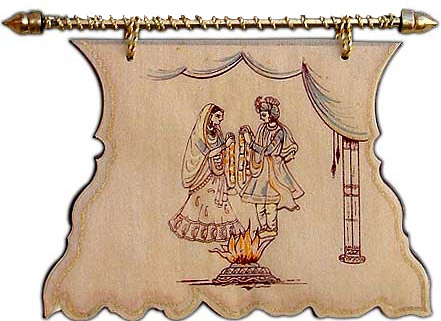
 In the following letter Srila Prabhupada clearly indicates that a proposed marriage will only have his sanction if there is committment to not separate under any circumstance.
Srila Prabhupada’s Letter to: Bhagavan — Los Angeles 7 July, 1971:
“The two marriages recommended by you may be performed at that time as well, but only after having sufficiently counselled the respective devotees. This marriage business should not be taken as a farce, but is a very serious matter. Recently so many couples have been cast adrift by the waves of maya’s influence. That is hard to check, but still the devotees must realize the responsibilities of household life. And there is no question of separation. Too much this has been happening and I am very much displeased. So if they are promising not to separate under any circumstances, but to work cooperatively in the service of the Lord, then my sanction is there for their marriage, and my blessings as well. Otherwise not.”
Here is an interesting article highlighting the need for both parties to be clear on each others expectations and views on key issues before tying the knot.
Marriage Is Not Built on Surprises
By ERIC V. COPAGE
IN love, as in other matters, what you don’t know may hurt you. Amanda Campo and Todd Johnson realized that last April, when the two 28-year-olds participated in Catholic Engaged Encounter, a retreat with 44 other couples who were planning to marry in the Roman Catholic Church. They remembered being surprised that so many of the couples seemed so seriously out of sync.
For instance, when the couples were asked whether they would start a family within a year of their marriage, nearly three-quarters said they hadn’t discussed the timing and were in disagreement on that point, recalled Ms. Campo, a graphic designer in San Francisco for the Banana Republic Web site.
“That’s a big thing to talk about,” said Ms. Campo, adding that she and Mr. Johnson had decided around the time of their engagement to wait three to four years after the marriage before having children.
Even so, Ms. Campo and Mr. Johnson, who had known each other for six years and were raised in the same cultural and religious traditions, had obvious issues that they hadn’t addressed. For instance, who would manage the money in their marriage?
“She automatically thought, ‘You’re in finance, you should do all that,’ ” said Mr. Johnson, a financial manager at Genentech, the biotechnology company in South San Francisco, Calif. He told her that the way she handled her own finances was impressive and that she should handle theirs. “For us, out of all the questions, we were 85 percent the same,” said Ms. Campo, who married Mr. Johnson in October. “But a lot of couples were 85 percent different.”
For too many couples, the spouses-to-be assume that they know each other and the ground rules for their marriages, experts say. And sometimes those heading to the altar dodge important questions because they don’t want to rock the boat.
A commitment to fidelity, for example, is a crucial issue, but one that is rarely addressed, said Robert Scuka, the executive director of the National Institute of Relationship Enhancement in Bethesda, Md. “It’s important to make those implicit assumptions about fidelity explicit,” he said. “Once the commitment to faithfulness is made explicit, it becomes more difficult psychologically to engage rationalizations.”
Seth Eisenberg leads classes for new instructors at an independent marriage-education organization based in Weston, Fla., called Pairs, which stands for Practical Application of Intimate Relationship Skills. He uncovered more basic questions. He recounted a recent class that his organization held in Fort Lauderdale, Fla. “A young man, a newlywed, thought his role was to be responsible for all the decision-making for the couple,” Mr. Eisenberg said. “However, the couple had never discussed those issues, and his assumptions came as a surprise to her.”
Debt is another important issue. Gary N. Skoloff, a partner in Skoloff & Wolfe, a matrimonial law firm in Livingston, N.J., recalled one divorce case his firm handled. Only after the couple married did the husband learn that his new wife had $230,000 in college debt. And because she went on to become a legal aid lawyer, Mr. Skoloff said, “her ability to pay back the debt was nil.”
Although a husband or wife is not automatically liable for the spouse’s debt, Mr. Skoloff noted that in a case like this one, “She could argue that he promised that he would help pay it when they got married, or that she was spending all her income after marriage on the family, rather than paying off the debt.” Either of those scenarios can trigger a legal nightmare.
It often helps to have a forum for those sensitive discussions. A wide range of premarital counseling options have cropped up to meet the need. Many couples seek counseling through their religious institutions, the best-known source being the Roman Catholic program called Pre-Cana.
But it is difficult for any person or institution to prescribe a single set of questions that every couple should ask each other before marrying. Something of vital importance to one couple may be a nonissue to another.
A good place to start would be for a couple to ask why they should not get married, suggests Corey Donaldson of Salt Lake City, the author of “Don’t You Dare Get Married Until You Read This!” (Three Rivers Press, 2001). “It’s the reasons that people should not get married that are going to cause trouble down the line,” he said.
Tony Hileman, the senior leader of the New York Society for Ethical Culture, said couples often fail to talk about religion — not whether they will go to a church, mosque or synagogue together, he said, but what role faith will play in a time of crisis. “If you have somebody who is even nominally religious in a traditional sense with someone who is an agnostic humanist, have they really discussed that?” he asked.
Asking these tough questions in a rat-a-tat fashion — about a potential life partner’s sexual orientation, or medical history, including sexual or mental illness — is unlikely to nurture the relationship.
Dr. Derek H. Suite, the chief executive of Full Circle Health, a counseling center in the Bronx, recommends a gentle “teachable moments” approach if asking those questions without benefit of a counselor.
“Wait for your opportunities and share from your own background first,” he suggested. “You might be in the car with somebody, and the person says, ‘I’m investing in a stock,’ and you can say, ‘Oh, are you’re into stocks? Do you have your own savings plan? I know I do,’ and that should open up a dialogue. Timing is everything. If you go with a checklist, you’re just going to turn that person off.”
Mr. Skoloff, the lawyer, also recommends lots of “hand holding” while making those inquiries — although it is difficult to imagine how intertwined fingers could take the edge off one question he suggested: if either the potential spouse or his or her family has a history of mental illness.
Couples should remember that the responses to premarital questions, whether asked bluntly or gently, aren’t necessarily going to cause doubt, acrimony or anxiety. “Ninety percent of the time the problems that come up are about a breakdown in communication,” Mr. Eisenberg said. In the case of the newlyweds in Fort Lauderdale, he said, the wife didn’t disagree with the decisions her husband was making, she just wanted to be part of the process.