
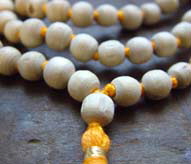
 By Payonidhi das
Recently HH Romapada Swami gave a wonderful lecture about Mantra Upasana from Srimad Bhagavatam 8.3.1:
sri-badarayanir uvaca evam vyavasito buddhya samadhaya mano hrdi jajapa paramam japyam prag-janmany anusiksitam
Sri Sukadeva Gosvami continued: Thereafter, the King of the elephants, Gajendra, fixed his mind in his heart with perfect intelligence and chanted a mantra which he had learned in his previous birth as Indradyumna and which he remembered by the grace of Krsna.
PURPORT
Such remembrance is described in Bhagavad-gita (6.43-44):
tatra tam buddhi-samyogam labhate paurva-dehikam yatate ca tato bhuyah samsiddhau kuru-nandana purvabhyasena tenaiva hriyate hy avaso ‘pi sah
In these verses it is assured that even if a person engaged in devotional service falls down, he is not degraded, but is placed in a position in which he will in due course of time remember the Supreme Personality of Godhead. As explained later, Gajendra was formerly King Indradyumna, and somehow or other in his next life he became King of the elephants. Now Gajendra was in danger, and although he was in a body other than that of a human being, he remembered the stotra he had chanted in his previous life. Yatate ca tato bhuyah samsiddhau kuru-nandana. To enable one to achieve perfection, Krsna gives one the chance to remember Him again. This is proved here, for although the King of the elephants, Gajendra, was put in danger, this was a chance for him to remember his previous devotional activities so that he could immediately be rescued by the Supreme Personality of Godhead.
It is imperative, therefore, that all devotees in Krsna consciousness practice chanting some mantra. Certainly one should chant the Hare Krsna mantra, which is the maha-mantra, or great mantra, and also one should practice chanting cintamani-prakara-sadmasu or the Nrsimha strotra (ito nrsimhah parato nrsimho yato yato yami tato nrsimhah). Every devotee should practice in order to chant some mantra perfectly so that even though he may be imperfect in spiritual consciousness in this life, in his next life he will not forget Krsna consciousness, even if he becomes an animal. Of course, a devotee should try to perfect his Krsna consciousness in this life, for simply by understanding Krsna and His instructions, after giving up this body one can return home, back to Godhead. Even if there is some falldown, practice of Krsna consciousness never goes in vain. For example, Ajamila, in his boyhood, practiced chanting the name of Narayana under the direction of his father, but later, in his youth, he fell down and became a drunkard, woman-hunter, rogue and thief. Nonetheless, because of chanting the name of Narayana for the purpose of calling his son, whom he had named Narayana, he became advanced, even though he was involved in sinful activities. Therefore, we should not forget the chanting of the Hare Krsna mantra under any circumstances. It will help us in the greatest danger, as we find in the life of Gajendra.
Romapada Maharaja mentioned how Srila Prabhupada, quoting Srila Bhaktisiddhanta Prabhupada, said one should regularly recite the Brahma Samhita and make it a daily function.
Contemplating this class, I was realizing how important it is also to chant more than 16 rounds or at last chant 16 rounds with full attention avoiding the 10 offenses to the Holy Name. Of course, even reading and chanting the prayers of Gajendra and studying Srila Prabhupada’s wonderful purports to these chapters regarding Gajendra is also a blessing. Sri Sukadeva Goswami has blessed us all:
SB 8.4.14: My dear King Pariksit, I have now described the wonderful power of Krsna, as displayed when the Lord delivered the King of the elephants. O best of the Kuru dynasty, those who hear this narration become fit to be promoted to the higher planetary systems. Simply because of hearing this narration, they gain a reputation as devotees, they are unaffected by the contamination of Kali-yuga, and they never see bad dreams.
SB 8.4.15: Therefore, after getting up from bed in the morning, those who desire their own welfare–especially the brahmanas, ksatriyas, vaisyas and in particular the brahmana Vaisnavas–should chant this narration as it is, without deviation, to counteract the troubles of bad dreams.
SB 8.4.25: My dear devotee, unto those who rise from bed at the end of night and offer Me the prayers offered by you, I give an eternal residence in the spiritual world at the end of their lives.
Srila Prabhupada requested the devotees to chant 64 rounds, but gradually it became minimum 16. The devotees then where not able to (many having been recent drug abusers), however the strict Gaudiya Vaisnava standard is a minimum 64 rounds. However, we should not think maximum 16 rounds, actually it is minimum 16, trying for 64 rounds a day (or more). Srila Vyasadeva felt despondent because he had not properly glorified Krsna in the Vedas (as described in the first Canto). Thus Sri Narada Muni asked him to write the Srimad Bhagavatam. Similarly, we will also feel unhappy if we don’t take shelter of Krsna’s Holy Names fully. Lord Caitanya has described five most important angas (limbs) of Bhakti to Sanatana Goswami in Caitanya-caritamrta, Madhya lila, chapter 22, text 128:
sadhu-sanga, nama-kirtana, bhagavata-sravanaM mathura-vasa, sri-murtira sraddhaya sevana
“One should associate with devotees, chant the holy name of the Lord, hear Srimad-Bhagavatam, reside at Mathura and worship the Deity with faith and veneration.
Caitanya-caritamrta, Madhya lila 22.129:
“These five limbs of devotional service are the best of all. Even a slight performance of these five awakens love for Krsna.
How important is chanting the Holy name? Lord Caitanya also states to Sanatana Goswami in Caitanya-caritamrta, Madhya lila 22.107:
nitya-siddha krsna-prema ‘sadhya’ kabhu naya sravanadi-suddha-citte karaye udaya
“Pure love for Krsna is eternally established in the hearts of the living entities. It is not something to be gained from another source. When the heart is purified by hearing and chanting, this love naturally awakens.
In each age mantras are chanted, but the Hare Krsna Mantra is supreme above all mantras and is the Maha mantra. There is a nice verse in Caitanya-caritamrta, Adi lila 7.73:
krsna-mantra haite habe samsara-mocana krsna-nama haite pabe krsnera carana
“Simply by chanting the holy name of Krsna one can obtain freedom from material existence. Indeed, simply by chanting the Hare Krsna mantra one will be able to see the lotus feet of the Lord.
And Caitanya-caritamrta, Adi lila 7.83:
krsna-nama-maha-mantrera ei ta’ svabhava yei jape, tara krsne upajaye bhava
It is the nature of the Hare Krsna maha-mantra that anyone who chants it immediately develops his loving ecstasy for Krsna.
What is stopping us then?
The Nectar of Instruction verse 7 states:
syat krsna-nama-caritadi-sitapy avidya- pittopatapta-rasanasya na rocika nu kintv adarad anudinam khalu saiva justa svadvi kramad bhavati tad-gada-mula-hantri
The holy name, character, pastimes and activities of Krsna are all transcendentally sweet like sugar candy. Although the tongue of one afflicted by the jaundice of avidya [ignorance] cannot taste anything sweet, it is wonderful that simply by carefully chanting these sweet names every day, a natural relish awakens within his tongue, and his disease is gradually destroyed at the root.
Srila Prabhupada’s purport here is very wonderful:
“The holy name of Lord Krsna, His quality, pastimes and so forth are all of the nature of absolute truth, beauty and bliss. Naturally they are very sweet, like sugar candy, which appeals to everyone. Nescience, however, is compared to the disease called jaundice, which is caused by bilious secretions. Attacked by jaundice, the tongue of a diseased person cannot palatably relish sugar candy. Rather, a person with jaundice considers something sweet to taste very bitter. Avidya (ignorance) similarly perverts the ability to relish the transcendentally palatable name, quality, form and pastimes of Krsna. Despite this disease, if one with great care and attention takes to Krsna consciousness, chanting the holy name and hearing Krsna’s transcendental pastimes, his ignorance will be destroyed and his tongue enabled to taste the sweetness of the transcendental nature of Krsna and His paraphernalia. Such a recovery of spiritual health is possible only by the regular cultivation of Krsna consciousness.
When a man in the material world takes more interest in the materialistic way of life than in Krsna consciousness, he is considered to be in a diseased condition. The normal condition is to remain an eternal servant of the Lord (jivera ‘svarupa’ haya–krsnera ‘nitya-dasa’). This healthy condition is lost when the living entity forgets Krsna due to being attracted by the external features of Krsna’s maya energy. This world of maya is called durasraya, which means “false or bad shelter.” One who puts his faith in durasraya becomes a candidate for hoping against hope. In the material world everyone is trying to become happy, and although their material attempts are baffled in every way, due to their nescience they cannot understand their mistakes. People try to rectify one mistake by making another mistake. This is the way of the struggle for existence in the material world. If one in this condition is advised to take to Krsna consciousness and be happy, he does not accept such instructions.
This Krsna consciousness movement is being spread all over the world just to remedy this gross ignorance. People in general are misled by blind leaders. The leaders of human society–the politicians, philosophers and scientists–are blind because they are not Krsna conscious. According to Bhagavad-gita, because they are bereft of all factual knowledge due to their atheistic way of life, they are actually sinful rascals and are the lowest among men.
na mam duskrtino mudhah prapadyante naradhamah mayayapahrta jnana- asuram bhavam asritah
“Those miscreants who are grossly foolish, lowest among mankind, whose knowledge is stolen by illusion, and who partake of the atheistic nature of demons, do not surrender unto Me.” (Bg. 7.15)
Such people never surrender to Krsna, and they oppose the endeavor of those who wish to take Krsna’s shelter. When such atheists become leaders of society, the entire atmosphere is surcharged with nescience. In such a condition, people do not become very enthusiastic to receive this Krsna consciousness movement, just as a diseased person suffering from jaundice does not relish the taste of sugar candy. However, one must know that for jaundice, sugar candy is the only specific medicine. Similarly, in the present confused state of humanity, Krsna consciousness, the chanting of the holy name of the Lord–Hare Krsna, Hare Krsna, Krsna Krsna, Hare Hare. Hare Rama, Hare Rama, Rama Rama, Hare Hare–is the only remedy for setting the world aright. Although Krsna consciousness may not be very palatable for a diseased person, Srila Rupa Gosvami nonetheless advises that if one wants to be cured of the material disease, he must take to it with great care and attention. One begins his treatment by chanting the Hare Krsna maha-mantra because by chanting this holy name of the Lord a person in the material condition will be relieved from all misconceptions (ceto-darpana-marjanam). Avidya, a misconception about one’s spiritual identity, provides the foundation for ahankara, or false ego within the heart.
The real disease is in the heart. If the mind is cleansed, however, if consciousness is cleansed, a person cannot be harmed by the material disease. To cleanse the mind and heart from all misconceptions, one should take to this chanting of the Hare Krsna maha-mantra. This is both easy and beneficial. By chanting the holy name of the Lord, one is immediately freed from the blazing fire of material existence.
There are three stages in chanting the holy name of the Lord–the offensive stage, the stage of lessening offenses, and the pure stage. When a neophyte takes to the chanting of the Hare Krsna mantra, he generally commits many offenses. There are ten basic offenses, and if the devotee avoids these, he can glimpse the next stage, which is situated between offensive chanting and pure chanting. When one attains the pure stage, he is immediately liberated. This is called bhava-maha-davagni-nirvapanam. As soon as one is liberated from the blazing fire of material existence, he can relish the taste of transcendental life.
The conclusion is that in order to get freed from the material disease, one must take to the chanting of the Hare Krsna mantra. The Krsna consciousness movement is especially meant for creating an atmosphere in which people can take to the chanting of the Hare Krsna mantra. One must begin with faith, and when this faith is increased by chanting, a person can become a member of the Society. We are sending sankirtana parties all over the world, and they are experiencing that even in the remotest part of the world, where there is no knowledge of Krsna, the Hare Krsna maha-mantra attracts thousands of men to our camp. In some areas, people begin to imitate the devotees by shaving their heads and chanting the Hare Krsna maha-mantra, only a few days after hearing the mantra. This may be imitative, but imitation of a good thing is desired. Some imitators gradually become interested in being initiated by the spiritual master and offer themselves for initiation.
If one is sincere, he is initiated, and this stage is called bhajana-kriya. One then actually engages in the service of the Lord by regularly chanting the Hare Krsna maha-mantra, sixteen rounds daily, and refraining from illicit sex, intoxicants, meat-eating and gambling. By bhajana-kriya one attains freedom from the contamination of materialistic life. He no longer goes to a restaurant or hotel to taste so-called palatable dishes made with meat and onions, nor does he care to smoke or drink tea or coffee. He not only refrains from illicit sex, but avoids sex life entirely. Nor is he interested in wasting his time in speculating or gambling. In this way it is to be understood that one is becoming cleansed of unwanted things
(anartha-nivrtti). The word anartha refers to unwanted things. Anarthas are vanquished when one becomes attached to the Krsna consciousness movement.
When a person is relieved from unwanted things, he becomes fixed in executing his Krsna activities. Indeed, he becomes attached to such activities and experiences ecstasy in executing devotional service. This is called bhava, the preliminary awakening of dormant love of Godhead. Thus the conditioned soul becomes free from material existence and loses interest in the bodily conception of life, including material opulence, material knowledge and material attraction of all variety. At such a time one can understand who the Supreme Personality of Godhead is and what His maya is.
Although maya may be present, it cannot disturb a devotee once he attains the bhava stage. This is because the devotee can see the real position of maya. Maya means forgetfulness of Krsna, and forgetfulness of Krsna and Krsna consciousness stand side by side like light and shadow. If one remains in shadow, he cannot enjoy the facilities offered by light, and if one remains in light, he cannot be disturbed by the darkness of shadow. By taking to Krsna consciousness, one gradually becomes liberated and remains in light. Indeed, he does not even touch the darkness. As confirmed in Caitanya-caritamrta (Madhya 22.31):
krsna—-surya-sama; maya haya andhakara yahan krsna, tahan nahi mayara adhikara
“Krsna is compared to sunshine, and maya is compared to darkness. Wherever there is sunshine, there cannot be darkness. As soon as one takes to Krsna consciousness, the darkness of illusion, the influence of the external energy, will immediately vanish.”(end)
We should all congregate and simply chant Hare Krsna. This is, after all, the Hare Krsna movement. Sukadeva Goswami finished the Srimad Bhagavatam with this advice:
SB 12.13.23: I offer my respectful obeisances unto the Supreme Lord, Hari, the congregational chanting of whose holy names destroys all sinful reactions, and the offering of obeisances unto whom relieves all material suffering.
Hare Krishna Hare Krishna Krishna Krishna Hare Hare Hare Rama Hare Rama Rama Rama Hare Hare
Your servant,
Payonidhi das
Gajendra was not an fallen animal of earth, he was the King of Elephants in heaven. It is not so easy to achieve human birth in heaven. I requires unlimited pious activity to reach there. Indrayumna gave extreme amounts of charity, and was a great devotee on earth, but was only able to achieve the body of an elephant on the heavenly planets. At the same time, he is counted as one of the great devotees of the Lord, remembered for all time in the pages of Srimad Bhagavatam.
The “Nectar of Devotion” states that the reward of engaging in sinful activities is one is induced to engage in more sinful activities, but the fruit of devotional activities is the opportunity to engage in more devotional service.
I think your comment is very important, king Indradyumna Maharaja is the one that brought Lord Jagannatha to earth and was an exalted devotee.Him being an elephant later was no hindrance as he remembered his devotional service to Krsna.;Any devotee is exalted , there is one famous elephant devotee that lived at Guruvayau temple, and served Krsna there , his name was Kesava and used to fast on ekadasi.He would always carry the Deity form of Krsna ,(this is a special Deity of Rukmini ,later worshipped by Brhaspati and Vayu, Madhavacarya installed this Deity there), especailly during festivals.When he was old he was taken to the other side of India for retirement, but he broke free and ran hundreds of miles to be there to serve Sri Krsna.He pushed the other elephant away that had taken his service.And carried Krsna a last time and gave up his body in front of the Lord.Also Bharat Maharaja became a deer and still KC,he remembered Krsna always in this body and gave up this body, we all know this pastime from 5th Canto and became Jada Bharat and taught king Rahugana.
Devotional service is never destroyed.The mantra upasana proscess is to also help us even if we get the body of an animal.See also Gita 2.40 Krsna declares his devotees are never destroyed, and mantras chanted in service to the Lord are never lost also.
ys
Payonidhi das