
 By Madana-mohana das
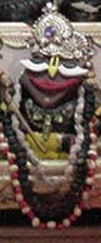
In the course of an unrelated research I have just happened to learn of one important, albeit rarely known fact about gunja-malas — those necklaces of scarlet-and-black or/and white glossy seeds that are widely used in Govardhana-sila worship as representing Srimati Radharani.
Lord Caitanya held such garlands in high esteem, worshiped them and gave one of them along with a Govardhana-sila to Srila Raghunatha dasa Goswami (refer to CC Antya 6.307).
However, the important fact is that the seeds of gunja (Abrus precatorius, also known as Jequirity, Crab’s Eye, Rosary Pea, Precatory bean, or Indian Licorice), are extremely poisonous. “Although they are unlikely to harm if swallowed raw and unbroken, as they have a hard seed coat” (1), but if they are pierced (as in Deity necklaces), crushed or chewed on, their ingestion can be fatal, with no known antidote to the toxin abrin contained in them.
Suffice it to say that even “jewelry-making with gunja seeds is dangerous, as there have been cases of death by a finger-prick while boring the seeds for beadwork”. (2)
By sending this to the public forum I intend to create a general awareness among devotees about the potential risk associated with the use of gunja-malas — especially as Govardhan-sila and salagram worship, where they are mainly used, both seem to become increasingly common in ISKCON.
Minor children, who are easily attracted by bright and colorful things and often want to taste them, may be at particular risk if there are gunja-malas kept within their reach. (3)
All the above should not be seen as compromising the sacredness of the gunja-malas for us as followers of Srila Caitanya Mahaprabhu. However, we have to keep in mind their extreme toxicity and exercise extra caution dealing with them on a day-to-day basis.
For instance, the idea to swallow broken pieces of such a garland as maha-prasadam may not be a very good one.
However, if swallowed, it is “best managed by vigorous gastric decontamination with activated charcoal, followed by use of cathartics such as magnesium citrate”. (4,5) Seek medical attention immediately.
Your servant, Madana-mohana das
(1) http://www.asanltr.com/newsletter/01-4/articles/Abrin&RicinRev.htm (2) http://en.wikipedia.org/wiki/Abrus_precatorius (3) http://www.botanical.com/botanical/mgmh/l/liqind33.html
(4) http://www.asanltr.com/newsletter/01-4/articles/Abrin&RicinRev.htm (5) http://www.bt.cdc.gov/agent/abrin/erc1393-62-0pr.asp
You may be interested to note that I saw a small news report about a week ago here in Australia with a warning from the Australian Government Poisons Information Line that all retailers are ordered to immediately withdraw a certain gift item from the pre-Christmas shopping shelves. The Current Affairs report noted that the gift item, a glass jar with many colourful tidbits, apparently from China, contained a few Abrus precatorius seeds which, if ingested by children thinking them sweets, would be fatal. I thought the seeds looked just like gunja. Now I understand the connection.
your servant,
Kurma dasa
is there any evidence in our gaudiya history about any devotee getting killed or poisoned due to this seeds? i guess many children and elders must be touching pierced seeds and not washing hands to “decontaminate” the “poison” coming out of those maha garlands. Nobody is known to have been poionsed / killed. That’s the power of maha prasad, even if the seeds are poisonous! if Mira, who many of us don’t count among the best of devotees, can drink poison and not get affected, why not other devotees not get poisoned by maha prasad “poison”? so much is there to do with what we preach and what we practice.
the point is, even if someone dies by mistakenly consuming such so called poison from maha garlands, it’s not due to the poison of maha garlands but due to his previous karmas….just that his apparently accidentally occurred death gets purified by consuming maha garlands at the time of death. Of course, if someone tries to kill oneself by such “poison” then he/she is foolish and an offender.
I am not trying to discredit the information given. Certainly we should take care of it but the thing is spiritual phenomena are not always comprehensible by one and all and we shouldn’t look at or touch gunj malas with fear of getting poisoned. It’s like fire—we obvioulsy take care of ourselves while taking blessings from maha arati lamp. Gunja malas are dear to Lord Caitanya and so are dear to His devotees, even if they get “killed” by them, because devotees’ destination is at the lotus feet of Lord Caitanya, and that only what matters to them.
Hare Krishna.
ys, bbd
Pamho.AGTSP.
Could be that Lord Krishna made this beads poisoneous to be just used by Him only and no other person who can not digest this poison.In fact it is a
blessing that they are poisoneous so that gunja mala can not be misused, but it is true that we have to be careful not to make them accesible to children.
YHS
DKD
Thank you for your article and reaserch on the gunja berries. I, too, am
very passionate about this most dear ornament of Lord Krishna and have done
a small research on it.
I was fortunate to live in Vrindavan during every Karttika for 5 years.
Karttika is the month when gunja ripens. Since I discovered several vines
around the KB Mandir, I would every year pick ALL gunja berries and make
malas for the Deities. At that time I didn’t know that the berries were
poisonous and although I did pierce my fingers now and then, there was no
reaction on my health whatsoever. I guess Sri Sri Radhe-Syama protected me.
I feel so happy making those gunja-malas, and when I see the Lords wearing
them I feel absolutely ecstatic.
Just wanted to share my practical experience with you. I am still trying to
figure out how to make gunja earrings and ornaments, as described in the
verse beginning with naumidya te bhra-vapuse…
Your servant,
Divyambara dasi
PS: If someone is interested in picking and making gunja-malas, I would be
happy to explain where the vines grow around the KBM. These are only red
berries, though. I haven’t discovered the white ones yet. I’ve seen many
times that the monkeys eat the gunja berries and remain the same alive
rascals… And I’ve been told by residents of Vrindavan that the cows love
eating gunja, too.
There is a process to make ornaments from these beads. They have to be first dried in the sun and made hard. Once they are hard, a hole has to be made through them in order to use them for jewelry.
Otherwise, devotees can make any ornaments from them when they are still ripened and soft. After stringing them through the thread, the beads can be dried and thereby the ornament can be made ready easily.