
 By Dayananda das
“Bhagavad-gita As It Is,” chapter four, text seventeen: The intricacies of action are very hard to understand. Therefore, one should know properly what action is, what forbidden action is, and what inaction is.
Commentary by Dayananda das
Prabhupada writes in his purport of this verse, “If one is serious about liberation from material bondage, one has to understand the distinctions between action, inaction and unauthorized actions (vikarma).” When one offers the fruits to Krishna, his or her work is not karma or vikarma. Unfortunately, some current members of ISKCON shun a normal occupation, because they believe it is karma or vikarma. In fact, akarma, or the work of a devotee, does not depend so much on the work itself, but on the results. To the extent that a devotee offers the fruits of work to Krishna, that work is akarma (work free from reaction). The idea that some types of work are karma and others are akarma has generally originated from poor training. The following is an example of one of the ways in which Srila Prabhupada personally trained his householders.
Prabhupada: Dayananda, you are here, and you can have more facilities. You family men, you require some money also. So your present situation is very nice? Dayananda: Yes. Prabhupada: What they are paying you? Dayananda: About one thousand dollars per month. Prabhupada: It is better than USA. You were getting six hundred there.
Prabhupada remembered this amount, because he knew that out of the six hundred, at least two hundred went to start the Los Angeles temple. He kept track of these amounts and was pleased with the sustained thirty to forty percent surrender.
Dayananda: Yes. Prabhupada: So you are getting more. Why Gargamuni advised you to give up? I chastised him, “Why you have given him such advice? He’s a grihastha, he must have some money. He has to take care of the children.” Anyway, you have got better job now and better service also. Krishna has rewarded you for your service. Stick to it. If you like to serve here, you can be permanently settled. Dayananda: Yes, they give visas very easily for working. Prabhupada: Oh? Especially to Americans? Dayananda: Yes. Prabhupada: That’s very good opportunity. Bring more Americans and start this movement nicely. Not necessarily that we have to establish a temple. We want to preach our philosophy. That is most important. Bhagavata-marga. There are two ways, bhagavata-marga and pancaratriki. The bhagavata-marga is more important than pancaratriki. Pancaratriki is Deity worship.”(1)
One year later, just one month before Srila Prabhupada departed this world he imparted this final householder instruction.
Prabhupada: You are working at computer? Dayananda: Yes, Srila Prabhupada. Prabhupada: So, what salary do they give? Dayananda: A little over $1000 in a month, about $1200. Prabhupada: Hm. So how you are spending that money? Dayananda: Now I live in my own apartment, I’m giving fifty percent to the ISKCON projects, and fifty percent I keep for maintenance. Prabhupada: So there is no scarcity? Eh? Dayananda: No, there’s no scarcity, Srila Prabhupada.(2)
Prabhupada”s point about “no scarcity” is extremely important. He was interested to hear that although his disciple was giving fifty percent he had no scarcity of facilities to maintain his family. Although Prabhupada loved his disciple”s family, this question was not out of concern for the family. Krishna explains that through yajna the demigods send rains to nourish the earth and supply the material needs of humanity. In this context, Prabhupada was, in effect, saying, “You”ve reported that you are practicing karma-yoga, and giving half of your income for the sankirtana-yajna. Are the higher powers taking care of you and your family? Is there any scarcity–anything you or your family lacks?” Prabhupada had faith that his disciple”s engagement in karma-yoga and offerings in yajna would be fruitful, but he wanted to check to see whether his disciple had similar faith in this principle.
Umapati Swami tells another story that describes Prabhupada”s householder training. Umapati was one of the very first disciples initiated in 1966. He is a very intelligent and wonderful disciple of Srila Prabhupada, currently a guru in ISKCON. In San Francisco, in 1967 or 1968, Umapati dasa brahmacari had a low-paying job and try as he might, he could not manage to give fifty percent to the San Francisco temple. Nevertheless, he was giving regular amounts. When Prabhupada visited San Francisco, he asked Umapati whether he was giving fifty percent, since Prabhupada generally sought this information from the householder disciples whom he was directly training. Umapati replied that he was having difficulty giving so much”he was giving something, but no, he was not giving fifty percent. At that time, Prabhupada made no further comment. However, about a year later Umapati had come to Los Angeles and was seeking a job when Prabhupada arrived for a visit. Umapati, who had an affectionate relationship with Srila Prabhupada, went to see him. Naturally, Prabhupada asked about his welfare. Umapati explained that he was looking for a job, but having difficulty finding one. Whereupon Prabhupada immediately told Umapati that he was having difficulty finding a job because he had not given fifty percent in San Francisco.(3)
One should not misconstrue this example. Umapati Swami, undoubtedly a great soul, was and is an advanced disciple. Usually only advanced disciples of Prabhupada received chastisement, because he affectionately considered them worthy of strict instruction. Thus, one should not see an apparent fault in a great devotee like Umapati Swami as anything but a glorious spot on the moon of his devotion to Prabhupada.
(1) ACBS, “Room Conversation in Tehran,” Aug. 8, 1976 (Vedabase 760808r2.teh)
(2) ACBS, “Room conversation in Vrindavana,” Oct. 21, 1977 (Vedabase 771021r2.vrn)
(3) Umapati Swami told me this story in New York in 2004 while we were discussing the fifty percent principle and Prabhupada”s personal training of householders.
It is wonderful that you are able to give 50%, Dayananda prabhu. Most grhasthas I know are flummoxed on this one. “If I give half my income I won’t be able to even pay my rent!” is a typical response. But how should we understand this? Does giving 50% for the KC movement mean giving it to other devotees, e.g. a TP or sannyasi, so they can use it in Krishna’s service? Or could it mean engaging laxmi in KC activities such as home deity worship, visiting the dhama, buying and distributing books oneself, distributing prasad, etc? Should we first give half our income away to someone else, and then try to do whatever KC things we can with whatever we have left, or can we count such activities within the 50% charity? How should this principle be applied, in your opinion prabhu?
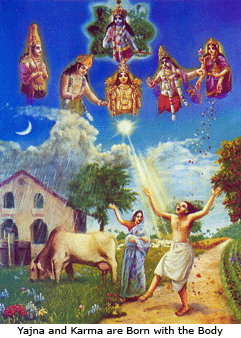
The illustration attached to this article will be nostalgically remembered by devotees who bought older copies of the Gita. Unfortunately some of these great old pictures are not being reproduced in later editions (perhaps because the standard of painterly-craftsmanship is thought to be less refined).
I wonder whether Srila Prabhupada personally directed the content of this picture (it seems so to me), and I wonder whether Srila Prabhupada also chose the caption.
The illustration shows Candra, Indra, Surya, Vayu and Laksmi providing the necessities of life, with Krishna above and behind these demigods. (They are obviously acting under His direction and with His approval.)
These demigods are supplying the necessities of peaceful, happy life to a householder couple with a baby and a contented cow, who are obviously engaged in sankirtan yajna (chanting and dancing). They have a simple house in the countryside and there is obviously no scarcity (they must be giving 50%).
The caption is also noteworthy, and is in keeping with Dayananda’s consistent theme that we should not talk about varnasrama dharma without also speaking of (sankirtan) yajna: Not only is karma (suitable work according to the modes of nature) born along with the body, but also yajna. When we speak of one’s material “sva-dharma”, we should not divide the work born of our material nature from the sacrifices that must be done along with that work. They are both “born with our body”.
saha-yajnah prajah srstva
purovaca prajapatih
anena prasavisyadhvam
esa vo ‘stv ista-kama-dhuk
(B.G. 3.10)
That is, Lord Vishnu, the Lord of all living creatures, created yajna along with the population of men and demigods, and blessed them all, saying, “Be happy by performance of sacrifice, which will bestow upon you all desirable things.”
(I seem to recall seeing a version of the Gita where praja-pati in this verse was translated as Lord Brahma, but in Srila Prabhupada’s purport he clearly says it refers to Lord Vishnu. Of course, elsewhere in Srila Prabhupada’s books we learn that there are many progenitors known as “prajapatis,” but in this verse the term clearly refers to Lord Vishnu).
The caption of the picture is saying, not only is our honest work (karma) born along with our body (according to the qualities of our different bodies), but also the suitable sacrifices for the satisfaction of Vishnu that we are required to perform.
If we do not perform the sacrifices, as explained in verse 3.12, we are thieves, and liable to be punished by sinful reactions, but in verse 3.13 Krishna explains that those who eat the remnants of sacrifice, the devotees, are released from all kinds of sins.
In the Purport of verse 3.10, Srila Prabhupada mentions specifically the sankirtan yajna, which is the specially prescribed yajna for this age of Kali (kalau tad dhari-kirtanam):
“The Lord created this material world to enable the conditioned souls to learn how to perform yajnas (sacrifices) for the satisfaction of Vishnu, so that while in the material world they can live very comfortably without anxiety and after finishing the present material body they can enter into the kingdom of God. That is the whole program for the conditioned soul. By performance of yajna, the conditioned souls gradually become Krishna conscious and become godly in all respects. In the Age of Kali, the sankirtan yajna (the chanting of the names of God) is recommended by the Vedic scriptures, and this transcendental system was introduced by Lord Caitantya for the deliverance of all men in this age. Sankirtan-yajna and Krishna consciousness go well together. Lord Krishna in his devotional form (as Lord Caitanya) is mentioned in Srimad Bhagavatam (11.5.32) . . . ”
Does anyone know who painted this illustration? (Was it Jadurani?) Is there any record of Srila Prabhupada directing what was to be depicted and what caption to use?
Make your own home a temple,organise your own sunday program ,invite folk round,
distribute prasadam to everyone,
Why wait for or expect someone else to do it for me.
live within your means and be happy.
that way you are giving 100%
mvdas
Krsna Dharma, here are some items regarding householders offering money. These points are based on Prabhupada’s teachings and precedents; however, they come under the heading of guidelines for living, and not rules or laws.
(1) Offering money is extremely important for householders, almost on the level of a regulative principle; however, it is not a regulative principle. Thus, householders should not offer money simply on principle, but through relationship and trust. Relationship means that the receiver also has important responsibilities.
(2) It is easier to give 50% when participating in communal life, for example, living with other families, sharing prasadam, etc.
(3) Using a significant amount of money for one’s personal worship, over and above coordinated sankirtana efforts, is second rate.
(4) Offering money to maintain ISKCON temples is within the scope of the 50% principle, however, sankirtana-pracara (spreading sankirtana) has declined in North America (and other places); therefore, sankirtana should now be a higher priority.
(5) If a householder cannot give a significant part of his/her salary, he/she should try to give significant time for sankirtana-pracara or temple seva.
(6) Money should be offered with intelligence; therefore, those who offer it should require accountability. This is important, so I’ll say, accountability, accountability, accountability.
Giving is a two-way street. Sometimes ISKCON devotees, even householders themselves, think that making money is second rate. The fact is that when a householder gives his/her hard earned money for sankirtana-pracara, he/she is a first rate, advanced devotee. Prabhupada explains that Mahaprabhu embraced Kholaveca due to his householder charity. Thus, as long as ISKCON managers and brahmanas are even subtly disdainful of householder money, it will probably be slow in coming.
mvdas,
Most of what you’ve written in comment 3 is O.K. in principle; however, I take strong exception with your characterization of the 100% devotee. According to Mahaprabhu (Cc Madhya 10.167), the pure or 100% devotee is karmady-anavrtam, which means that all the fruits go to Krishna.
In fact, the advanced, 100% devotees are not exactly happy. They are have progressed beyond the happiness of liberation, and they are in anxiety (laulyam) to serve Krishna.
–d
I can imagine, if one is forced by circumstances to live far away from an existing temple, one might want to turn one’s own home into a full-service temple with regular Sunday feast and everything.
If there is a local temple nearby, it might be better to just participate in the communal worship and regular temple programs when possible.
(Some temples may be dying for volunteers to dress the Deities or offer aratis or give classes; other thriving temples might have waiting lists and it might be difficult to get much opportunity to do Deity service or give class or lead kirtan or even cook the feast or clean the pots).
I always enjoy classes and kirtans better with lots of faithful devotees around, and the temples should ideally be places that facilitate such meetings of big groups of devotees.
On the other hand, private home programs might have a more relaxed mood and be a better introduction for some guests who could feel shy to speak up and ask questions in a temple room (see, Kshudi’s interview regarding “bhakta vriksha” programs).
Hopefully, if a local temple already has a regular Sunday feast program, it would at least be possible not to compete with that program, but to pick a different day of the week for a regular home program. Hopefully it could be done with the friendly cooperation between temple authorities and the independent householder.
Personally, I am usually selective about whom I invite into my home. That is just because I am a materialistic krpana and I am afraid someone off the street I do not know might just be casing the place to steal my possessions. :-)
I took the spirit of Mahavidya’s post #3 to be from someone who does not have a temple nearby. (His question, “Why wait for someone else to do it?”, implies it is not already being done locally by someone else).
I hope the problem is not that the local temple’s mood and atmosphere is not inviting enough, so that independent householders feel compelled to keep themselves aloof and have their own programs. One thing we all must learn to do is cooperate to serve Srila Prabhupada despite our less significant differences and work together to make nice propaganda for Krishna and Prabhupada’s books.
I can imagine, though, that a devotee living peacefully at home, chanting the prescribed number of rounds, not wasting any time in frivolous sports or watching TV (but tolerantly making allowance for family members who might do so), doing all his or her duty in a spirit of offering everything with bhakti to Krishna, could be “jnana karmady anavrttam. . . bhaktir uttamam,” although living at home.
Srivasa Thakur lived at home with his wife Malini and there are so many other examples of the Lord’s personal associates who did. Pundarik Vidyanidhi appeared to be a materialistic man even to Gadadhara Pandit until the recitation of Srimad Bhagavatam sent him into uncontrollable ecstasy.
Lord Caitanya gave an example of what Dayananda is talking about, in His extreme humility and ecstatic mood, saying “I have no love for Krishna, because if I did I could not maintain my fly-like life. How could I eat? etc.” That is an unusual display of intense ecstacy though, isn’t it?
Isn’t it true that pure devotees can (and should) eat sufficient prasadam to keep their bodies fit for vigorous preaching activities, and do not have to do without the necessities of life if they can actually use everything for devotional service?
Srila Prabhupada said, sense gratification is like salt on your food: too little is not good, but too much is a disaster.
I know in my own personal case there is way too much sense gratification, and it is a disaster, but still I believe there can be uttama bhaktas living outside of temples as householders without starving to death or neglecting the needs of their dependents.
In their “perfection of renunciation”, they would just see their “manasa, deho, geho” as Krishna’s property. They would not have to externally leave home and live outdoors, going naked or dressed in discarded torn cloth.
Good, tempered post, Akruranatha Prabhu.
My son-in-law once put forward a wise perspective: “We should first understand the standard, and then we can deviate.” I liked it, because it was a little iconoclastic, but the actual meaning was that we should understand our position in relation to the standard. From there we can move forward as we can.
Would anyone care to comment on financial situations where devotees’ bills and legitimate expenses are more than 50% of their income? Sounds like poor financial planning but it’s a reality nonetheless.
Also, can one suggest how (and when) the 50% policy should be presented to people that one is preaching to? A lot of Christian churches demand 10% of earnings and many people are actually turned off by that. How can we share that householders should give 50% without having people fleeting for the exit door?
Tamal Krsna dasa
Thank You Dayananda prabhu. I do agree that giving charity is an important duty for householders. In this connection Srila Prabhupada writes:
[quote]Factually, according to the instructions of Srimad-Bhagavatam, every grhastha is a great communist who provides the means of living for everyone. Whatever a grhastha may possess he should equally distribute to all living entities, without discrimination. The best process is to distribute prasada. A grhastha should not be very much attached to his wife; he should engage even his own wife in serving a guest with all attention. Whatever money a grhastha accumulates by the grace of God he should spend in five activities, namely worshiping the Supreme Personality of Godhead, receiving Vaisnavas and saintly persons, distributing prasada to the general public and to all living entities, offering prasada to his forefathers, and also offering prasada to his own self. Grhasthas should always be ready to worship everyone as mentioned above. SB 7.14 Summary[/quote]
We find this instruction frequently, i.e. that householders should distribute prasadam in order to maintain the rest of society. I would suggest that direct preaching and book distribution is more appropriate for the renuniciates. (Also, although you suggest that using one’s wealth for deity worship at home is “second rate”, in the above statement Srila Prabhupada lists it as the first important item for householders)
While discussing sankirtana yajna Prabhupada says the following:
[quote]At the present moment, however, almost all forms of sacrifice are not at all possible; therefore, it is recommended in the sastras that people should perform sankirtana-yajna. Any householder, regardless of his position, can perform this sankirtana-yajna without expenditure. All the family members can sit down together and simply clap their hands and chant the Hare Krsna maha-mantra. Somehow or other, everyone can manage to perform such a yajna and distribute prasada to the people in general. That is quite sufficient for this age of Kali. The Krsna consciousness movement is based on this principle: chant the Hare Krsna mantra at every moment, as much as possible, both inside and outside of the temples, and, as far as possible, distribute prasada. SB 4.12.10[/quote]
Here he says that chanting together and distributing prasadam is “quite sufficient.” IMHO, we do not do enough hearing and chanting together as householders. Our grhastha ashrama is struggling and perhaps this is a main reason. Charity begins at home. In my view we must begin by getting our own Krishna consciousness together, particularly as a family. Husbands and wives can do sankirtana together by hearing and chanting together, along with their children.
[quote]The best process for making the home pleasant is Krsna consciousness. If one is in full Krsna consciousness, he can make his home very happy, because this process of Krsna consciousness is very easy. One need only chant Hare Krsna, Hare Krsna, Krsna Krsna, Hare Hare/ Hare Rama, Hare Rama, Rama Rama, Hare Hare, accept the remnants of foodstuffs offered to Krsna, have some discussion on books like Bhagavad-gita and Srimad-Bhagavatam, and engage oneself in Deity worship. These four things will make one happy. One should train the members of his family in this way. The family members can sit down morning and evening and chant together Hare Krsna, Hare Krsna, Krsna Krsna, Hare Hare/ Hare Rama, Hare Rama, Rama Rama, Hare Hare. Bg 13.8-12
[/quote]
Householders are not trained in this way, in my experience. In fact little or no training at all is usually the case, and devotees often enter grhastha ashram ill prepared, with tragic results. If we want more out of our householders then maybe we need to put more into them. They need help and support, especially in the matter of keeping their KC together. Often though our focus is on getting out there and doing bigger, bringing in more people, while the people we already have simply dry up and die. How then can they even think of helping others?
ys
KDd
Tamal Krishna, I suggested communal living in my post number 4 above. In addition, I suggest night school, change of occupation, or whatever will bring in more money. In the 1980s and 1990s in America, making $1 million in about 10-20 years was doable through determination, and not necessarily a great deal of intelligence.
Krishna Dharma, the focus of household life, and varnasrama dharma, is yajna. Mahaprabhu prescribed sankirtana-yajna. Prabhupada indicated that the book distribution yajna was most important, but public chanting and deity worship should also not be neglected.
Certainly, householders should take care of themselves, but they should train themselves to be self-sacrificing for yajna. The process of bhakti-yoga begins with karma-yoga. Your suggestion that sadhana-bhakti will solve all problems without karma-yoga, which is sacrificing money for sankirtana, does not yield the desired results for householders–advancement in Krishna consciousness.
At the same time, as I indicated in my post in number 4, the ISKCON organization has been very slow to understand the role of householders, and train them accordingly. If that is indeed the case in your area, then Prabhupada encourages us to be independently thoughtful and intelligent. However, independent intelligence does not mean that we should act as islands and not find ways to cooperate to perform the yajna. We must find ways to cooperate for sankirtana-yajna, because that is the meaning of sankirtana–congregational yajna.
Your suggestion that “getting out there” will make someone dry up and die is unfortunate. As householders we “get out there” to make a living. We are supposed to work hard and self-sacrifice for our families. If we do not “get out there” and self-sacrifice for Krishna, then we’ve neglected our spiritual dharma. I’m deeply in favor of strong household communities, schools for our children, and wonderful, full-function temples for our families; however, we can achieve these things by first bringing our communities together for the yajna, not by hiding in our individual homes with our families and our deities. Worshipping in such a way may not be third class, but it is definitely not first class.
Regarding your first quote from SB 7.14, Prabhupada is paraphrasing the five kinds of yajnas that Manu prescribes in Manu samhita (3.67-74). The Vedas and dharma sastra emphasize that household life is based on yajna. Prabhupada comments more fully on the five yajnas in his SB lecture 6.3.25-26 Gorakhpur Feb 18, 1971, and his purports of SB 6.2.11 and SB 8.14.6. According to the teachings of Mahaprabhu, the five traditional yajnas should be performed within the broader context of sankirtana-yajna.
Your opinion that “direct preaching and book distribution” be relegated to renunciants will lead to a religion that is not Mahaprabhu’s religion. He sent Nityananda Prabhu to Bengal to preach as a householder (Cc Madhya 16.64-65). Prabhupada writes that we should follow in the footsteps of Nityananda Prabhu, and preach like Him. In “Light of the Bhagavat” verse 21, Prabhupada states that the brahmanas have the responsibility to coordinate all of society to perform yajna. He also explains that it is the duty of the brahmanas to coordinate, inspire, and administrate the yajna (BTG, May 20, 1956, “Yajna for the Supreme”).
The sankirtana-yajna is either Krishna consciousness itself (see Krsna Consciousness: The Sankirtana Movement, KC Handbook 1970), or the two “go well together.” (Bg 3.10 purport) Either way, the yajna is essential for all those who profess to aspire for Krishna consciousness. Indeed, Prabhupada’s sankirtana movement is intimately linked with Mahaprabhu’s siksastakam, and the instructions and sentiments contained in the siksatakam are available to those who participate in the ISKCON sankirtana-yajna. (Cc Adi 3.19)
ys, d
Krishna Dharma Prabhu,
PAMHO. All glories to Srila Prabhupada.
I appreciate your comments, as always, but may I humbly suggest that if householders are drying up they will undoubtedly find new life and enthusiasm by going out on harinama and book distribution.
If they feel shy about walking up to strangers and trying to get them to stop and look at books, then, as Dayananda suggested, they might like chanting where the book distribution is going on.
After all, we have to keep doubling book distribution. And it is so enlivening to do that service!
The public really relates to families with kids, too. Bahudak used to take us out to Stanley Park in Vancouver on Saturdays and just set up some blankets on the grass and have big kirtans, with the kids playing and everyone enjoying the outdoor kirtan. Big crowds would gather round and Bahudaka would give short lectures to them about why we were chanting, etc. The people would comment on how nice our family life seemed.
The spirit of giving Krishna consciousness to the public is infectious. It is not “bitter medicine”. It makes everyone happy. It is Lord Caitanya’s mood. He cannot distribute all the fruits himself, so He asks us to help Him. The more we give away the more we have for ourselves.
After a good day of preaching, tomorrow’s japa will be better, too. The “dried up” householders will find this and regain their spiritual vitality. Guaranteed.
Even the temple cleaners, pujaris, cooks and administrators should see their service as part of the preaching mission. Just like everyone who works for the railroad is helping “keep the wheels rolling”, so everyone serving in ISKCON is helping the “gaura vani pracarine nirvisesa sunyavadi pascatya desa tarine”
Recently someone was reading to me how preaching is a great way for a novice devotee to get recognized by Krishna. Srila Prabhupada wrote (I do not have the exact quote) that just like in wartime, a simple farm boy can become a national hero by acts of valour, in the same way a preacher may become recognized by Krishna very easily by heroic preaching activity.
We householders cannot allow this opportunity to be monopolized by the sannyasis and brahmacaris. We can take great benefit, too, without neglecting any other required duties.
Actually, at least in the west, householders have special facility for preaching. People can relate to someone who has a job and a family and shares many of the same responsibilities and cares. They appreciate seeing us with our kids obviously enjoying chanting Hare Krishna and presenting these books of spiritual knowledge in public.
I do strongly agree with you that there should be more guidance for devotees entering grhastha asrama.
Maybe if I had been trained how to give 50% before I bought a big house with a big mortgage and developed big spending habits and got used to living beyond my means, I would have found there was “no scarcity” and become more peaceful in Krishna consciousness.
I guess its never too late, even for an “old dog” like me, but I would have no enthusiasm at all if I were told that householders should not preach.
Dayananda and Akruranath prabhus, I appreciate your comments. Thank you. I don’t have time to respond fully at present (sunk in the well :-) but will try later if possible.
ys, KDd
Hare Krishna Prabhus,
When we trade our labor for fruits ( usually money) , the potential of the labor is stored in such fruits. If we offer this fruit ( money) to Krishna, then it is like having worked for Krishna. If this offering is done on a habitual basis ( love is not a one shot thing!!), and especially with the knowledge that we are FACTUALLY Krishna’s eternal servant, such a behavior is a very powerful tool for those who are householders ( and have the adhikara to earn money). In the beginning such activity may be done out of self interest, but as we mature properly we begin to do it for Krishna. Then understand that these material elements are a vehicle for offering love as words are a vehicle for offering prayer.
Dayananda prabhu,
Please accept my humble obeisances. All glories to Srila Prabhupada.
While I have a 30 minute window between ‘Dad’s taxi’ duties, cooking the evening offering and writing an article I thought I should clarify what I was trying to say. Forgive me for being brief, and for not providing all the relevant quotes.
If by karma yoga you mean varnashrama, in which charity is a householder’s duty, then yes, I do agree. We have both constitutional and conditional duties, as explained in the Gita. But the latter are only a support for the former, as far as I understand. It is the constitutional duties of hearing and chanting that are actually liberating. My point was simply that we do not do enough hearing and chanting, as far as I have seen, especially as householders. I would say this is more of a problem than the fact that they do not go out to sell books. Preaching should surely be a natural overflowing of one’s own Krishna consciousness. If we are happy and fulfilled in KC then we will naturally want to share that with others.
My point here was simply that there should be more emphasis on maintaining devotees. Prabhupada said this was more important than making new devotees. Of course we have to work hard and sacrifice, but let’s also take care of each other as best we can by good sadhu sanga. In the Gita (16.1), Prabhupada writes that it is the duty of sannyasis to preach to householders. In the seventies he was stressing to ISKCON leaders that their main duty was to look after the KC of existing devotees, rather than go out and make more. “What good are many, many devotees if none of them are knowledgeable?” he said. (I can provide all the quotes for the above, or you can view them on my website at www.krishnadharma.com/sadhu-sanga)
I understand that Prabhupada has ‘Krishna-ised’ the pancha-suna here. But the emphasis is on deity worship and prasadam distribution. This seems to be the main tenor of his instructions for householders throughout his books, as far as I have seen. In one place he even says that in Kali yuga it is not possible to give money in charity and therefore we should distribute prasadam. (Prabhupada writes: “’In this age, distribution of prasadam has replaced distribution of money. No-one has sufficient money to distribute, but if we distribute Krsna-prasadam as far as possible, this is more valuable than the distribution of money”. (SB 4.9.24).
And here’s one about deity worship.
Many such instructions are there. See SB 2.3.22 for example.
Sure. But his instruction to the Kurma Brahmin was to stay at home and preach to “whoever he met”, which I think is Akruranath prabhu’s suggestion. “Amara ajnaya guru…” We should all become guru, but again, in my view this begins at home. Preach to our family members first, hear and chant together, as Prabhupada directs. Then if we can get extended families and communities doing sankirtana together, so much the better. But right now we face the nuclear family situation and we have to deal with that as best we can.
Surely householders can go out on harinam and books, (a grhastha won the Xmas marathon here in the UK) but in my experience most find this difficult. And many of them are struggling in their own KC, finding the temples and even ISKCON as a whole an increasing irrelevance to them. They need help, and in my humble opinion the first thing is to get their own KC on track. Householders have to be independently thoughtful, as you say, and realise that they can nicely practice KC in their own homes. They are their own best sankirtana partners – husbands and wives together can hear and chant, and maybe even get the kids to join in (good luck). This will surely form a solid basis for everything else you envision, i.e. grhasthas going out to preach and sell books (in between taxi duties, of course :-)
Anyway, these are just a few humble views from a conditioned soul, my admittedly less than perfect understanding of Srila Prabhupada. I appreciate your comments, but felt I needed to clarify as you had misunderstood me (my fault, I admit)
Yhs
KDd
From the following quote, it is unclear whether his contribution of 50% was simply his own personal “home” worship or if he was giving to someone else. If it was, indeed, his own personal worship, then such use of 50% cannot be considered “second rate.” Just a thought…
SB 5.19.7 purport:
Lord Sri Caitanya Mahaprabhu had a very sincere devotee whose name was Kholaveca Sridhara and whose only business was to sell pots made of the skin of banana trees. Whatever income he had, he used fifty percent for the worship of mother Ganges, and with the other fifty percent he provided for his necessities. On the whole, he was so very poor that he lived in a cottage that had a broken roof with many holes in it. He could not afford brass utensils, and therefore he drank water from an iron pot. Nevertheless, he was a great devotee of Lord Sri Caitanya Mahaprabhu. He is a typical example of how a poor man with no material possessions can become a most exalted devotee of the Lord.
Your servant, Urmila devi dasi
Krishna Dharma,
I feel compelled to argue strongly in favor of householder involvement in sankirtana. Prabhupada taught me to be accountable toward him and ISKCON’s goals. Sankirtana book distribution has declined to the extent that BBT remittances are only about $3 million worldwide, which is equivalent to a small business’s revenue. It is true that someone who is wounded must take care of him or herself, or a family in need must build itself. However, healthy families should serve the community, and the core service in kula-dharma (family) or varnasrama-dharma (community) is yajna–sankirtana-yajna.
In Mahaprabhu’s system, pancaratriki viddhi is secondary to, although not excluded from, bhagavata-viddhi, which is sankirtana. As Sri Rupa explains, active service results from sadhu-sanga (adau sraddha…) Thus, I would not be willing to concede that a goal of bhakti is sadhu-sanga, but rather the active service (bhajana-kriya) that proceeds from it. In practical terms, association groups should be measured by (or accountable for) the services they render. There is no higher service in ISKCON than distributing Prabhupada’s books or working in some capacity for an orchestrated distribution effort.
Unfortunately, ISKCON’s distribution systems and methods are old, outdated, and Prabhupada did not even suggest or implement those methods. The systems no longer produce good results, and at the same time, leaders (brahmanas) are unable to innovate or develop new ones. Moreover, ISKCON brahmanas, including householders, have not accepted accountability for the mediocre results. In some areas like temple maintenance, ISKCON is strong enough, but in this essential area, ISKCON is weak and second-class.
Urmila,
Yes second rate, I won’t budge from that. When we are weak, we should admit it. When we are not up to standard, we should admit it. When our worldwide sankirtana results are paltry, we should admit that we have not been as innovative, forceful, or result-oriented as we should be. When householders focus on their personal needs and cannot find enough time and money to support one of Prabhupäda’s fundamental goals, then such householders, as a group, are operating at a lower standard.
Prabhupada taught his leaders to be accountable. Just as every initiated devotee is accountable for sixteen rounds and four regulations, similarly ISKCON’s brahmanas are accountable to Prabhupäda for maintaining ISKCON as well as arranging for and increasing the yajna–sankirtana yajna. Naturally, there are exceptions, but when the results are poor, I must insist the every brahmana has the responsibility to bring the focus back to sankirtana, or that which nicely ties in with sankirtana. Therefore, attempts at increased sadhana, education, puja, or sastra study that do not tie in with result-oriented sankirtana are not first rate.
With affection for you both, I am still your servant in spite of differences, Dayananda das
Hare Krishna Prabhus,
The relation of the self to the complete whole ( Sri Krishna ) is like a point in an infinite plane. The giving of love extends from this point to other points in the plane which progresses from family to community to country to humanity , and finally to the complete whole. The more we spread love away from our ego centered insular point the more we approach loving the complete whole, and this proportion is reflected to us in both the Deity and the Name; specifically, the complete whole as the Deity and Holy Name manifests itself locally to the sadhaka. If we fail ( in our practice of KC) to spread love outside our immediate self ,both the Deity and the Holy name does not show its potency to such miserliness.
Thank you Krishna Dharma for your clarification. I *knew* you could not have meant that householders should not go on book distribution.
We do have to “save ourselves” before we try to save others, and we should also concentrate on making the existing devotees stronger, rather than just canvassing new innocent people without having a solid way of life for them to embrace after they decide they want to surrender to Krishna.
On the other hand, if I wait until I am really Krishna conscious before I go out on book distribution, I may never get the chance. I am a complete basket case, but somehow Krishna is letting me go out a little on weekends anyway (by the mercy of Vaisesika Prabhu), and I am very grateful for the opportunity. I feel practically how it is helping me.
One common thread I see in Krishna Dharma’s and Dayananda’s remarks is a sense of the need to be realistic about our actual stage of advancement. We need to constantly appraise ourselves and work on making gradual improvements by taking steps actually suitable to our own position.
(We need to appraise ourselves but be mild and tolerant with others. Materialistic rascals like me are always trying to ignore our own shortcomings and consider ourselves superior by finding shortcomings in others. With such a hellish mentality, I cannot even expect to have friendly dealings with other devotees, let alone have any effect on the innocent public. They can spot my puffed up mentality from fifty feet away and will not want to stop and discuss a spiritual book with me.)
IMHO, Prabhodananda Saraswati’s verse about “he sadhava” is not advising us to insincerely flatter people when we preach, but to learn to actually appreciate their good qualities or eligibility for Lord Caitanya’s mercy (and Lord Caitanya is so merciful, practically everyone is eligible).
Only then, when we are not competing with them for false prestige, will we be able to persuade them to fully embrace Lord Caitanya’s lotus feet and throw away everything else.
One thing about sadhana bhakti, or I should say especially about the vaidhi division of sadhana bhakti, is that it involves us doing the *activities* of vaishnavas on the guru’s order (and refrain from the association and forbidden activities of the non-devotees), even if we are not at first attracted to do so or find it disagreeable.
If we can stick with it, eventually it starts to dawn on us how very relishable the activities of devotional service are, and how disagreeable and lifeless are the activities that have no relation to Krishna. Then we become really “integrated” people who love what we do and do what we love. Once we get that higher taste, controlling our senses will not be hard work as it is now.
But what happens when we can’t stick to it? If we feel the pull of material association too strong and go back to our old bad habits?
Dayananda and Krishna Dharma are both talking about this. For those who know the standard and then deviate, their psyche becomes a little fractured due to divided loyalties, but they should not despair, because very soon it will all be made right.
(They may be feeling like “riven clouds”, but Krishna destroyed Arjuna’s doubt on that score and declared that fallen yogis lose nothing in either world)
Devotees never really fall down again and become like ordinary karmis, because they are specially marked by Krishna, and they cannot really forget the fragrance of His lotus feet, which is fully satisfying and is not available anywhere in the material world (Na vai jano jatu kathancanavrajen mukunda-sevy anvayad anga samsmrtim smaran mukundanghry-upaguhanam punar vihatum icchen na rasa-graho janah. SB 1.5.19)
We need to still remember that we had at least once been determined to fully surrender, and we should know without doubt that our sincere determination was the greatest asset of our lives.
Our real identity as Prabhupada’s people will save us. From that recollection we will at least feel affinity for Prabhupada’s preaching mission and want to make sacrifices to assist in whatever way we can, even from our imperfect condition. We will never be able to become very close to nondevotees, so we will seek out friendships with the devotees. We can give money, do some physical work, constantly apply ourselves to understanding Srila Prabhupada’s books, and share our realizations with others as the situation permits.
Getting back out on book distribution for older devotees, even those who have more or less embraced material life, can remind them of the glorious times in their youth when they were able to live austerely and embrace sadhana bhakti more fully.
Picking up their book bags can be like Gajendra picking up a lotus flower to offer to Vishnu, even while the crocodile of mortgage payments and health insurance and family cares gnaw away at their feet.
Getting back to the essence of this article, it does seem that we at least *used* to have a conception that having an “outside” job or getting higher mundane education after becoming a devotee (at least for those who were not born in a family of devotees) was more or less prohibited. If you did that, at least in some temples, you were considered to have “blooped.” That was a misconception that many of us accepted.
Dayananda is addressing that point. A grhastha devotee can have an honest job, carefully support and raise a family, give 50% of his income to further the cause of the Krishna consciousness movement, and still be a fully surrendered, pure devotee. I think this is more well accepted in ISKCON these days.
(I do not see why money spent in home deity worship or home prasadam distribution or one’s own book distribution should not count toward the 50%, but a devotee should avoid “creative accounting”.)
Anyway, it is clear Dayananda recognizes that everyone is going to give according to their own conscience, but Srila Prabhupada undoubtedly established 50% as the standard for pure devotees, recognizing that some money is required for the necessities of life.
A householder is not supposed to give away 100% and let his wife and children suffer from scarcity of adequate food, shelter, clothing, medicine, good education, etc. Srila Prabhupada’s instruction seems to be, 50% is sufficient, and there will be no scarcity.
[I should also admit that I have not given 50%, and clarify that I am not judging or feeling superior to anyone for failing to do that. We are talking about the high ideals that Srila Prabhupada requested from his disciples, which we should aspire for and praise in those who embody them.]
In fact, we could probably go so far as to say that generally a grhastha *should* have a job and earn an honest living somehow. Some very austere grhasthas can be maintained by the society because they take very little devotee maintenance for their bare sustenance and do a lot of important direct service in the temple.
Less brahminical grhasthas might be moved to give charity to such brahmanas and other qualified vaisnava grhasthas who live very simply because of their attachment to and qualification for performing direct temple service.
However, once upon a time in ISKCON, at least in some places, we considered it the standard that *all* devotees had to live in communal ashrams, and in retrospect it seems this was an unusual situation. It was not required by Srila Prabhupada.
There might be good reasons we thought that way. If we can engage in direct Deity worship, cleaning and cooking at the temple, preaching to guests or going out for preaching to the public (not collecting money under false pretenses), it is natural for us to meditate on Krishna all day.
If we become financially independent, associate with nondevotees at work, struggle to please our mundane bosses, etc., it could be easy for us to fall prey to maya. Most likely we will find it expedient to eat in restaurants. We may develop other bad habits.
When we live in the temple, the peer pressure helps us have good sadhana. People will notice if we are not present for mangal arati or japa period, so we have to be there, and that is good for those who are not strong enough to observe such practices at home on their own.
Sure, we are trying to create a class of real brahmanas, but generally a householder requires some independent means of livelihood and perhaps a more private, peaceful environment than is available living at an ISKCON center.
The way things are supposed to work, generally grhasthas should give charity to the renunciates and for support of the preaching mission, and that is an authorized path of self-realization created and endorsed by Lord Krishna.
Those who earn money honestly and give abundantly in charity should be respected as being properly situated. They also can meditate on Krishna all day, because they are using the fruits to worship Krishna and perform the sacrifice for this age, Sri Krishna sankirtan. Perhaps when their children or grown they will become more renounced as vanaprasthas and eventually some will become sannyasis.
If ISKCON had its own economy, sufficient to support honest grhasthas with work inside ISKCON, and could provide adequate housing and so on, it could be a nice arrangement. We used to think it was the *only* acceptable arrangement, but ISKCON’s economy did not function that well. Maybe some day it will, and many devotees will be satisfied to live in ISKCON communities and be satisfied with ISKCON occupations.
Sometimes devotees could be tempted to take to unfair means to earn a living, which could hurt our reputation and harm the preaching movement. We do not need to do that.
Even materialistic people, at least those who are not completely inimical to God, ought to be able to appreciate what wonderful, saintly, Godly people the Hare Krishnas are. Then they will know we really have got something special, and they will want to read Prabhupada’s books and come join the kirtans.
Trying to get something for nothing, or to get money very easily by dishonest means, may be akin to gambling. Devotees should recognize the value of an honest day’s work. The difference between the materialist and the devotee is that the materialist will go spend his profits in mundane sense gratification, whereas a devotee will dedicate his earnings as far as possible to serving Krishna.