
By Dayananda das
Several devotees on dandavats.com who are discussing environmental problems have posted their concerns about devotee use of plates, plastics, oil products, solar power, etc. This introspection is certainly not wrong, but devotees’ environmental faults are minuscule compared to those of the business and other communities.
Prof Haberman and others* have written important, informative books about the pollution of the Yamuna and other sacred rivers. India has serious pollution and environmental problems, and some of these books contain important Krishna conscious strategies that I share with you here. Personal conservation and implementation of scientific methods are a miniscule part of those solutions.
Here is what devotees can do as representatives of Krishna, but first some background thinking. According to experts there are at least two important ways the serious environmental problems can be curbed in India. (1) Religious leaders should be convinced there is a problem. They should also be induced to preach about it to their constituents and urge practical actions; (2) The Vaishnava doctrine of respect for nature, seeing the soul in nature, over and above the monistic (impersonal) idea that the world is false, should be widely disseminated in India.
Particularly in India, environmental solutions can be solved within the context of religion. Experts say that a fundamental cause of environmental problems in the West is that the Protestant disregard for God’s nature has allowed business, government, and science to collaborate in the rape and destruction of the earth and its living beings.** Similarly, in India, a similar collusion among government, business, and science, based on monistic (impersonal) thinking, has caused considerable damage.***
Devotees can do the following: Small groups of devotees—both foreign and Indian–can meet with religious leaders throughout India, specifically to address the environment. Devotees can simply, non-offensively question those leaders about (a) what they feel about the violation of Krishna’s sacred bharata-bhumi, its tirthas, its holy rivers, and its cows; (b) what they are doing to influence their congregations regarding these violations, and (c) what will be their actions going forward. This or a similar method of guided, non-confrontational interviewing will likely have the best result.
In addition, although not as easy, small, more experienced, devotee groups can go to large industrialists who are significantly polluting the environment, and take bold tactics with them. Highly skilled devotees should confront them. Essentially, devotees should firmly tell them to stop polluting and give back to Krishna 100% of all profits derived from pollution. Krishna says yo bhunkte stena eva sah, “He is a thief.” I reiterate that such confrontation should be done skillfully, by mature, advanced preachers; however, any group of responsible devotees with a little intelligence can approach religious leaders, provided it is done with respect and sincerity.
* Haberman, “River of Love in an Age of Pollution,” Ranchor Prime, “Vedic Ecology,” Palmer, “Faith in conservation,” are a few.
**White, “The Historical Roots of Our Ecologic Crisis”
***Haberman
Prabhu, these are all great ideas and I hope that a group gets together to implement them. Just by discussing these issues we will generate ideas and please Krsna with our desire.
All the above require skills or contacts beyond the means of most of us. I do see that simple, grassroots endeavor in Western countries was the start of the ecological movement. Money and greed are powerful forces, and if shopkeepers know that they will get more business by using only paper bags, clay cuts, etc. they will do so. Also, many devotees unwittingly harm cows out of ignorance, and an education program for visitors could make a big difference to many individual animals.
Your servant, Urmila devi dasi
In the West, a grass roots approach has been somewhat successful, along with legislation, regarding surface attempts to address serious environmental problems. However, in the East, grass roots and legislation are generally secondary to religious and traditional influences. Compared to Westerners, the Indian people are more likely to disregard new ideas and new laws, whereas they tend to follow traditions and religious injunctions.
Regarding Vrindavan, I understand that the surface issues like refuse and sewage tend to be concerns. However, these are secondary compared to deforestation and pollution of the Yamuna. (Yes, if the Bhagavatam says that Kaliya can pollute her, then we can, too.)
I still suggest approaching Srivats Goswami, who represents the Radha-raman family. He’s well connected throughout India, and the world. Most important, he has been involved in countering deforestation for about two decades, and he’s an international spokesperson on Hinduism and the environment. His disciple, Michael Duffy started Friends of Vrindavan, which does indeed clean the streets of Vrindavan. Although I’m opposed to some of Srivats Gos’s non-environmental philosophies, I agree with him and most of his Krishna based philosophies when it comes to the Braj environment. If ISKCON wants to do something, it should consider putting aside its isolationism and competitive spirit in this area (I like competition in other areas.) and see whether it is possible to work with already established groups like Friends of Vrindavan.
I agree with your point that devotees themselves should be trained, but both you and other devotees have suggested interactions with locals like shopkeepers, Mathura sewage authorities, etc. Therefore, you yourselves argue for some cooperative efforts. However, for interactions with the community to be successful, devotees should be sensitive to the local influences and traditions. True, ISKCON has a tremendous financial influence, but especially in Vrindavan that is not everything.
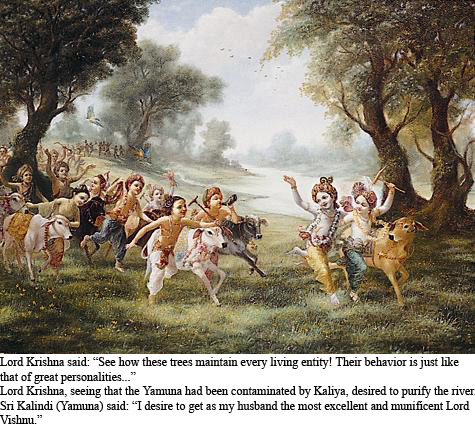
Regarding my suggestions in this article, I agree they may be too far-sighted, so put them aside for now. Yet the spirit of my presentation is that Krishna loves the trees, cows, and Yamuna (see the picture caption). In the Gita, he taught that sacrifice is the way to material prosperity, not exploiting earth’s resources. If we are to be good devotees of Krishna, we should intelligently integrate environmental issues in the sankirtana movement, not necessarily following methods of scientists and ecologists, but using the teachings and examples of Krishna, Mahaprabhu, and Prabhupada for our vehicle and motivation.
There probably should be an organized orientation program for western devotees visiting the dhama, at least at festival times (there may be one already).
The orientation program should cover these environmental issues as well as other issues about proper behavior, offenses to the dhama, appreciation of the dhama, and any other subject of practical importance for pilgrims.
Different dhamas also may have different local attitudes that foreign pilgrims should be made aware of. On my first visit to Jagannatha Puri, a local non-ISKCON devotee publicly chastised me for circumnambulating the temple while wearing shoes. Had I known that might happen, I probably would have arranged to go barefoot.
If senior devotees could give organized orientation programs, we will not only be able to serve the holy dhamas better but also will be able to make a better impression of ISKCON which will help our preaching.
Not only for Western devotees, but also for Indians from other places in India. And the orientation could include not only when to wear shoes, but also how to shop, how to dispose of trash, how to find a place to stay, etc. that will be most friendly to the cows, bulls, and the environment.
Anybody up for creating booklets or films on this topic?
Your servant, Urmila devi dasi
Iskcon’s practical record in the area of environmentally responsible living and land development is very modest at best. Even our own farms are not much to bragg about in that area. We have good intentions but that is about it. Therefore it seems like a good idea to work with people who are experienced in environmental activism and have local connections. We may claim to be the most environmntally responsible religion but facts on the ground in our most holy places simply mock that claim.
We may be building fantastic temples spending millions of dollars in the process, but if all the Vrindavana forests are gone, what is the point? What will the pilgrims see? That we worship Krsna on the altar but neglect His holy Dhama just outside the temple door? How much money and time was spent on serving the Dhama, versus time and money spent on our buildings? We may give a lip service to conservationism but if we can’t protect the land we see as most sacred, it is all just empty words.
One simple step towards the elimination of plastic bags would be re-useable cloth bags, I have seen many people in India using them, now these are being systematically eliminated by plastic. There are many good ideas given in this posting, for example the nice suggestion that devotees entering holy places should be given some guidance, they can informed about the cows and plastic and asked to hold a mindset in Vrindavan as if inside the mandir before the Deities of Sri Sri Krishna Balaram. There should also be a push for a high enviroment tax on plastic bags considering the amount of pollution they cause. I know that in Mumbai there was a law being considered that bags are required to have a minimum thickness, but I don’t know too much about this, whether it can be enforced and if it has a positve effect. I for one will not use plastic bags in India and encourage others not to as well. Thank you for bringing this forward, I hope this endeavour and topic “stays alive.”
Ys
bhakta piyush
One model that seems to be suited for protecting Vrindavana is that of Nature Conservancy (http://www.nature.org/). That model has werked very well all over the world. Nature Conservancy collects donations to buy land in ecologically important locations and turns that land into nature preserves. It is one of the most trusted environmental organizations in the world, with a proven strategy model and long track record of success.
Hare Krishna
PAMHO. AGTSP.
Here are some green-living things people can do
1. Use online banking and receive and pay bills online. Is this secured and tamper-proof? In the US, it is as safe and secured as the postal mail. Also, Banks and online merchants keep improving internet security. Postal mail can be easily tampered. This way you cut down on use of paper twice. You also save hassle of going to post office to buy stamps, envolpes etc. and you save on gas.
2. When buying groceries, carry cloth bags or waterproof tote bags and reduce plasic bags consumption.
Hari Bol
Your Servant