
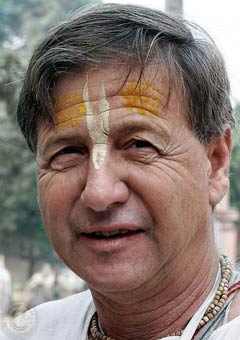
 Those Who Have Life Can Preach
An Interview with Ksudhi Dasa by Amrita Gopala Dasi
(Congregational Development Ministry www.namahatta.org)
Ksudhi dasa, initiated by ISKCON Founder-Acarya Srila Prabhupada in 1970, is known for his pioneering spirit. A dedicated and caring preacher, Ksudhi Prabhu is credited with starting the South African yatra back in 1972. Presently he lives in Laguna Beach, California and is engaged in Bhakti-vriksha propagation. In this interview, done in Sri Mayapur Dhama, Ksudhi Prabhu speaks about the essential elements of congregational preaching.
Amrita Gopala Dasi: Bhakti-vriksha preaching is still in the pioneering stages. What is the value of using the model to spread the Hare Krishna movement?
Ksudhi dasa: In some places, things expand quickly; in other places it takes more time. To train people how to do devotional service on their own—as the Bhakti-vriksha model promotes—allows everyone to be responsible even at the early stages of their Krishna consciousness. Sometimes the situation is that people come to the temple over a long period of time, but they are not given any responsibility. But with Bhakti-vriksha, you don’t wait for a year to ask people to chant 16 rounds, but you propose that everyone chant one round together.
AGD: Have you found the “Each-One-Teach-One” method to be effective?
KD: Teaching means to show people according to their level. Start with the basics: explain what prasada is; show them where the sloka is on the page. The teacher must be able to relate to the student. For example, if Jayapataka Swami says to a person, “You shouldn’t smoke, its not good,” coming from him, a sannyasi, it wouldn’t have the same impact. It has more meaning coming from someone who’s been there. “Hey, you know, I couldn’t give up smoking for twenty years, but as soon as I started chanting four rounds of Hare Krishna, I could leave cigarettes.” That shared experience has great value. That the teacher has changed his behavior in the recent past impacts the new person. The teacher is convincing the student that by taking shelter of Krishna, the results are positive. Sometimes we forget the power of life experience and we think, “Oh, let me send him to the swami and he’ll explain everything.” It’s true that the swamis and senior, long-time devotees can give so much inspiration, and it’s also true that someone who has come more recently to Krishna consciousness can share and inspire people to change their behavior and habits.
Nowadays, devotees beg, “Give me mercy!” But in the old days, devotees used to ask, “How can I get mercy?” Like Krishna says in Bhagavad-gita:
ya idaà paramaà guhyaà
mad-bhakteñv abhidhäsyati
bhaktià mayi paräà kåtvä
mäm evaiñyaty asaàçayaù
“For one who explains this supreme secret to the devotees, pure devotional service is guaranteed, and at the end he will come back to Me” (18.68). We get more mercy when we go out and preach. Teach someone how to chant a round. Give someone a book—you don’t need to be able to quote the entire Sanskrit before you can sell one. You do need to know a little bit, but not everything.
AGD: Speaking about sharing relationships, have the devotees in Bhakti-vriksha groups formed close bonds?
KD: We know the solution is Krishna consciousness, but sometimes we don’t know what a person’s problem is. That’s the first thing one must know if he or she is going to help someone—what their problem is. That’s why making friends with people is so important. Trust will come from that friendship. People don’t care how much you know; they want to know how much you care. We can’t offer the solution—Krishna consciousness—unless we know what’s going on in that person’s life. “You should so this, you should do that,” doesn’t work.
If the facilitator can create a mood of trust and generate a space for sharing, then people will open up and reveal what is close to them. The facilitator must be able to share his own experiences: “When I had this problem, I started chanting more and taking shelter of Krishna and it helped me.” We demonstrate the applicability, the practicality of Krishna consciousness.
AGD: Have you experienced that the devotees engaged in Bhakti-vriksha advance very quickly?
KD: It’s a matter of dedication. When one goes to the temple, there may be a tendency to look at it like a spectator sport. One can just stand back and observe. But with Bhakti-vriksha and Nama-hatta groups, it’s important to establish commitment. Like if a person comes to three meetings out of five, and then frequently comes late, it will be a disturbance. The Bhakti-vriksha Manual advises that the meetings start on time, and this is an essential rule to follow. The latecomers shouldn’t be rewarded while the people who come on time get punished.
AGD: A variety of people with different backgrounds and professions comprise the congregation. This culture, having to open up to a group, do people find it alien?
KD: People generally seem to prefer the Nama-hatta setting because they don’t have to share as much, or give as much. They can come to hear a swami give a talk, but they can remain in the background.
AGD: What are some strategies to attract people to join Bhakti-vriksha?
KD: The method that I use today comes from my experience in South Africa when I was preaching there alone. Instead of waiting for people to help me, I had to canvass and engage those people who I found to be willing to help out. You have to preach to those people who are there. Engage people. Rather than say, “I’m going to do this and you’re going to watch me,” have people assist.
An ideal situation would be to have many Bhakti-vriksha groups rather than a few small ones. Say in a city there are 50 groups—there would be a meeting everyday for people to go to once or twice a week. Of course, the advantage of Bhakti-vriksha is that it is small and local. But getting started is difficult because the logistics are narrower. If someone can’t make it on Thursdays, for example, you may lose that person. But if there are several groups in a city, there are options and alternatives. There are so many advantages to expanding, and that’s what you generally don’t find with Nama-hatta. Different groups can be orientated towards different things; membership can be tailored to particular interests. There can be a groups just for ladies, and groups of people who share a common profession.
AGD: One focus of Bhakti-vriksha is preaching and bringing new people in. How are you cultivating the preaching spirit in your group?
KD: This is the toughest thing. I haven’t been able to cultivate it to the level I would like. One difficulty is that people move away frequently. They go away to college, or they get new jobs. I do make a point to try and keep in touch, and some people have moved to places where they can attend Bhakti-vriksha or go to a nearby temple. And then there are politics. One member of our group was creating a disturbance, and I found out that some community members didn’t want to come to our meetings because this guy was involved. He was a notorious cheater. And in the Bhakti-vriksha group, because it’s intimate and small, to have this type of person involved is detrimental. It reflects badly in the minds of new people. How will they feel about the facilitator and about devotees? About Krishna consciousness?
AGD: When Srila Prabhupada was pioneering the Krishna consciousness movement, he dealt with so many different kinds of characters and natures. In your Bhakti-vriksha groups, how are you connecting people with Srila Prabhupada?
KD: Because we’re studying Srila Prabhupada’s books, that connection is developed. The whole thing is based on how to apply the teachings in Srila Prabhupada’s books. If one is a temple devotee, the Deities are there, devotee association is there, being Krishna conscious isn’t such a challenge. But congregation members have to associate with all kinds of people, so learning how to apply the teachings of Lord Krishna is an important part of Bhakti-vriksha. The practical aspects must be learned: “Who can I speak to? Who do I avoid completely?”
One important lesson to learn from Srila Prabhupada and his followers is how to encourage people. Devotees such as Jayapataka Swami and Kadamba Kanana Maharaja are expert in treating people with care. Getting people to take part and play a role—that is the duty of the facilitator. Let people know about the variety of activities in Krishna consciousness. There is something for everyone in Krishna consciousness. Some people are inclined towards preaching, others toward puja and Deity worship. It’s a matter of encouraging people to find their place. Having people just come and watch isn’t enough, but at the same time, it’s rare that a person will instantly give up everything and become a devotee overnight.
Sometimes we limit the options by presenting them too narrowly. “You can have a glass of water or a fifteen-course feast. Nothing in between.” We are a preaching movement, but not everyone is ready or willing to distribute books at the airport. In other words, it’s not an “all or nothing” situation. Everyone can be encouraged to do a little, and for those who can do a lot, that encouragement will naturally be there. The main factor is consistency. Srila Prabhupada said it’s better to do something simple than to be inactive. Our movement will benefit by developing the kind of culture where people are trained to be responsible. Maybe a person doesn’t have the capacity to save the whole world, but their efforts should be appreciated.
The simplicity of Bhakti-vriksha is very attractive: a few people come together and have kirtana and study the philosophy and learn how to apply it. The group members get a taste and share it with others. Getting people to work together, not as inimical competitors, but as friendly allies with a shared purpose—these are the fruits and flowers of Bhakti-vriksha. Maybe you don’t have as many people coming as you would like, but work with what you have. Like in kirtana: one is blessed to be able to play mridanga like an expert, but another can only clap his hands. But still the kirtana is there, going on.
For more discussions on congregational development: www.namahatta.org
Ksudhi’s comments here, and the 2002 speech of Rabindra Swarup that was recently published on Dandavats (“Nama Hatta in USA”), make a lot of sense.
Whether through bhakti-vrksha programs or just through the way we preach and do things at ISKCON temples, it seems unreasonable for us to take an “all or nothing” approach. We cannot expect or demand everyone to move into temples and give up all their education, career, money (though we ideally should have some facility for those who would like to experience full-time ashram life).
We should be able to try to encourage people to completely surrender to Krishna without judging them for going at their own pace and doing as much in terms of their personal surrender as they feel called to do or feel ready for. (The fully-committed brahmacaris and sannyasis should never be envious of the householders or less committed visitors).
Besides, someone can conceivably be fully surrendered without actually physically moving into a spiritual commune or even changing the way they dress or wear their hair. Householders living “outside” can be pure devotees. (Can’t they?)
(Do temple devotees really have to offer only a “15-course feast” or a “glass of water”? Why do we do that, anyway? Maybe there is some hidden value or necessity in doing that that I am missing. Are we afraid no one will want to become a brahmacari and sleep on the floor if we tell them they can still be our friends if they want to just chant at home and visit the temple a few times a week while they continue with their college and career track? Won’t some people want to adopt a more renounced and austere lifestyle, which has its own special rewards, anyway?)
I can understand that people may feel more relaxed and uninhibited to speak in a home program as opposed to a temple program (but couldn’t our temple programs encourage more of an open and friendly, relaxed mood?)
Is there also some dangerous tendency for separate, organized bhakta vriksha programs to cause divisions within local devotee communities? Some ahankara might creep in where people start identifying themselves as “temple devotees” or “bhakta vriksha” devotees.
Some bhakta vriksha leaders might also, even unconsciously, steer new devotees toward particular gurus (e.g. their own gurus) and away from other gurus who are also preaching at or commected with the local temple. I suppose this could happen with temple preachers too.
Separateness between local bhakta-vriksha groups and nearby temples could even rise to the point where there can even be friction between temple and bhakta-vriksha leaders. That is a concern of mine. I have heard of such things without personally experiencing them up close.
If this happens (and I am more asking whether it happens than saying it does happen), it could be that the temple authorities are at least equally at fault. But why should it happen at all? Shouldn’t the bhakta vrishka groups strive to be more integrated with the local temples, and vice versa?
Is there a way for bhakta vriksha groups to encourage more active participation in temple activities, festivals, classes, kirtans, and public sankirtan outreach? Shouldn’t that be a main goal of the bhakta-vriksha group?
Can temples also encourage independent householders to form friendships and meet together for home programs without necessarily making it into a separate “program”?
Is there any reason we cannot incorporate more of the spirit of engaging people according to their level of commitment and surrender right at the temple? Does there have to be a separate “bhakta vriksha” program rather than just a more understanding and universally accommodating, natural friendly mood in the temple and its congregation?
Is there a danger of having bhakta vriksha programs begin to compete and separate from the temple congregations? If so, what are the solutions?
Is it better to have the bhakta vriksha leaders who come from the ranks of temple managers or devotees closely in tune with the spirit and preaching vision of the local temple management? Is it important to have temple authorities develop more appreciation and sympathy for local bhakta-vriksha programs?
Sorry, I have more questions than opinions on this. I am kind of doing some thinking out loud, hoping to hear the comments of more well-informed devotees.
I am not really familiar with bhakta-vriksha groups, but my local temple is really a “congregational” temple made up of householders mostly with professional jobs. We have some active bhakta vriksha groups (but I do not know much about them), and we also have devotees who just have programs or parties at their own homes from time to time.
We *are* finding that everyone can enjoy going out on harinama and book distribution, though, even if they are not ready to give up their job or shave their head or even regularly chant 16 rounds. Everyone experiences that joining in that mood of showing mercy to all jivas by distributing the holy names gives them greater attachment and realization in their own devotional practices.
It seems one thing people are looking for from becoming a member of a congregation (whether in a church, synagogue, or Krishna temple) is a sense of community. They can find like-minded friends and feel themselves part of a larger group dedicated to God. We do not have to actually live in a spiritual commune to find a deep sense of community, but we do need to find other like-minded people we can personally resonate with and form solid connections with. This can happen in temple congregations as well as bhakta vriksha groups or brahmacari ashrams.
Maybe it is okay if we develop as separate “bhakta vriksha” and temple communities, but it seems to me that this goes against the spirit that Srimad Bhagavatam will fulfill the need of a unifying force for all human society. It seems that the temple and bhakta vriksha groups should ideally see themselves as part of one big ISKCON community, both locally and globally.
[Sometimes ISKCON temples may become places of residence for strange, wild people, or even criminals and mental hospital cases. While we want to be merciful to everyone, not everyone should be allowed to live at or even necessarily visit the temple, if they disturb or frighten our congregations…but that is another issue.]
Dear Akruranath Prabhu,
Please accept my humble obeisances. All glories to Srila Prabhupada. All glories to Sri Sri Guru and Gauranga.
I would like to invite you to view the article on “The Festival of Love and Trust” at http://namahatta.org/nh2/en/node/2972 which might address some of your concerns regarding the interaction between temple and Bhakti Vriksha programs.
Your aspiring servant,
Advaitachandra das
http://namahatta.org/nh2/en/node/3024
Pls view this article as well
Thanks Advaitachandra, that was a nice article and it looks like it was a very nice “festival of love and trust”.
The devotees in Houston are obviously addressing the concerns I expressed in the way they are organizing their Bhakti-vriksha preaching.
It is nice to see that Adi-guru Prabhu and his good wife Kamalagopi are involved in such a nice community. We are missing them here in San Jose, and I am especially missing Adi-guru’s association out on book distribution.
I can add that a society of real love and trust, which is so rare in kali yuga but which is possible in Krishna consciousness, is extremely attractive to everyone. People are really hankering for this genuine friendship that can be shared by those who are subduing the false ego through bhakti yoga.
Lord Caitanya is shooing away kali yuga. Hare Krishna!
Your servant, Akruranatha dasa
Hey Haribol Adiguru! I was just talking about you and then you showed up. :-)
I really liked Kaunteya’s article that you gave the link to. I agree that there is a danger of getting overly dedicated to erecting buildings, rather than to building communities of sincere devotees.
In fact, I just recently wrote a private email to a godbrother who has proposed a massive building project without, it seems to me, having a sufficient community of devotees in the area to even maintain the project.
(I may have been out of line to write a letter out of the blue like that, complaining to this enthusiastic godbrother and being a wet blanket, but I took the risk because it seemed necessary for me to say something. On the other hand, if he actually succeeds in erecting a huge temple and as a result lots of visitors come and get exposed to Krishna consciousness, I will happily admit I was wrong and give him the tremendous credit he will deserve.)
Not that there is no place for big projects. Specifically, Srila Prabhupada established a big project in Mayapur, which we have been a little slow in accomplishing (i.e., the massive temple and planetarium that will be built there eventually), but that community is being gradually developed nicely and I do not mean to sound impatient.
The materialistic people of this age will be impressed by big buildings if we can do it in a first-class way, but I agree that the priority is to have advanced devotees, madhyama adhikaries who can preach effectively, as Kaunteya says. Otherwise, as Srila Prabhupada warned, we will just end up with a bunch of empty buildings we cannot even maintain adequately. Preaching is the essence.
We have been warned that sannyasis should not establish many temples or accept many disciples, and I take it the reason is that there may be a subtle influence of material prestige and so on associated with these activities.
(Dhanam and janam can be dangerous for anyone. Of course for sannyasis there can be no question of sundarim. If we get too wrapped up in collecting money for building projects, we could lose sight of our actual preaching goals. Buildings have their place so long as we do not get our priorities mixed up and we build them at appropriate times for the right reasons.)
What I still do not understand fully, though, is why it is necessary to do build communities by separate bhakti-vriksha programs, as opposed to just to inculcating the same mood in the temple community. We cannot argue with success, though, and if bhakti-vriksha groups or loft centers are working, we should support those initiatives.
The article that Advaitachandra linked me to seemed to show how in Houston the two projects (temple and bhakti-vriksha groups) are consciously working hand in hand. That seems good. Kaunteya’s article addressed my concern that there can be at least the possibility of tension between the temple and bhakti-vriksha groups.
If the temple managers see their mission as reaching new devotees and encouraging them in spiritual life (rather than using them as a means to an end such as erecting a big building), and the bhakti-vriksha leaders see their mission in the same way and encourage the bhakti vriksha members to assist the temple projects as practical devotional service, there should be no conflict.
It seems to me that the temple mentality that Rabindra Svarup described in his 2002 speech published here as “Nama Hatta in USA” — that if someone comes to the temple for a few months but does not shave his head or give up all his possessions and “move in”, then there is something wrong with him — should not be the proper attitude in the temple or anywhere else. Realistically, not everyone should be expected to abruptly give up their job, their money, their education, their parent’s hopes for their material future.
On the other hand, we do also need to find ways to encourage and support those who think they might really want to take the “leap” into brahmacari life. We should still have ashrams and traveling sankirtan parties and a spirit of renunciation and austerity, as H.H. Trivikrama Maharaja was reminding me here recently in Dandavats.
I loved Syamasundara Prabhu’s “Memories of Srila Prabhupada” video in Bhaktisiddhanta dasa’s series, where he described the risks devotees took in the early days, and the miracles that always occurred. He described his vision in those days of Srila Prabhupada being like a “pirate captain”, and how the devotees were so bold and fearless like a pirate crew. After all, our real “material future” is only death, and we are basically preaching renunciation of everything that cannot be used in Krishna’s service. “The viasnavas die to live and living try to spread the holy life around.”
I just think that devotees with all these different mentalities should be able to all feel part of the same mission and fulfilling different necessary roles in our organic preaching society.