
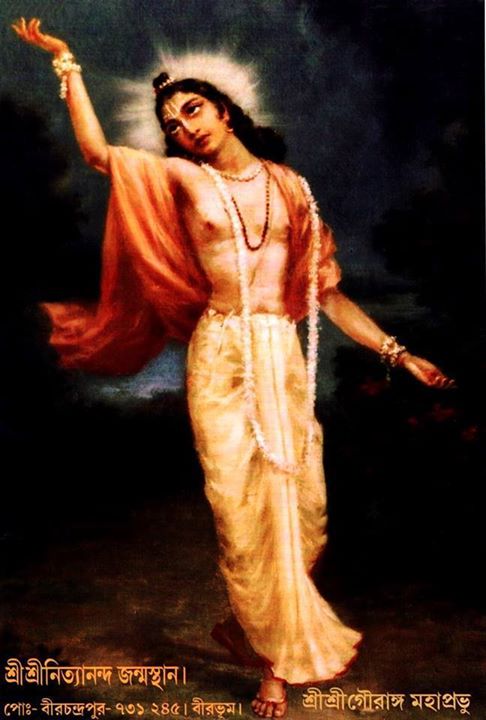
The great Sankirtan Movement of Lord Caitanya Mahaprabhu is a great gift to the world and a very rare event!
Gauragopala dasa: Many could take it for granted without realizing how rare Lord Caitanya’s appearance actually is as He comes once in every day and night of Brahmā. That is once every 2000th Kali-yuga in the cycle of Maha Yugas, there are 4 Yugas to a Maha Yuga, Lord Caitanya appears “once” in a Kali-yuga with His Sankirtan Movement out of every two thousand.
There are 4,320,000 human years in a Maha Yuga multiply that by 2000 (that equals 8 billion 640 million years) and you will see that Lord Caitanya’s appearance is very rare as He comes once over that enormous period of time
Krishna also comes once every 2000 Maha yugas or every 8 billion 640 million years at the end of Dvarpara-yuga just before Lord Caitanya’s appearance 4,500 years into the Kali-yuga
In this rare Kali-yuga there there is a 10,000 years Golden Age of the Sankirtan Movement of Lord Caitanya Mahaprabhu or the congregational chanting of the Hare Krishna Maha mantra, the previous 1,999 Kali-yugas had no Lord Caitanya or Golden Age of Sankirtan.
The Four Yugas
The four yugas make up a cycle called Divya-yuga or Maha-yuga, which lasts 4,320,000 years.
One thousand of these yugas equal one day of Brahma, which is called a kalpa and another one thousand makes up a night.
Brahma’s lifespan is 100 years of his time and 311 Trillion 400 billion years of our time.
SATYA YUGA – (sometimes also called krta-yuga): The golden age lasts 1,728,000 years. The process of self-realization in this yuga is meditation on Vishnu. During this yuga the majority of the population is situated in the mode of goodness and the average life span at the beginning of the yuga is 100,000 years.
TRETA YUGA – Also called the silver age, lasts 1,296,000 years and the process of self realization is the performance of opulent yajnas(sacrifices). The average life span is 10,000 years and the godly qualities decrease one fourth compared to the Satya yuga.
DVARPARA YUGA – Or the bronze age, lasts 864,000 years and the process of self realization is the worship of the deities within temples. Godly qualities are reduced to 50% by now and the average life expectancy is only 1000 years. Krishna in His originally Form comes at the end of Dvarpara-yuga but not every Dvarpara-yuga as He only comes once in a day of Brahma which is only every 2000th Dvarpara yuga
KALI YUGA – The iron age of hypocrisy and quarrel lasts 432,000 years. Lord Krsna appeared in His original, transcendental form right before the beginning of a Kali-yuga at the end of Dvarpara-yuga in one day of Brahma which is every 2000 cycles of the four yugas. Both Krishna in His original Form and Lord Caitanya do NOT appear in every Maha-yuga. Krishna does not appear at the end of every Dvarpara-yuga and Lord Caitanya does NOT appear in every Kali-yuga as explained above
Lord Kṛṣṇa Himself on His original blackish color does not appear in all the Dvāpara-yugas in a day of Brahma
CC Madhya 20.337
By His Divine Grace A. C. Bhaktivedanta Swami Prabhupada
TEXT 337
TRANSLATION
“‘In Dvāpara-yuga the Personality of Godhead appears in a blackish hue. He is dressed in yellow, He holds His own weapons, and He is decorated with the Kaustubha jewel and the mark of Śrīvatsa. That is how His symptoms are described.’
PURPORT
This is a quotation from Śrīmad-Bhāgavatam (SB 11.5.27). The śyāma color is not exactly blackish. Śrīla Bhaktisiddhānta Sarasvatī Ṭhākura compares it to the color of the atasī flower.
It is not that Lord Kṛṣṇa Himself appears in a blackish color in all the Dvāpara-yugas.
In other Dvāpara-yugas, previous to Lord Kṛṣṇa’s appearance, the Supreme Lord appeared in a greenish body by His own personal expansion. This is mentioned in the Viṣṇu Purāṇa, Hari-vaṁśa and Mahābhārata.
Also a correction to – Brahma’s lifespan is 100 years of his time and 311 Trillion 40 billion years of our time and not 400 billion and a day of Brahma is 8 billion 600 million in some references in sastra and 8 billion 640 billion in other places.
Bhagavad Gita Preface: Srila Prabhupada – ”Our only purpose is to present this Bhagavad-gītā As It Is in order to guide the conditioned student to the same purpose for which Kṛṣṇa descends to this planet once in a day of Brahmā, or every 8,600,000,000 years”.
Caitanya Caitamrta Adi 3.10,
Purport:
Now is the term of Vaivasvata Manu, during which Lord Caitanya appears. First Lord Kṛṣṇa appears at the close of the Dvāpara-yuga of the twenty-eighth divya-yuga, and then Lord Caitanya appears in the Kali-yuga of the same divya-yuga.
Lord Kṛṣṇa and Lord Caitanya appear once in each day of Brahmā, or once in fourteen manv-antaras, each of seventy-one divya-yugas in duration.
From the beginning of Brahmā’s day of 4,320,000,000 years, six Manus appear and disappear before Lord Kṛṣṇa appears. Thus 1,975,320,000 years of the day of Brahmā elapse before the appearance of Lord Kṛṣṇa. This is an astronomical calculation according to solar years.
Note – There is also 4,320,000,000 years in Brahmas night so a night and day together is 8,640,000,000 years. Sometimes one will notice figures in some Purports are a little different from others for example here a day and night of Brahma is 8 billion 640 million were as in the preface of Bhagavad gita it says 8 billion 600 million.
Renunciation Through Wisdom 4.5:
The undifferentiated Absolute Truth, the original Supreme Personality, Lord Śrī Kṛṣṇa, incarnates in this material world once in every day of Lord Brahmā—that is once every 8,640,000,000 solar years—to shower His mercy upon both His surrendered devotees and the atheistic nondevotees. He protects His devotees and slays the atheistic demons, thus giving the latter troublesome release, so to speak, in impersonal liberation.
Lecture on SB 6.1.3 — Melbourne, May 22, 1975:
Prabhupāda: Oh. Anyway, I give you the right figure, four million, according to American or English calculation, (laughter) 4,300,000 years and multiply it by one thousand. Then what it comes according to English calculation?
Paramahaṁsa: 4,300,000.
Prabhupāda: That is twelve hours. And add again twelve hours, night. Then eight billion…?
Paramahaṁsa: 600,000,000.
Prabhupāda: So Kṛṣṇa comes after this period. (laughter) In one day, after one day of Brahma, He appears.
Devotee: Śrīla Prabhupāda, does Lord Caitanya Mahāprabhu also appear every day of Brahma?
Prabhupāda: Yes, following Kṛṣṇa. Kṛṣṇa comes in the Dvāpara-yuga. There are four periods of each yuga: Sattva, Tretā, Dvāpara, Kali. So Kṛṣṇa comes at the end of Dvāpara-yuga, and Caitanya Mahāprabhu comes in the Kali-yuga.
So if one does the maths there is 1000 Maha-yugas in a day of Brahma and another 1000 in a night of Brahma making 2000 Maha-yugas.
There are 4,320,000 human years in a Maha Yuga multiply that by 2000 (that equals 8 billion 640 million years) and you will see that Lord Caitanya’s appearance in one day of Brahma is very rare.
There are 4,320,000 human years in a Maha Yuga multiply that by 2000 (that equals 8 billion 640 million years) and you will see that Lord Caitanya’s appearance in one ”day and night” of Brahma is very rare.
Correction – Krishna and Lord Caitanya comes once every 1000 Maha yugas not 2000. When ‘night’ falls, Brahma goes to sleep for a period of 4 billion 320 billion years, which is a period of time equal one day of Brahma
The day of Brahma is 1000 Maha-yugas that takes 4 billion 320 million years and the night of Brahma has no yugas at all because Brahma sleeps through the night and does not create any of the 4 yugas however, that sleeping period called ”Night of Brahma” also lasts for 4 billion 320 million years where a ”day and night” equals 8 billion 640 million years.
So if one does the maths there is 1000 Maha-yugas that equals 4 billion 320 million years and then another 4 billion 320 million years for Brahma’s night. Once Brahma’s night arrives, every living entity is annihilated and unmanifest, and the living entities take rest in the body of Lord Vishnu.
Srimad Bhagavatam Canto 2 Chapter 6 Text 11 Purport – ”The universe (called the brahmāṇḍa, or the round football-like domain controlled by a Brahmā) is thus annihilated, and thus the inhabitants of a particular planet, or of the whole universe, are also annihilated. Avyakta, mentioned here in this verse, means the night of Brahmā, when partial annihilation takes place and the living entities of that particular brahmāṇḍa, up to the planets of Brahmaloka, along with the big oceans, etc., all repose in the belly of the virāṭ-puruṣa. At the end of a Brahmā’s night, the creation again takes place, and the living entities, reserved within the belly of the Lord, are let loose to play their respective parts as if being awakened from a deep slumber”.