
An Ancient Temple Renovated (Album with photos)
Indradyumna Swami: When Sri Rangam was invaded by Muslim conquerors in the early 13th century almost the entire Vaisnava population was exterminated. Only 750 devotees managed to escape and create a small village some distance from Sri Rangam. There they established a beautiful deity looking much like their beloved Rangunath, who was hidden during the Muslim invasion. Through the centuries the village and it’s temple fell into disrepair until a few years ago, when Murali Bhattar, a priest in the Sri Rangam temple, renovated the temple and began the worship of the deity again. Today we visited that small village. The deity was gorgeous. On the way back to Sri Rangam we stopped by another important temple. Vedic culture is still prominent in South India.
Find them here: https://goo.gl/YwnPwg
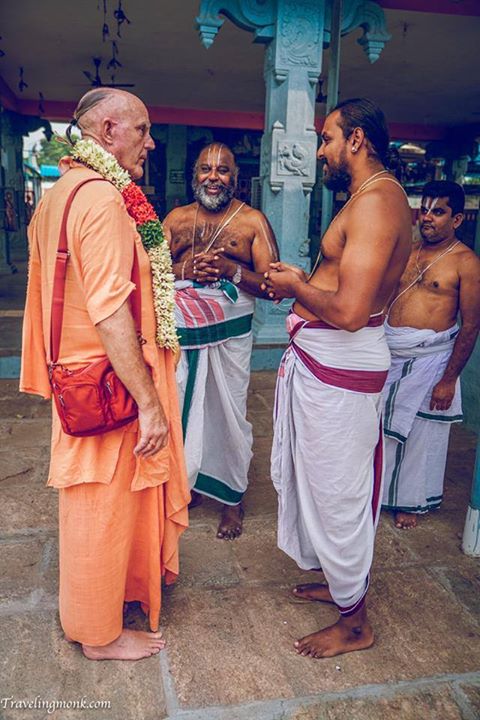
For the record from left to right are Muralidhar Bhattar, his son Harish, and his student Madhu. Muralidhar Bhattar is now the head archaka in Sri Rangam. His father Rangaraja Bhattar was also head archaka. Their family is descended from Tirumalla Bhatta who was the brother of Venkata Bhatta (the father of Gopala Bhatta Gosvami) and Prabhodananda Sarasvati. In the 1970s when ISKCON was just starting its preaching in S India we were being criticized by the caste Brahmins. But Rangaraja Bhattar on behalf of the Sri Sampradaya (and Pejvara Swami for the Madhvas) wrote an open letter, which ISKCON distributed as a pamphlet, entitled “ISKCON is Bonafide”, in which Rangaraja Bhattar explained how ISKCON is a bonafide Vaisnava Sampradaya.
Until very recently (2-3 years) they kept their ancestral home intact, the very one that Lord Caitanya stayed in while He was in Sri Rangam for Caturmasya. That home has been demolished and flats built. With the exception of the room where Lord Caitanya lived during his stay which Muralidhar claimed as his share of the inheritance in order to preserve it and which he will convert into a yajnasala for performing homas.
Regarding the renovated temple: it is situated in Goparbhatti a small village about 20 km from Sri Rangam. In 2006 Muralidhar happened to go to that village and noticed the dilapidated temple. Climbing on top and looking in he could see the damaged form of Seshasyana Visnu (Visnu laying on Seshanaga). After discussing with the pancayat it was decided to renovate the temple and Muralidhar took charge. Every stone on the temple was first numbered and then the whole structure disassembled. Then the garbhagriya was refurbished and a new Deity made and installed. Then taking the numbered stones the temple was then put back together except in a much better shape.
During the reconstruction process Muralidhar Prabhu saw that the walls were inscribed with the history of the temple in Tamil. It explains that during the sack of Srirangam in 1311 by Malik Kafur he murdered 12,000 Sri Vaisnava men, women and children. Later a Sri Vaisnava acharya established 700 families in Goparbhatti to do the tarpana for the deceased Vaisnavas. It is not yet certain if the temple at Goparbhatti that Muralidhar found was desecrated before the Vijayanagara Empire was established or after it fell.
yhs
Shyamasundara Dasa ACBSP
I mis-spelled the name, it is actually spelled “Gopurapatti”. You can find out more information about the temple here:
http://www.thehindu.com/todays-paper/tp-features/tp-editorialfeatures/a-village-intertwined-with-history-of-srirangam/article4233379.ece