
By Basu Ghosh Das
Early on August twenty ninth, I caught the Air Mauritius flight from Bombay to Mauritius for a nine day tour to lecture in Hindi at the Sri Krishna Janmastami festival at the Krishna Balaram Mandir/ISKCON Farm at Bon Accueil, on the Eastern side of the island of Mauritius as well as at similar observances in several towns nearby.
For the reader who is not aware, Mauritius is a small island in the Indian Ocean, approximately four thousand seven hundred kilometers Southwest of Bombay. It’s situated around fifteen hundred kilometers due East of Madagascar, the huge island itself one thousand kilometers East of continental Africa.
Port Louis is the capitol of Mauritius and now the largest town. The island has many small towns, where the vast majority of the population resides. The island is covered with sugar cane fields, and the crop is totally commercial. Nowadays, all of the crop goes to a handful of large sugar mills to manufacture sugar from the raw cane, which is almost totally exported.
Approximately fifty full time devotees live at the ISKCON Farm and Krishna Balaram Mandir at Bon Accueil. The community is sustained by preaching programs in various towns in the East and North of Mauritius and by a sweet stall and “Govinda’s restaurant” located in the town of Flacq, the largest commercial town of Eastern Mauritius.
From August 31 until the day before ISKCON’s observance of Janmastami on September 4, (many Hindus and Hindu temples at Mauritius observed Janmastami on September 3), programs were arranged in the evenings at several places in the East and North.
The schedule was as follows:
Friday, August 31- Riche Mare, Flacq
Saturday, September 1 – Petite Cabane, Camp de Masque
Sunday, September 2 – Shakespeare Road
Monday, September 3 – Morcellement St André
From the names of the towns of Mauritius, one becomes familiar with the influence of the French colonialists, who dominated the Island until independence back during 1972. Although the British took administrative control of Mauritius in the early nineteenth century, after fighting the French in the Indian Ocean, the French retained commercial and residential rights on the island. Hence French Creole (a simplified form of French) is the language of common usage there, even amongst the now politically dominant Hindus, who make up approximately seventy percent of the population of 11 lakhs (one million one hundred thousand) inhabitants. The “Franco-Mauritian”, descendents of the French colonialists number twenty thousand at present. The balance of the population consists of Muslims of Indian descent and small number of “Creoles”, persons of mainly African origin, who were mainly fishermen on the coastline. There are also some Chinese residents as well.
Despite French Creole being spoken by all of the Island’s inhabitants and used for common communication, English is the “official national language”, and most Mauritians speak it as well as French Creole. However, most of the Hindus are native Hindi dialect speakers, and due to the recent influence of films from India, which are very popular amongst all Mauritians of Indian descent, mostly all of them speak or understand Hindi.
The programs in the towns of Riche Mare and Camp de Masque were organized in Hindu temples, both of which are run by persons originating in Andhra Pradesh in India. At Riche Mare the Deity in the temple is Lord Balaji, who is worshipped at the famous temple on the hills at Tirumala, Tirupati.
At Camp de Masque there is a Rama Mandiram, where several Deities of Lord Vishnu are worshipped.
In attendance at the program at Camp de Masque was the honorable government Minister for Environment, Sri Anil Kumar Bachoo. Sri Bachoo, who later on was Chief Guest at the Janmastami function at ISKCON’s Krishna Balaram Mandir at Bon Accueil, is a keen student of Bhagavad-gita and a good supporter of ISKCON.
In his short speech at the honorable Minister lamented that many of the male members of the Hindu community of Mauritius were indulging in the bad habit of drinking, to the detriment of their families and society. He hoped that by studying Gita, becoming attached to spiritual programs like kirtan and associating with devotees of ISKCON, they might realize that there was a higher aim in life.
Just next to both temples are situated halls, where occasional programs such as our Krishna Janmastami program. ISKCON has a number of grihasta (householder) devotees spread throughout the towns of Mauritius, and when they arrange programs in these various towns, they turn out in large numbers in attendance.
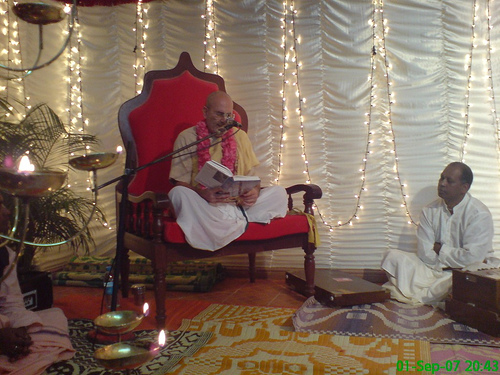
At the programs, kirtan and bhajans were first performed for a long period before my arrival from Bon Accueil, and at both of these programs I was well received by the local organizers. I spoke in Hindi for a good part of an hour and there were question and answer sessions after the lectures. I also sang the “jaya radha madhava” bhajan and sang kirtans after the lectures, during arati, and abhishek ceremonies that followed the lectures.
There were two Janmastami programs at Fond du Sac and Morcellement St André, towns located in the North of the Island, near the well known tourist spot at “Grand Bay”.
My lectures focused on the teachings of Lord Krishna in Bhagavad-gita, rather than “katha” – the transcendental story of Lord Krishna’s appearance. However, one of the leading devotees asked me to tell the story of Lord Krishna’s appearance at the program at Morcellement St André, which was held on September third, when many Hindus were observing it as Janmastami day.
As was apropos for the occasion, I obliged, to the great pleasure of the devotee who made the request, as well as the assembled devotees.
One thing that I observed was that there were greater numbers of ladies in attendance at these programs. One of the senior most grihasta devotees attached to Krishna Balaram Mandir is a very sweet singer of kirtans, and his son a very expert mrdanga player. They led very nice kirtans at these two programs in Northern Mauritius, and again at Krishna Balaram Mandir’s Janmastami function on September fourth.
At Mauritius, the devotees serve prasad to the attending members of the public before and during the kirtan segment of the programs. When it was time for the lecture to begin, the prasad (full course dinner) service was usually complete, and the halls filled up with devotees eager to hear the lecture.
It’s pertinent to mention here the visit of Sri Raj Dayal, the ex-Commissioner of the Police (for all of Mauritius) to the Krishna Balaram Mandir on Sunday, September first. Along with his wife and daughter, Commissioner Dayal, who also headed Mauritius’s SMF, (the “Special Mobile Force”, which is a paramilitary unit that was formed to protect Mauritius from any “coup d’etat” or internal threat to the Government) spent more than an hour touring the Hare Krishna Farm after having darshan of Their Lordships in the Krishna Balaram Mandir. On my earlier visit to Mauritius for Janmastami 1992, I had met Commander Dayal (at the time, he was “Commander” of the SMF) at his office at SMF headquarters.
Something interesting happened during Commissioner Dayal’s visit to the Mandir. In an enclosure situated just behind the Krishna Balaram Mandir, reside a peacock and peahen. We took Commissioner Dayal and his family to see the birds. The peacock himself came right over near the viewing door of fenced in enclosure, and at that time I explained about the mating dance of the peacock, which is when the bird fully opens it’s tail feathers in a beautiful display of colors.
It so happened that while we were talking the peacock moved towards the back of the enclosure and suddenly began his mating dance, opening his feathers fully at that time. It was a very beautiful site to behold. A description of the peacock and their dancing is given in Srimad Bhagavatam in the description of the “sharad ritu” – the autumn season – in the “dashama skanda”, the “tenth canto” as follows:
meghaagamotsava hrstah
pratyanandan chikhandinaha
grheshu taptaa-nirvinna
yathaacyuta-janaagame
“The peacocks became festive and cried out a joyful greeting when they saw the clouds arrive, just as people distressed in household life feel pleasure when the pure devotees of the infallible Supreme Lord visit them”. (Srimad Bhagavatam, 10.20.20)
Lord Krishna always wears a peacock’s feather on his turban or crown:
shyamam hiranya-paridhim vanamaalya-barha-
dhaatu-pravaala-nata-vesham anuvrataamse
vinyasta-hastam itarena dhunaanam abjam
karnotpalaalaka-kapola-mukhaabja-haasam
“His complexion was dark blue and His garment golden. Wearing a peacock feather, colored minerals, sprigs of flower buds, and a garland of forest flowers and leaves, He was dressed just like a dramatic dancer. He rested one hand upon the shoulder of a friend and with the other twirled a lotus. Lilies graced His ears, His hair hung down over His cheeks, and His lotuslike face was smiling”. (Srimad Bhagavatam, 10.23.23)
Needless to say, Commissioner Dayal and his family were quite pleased with this sudden display and he remarked that now his visit to the temple would be remembered well!
On September 4, on the auspicious day of Sri Krishna Janmastami, crowds began gathering at five in the afternoon at the Krishna Balaram Mandir, when mass prasad distribution began. Prasad was served continuously to the visiting devotees/members of the public. Prasad was served on tables were devotees and their families were seated. Prasad service continued until eight in the evening. Several Franco-Mauritian devotees and a few foreign tourist guests also attended the festival.
At eight PM the stage program began with kirtans led by one of the senior devotees of the Krishna Balaram Mandir, Sriman Guru Shakti Prabhu. There was a short drama presented by a group of devotee children on Krishna-lila and a short performance of a Bharata-natyam dance by two devotees – a lady and a girl, both dressed in the traditional bharata-natyam elaborate costumes. Thereafter, at about nine-thirty I gave a half and hour lecture to the assembled devotees. My lecture was heard by Chief Guest Sri Anil Kumar Bachoo, Mauritius Minister for Environment, and also by the Mauritius Minister of Education, Sri Dharambeer Gokhool.
Thereafter, Chief Guest Sri Anil Kumar Bachoo spoke. Beginning from his lecture, the program was broadcast live by the MBC – Mauritius Broadcasting Corporation – to a nationwide audience. After Sri Bachoo’s speech, I lectured again for fifteen minutes, trying to cover the topics of Krishna Janmastami, ISKCON and it’s worldwide mission and the great service that Srila Prabhupada rendered by establishing ISKCON.
This was followed by a few minutes of kirtans by Guru Shakti Prabhu and temple and congregational devotees. Immediately after this, an abhishek of Lord Krishna’s small Deities began on the stage, and simultaneously there was abhishek in the temple.
Afterwards, Sriniketan Prabhu, who worked so hard to organize the festival for days – maybe even weeks, and who so kindly hosted me at his house behind the Krishna Balaram temple, arranged a simple “phal-aahaar” break-fast for us.
The program had been a success and my hosts were happy. Large numbers of visitors had come – and some were still present – but most had taken prasad, had darshan of Sri Sri Krishna Balaram, attended the stage programs, purchased sweets and books at the stalls and left.
The next day, Sri Vyas Puja day, a smaller group comprising both temple and congregational devotees began observing Srila Prabhupada’s one hundred and eleventh appearance day on the stage in the tent erected for the Janmastami program.
Devotees spoke glorifying Srila Prabhupada. Sriniketan Prabhu and Arjuna Prabhu spoke in French Creole. Krishna Vallabh Prabhu from France, spoke in French. Mukta Purush Prabhu and Guru Shakti Prabhu spoke in Hindi. My speech, in Hindi, was mostly a recollection of anecdotes of my early days in India with Srila Prabhupada. The speech went beyond the time limit, and I got an enthusiastic extension from Sriniketan Prabhu. After continuing for a bit more, I brought the talk to a halt, as several more devotees were to speak. Sriniketan Prabhu told me in front of the devotees that I would have to return to speak more on the same topic!
After the speeches there was both a “pushpanjali” – offering of flowers – to, and abhishek – bathing ceremony – of Srila Prabhupada. Again, after these ceremonies were completed, all the devotees lined up to offer more flowers – this time personally – to Srila Prabhupada’s Deity. All throughout I led kirtan for almost forty-five minutes. It’s amazing that my voice held out!
The program started at noon and ended almost at four thirty! It was at five in the afternoon that prasad was served to all in attendance. Much mahaprasad and a sumptuous feast was served to all.
It’s not easy to describe the enthusiasm of the large number of devotees of ISKCON at Mauritius! It’s a small country, but the ISKCON movement has done well in attracting large numbers of followers and well-wishers there. My visit was short – too short, and I hope that by the grace of Lord Krishna I will be called back again, hopefully sooner, rather than later!
Many thanks to so many kind devotees there, who extended to me their help and cooperation.
Thanks to the devotees who gave me their association while I was there. Surely their sincere efforts to serve the mission of Srila Prabhupada and Lord Krishna will not go unrewarded.
Srila Prabhupada visited Mauritius twice, during his twelve years of world travel to spread the ISKCON mission, between 1966 and 1977. Many devotees there remember that he remarked during one of his visits that Mauritius would become the first Krishna Conscious country in the world. Let us hope that desire fructifies!
Hare Krishna! To view pictures of my Mauritius visit, please click on this link or copy/cut and paste it into your web browser (such as MS Internet Explorer, Firefox, Opera, etc. for Windows and Safari for Mac OS-X): http://www.flickr.com/photos/mrujanmastami/