
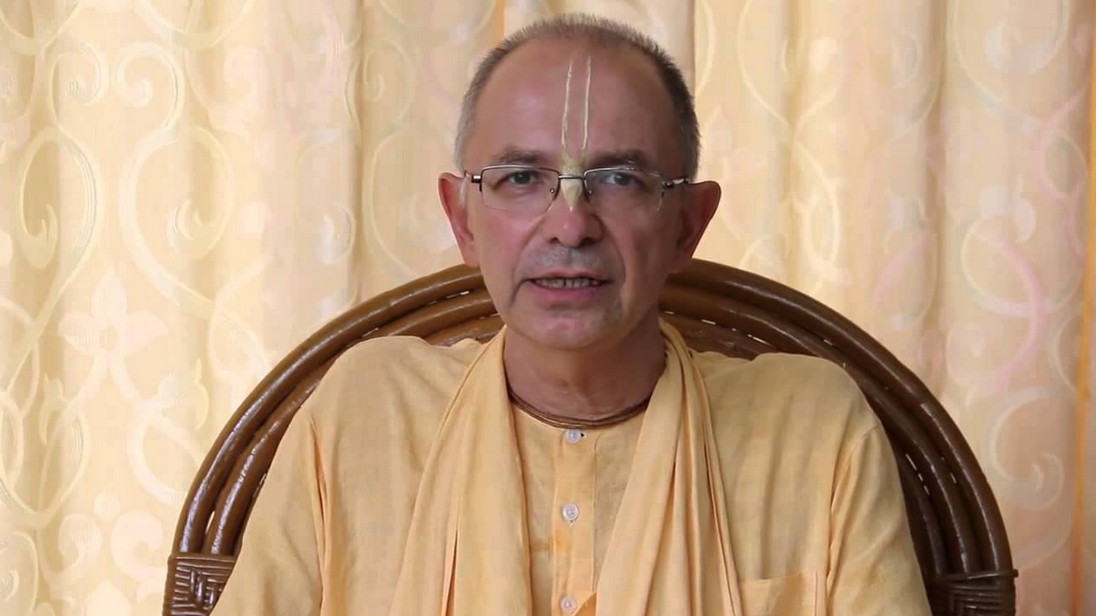
From Sri Mayapur Chandrodaya Mandir
Date: February 24, 2017
Speaker: HH Bhakti Vijnana Goswami
Subject: Srimad Bhagavatam 7.10.14
TEXT 14
ya etat kīrtayen mahyaṁ
tvayā gītam idaṁ naraḥ
tvāṁ ca māṁ ca smaran kāle
karma-bandhāt pramucyate
TRANSLATION
One who always remembers your activities and My activities also, and who chants the prayers you have offered, becomes free, in due course of time, from the reactions of material activities.
PURPORT
Here it is stated that anyone who chants and hears about the activities of Prahlāda Mahārāja and, in relationship with Prahlāda’s activities, the activities of Nṛsiṁhadeva, gradually becomes free from all the bondage of fruitive activities. As stated in Bhagavad-gītā (2.15, 2.56):
so ’mṛtatvāya kalpate
“O best among men [Arjuna], the person who is not disturbed by happiness and distress and is steady in both is certainly eligible for liberation.”
[Bg. 2.56]
“One who is not disturbed in spite of the threefold miseries, who is not elated when there is happiness, and who is free from attachment, fear and anger, is called a sage of steady mind.” A devotee should not be aggrieved in an awkward position, nor should he feel extraordinarily happy in material opulence. This is the way of expert management of material life. Because a devotee knows how to manage expertly, he is called jīvan–mukta. As Rūpa Gosvāmī explains in Bhakti–rasāmṛta–sindhu:
nikhilāsv apy avasthāsu
“A person acting in Kṛṣṇa consciousness (or, in other words, in the service of Kṛṣṇa) with his body, mind, intelligence and words is a liberated person even within this material world, although he may be engaged in many so-called material activities.” Because of constantly engaging in devotional service, in any condition of life, a devotee is free from all material bondage.
“Even one born in a family of meat-eaters is purified if he engages in devotional service.” (Bhāg. 11.14.21) Śrīla Jīva Gosvāmī cites this verse in logically supporting that anyone who chants about the pure life and activities of Prahlāda Mahārāja is freed from the reactions of material activities.
Maharaj:
Pranam Mantras.
Hare Krishna. I will try to speak a few words about this wonderful verse from Srimad Bhagavatam, in connection with the Kirtan Mela which is going on in Sri Dham Mayapur before the Gaura Purnima Festival.
This verse is a usable edification of the hearing and chanting pastimes of the Lord together with the pastimes of His devotees. We all know that the whole Srimad Bhagavatam is all about this. Srimad Bhagavatam is about describing the glories of the Lord and the glories of His devotees and their loving relationship with each other.
We know that Srimad Bhagavatam again and again stresses this point that this gives you liberation from material bondage. And moreover not only liberation, because liberation is just the meager result of hearing and chanting, but it can give you love of God.
What is very interesting in this particular verse, which distinguishes this verse from many other verses of this nature which are describing the potency of hearing and chanting, is that specifically it is said here kāle, which means in due course of time. Very often we hear the statements that immediately it gives you liberation from bondage. But a very interesting feature of this particular verse is that it specifically says that you will be liberated, no doubt about it, if you hear about the activities of Prahlad Maharaj and Myself. Lord Nrsimhadeva very humbly says that, you’re activities, and also Myself, in connection with Myself. But He also says this interesting point that it will not happen immediately, but it may take some time. We know by our own study as students that it usually takes some time. The result of it is not as immediate as we would like for it to be.
Srila Prabhupada very beautifully explains why it takes time. Oftentimes we like to stress this particular point that I am already liberated. Why? Because I chanted once the Hare Krishna mantra. Ok, not once, sixteen rounds a day. Or sometimes people say that I vow to chant sixteen rounds until the end of my life. I usually say that sixteen rounds until the end of your life is not so much…if you spread it out.
Of course the sastra wants to emphasize the potency of the holy name, so it will say yes, it can be done immediately. But here a different stress is given, that it usually takes time. Srila Prabhupada very beautifully explains in the purport when he quotes these verses from Bhagavad Gita. Krishna explains what the precondition or the mental state of the person who is free from the reactions of his sinful life.
Unfortunately, oftentimes, we being faulty human beings with all of our frailties, tend to take the statements of sastra something like the way Christians take salvation. I am already saved. Why? Because Jesus was crucified. I don’t have to do anything else because He already did whatever I am supposed to do. All of my sinful reactions are already gone because He suffered in a very convenient circular philosophy.
The same sort of mentality sometimes comes to our mind because we take it for granted that we don’t have to do much. It’s just that if we mumble something every morning religiously, then by the strength of this we will be liberated. But no. It specifically says here kāle. And that means that certain processes have to take place in your mind, which is not an easy thing.
Ultimately what Nrsimhadeva is saying here is that, as Srila Prabhupada explains, is that you have to change your consciousness or your reactions to the material life and circumstances that you are living in. That’s exactly what Srila Prabhupada explains when he says that liberation means that you are not reacting as you are programmed to react. We are all programmed to react.
We all like happiness. Is there anyone who doesn’t like happiness, by any chance? I like happiness, definitely, very much. Happiness and distress, it’s a nice philosophy, isn’t it? That we should take happiness and distress in the same way, it’s a very nice philosophy. Srila Prabhupada calls it expert management of our material life. If we develop it, yes, but there is a big if in the beginning of this statement, IF we develop this thing then we are liberated.
Moreover he sites the second verse from Bhagavad Gita from the second chapter and Lord Krishna is even more emphatic about this. In the first verse He says sama–duḥkha-sukesh, one who is equal in happiness and distress and in the second verse He says duḥkheṣv anudvigna–manāḥ, when you are unmoved during suffering. Prahlad Maharaj actually is the best, most beautiful, and most vivid example of somebody who is liberated because his reactions are not a problem.
What I want to say is what is this karma bondage? Bondage of karma. Karma bandana. Karma bandana is the problematic reactions in our lives. Unless we drastically change these reactions, by the means of hearing and chanting, unless we change this, we cannot claim that we are free and safe and that our salvation is guaranteed. If our reaction is the same for good or bad, if I’m really late and in a bad mood or really put down by certain circumstances or even the slightest provocations from material nature, then it basically means that there is something wrong in my practice of Krishna Consciousness. In other words, I am not really chanting and hearing offenselessly. Therefore, the promised effects of sravanam kirtana do not take place. That is the only explanation.
Srila Prabhupada was very emphatic about this. He actually said many times, yes, salvation is guaranteed. And sometimes we like to remember the Ajamila story. It’s a nice story, isn’t it? You can just live a long life and commit sinful activities and then at the end of life if you just happen to call your son Narayana. You can name many of your sons Narayana, Govinda, Mukunda, so many. But it’s not. There are some conditions and we really have to work.
There is a very beautiful story from Srila Prabhupada’s life about this. One of Prabhupada’s first disciples was doing a lot of service and he was actually the first and main Editor in Chief of Back to Godhead magazine with Srila Prabhupada came to America. At the end of the 60’s he drifted away and became very much entangled in material life and sense gratification. Then in the middle of the 70’s, he again wrote to Srila Prabhupada. He said Prabhupada, I want to come back to Krishna Consciousness, but on one condition. I am ready to resume my editing service for you Back to Godhead Magazine so everything is nice and fine. There is only one condition. I cannot promise to you that I can follow this no illicit sex rule. I can’t promise this. In other words, I will be engaged in this activity.
Srila Prabhupada read it and he didn’t say anything. Trivikrama Maharaj was in the room at that time with Srila Prabhupada. He was giving him massage and he asked, because he knew this devotee, Srila Prabhupada, how is he doing? Prabhupada looked at him and with great and intent force said to him, he’s going to hell. That was what Prabhupada said. It doesn’t match this Ajamila story does it? Because specifically Yamaraj said don’t bring to me someone who was Editor in Chief of Back to Godhead magazine. It doesn’t really match in one sense. But again, Prabhupada wants to make a point. If you are offensive and you are vehemently committing the sins on the strength of the holy name, that basically means that you are offensive. The story of Ajamila doesn’t apply to you. It’s not your case, my dear sir, unfortunately. So don’t try and hide behind this story. It’s not the case. He should be conscientiously and strictly following the rules of scriptures and trying to cultivate the holy name.
Immediately I can already hear the objection to this statement. Krishna Himself says api cet su-duracaro/bhajate mam ananya-bhak/sadhur eva sa mantavyah/samyag vyavasito hi sahhe (BG9.30) he has to be considered sadhu. Srila Jiva Goswami in his Bhakti Sandarbha writes a beautiful and profound explanation to this statement of Krishna in Bhagavad Gita. He says that when Krishna says api cet su-duracaro/bhajate mam ananya-bhak, he means somebody who has conventional faith. He says that this person does not really have proper faith. Proper faith means that one has complete faith in the statements of sastra. He says, how come if you have complete faith in the statements of sastra that you still commit all sorts of sinful activity?
There is no chance of it. If you properly understand the meaning of sastra then there is no chance that you will commit sinful activity. Krishna, after that, says kṣipraṁ bhavati dharmātmā, very soon he will become righteous. Why? Because this is the starting point. Still, he says very specifically to Arjuna that his faith is not properly situated, it’s conditional faith. It’s not the transcendental sraddha. It’s just sraddha that we get in the society when somebody is doing something and I’m doing something and I’m just being a very stubborn devotee. I don’t say fixed up, but I’m stubborn. I just want to stick to it. It’s good. There is no doubt about it. Therefore Krishna says in the next verse kṣipraṁ bhavati dharmātmā, very soon he will become righteous. But the point is that this should be an evolutionary process.
You cannot just be satisfied with this beginning stage and pacify yourself with the thought that you are already saved. Very clearly Nrsmhadeva says kāle, after some time he will become free from world, provided that he is doing it properly. If he is not applying himself to do it properly, then this purification will not take place. Lord Hari will not take your anarthas. He is Hari, He can take all of your anarthas if you just once chant Hare. Just Hare is enough. But if you really stick to these anarthas then He will say, what can I do? He does not want to be free from his anarathas, he wants to continue this offensive sort of attitude. Therefore this kāle basically means that while doing this, we have to also be conscientious of what has to take place in our heart.
There is another very important and meaningful statement from the sixth canto from the story of Ajamila. Yamaraj, while explaining the purport of this story, he says something very interesting. A very important element of this story is that the holy name is much more powerful than any other means of purification. It is much more powerful than any of the vratas or atonements prescribed in twenty dharamsastras.
In the purport of this verse which I am referring to, the eleventh verse of the second chapter, Srila Prabhupada says that yes, there are twenty dharmasastras. All of them, one after another, describe different ways of purification and what to do to purify yourself from sinful reactions.
This specific verse, 6.2.11, says that all of these vratas are not effective. They are not really doing a good job, whereas just the syllables of the holy name are much more effective than all of these vratas. Why? Specifically Srila Prabhupada quoted Visvanatha Cakravarti Thakura while commenting on this verse saying that even if you are not so attentively chanting the holy name, still, the holy name is more powerful than any other vratas which are mentioned by Manu, Parasara Muni, and so many other authors of the dharmasastras.
This is very important, and exactly the way that Srila Prabhupada explained this verse in one of his letters. The syllables of the holy name are very purifying and powerful because they remind you about the qualities of the Lord, guṇopalambhakam. They have the imprint of the qualities of the Lord. Prabhupada gave a beautiful verse while somewhere here in India explaining this particular verse, uttamaśloka-guṇopalambhakam.
Usually we hear that Ajamila just chanted the name of Narayana. But Prabhupada explains it in an amazing way in this lecture why this chanting of Narayana was so effective. We know it was namabhasa and so on an so forth. But Prabhupada said that because he also had a background – he was a very nice brahmacari in gurukula, he studied under his spiritual master, and he learned about Krishna, Bhagavad Gita, and Krishna’s activities.
Srila Prabhupada specifically while he was chanting the name of Narayana, the qualities of the Supreme Lord would flash into his mind. He would remember Mother Yasoda and her relationship with Krishna. That’s what Srila Prabhupada says. He says that Ajamila would remember Krishna preaching to Arjuna and how Arjuna received His instructions and was freed from maya, and so on and so forth. Prabhupada said that he was not only chanting Narayana, Narayana in a mechanical way. He was also remembering the Lord. After saying this Prabhupada said, just try and understand this.
In other words, this is not so easy to understand. The tendency is that we want to conveniently chant in a very mechanical way without understanding who Krishna is, or why we are calling for Him, or even why there is this whole process.
This is a science. Srila Prabhupada would very often make the point that Krishna Consciousness is a scientific process, not a religion. Science means that we are conscious of what we are doing and what should take place when we are doing it, not just rely on the strength of ritualism. Religion means individuals are doing everything properly. I am fine, prabhu. I am chanting sixteen rounds. Get lost. This is our speech towards Yamaraj. You have nothing to do with me.
Science means we have to understand the laws of what we are doing and how we are doing it. Therefore Lord Nrsimhadeva specifically says in this particular verse that it happens after some time, that you must consciously chant your prayers. If I’m just chanting like a brahman chants mechanically all of his vedic mantras, it’s a nice song to hear, but there is no meaning involved. Then there is no actual point to all of these activities. There is no loss or diminution on this path, but still, the point of this is different.
Srila Prabhupada says another amazing thing in this same letter. I wanted to share it with you because this is an extremely important statement. Immediately after his statement, Prabhupada says to please, just try and understand this, that we really have to understand who Krishna is and why we are calling Him. Immediately after this statement Prabhupada says that offenseless chanting means that you remember the form of the Lord.
Isn’t this an amazing statement that Prabhupada says? He basically explains what it means or by which criteria you can use to understand that you are chanting offenselessly, if the form of the Lord is not coming automatically in your mind. By saying remembering, he does not mean that you have to artificially force the memory of the Lord’s form. What he means is that if your mind is pure enough, then automatically the form of the Lord will be reflected in your mind.
That is the siddhanta, the meaningful scriptural statements, when they say that by sravanam kirtanam of the holy name, we purify our mind. When the mind is sufficiently purified and anartha nivriti really takes place, all of the anarthas are really gone, then the form of the Lord is reflected. This is a very important statement that is repeatedly made by different acharyas. Srila Prabhupada is repeating this in this beautiful letter on the sixth canto of Srimad Bhagavatam. He says that offenseless chanting means that for most devotees, they are not.
I want to share with you this statement from Jiva Goswami where he very beautifully explains this process of purification which should take place. If you do it offenselessly, if you are really consciously trying to get rid of offenses and not doing it in a mechanical way. This is the 256 anuccheda of Bhakti Sandarbha Jiva Goswami. He basically says the same thing that Srila Prabhupada says. Here it is: The first thing which you need to do is to apply nama, the holy name of the Lord so that your heart, your internal organ, your conditioned consciousness will be purified. Then he says what happens when the heart of the living being is sufficiently purified.
That’s exactly why I said that this is not by artificial attempts of trying to forcefully mediate on the Lord. Srila Jiva Goswami says that when your mind is sufficiently purified, then you become qualified to hear about the form. Then, when you hear about the form, the next process will take place. The qualification appears or manifests in your mind to hear about the form. The hearing will bring the form to you.
The very severe mistake which many people think is that sravanam is an artificial process. Sravanam is not an artificial process. It is the real contact of the mind with the Lord in the form of His name. It is possible only if the mind is not offensive. The next statement which Srila Jiva Goswami says is that when the form becomes complete, when your mind becomes amicable to completely hold the form, then you will start remembering the qualities of the Lord. The flashes of the gunas of the Lord will come to your mind.
Srila Prabhupada explains in this lecture which I have referred to that you chant the holy name and at the same time you remember the qualities of the Lord, how nice and kind He is and how He gives complete protection to everyone. If the purification of the heart really takes place, then it will take place in your mind in a very natural and spontaneous way.
The very point here in this section of the Bhakti Sandarbha is that spiritual development is gradual, it takes time. You have to understand what has to take place and in your heart while you are chanting and doing this. Jiva Goswami writes this to stress this point that sadhana is a gradual process. There is a certain sequence, process, that has to take place. After this he says that when you’re finished with this and are successfully past this stage of your spiritual development, after these three things are established within your heart, nama, rupa, and guna of the Lord, of Bhagavan, then you will see the eternal associates of the Lord. Then, only, lila smaranam. Very often devotees hear about this and then they go to Radha Kunda to do lila smaranam.
Once a disciple asked Srila Prabhupada if he could live in Radha Kunda. Prabhupada said no. The devotee asked why. Prabhupada said there are a lot of monkeys there anyway. He was saying that there is no lack of monkeys, what is the use of yet another monkey living there. There is no point of it.
Because if you do nama kirtan, if you do nama smaranam, nama sravana, if you listen to and chant the holy name properly with the proper attitude and remember the holy name properly then this qualification will come to your heart in a very natural and spontaneous way. You will go through this path and anartha nivriti will take place. How will it take place? Again, only if we are willing, only if we understand.
If we have this very sinful mentality that I will chant the holy name and at the same time somewhere under the table I will commit my sinful activities, little ones, not so gross, it means that there is no understanding of who Krishna is,what we are doing, and why we want to go to Him. There is no proper understanding of the whole process of devotional service which starts with sravanam and kirtanam. It only continues with sravanam and kirtanam, which will bring the promised result only if we do it properly and offenselessly.
Thank you very much.
Maharaj:
The question is about this verse in the Bhagavad Gita about happiness and distress.
It says here sukha and dukha and material duality. Spiritual happines is called ananda, and there is no opposite to ananda. Of course there is nirananda, but it’s not exactly some essential thing. It’s nirananda. It’s the absence of ananda. But when we speak about sukha and dukha, it means material happiness and material distress. We have to really develop the proper attitudes towards sukha and dukha if we want to be liberated. Again, our karma means that we have certain programmed reactions about sukha and dukha, material circumstances. If we are not really indifferent to material circumstances then it means that we do not really have so much faith in God. The faith is not so strong because the beginning qualification of devotional service is the example of Prahlad Maharaj and his reaction to material circumstances. Of course I think he didn’t like them, he didn’t like being thrown into the fire, but he wasn’t disturbed. He was not so much disturbed because for him, the faith that he had in Nrsimhadeva and Lord Krishna was much stronger than all of this happiness and distress.
Devotee:
Maharaj you mentioned a programmed reaction in this particular case, that we have programmed reactions. Is that happening because of the three modes of nature or is that our faulty desire? How do we stop programmed reactions?
Maharaj:
It is programmed because it is the program of our karma. We experience some happiness which we like and it is very strongly recorded in our mind that this is good. Pizza is good. If you are born in Italy you probably have very strong pizza samskaras, or if you are born in Mayapur. Or if there is something that you experienced that you didn’t like and again you recorded it with great sakti and power in your mind. Then you carried this program into your next life. Unless you understand that this is all futile, then this sukha and dukha doesn’t have so much meaning. This meaning is illusory, it’s only our perception. In our mind we think that this is so great, but it’s not so great.
If we just develop this understanding of sastra and the analyzing of it, then actually it’s very interesting. In the Bhakti Sandarbha Jiva Goswami says that the definition of smaranam means the very minute investigation of your mind and that this should be there when we’re studying sastras. Otherwise it’s not smaranam to just very superficially browse through the statements. Smaranam gives a certain ability that comes with minute investigation.