
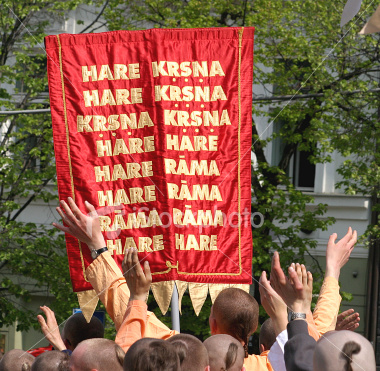
 By Kesava Krsna Dasa
Among the plethora of religions and organisations prevalent in secular, tolerant societies, we the Hare Krishna’s must be the most visually outstanding, and culturally different among them. Though our way of life has very much been publicised, still, very few people, intent on enjoying this world, understand who we are. We remain an enigma to them.
When we chant Hare Krishna, it is advisable to develop a level of intensity and concentration to chant as if each day is the last day. This constant ‘state of emergency’ prayerful mood certainly seems to border on what some professional people say is, an ‘obsessive compulsive disorder’ which can interfere with ‘normal’ enjoying behaviour. For us, our life evolves around chanting the holy names of the Lord, and is the means of direct communion with Krishna. This ostensibly ‘extreme’ or ‘obsessive’ approach to ‘religion’ is quite normal and acceptable for us, when pitted against suggested moderation.
We worship the deities in our temples with love and devotion. The iconoclasts will accuse us of meaningless idolatry fit for slander and severe rebuke. “God is everywhere,” we say. “He can do anything and everything. He can appear in stone or the mind, in a burning bush or a dove. Why limit Him?” While society idolises famous people who are prone to death, and whom appeal to selfish inclinations, our selfless devotion to authorised forms of the Lord is tantamount to unproductive worship of decorated dolls, by those who willingly wish to destroy them, if given half a chance.
Of our open lifestyle, falling down like felled trees in reverence to the gurus and other respected vaisnavas at airports and other public places, tells the world we are exceedingly obedient to authority. Not long ago, when it was discovered that Ambarisa prabhu of the Ford dynasty was affiliated with the Hare Krishnas, a famous cartoon depicting devotees paying obeisances to Ford cars, seemed to sum up a common perception – if we can bow down to cars, we can bow down to anything.
When most people not so much as bat an eyelid when teeming millions of cows and other helpless creatures are sent to slaughterhouses merely to satisfy the taste buds, they sit up and wonder, with derisory disbelief, how we Hare Krishnas can lovingly care for an ailing cow we call ‘Mother.’ They wonder even more when we kick up a fuss after she is routinely killed by a vet, whose sense of compassion saw her as a collateral unit, a soul-less mechanistic used up utility. Even the aged humans, who are unceremoniously bundled and herded into old age homes do not receive the same loving care as Gangotri got.
When we preach to people, we often warn of the futility of accumulating unnecessary material assets, because cruel death will take away everything. Like those morose people who stalk the streets wearing placards that read, “the end is nigh,” or those petrified people belonging to doomsday cults, our death talks are a blatant interference with the desire to enjoy this world. Forget the Seven Wonders of the World, the phenomenon of seeing other’s die, “yet it won’t happen to me, yet”, is a super-wonder Maharaja Yudhisthira observed. Who can blame people who do not want gory reminders of impending death? However, we are blameless.
We tell people that we avoid the four gigantic moneymakers, which makes the merry, um, miserable world go around – no meat eating, fish or eggs, no intoxication, no illicit sex, and no gambling or speculative pursuits. Another wonder is, how can the Hare Krishnas be so diametrically opposed to material enjoyment, yet they sing and dance happily on the streets, and hold blissful festivals? Our messages that material enjoyment equals misery are truly an incomprehensive play of words for the average enjoyer. Earning a degree, PhD, or professorship cannot enable a grasp of this understanding, except to receive a ray of mercy from a non-enjoyer who enjoys living here to serve Krishna.
Our dress code sends an automatic statement telling everyone, “I am part of this world, but not of it.” To the average person obsessed with personal grooming, beauty, and image, our ‘bed sheets and tablecloth’ rags make us appear as ridiculously brave daredevils with the carefree attitude of enlightened derelicts. If our address is somewhere in Vaikuntha, it should explain our ‘out of this world’ appearance, which predates all known fashion trends.
These are just a few ways by which Hare Krishna devotees, differ quite radically from the average citizen of this world. We do everything practically the opposite way to standard comfortable norms. We cut oranges differently, are prepared to sleep on the floor if necessary, Lord Krishna Himself says, “What is night for all beings is the time of awakening for the self-controlled; and time of awakening for all beings is night for the introspective sage” (BG. 2.69). As such, innocent or envious people, whose aim in life is to pursue pleasure by all means reasonable or foul, see us as consummate fanatics, either to be admired or despised.
Fanatical we may be, in the worldly sense, yet the Hare Krishnas know how to blend in with society. Rather than incite enmity, bigotry and hatred, we extend a hand of friendship and love, as befitting an all-loving, all-accommodating Lord Krishna Who is above all sectarian divides. As law-abiding citizens, we work with the same material ingredients that cause misery – an opposite, 180-degree turnaround trick, which brings happiness. Nuclear scientists and poets, soldiers and politicians, farmers and businesspersons, factory workers and labourers all have a place in the Vedic way of employment, which seeks to engage bulls to till the land, rather than tractors.
Our agrarian ideals may appear backwards, our simplicity meant for dull minds, and our theistic convictions worthy of cowardly fear of the unknown. Our vegetarian fare appears to be a low protein staple to keep us as docile slaves to authority, our constant chanting as rigid mind control to prevent independent tendencies, and our cultivation of humility, a grovelling, effete show of weakness. However, all these objections fail wretchedly against our high thinking, based on the timeless wisdom of the Vedas, for we are both ultra traditionalists and way-ahead futurists too.
In a world bedevilled with uncertainty, and when society is bound up to dependence on fossil fuels, which destroys the environment, the Hare Krishna lifestyle is suited to withstand the rigors of a collapsing civilization. In such an event, our perceived fanaticism will become a normal survival guide. Because people will not cope without electricity and oil, their shattered dreams will induce extreme behaviour. Who will laugh at our simple extreme lifestyle just turned normal then?
Srila Prabhupada advised to acquire land near bodies of water; he had the end of civilization in mind. His intuition warned of Gandhi’s assassination, and his sweeping view of history foretold the collapse of the Soviet empire. His observation that the present civilization will crumble eventually, had our “simple living, high thinking” mode adaptable to what may happen to society as we know it – Srila Prabhupada was way ahead of his time.
By being vegetarians, the Hare Krishnas are saving many trees and animals from needless loss of life. Refraining from illicit sex keeps us away from the ever-increasing ravages of aids and STD’s. Being intoxication free helps to reduce levels of crime and violent deaths associated with drugs and alcohol. By shirking gambling and speculation, an aptitude for truth develops, seeking to undo the ingrained atheistic conjectures of big bang, and evolution theories, which destroy the essence of sacred life and its traditions.
In short, our ‘fanatical and extreme’ spiritual behaviour is quite normal. The challenge is to understand how the present civilization with its reliance on the four big money guzzlers, is an abnormal situation. Wherever sections of society are unhappy, more solutions that are abnormal are invented to appease them. The fabricated isms filled with exclusive dogma have done more harm than good, and have brewed such tenacious fanaticism and extremism as to degrade human values to less than animal standard.
To those who lurch to the right of the political spectrum, our multiracial mix is surplus to eugenic requirements – racial purity. The inclusiveness of the Vedic way to human progress, allows anyone to become an Aryan, should his or her developed qualities permit. Those with a nationalistic curve see the Hare Krishnas as fanatical foreign invaders corrupting the established traditions of their cultures. In fact, the Nazi symbols of the swastika and Aryan goals are borrowed twisted perversions of the original pure symbols and ideals found in Vedic culture. The Hare Krishnas have come to rectify this mistake, and help anyone who wants to become a real Aryan.
To those on the red left, our ‘spiritual communism’ allows God worship, and encourages all classes of men and women to engage their talents for the betterment of society. Such allowances are seen as anarchist threats to divert people’s allegiance from God-state control run by atheistic power hungry cronies, to outlawed fanatical madness. The enforced equality of Marx’s whims is a soul-destroying ploy to reduce humans to mere inexpressive cogs of state machinery. An injection of Krishna consciousness will no doubt expose the evils of a Godless system, and restore people to the happiness they are meant for as humans.
Unless the perceptive tables are reversed, and people realize that the insanity of an atheistic stranglehold makes all economic mass killings and other abnormal extremism acceptable, the illusion of material progress will consider any genuine spiritual attempt to help, as inconsequential fanaticism. Insignificant we may be, the Hare Krishnas will wait on the sidelines if necessary, and kindly inform people about a culture that knows no beginning or end, until people come to their senses and see that what is going on is really, really unacceptable.
Ys, Kesava Krsna dasa – GRS
very interesting………………yes srila prabhupada did forsee the end of this world mcdonaldscreditcard world so called civilisation………………and he offered a radical way too live .without so called modern ammenities..when this modern world ends…..remember this modern world is very new…and it really only affects a small percentage of the worlds population…..most of the world still lives without so called modernworld comforts…ie running hot water and creditcard.money….most of the worlds population still live the way their forefathers did…….but i also feel we should be ready….and buying land neat water..away from the big cities is one of the best advice our spiritual founder ever gave……yes ..vaishnavas beware…the end maybe nearer than you think
I think its a form of provocation. I can not find any reference in Prabhupadas books telling his disciples to be fanatics. Why? We can accept as the reality that first wave of devotees or some of them would be fanatical, as its natural to contrast oneself to the reality.
However Prabhupada did not ever encourage fanatical or extreme behavior, we know however he would have to live with it.. and we have to pay for it.. For example Prabhupada never insisted on wearing pink curtains that look like dhotis as the only dress for a Vaishnava. It is a nice thing to do, but not necessary.
Prabhupada would be critical of whims or sentiments or fanaticism. We should be guided by science of devotion, not fanatical views or acts.
As he contrasted Religion to fanaticism, I would contrast any fanatic to a devotee who is mature. One can have absolute dedication and devotion, without ANY fanatical acts.
As Prabhupada said: I do not wish to take your more time. Dharma means your occupational duty. Dharma does not means it is a fanaticism. That is not. That is not the meaning of the dharma. The meaning of dharma, in English, is “religion.” And religion in English is a kind of faith. So faith may be wrong or right. That is not dharma. – clearly he expained the difficulty of translating the dharma as religion, clearly he was against fanatical acts. He called it the ‘art’. A good word to describe the science of bhakti. It is not dry science nor is it fanatical faith, its an art!
Extreme internal desire to serve guru is great factor of preaching, and some side effects to it is fanatical behavior. That must be stopped. There should be fanaticism awareness pro gramme, where real enthusiasm is encouraged and immature enthusiasm channeled. When Peter the great drew a straight line on the map for the road from moscow to the new capital, he left his finger out, to this day there is a bend in the railway tracks… that is fanatical and is not helpful, as so many thousands died because of “straight” road design. Prabhupada wanted us to be rational and sane, realistic and enthusiastic at the same time. Certainly not fanatics, who follow the letter and forget the bigger picture.
Your servant,
CCd
Keshava Krishna Prabhu points out that just being a devotee in this modern world is seen by nondevotees as “fanatical.”
Those of us who have nondevotee relatives know how difficult they find us to associate with. We don’t eat anything they want us to eat or do anything they want us to do. They say, “Why do you have to be so ‘fanatical’?”
Mostly we find that just to get along with them on short visits, we have to compromise our high standards (we will eat unofferable food in a restaurant as long as it has no meat fish or eggs, we will watch TV and movies and make small talk).
[Sometimes we go on compromising, at work, at home, and before we know it we are practicing very watered-down sadhana. Anyway, speaking for myself, that is my problem. I may be less “fanatical” than I was as a new devotee, but I seem to have lost the edge of strictly following the program Prabhupada chalked out for his serious disciples: full morning program, no restaurants, no cinema or TV, constant engagement in bhakti yoga. But that is a different discussion. . . ]
Now, Caitanya Caran Prabhu points out that enlightened devotees do not behave in extreme confrontational ways that disturb others. Sometimes beginning devotees try to set themselves apart from the world they are struggling to leave by loudly decrying or confronting the improper behavior of nondevotees in an unnecessary and counterproductive way.
Thoughtful (but misguided) people are already inclined to distrust devotion to God as dangerously emotional, illogical and unintelligent. They are unable to appreciate how devotees dovetail transcendental anger in devotional service, and therefore they are apt to misunderstand the behavior of even mature pure devotees who become furious against atheists (as Srila Prabhupada sometimes did).
When they see childish beginning devotees struggling with our own confusion and anger at the objects of our own lingering material attachments and stumbling blocks, Krishna consciousness appears unattractive to them. It reminds them of similar behavior of neophyte Christians and Muslims, and some unfortunate people are apt to think of Hare Krishnas as the “fanatic Baptists” of the yoga world (I have met people who say that).
A “fanaticism awareness programme” for channeling immature enthusiasm, as CC proposes, sounds like a good idea. We have so much more to offer than the fundamentalist evangelical Christians. We should not be mistaken for them.
I guess I do want to clearly acknowledge that CC and I have started veering the discussion away from the point that Kesava Krishna was making.
It is certainly true, as Kesava Krishna indicates, that even mature, very advanced devotees, who are always unruffled, are nevertheless seen as “fanatical” by nondevotees.
Advanced devotees generally avoid nondevotees, except when they go out among them to preach. Great devotees like Narada Muni are always showing mercy and giving fallen souls an opportunity to reconnect with the Lord through bhakti yoga. Some preachers expertly confront and challenge the cherished misconceptions of innocent souls.
Srila Prabhupada has endowed ISKCON with a mission to make propaganda for Krishna on a large scale, primarily through vigorous book distribution.
When we go out for preaching, we always run the risk of disturbing people, especially if we are not expert. It is a risk we have to take, but we should also learn to become expert.
[Our emphasis on books and a great philosophical literary tradition can make us seem more thoughtful, scholarly and cultured, setting us apart from “fanatical” fundamentalists and enthusiasts. Religion without philosophy is sentimentalism or fanaticism.]
As enthusistic, sometimes even pushy preachers, we may remind people of fanatical sentimentalists who do not have a very deep and comprehensive philosophy. Sometimes our own shortcomings as preachers adds to that impression.
We may try to adopt the “chopping” style of defeating all opposing theories, without the depth of realization to pull it off. Too often we come accross as mere faultfinders, trying to increase our sense of false prestige by declaring “us” superior to “them”. These are mistakes that we can and should learn to avoid, and we can have classes or programs as suggested by CC to improve our craft as respectable preachers of the Holy Name who “always leave everyone with a good impression.”
One thing we should always remember though. The devotees, no matter how rough and immature, are our real friends and family, whereas nondevotees, no matter how polished and refined, are not for us.
Sometimes devotees (like dear Subhananda) who could preach expertly among highly educated people, became attracted to the qualities of their elite, aristocratic audiences, and embarrassed by crude manners of immature devotees, and fell away.
Give me the fanatic new devotee over any nondevotee.