
By Sahadeva dasa
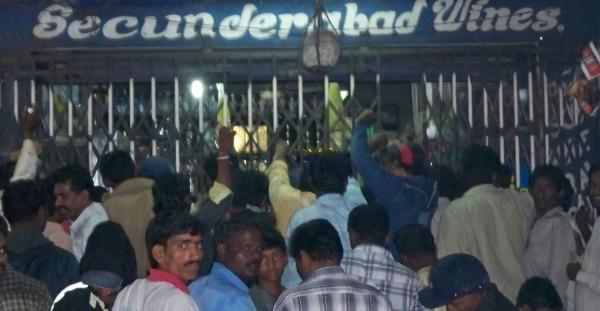
The other day while passing through a shopping area, I witnessed a chaotic scene, a kind of riot. Curious, I got off to have a look and found that the gold rush was for a bottle of wine. People were pushing, pulling, fighting and yelling at each other. Scene could have easily turned violent and it was a volatile situation. I took out my camera and aimed, several faced turned and some proceeded in my direction. I took a quick shot and retreated, saving myself from a possibly unpleasant experience.
I think I crossed this way many times but this kind of crowding was something new. It appeared that India was finally catching up. Dreams of leaders like Nehru to see a ‘cultured’ India was finally coming true.
Back home I sat reflecting for some time, bit saddened by the turn of events for India.
It is apparent that more and more Indians are resorting to alcohol these days. Thanks to the destruction of traditional values, easy spending power and wide availability of brands to choose from…a modernized India is saying cheers.
Around 15 to 20 per cent of Indians consume alcohol and over the past twenty years, the number of drinkers has increased considerably. According to a survey done by The Hindustan Times, an estimated 5 per cent of Indians can be classified as alcoholics which projects that at least five million people in India are addicted to alcohol.
Prior to British rule, bhang, and afeem were the major intoxicants in India but their consumption was extremely low. Use of alcohol was limited to Rajas and the upper echelon of society. British rulers opened liquor shops. It became fashionable among Indian Babus to use and offer alcohol at their western style parties. The use of alcohol started among educated and middle class. Gandhi was opposed to alcohol consumption and on his insistence, the constitution of India incorporated a directive principle of State policy stating that “the State shall endeavour to bring about prohibition of the consumption of intoxicating drinks”. In 1977, India imposed total prohibition that lasted two years. But despite all this, alcohol has become “the in thing”, a sign of social sophistication and a symbol of prestige. Just a century ago it was condemned and regarded as something alien to local culture.
Srila Prabhupada explains this phenomena: “This gambling, drinking, meat-eating, these things were all unknown in India. They did not know how to drink. These Britishers introduced. There is still a lane, a street, Porterly Street. There was a woman of suspicious character. She was supplied big bottles of wine, and she used to canvass rich men’s son to take wine, and it was distributed free. In this way wine was distributed, and people began to drink, gradually. And I have seen a tea set committee. They… Advertising tea, preparing tea nicely. “You take this tea, you’ll not feel hungry, you’ll be cured from malaria…,” and so many things. And people come and take tea in this way. Now any man is taking tea. In the morning they’ll gather in the tea stall. You see. So people, they did not know what is gambling, what is drinking, what is meat-eating. So these things were introduced gradually.” (Lecture on Srimad-Bhagavatam 5.5.2 – London, September 17, 1969)
In another place, Srila Prabhupada explains the reasons behind British eagerness to modify Indian behaviour and thought pattern. “The Western, the Britishers were for two hundred years and they preached. Their policy was to kill the Indian culture. Because that report of Lord McCauley, after studying Indian situation, the report was to the Parliament that “If you keep India as Indian, then you will not be able to rule over them,” so therefore there was regular policy to kill Indian civilization. And because they were on the governing power, they could do it. Therefore India lost its own culture and victimized by the Western culture. This is the position. Just they are learning how to eat meat, how to drink wine, how to dress them with coat and pant, how to go to the hotel, illicit sex. (Morning Walk – Durban, October 13, 1975)
Due to its large population, India has been identified as the potentially third largest market for alcoholic beverages in the world which has attracted the attention of multi-national liquor companies. Sale of alcohol has been growing steadily at 6% and is estimated to grow at the rate of 8% per year. At this rate, soon we may see widespread enactment of the following story told by Srila Prabhupada.
“There is a story that one man was drinking. So, drinking in India is a great sin. So his friend advised that “You are drinking. You’ll go to hell.” So he said, “Oh, my father also drinks.” So he said, “Your father also will go to hell.” “Oh, my brother also drinks.” “Oh, he also will go to hell.” In this way, he continued to say, “My father, my brother, my sister, my this, my that…” So… And he was replying, “Yes, he will also go to hell.” Then the drunkard replied,”Oh, hell is heaven. Because we’re all drinking here and we will drink there. So what is that hell? That is heaven.” (Lecture, Los Angeles, June 27, 1972)
Barely three decades ago, less than 1% of the cases in psychiatric wards were admitted for alcohol-related problems; now the number exceeds 30% in most of the major psychiatric centres.
Nothing has worked to contain this growing menace of drinking. Legislative measures like prohibition, awareness programs by social organizations, educational propaganda by social activists, nothing has had any success so far. Only solution is to get the drunkards and everyone else hooked up to a much stronger liquor, a liquor far more stimulating than Vodka, bourbon, brandy, gin or rum. It goes by the brand name of ‘namasava’, or booze of Holy Name. This brand is owned by the liquor baron Sri Nityananda. He Himself is an addict and has a global marketing network. They say the retail chain for this brand is managed by Hare Krishnas. Free sample of this prestigious label is shipped (by express delivery) to any one who calls out the following slogan:
hare krishna hare krishna krishna krishna hare hare
hare rama hare rama rama rama hare hare
Thakura Bhaktivinode, Marketing Director for Sri Nityananda Inc., says in a company advertisement:
anudina jeno, tava nama gai,
kramete krpaya tava
aparadha ja’be, name ruci ha’be,
aswadibo namasava
If I sing Your name every day, then gradually by Your mercy the ten offenses will disappear, taste for Your holy name will grow within me, and then I shall relish the intoxicating wine of that name. (Saranagati)
“According to a survey done by The Hindustan Times, an estimated 5 per cent of Indians can be classified as alcoholics which projects that at least five million people in India are addicted to alcohol.”
Assuming there are a billion people in India (the figure is actually greater) a 5% alcoholic rate means there are 50 million alcoholics, not 5.