
Mathura Lilesvari JPS: Hare Krishna Prabhus
PAMHO
AGTSP
This article appreared in a Malaysian Daily following the URI Gathering in January.
By DR AMIR FARID ISAHAK
A gathering in India of different religions and different people offers hope for the unity of religions.
I RECENTLY spent nearly two weeks as a vegan, interfaith explorer and peace-pilgrim at the world headquarters of ISKCON (International Society for Krishna Consciousness, more popularly known as the Hare Krishna movement) at Sri Mayapur, West Bengal, India.
I was there with about 300 members and youths of URI (United Religions Initiative, www.uri.org) for our triennial global assembly, hosted by ISKCON and the Bhaktivedanta Institute of Manipur.
Mayapur is about 100km north of Kolkatta, but the journey by 4WD took three hours because the road was full of potholes and the trip was more like an obstacle race, zigzagging to avoid craters, rickshaws, bicycles, cars and cows. Then there were the oncoming buses and over-laden lorries threatening to smash us head-on as the vehicles on both sides took turns transgressing into the wrong side. I was praying frantically through much of the journey, which was appropriate as I was going there as a “pilgrim” of peace!
Mayapur is the spiritual centre of Hare Krishna devotees. It is located just beside the sacred Gangga (Ganges) river in the agricultural heartland away from the hustle and bustle of Kolkatta.
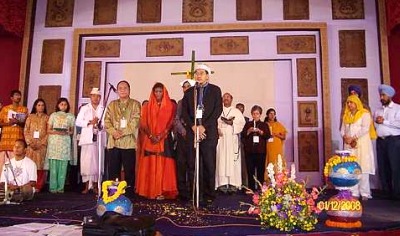
Interfaith prayer at Mayapur.
The temple complex is walled like a castle, and on the outskirts are numerous stalls, shops, eateries and hotels catering to the pilgrims and tourists alike. Inside is a small town with several temples, halls, restaurants, hostels, apartments and meeting venues. There is a bank, communications and Internet station, travel agency and other services that the thousands living inside and outside may require.
There are also schools and several sacred places in the surrounding area. Transport to the neighbouring towns or places of interest is easily available, and one can even cross the Gangga on a boat or ferry across to the small town of Navadip.
Although it was approaching winter then, global warming showed its impact this year, as it was unusually warm, being cool only at night. I had gone there expecting the worst, bringing winter gear to protect me from the biting cold, but it turned out that even a T-shirt was sufficient.
And although the place was well maintained in terms of cleanliness and food preparation compared to what you may expect of India, the water supply was still suspect. The dry, dusty conditions made it worse. No matter how much precaution we all took, many still ended-up with diarrhoea or fever. Some got really sick.
Apart from us, there were hundreds of their devotees from all over the world who were there on their own pilgrimage, while many also came as volunteers for our global assembly. Just like us, they came from all the continents. I was fortunate to have been dinner guests of a Hare Krishna devotee couple from Moldova and Ukraine. There were also many African devotees who were very active in the dancing and singing.
Just outside the gates there is a well-planned housing estate where most of the Western devotees stay. Many are permanent residents with their children attending nearby schools, while others divide their time between their homelands and this spiritual home.
There was always activity in Mayapur. The singing and dancing in the main temple started at 4.30am. Since my room was just nearby, it served as my wake-up call, since my own prayer time was about that time too. Their devotional chanting, singing and dancing would go on at scheduled times throughout the day, often ending past midnight.
Every Saturday night, there was a festival with a parade headed by a decorated elephant, followed by a chariot carrying the deities, and devotees chanting and dancing down the streets within the compound. Thousands of devotees and tourists would throng Mayapur during each festival, more so if there were special events or celebrations.
Even though men and women freely mixed, there were strict rules against touching, holding hands, hugging or kissing in public. In fact, at the entrance, there was a sign which says “No playing; no games; no mundane music”. Before we went there, we were already warned about the no-hugging, no-meat, no-smoking and no-caffeine rules, but they actually allowed caffeinated-coffee for the URI group. That was the only compromise.
The vegetarian food was always delicious. I had never seen more varieties of fruit and veggie dishes, and enjoyed all of them. Many of us became sluggish in the first few days because we ate too much, trying to savour every dish that was new to us.
It was only after cutting down the portions and avoiding the sugary desserts that I felt energetic again, and managed to lose the weight gained previously. Our food was lovingly cooked and served by volunteers from all over the world, so the spread was also international.
After almost two weeks of being a strict vegan (the food also excluded onions, garlic or leek as these can arouse the libido and hamper the spiritual quest), I hope it will help me drastically cut down on my meat intake for the rest of my life. I have been espousing a low-meat diet and must practise what I preach.
The URI plenary sessions were held at a temporary structure erected at the site of the future Sri Mayapur Vedic Temple, which will be the largest Hindu temple in the world. When it is completed, it will bring many thousands more to Mayapur. It will dwarf the current icon, the Samadhi Temple, dedicated to the movement’s founder, His Divine Grace A C Bhaktivedanta Swami Prabhupada.
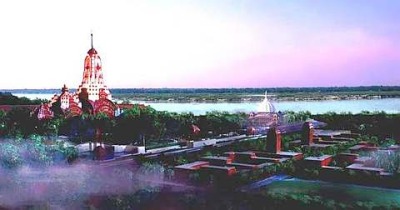
Mayapur is the spiritual centre of Hare Krishna devotees. It is located just beside the sacred Gangga (Ganges) river in the agricultural heartland away from the hustle and bustle of Kolkatta.
Unity of religions
URI, which was established in 2000, is the fastest growing global interfaith movement. It is grassroots-based, being composed of over 400 interfaith groups (called “Cooperation Circles” or CC) spread all over the world.
Each group is made up of people of diverse religions, faiths or spiritual traditions doing any activity that promotes enduring interfaith cooperation and helps end religiously-motivated violence. Activities may include interfaith dialogues, sports, mountain-climbing, dance, music, art or anything you can think of. Together, over one million people are directly or indirectly involved in our activities.
So you can imagine how fun and activity-filled it was when 300 of us gathered for the Global Assembly at Mayapur. Our theme was “Pilgrims of Peace – Many Paths, One Purpose”. There were songs, dances and story-telling from the Sufis, Native Americans, indigenous South Americans and others, interspersed with prayers, plays and performances from every region of the world.
Our hosts further enriched our experience with their continuous chanting, dancing, processions and prayers.
Of course there were the serious meetings too, but we always had sing-and-dance interludes whenever the meetings got too long or too boring.
And probably for the first time, the Jewish Sabbath, Christian Mass, and Muslim azan (the call to prayer) and Friday Prayer were held in Mayapur. The prayers of all the other religions were also heard as our programme was full of such prayer occasions. We have proven that the people of all faiths can unite for peace, and have fun together, while keeping true to their respective beliefs.
Dr Amir Farid Isahak is a medical specialist who practises holistic, aesthetic and anti-ageing medicine. He is a qigong master and founder of SuperQigong.
…Alwiz remember Krishna and never forget Krishna…
I wish I could have been to that Mayapur conference. We can easily see how Lord Caitanya’s fame is being spread nicely throughout the world by those who participated.
I can only imagine how pleased Srila Bhaktivinoda Thakur must be with H.H. Bhaktiswarupa Damodar Maharaja, Jayapataka Maharaja, Bhaktipurusottama Swami and all the hundreds of devotees that helped make this program such a success.
Lately I have been rereading Sukavak Prabhu’s book, “Hindu Encounter With Modernity: Kedaranath Datta Bhaktivinoda, Vaisnava Theologian.” In it, we see to what lengths Bhaktivinoda Thakur went to find common ground among religious thinkers throughout the world.
Shukavak Prabhu writes:
“Paul Tillich proffers a model of theology — which he calls the theological circle — that illustrates Bhaktivinoda’s perspective. The area within the circle is the perspective of the religious insider and the area outside is the perspective of the religious outsider. Tillich suggests that it is the unique ability of the theologian to move on both sides of the theological circle. In the contemporary global context, the theologian must have the ability to step beyond the parochial perspective of the religious insider and critically examine that perspective from a position shared with the religious outsider.”
Shukavaka explains that Bhaktivinoda saw that orthodox Hinduism of his time had failed to address the concerns of the growing, western educated intellectual class, who had become spiritually alienated by a religious literalist approach to explaining their own Hindu tradition. Bhaktivinoda Thakur thus wrote books, notably Krishna-samhita, to give these modern Hindus access to the real intellectual tradition of the Vedas, and also to reach out to great religious visionaries from outside the Vedic tradition.
H.H. Hrdayananda Maharaja recently gave a brilliant Bhagavad-Gita class in Alachua (which I found from a link here on Dandavats), in which he analyzed the modern over-relativistic approach of liberal theologians as an overreaction to the evil, fanatical history of torturing and killing people for not having precisely the same answer to obscure theological questions (as found in the Crusades and Inquisition).
Maharaja said that the Hare Krishna movement introduces “principled diversity.”
We can expect those whom Bhaktivinoda would have called “saragrahis” will appreciate profound spiritual truths from diverse religious traditions.
The Hrdayananda Maharaja lecture I was talking about can be found at the following link.
http://alachuatemplelive.blogspot.com/2009/03/atl-09-03-29-hh-hridayananda-goswami.html
It was the most recent Sunday Feast lecture in Alachua, given on March 29, 2009. I suppose that in no place but Alachua can a Sunday Feast lecture be so sophisticated.
We can see that these books by Srila Prabhupada can bring about a worldwide revolution of spiritual understanding, based not on a watered-down liberal relativism — a fear of saying anything meaningful about God or religion because whatever one says is bound to be offensive to someone — which is an overreaction to the offensive, unphilosophical militancy still represented in fundamentalist movements throughout the world (like our own evangelical Christians).
“Principled diversity” will satisfy the needs of what Bhaktivinoda Thakur called “madhyama adhikaris,” whose faith is strong enough and whose philosophical nature pronounced enough to critically examine their own traditions.
In “Hindu Encounter With Modernity”, Shukavak Das reveals that in Krishna Samhita (which I have never read) Bhaktivinoda Thakur gave a slightly different explanation of the terms “madhyama adhikari” and “uttama adhikari” than we are familiar with:
“The expression ‘komala-shraddhas’ literally means persons of ‘tender faith’. Their most common characteristic is their inability to see beyond their own subjective and parochial religious perspective. Next are the madhyamadhikaris, or persons of middle faith. They are also known as ‘yukty-adhikaris’ or persons capable of independent reasoning. Perhaps their most common characteristic is that they are plagued by profound religious doubt. Skepticism is the hallmark of the madhyamadhikaris. They are the intellectuals of society, who in Bhaktivinoda’s time included many of the bhadraloka.* Above them are the uttamadhikaris or enlightened saragrahis. … Bhaktivinoda’s classification of spiritual seekers is analogous to Paul Tilich’s three types of believers: primitive believers, doubting believers and enlightened believers.”
Armed with Prabhupada’s books, this ISKCON is properly poised to reach out to the intellectual doubters and the enlightened saragrahis of today’s world, and bestow upon them an understanding of the glories of Lord Caitanya.
*The bhadraloka were Bengali elites who interacted with the ruling British in the 18th and 19th century.
Global Assembly creates opportunities for Interfaith Dialogue:
I had the good fortune of attending (and speaking at) the URI Global Assembly both as a member of the URI through my local Cooperative circle, The Interfaith Council at Stapleton, and also as a member of the Bhaktivedanta Institute, of which I head the local branch in Denver, Colorado.
The Global Assembly has created an amazing level of interest in Interfaith dialogue and in Sridham Mayapur in the Interfaith community around the world. Fortunately, I was able to take several hundred photos, as well as collect a lot of material from the Assembly, which have come in handy in my presentations to the local Interfaith community.
Here in Denver, I have been asked to speak about my experiences in front of several audiences, including interfaith organizations, a couple of churches and at our local temple. In my presentations, not only do I have the opportunity to expose the beauty of the Holy Dham through multimedia presentations, but I also explain the significance of Lord Chaitanya, and the profundity of Vaishnava theology. More and more invitations are coming, and it is indeed a privilege to expose Vaishnavism and the importance of Lord Chaitanya to some very religiously sophisticated audiences, many of whom are pastors, ministers, or graduates of Christian seminaries.
There has been great interest in Krishna Consciousness, and its philosophy at all venues. Many visitors I spoke to in Mayapur (and elsewhere) remarked at the outstanding hospitality of the devotees; spoke with respect about our principles; and most importantly, sensed that the devotees are much more mature and open-minded than their previous encounters (mostly in the street and in airports many years ago) made them believe. For this, all glories should be given to the Mayapur devotees, and to Srila Bhaktisvarupa Damodar swami, the pioneer in Interreligious dialogue and a founding member of URI, through his Bhaktivedanta Institute. It was his personal example of Vaishnava qualities that inspired the URI to hold the Global assembly in Mayapur.
Every delegate carries back with him fond remembrances of the Holy Dham and good will towards the movement that he will share, like I did, with others in his homeland. Indeed, for me, this Assembly was a turning point in the maturity of the Krishna Conscious movement, and in the immense goodwill that ISKCON has created for itself around the world.
gaura premanandi…
y/s
hari mohan dasa
On Rama Navmi, one of the devotees gave me as a gift the wonderful new book by H.H. Radhanatha Swami: “The Journey Home — Autobiography of an American Swami”
I knew Maharaja had been working on this book but I had not heard that it had been published yet.
I could not put it down and have been reading it out loud to my wife as we drove out to a home program in Modesto yesterday and again this morning until I just finished it.
My hairs are standing on end! This book has real potential to become a best seller and an instant classic in the tradition of Yogananda’s “Autobiography of a Yogi.”
I hope there is a competent marketing program in place. Someone must get Oprah Winfrey to read this book and get Radhanatha Swami on her TV show. Someone should be preparing a screenplay and negotiating movie rights.
The book is extremely entertaining, full of adventure and charming humor, and it is also full of obviously genuine spiritual wisdom.
Is there anybody Radhanatha Swami didn’t meet in his spiritual quest? He tells of his youthful meetings with civil rights leaders and blues musicians (including a plane ride jamming with legendary musician Johnny Winter), his travels as a spiritual hippie wanderer in Europe, his tranformation into an ascetic sadhu in India, where he met with Mother Theresa, the Dalai Lama, J. Krishnamurti, numerous famous and lesser known yogis and saints, until finally being drawn to the Krishna bhaktas in Vrndavana and his true guru Srila Prabhupada.
Along the way, he humbly takes lessons from numerous teachers including Jews, Moslems, Christians, Buddhists and others. He also takes lessons from various predicaments that befall him, distilling them into important spiritual lessons.
He has the knack of not being interested in criticising anyone, and his book stands as an important lesson to those devotees (like myself) who turn off people from other paths by constantly, often inappropriately, arguing the superiority of our own.
As a genuine spiritual leader who has also been responsible also for helping the poor and sick in Mumbai, he is perfectly positioned to become famous as a champion of interfaith understanding and spreading the fame of Prabhupada, Prabhupada’s books and the maha mantra. He is like the perfect poster child for Krishna consciousness, and this excellent book has appeared just at the right time, when “Slumdog Millionaire” stole all the oscars and interest in Mumbai and Bollywood is high.